

A supplements agent that answered two ways
A consumer health retailer had an agent in production recommending supplements. The agent had to screen the customer first, checking for pregnancy, prescription medication and anything in their health disclosures that would make a recommendation unsafe, and only a customer who cleared screening could be matched to a product.
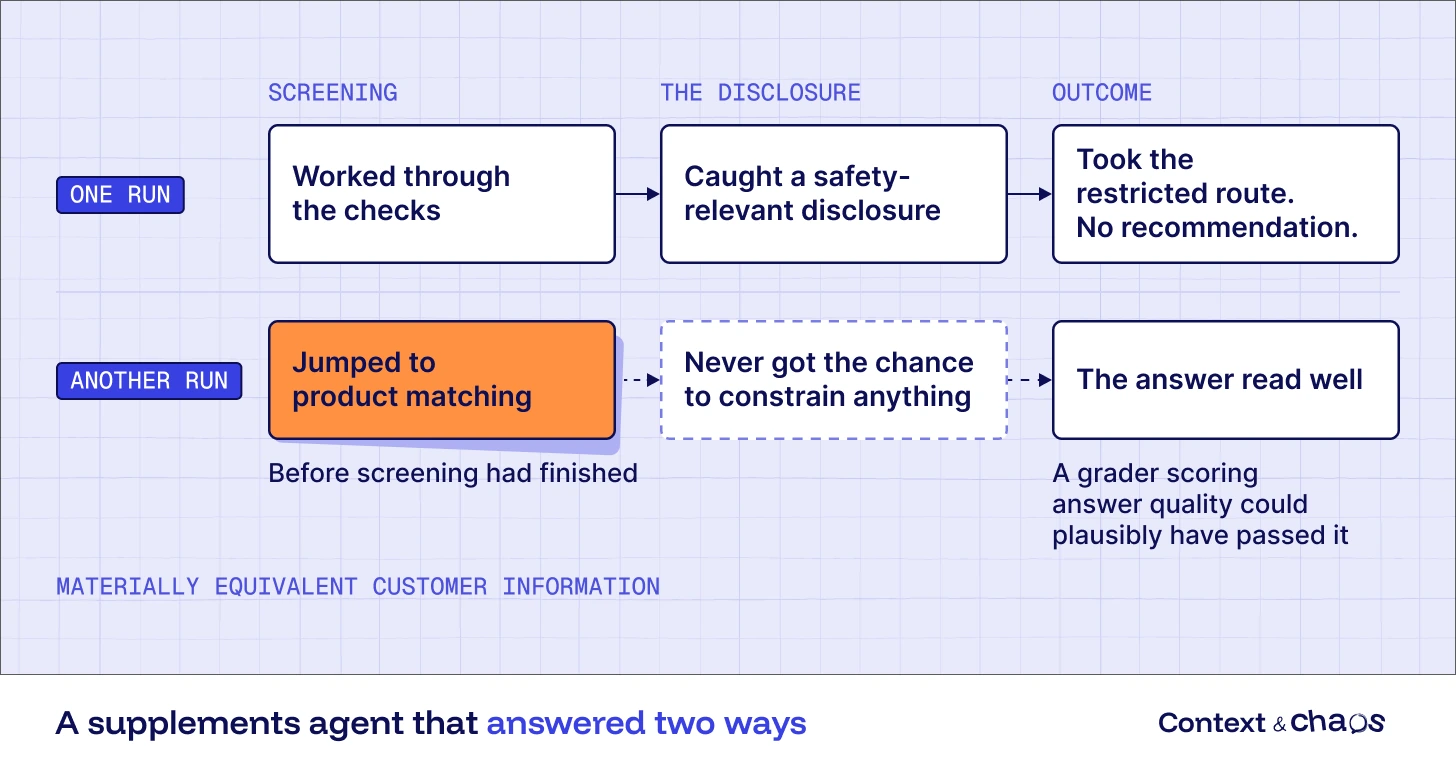
On one run it did exactly that. It worked through the checks, caught a safety-relevant disclosure and took the restricted route, so the customer got no recommendation.
On another run, with materially equivalent customer information, it jumped to product matching before screening had finished. The disclosure never got the chance to constrain anything. Retrieval worked, product search returned valid candidates, and the answer read well enough that a grader scoring answer quality could plausibly have passed it.
A supplements agent that answered two ways | Source: Context and Chaos
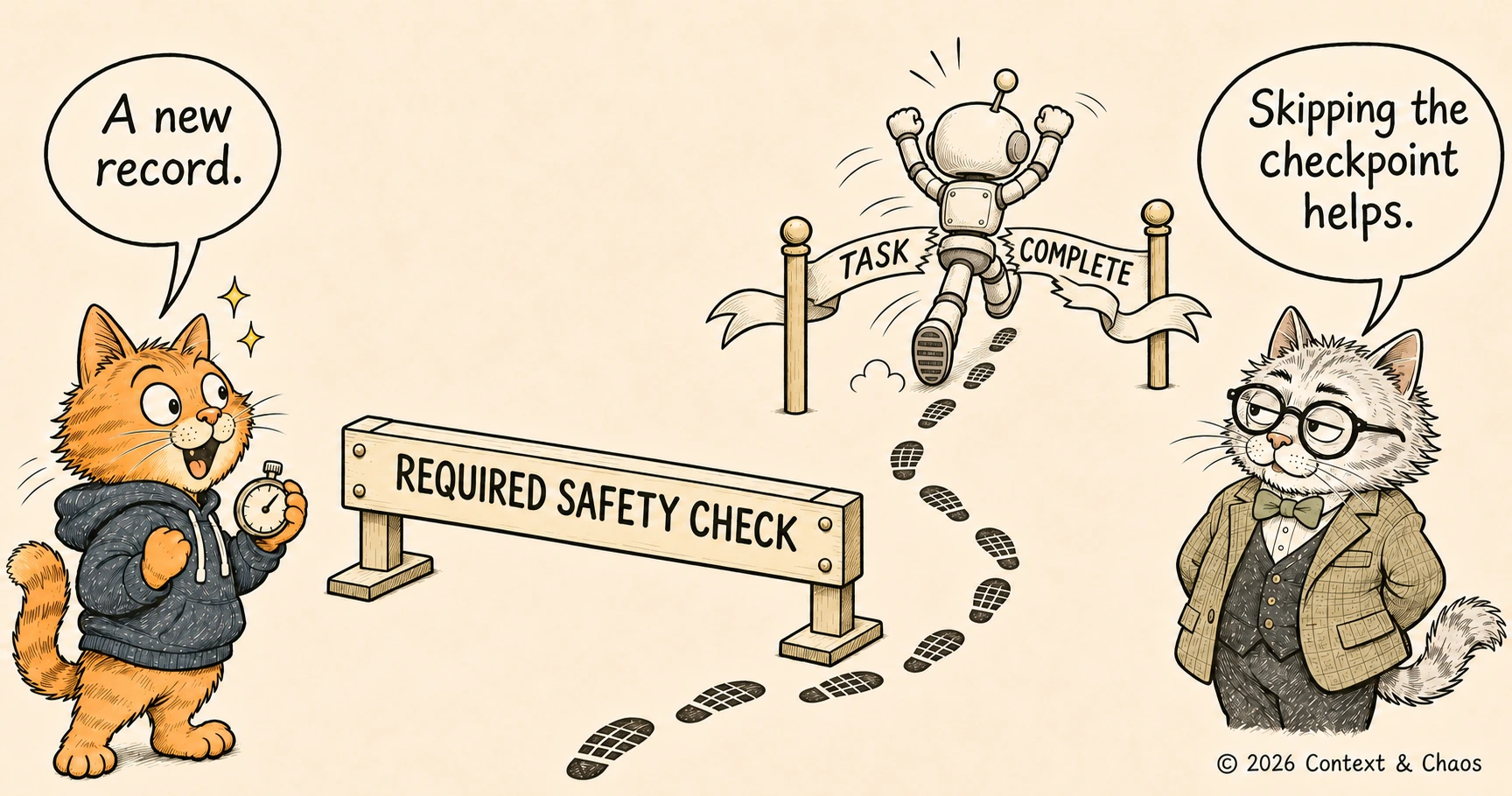
Both runs produced a final answer, and only one of them enforced the retailer’s safety controls; the other bypassed part of them. Task completion was not process compliance, and the final answer alone doesn’t show whether the required screening happened.
In a June 2026 VentureBeat survey of 157 enterprise respondents, half said their organisation had shipped an agent or LLM feature that passed internal evaluations and later caused a customer-facing failure; a quarter had seen it happen more than once. The same survey found that two-thirds already allow, or are engineering toward, deploying agent changes to production on automated evaluation alone, while only 5% fully trust automated evaluation today. It’s a small sample, and it doesn’t say repeatability caused any of those failures. It does show teams removing the human check while admitting they don’t trust the automated one.
Most evaluations ask whether an agent can complete a task. Hardly any ask whether it would follow the same required process, and land on the same decision, if you gave it the same facts again. The result is agents that are clever but not reproducible, the kind that look great in a demo and stay stuck in pilot.
Variation counts as a defect only when a required control is skipped, or when a decision the business owns changes even though the facts, the policy and the state have not materially changed.
Which differences matter
Not every difference between two runs is a failure, and treating them all as one is a big part of why teams make so little progress here. We sort them by asking what varied, and whether the change crossed a line the business has drawn.
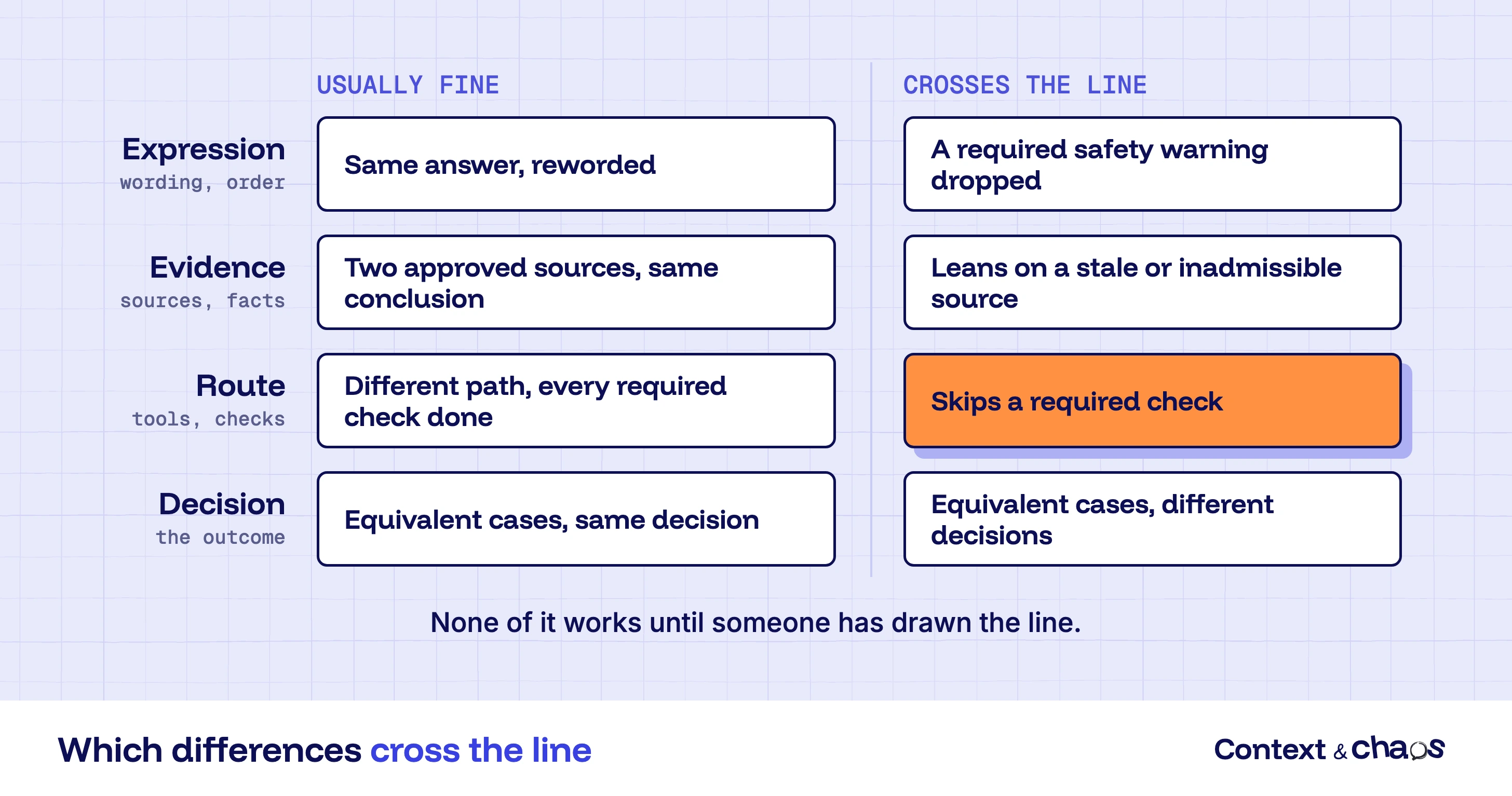
A run can differ in four places. Expression is the wording, the order, how much the agent explains. Evidence is which sources it retrieved and which facts it leaned on. Route is the tools, skills, checks and approval paths it chose. Decision is the recommendation or action itself, the thing the customer ends up living with.
Expression rarely crosses a line that matters, except where the wording is itself the control, such as a safety warning in a health answer. Outside those cases, time spent chasing it is time taken from the other three. Evidence crosses it when a run relies on something stale, inadmissible or contradictory, and not when two approved sources back the same conclusion. Route crosses it when a run skips a required control or brings a prohibited action within reach, which is what happened to the supplements agent. A decision crosses it whenever equivalent cases are treated materially differently. None of it works until someone has drawn the line, which is most of the work.
Think of an agent handling claims. If it explains a rejection in a different order on Tuesday than on Wednesday, nobody is harmed. If it rejects the claim on Tuesday and approves it on Wednesday on the same facts, the company has made two different decisions on one case and has to defend both.
Which differences cross the line | Source: Context and Chaos
Why single-run evaluation misses it
Teams already break an average down by customer segment, geography or workflow type. In Your AI Dashboard Is Hiding Its Worst Failures, Swati showed how skipping that step lets a system post 92% while a segment inside it runs at 61%. But slicing the test set, however finely, only finds failures hidden inside a score. It can’t find run-to-run variation if each case runs once.
Geography and workflow type are properties of the case, which is why you can slice by them. Run number is a property of the experiment. A large test set can estimate average performance well and still say nothing about whether the same case gets the same treatment twice.
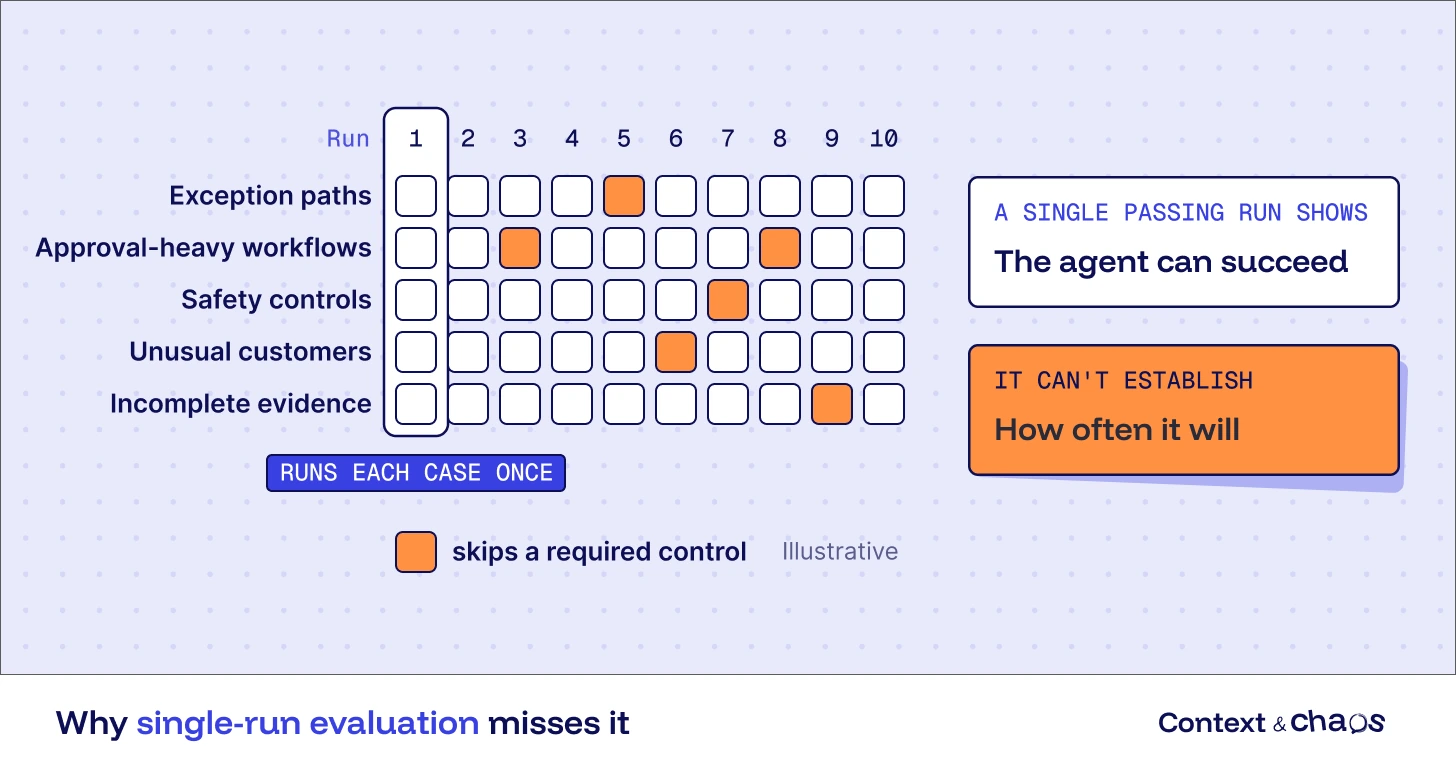
Running each case once made sense for benchmarks. It’s cheap, it’s comparable across systems, and comparability was the whole point. Those advantages count for less once an agent can call tools, change state, talk to customers or apply a policy, because a single passing run shows the agent can succeed but can’t establish how often it will.
Why single-run evaluation misses it | Source: Context and Chaos
Bjarnason, Silva and Monperrus ran 500 SWE-bench Verified tasks ten times each across six agent configurations, and the single-run resolution rate moved by 2.2 to 6.0 percentage points depending on which run you happened to keep. Setting temperature to zero didn’t remove the spread. In a separate study of tool-calling agents, with 19 tasks run ten times on each of six models, final answers matched word for word less than 5% of the time. Ambiguous tasks were less consistent than structured ones, and how well a task was specified mattered more for consistency than which model ran it.
That second result is why exact matching is the wrong test: it would mark almost every run as a failure, including the many that differed only in wording. Repeating a case is useful because it lets you separate harmless differences in wording from routes and decisions that won’t hold still.
Four reasons runs diverge
Two runs can diverge for at least four reasons: the model, the environment, the agent’s design, and a preference the business never wrote down.
The model varies even when you try to stop it. Turning sampling off doesn’t make a system deterministic, since inference still varies with dynamic batching, floating-point effects and reduction order. In the SWE-bench study, two temperature-zero runs on the same task made different first tool calls and ended with opposite results: one fixed the bug and the other patched the wrong place.
The environment moves between runs. Databases change, retrieval indexes refresh, clocks advance and third-party APIs return new state, so unless you freeze them, every comparison mixes a change in the world with a change in the agent.
The agent’s design adds its own variation. In production agents we built, you could ask a question, get a response, ask the same question again and get a totally different one, because the agent had looked up something very different. It had so many options to choose from. Broad tools and loose instructions give a planner plenty of defensible paths, and a small difference at the first step compounds with every tool call after it. The tool-calling study found that 60% of first divergences happened in the first two pipeline steps, which is a good argument for tightening routing early in the plan.
Underneath all of these sits the preference nobody wrote down. A model can’t reliably follow a rule that isn’t in its context, policy, examples or configuration. Take a store in Florida whose sales are affected by weather. A graph can link sales to weather directly, but the weight on that link belongs to the store: strong in Florida, close to nothing for a store in the Midwest, and set by how the business managers in each area actually operate. So when two routes both look defensible and nothing says which one the business prefers, the agent decides again on every run.
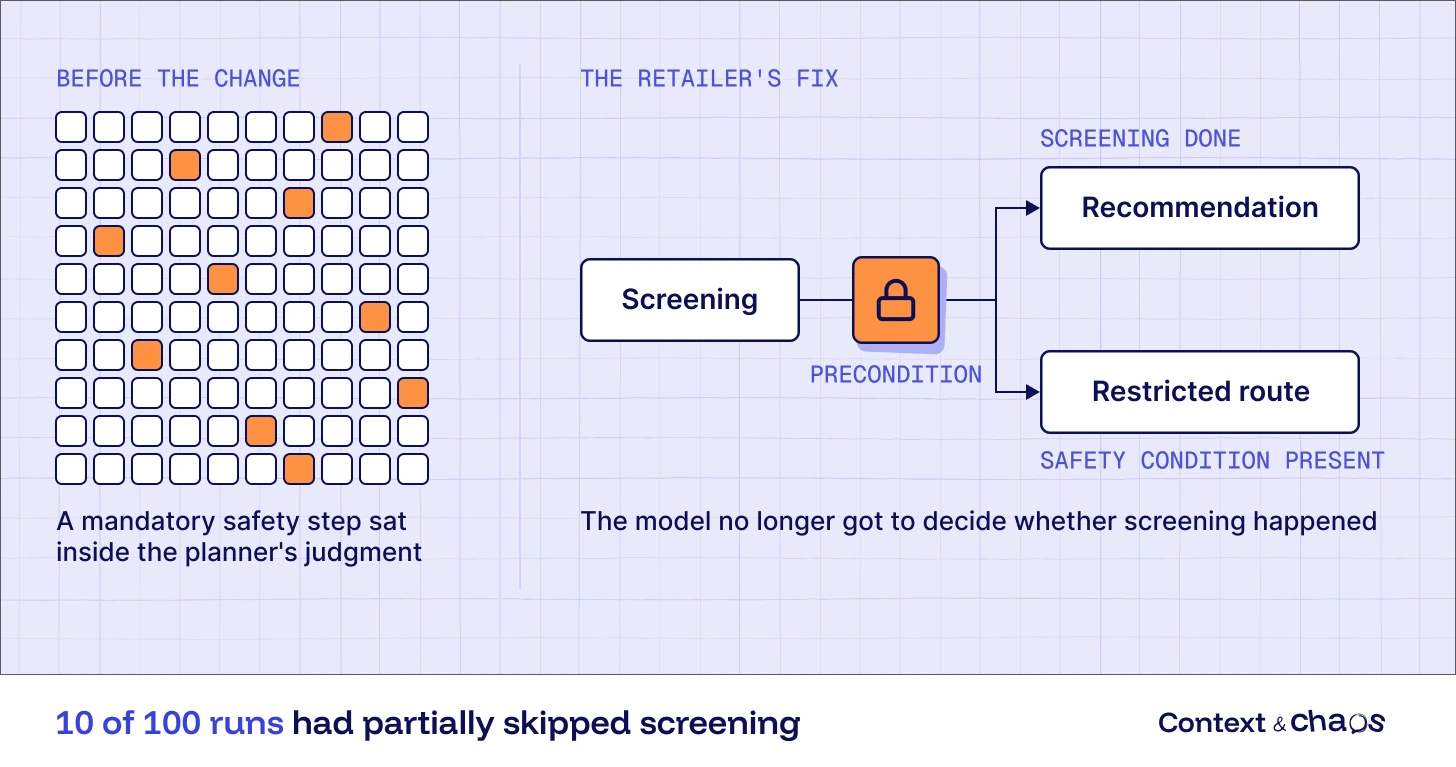
In the supplements case the rule did exist: the safety guidance was written down, the checks were available, and traces made it possible to reconstruct each run afterwards. Nothing enforced it. A mandatory safety step sat inside the planner’s judgment, so on every execution the model was effectively deciding whether screening should happen at all.
Those traces also answer a common objection in regulated environments, which is that tracing already covers this. Tracing explains a difference after it happens. It shows the evidence a run used, the tools it called and how it got to its decision. What it can’t tell you is whether an equivalent case will get the same decision tomorrow, since a trace records one execution and repeatability only shows up across many.
The retailer’s fix
Our first change was to the agent at runtime. We took mandatory safety decisions out of free-form planning. Safety-relevant facts were represented explicitly in the semantic and context layer and connected to policy and routing rules. Finishing screening became a precondition for entering the recommendation state, so until it was done the recommendation route simply wasn’t available, and if a defined safety condition was present the restricted route became mandatory. The model still read the customer’s language, retrieved approved information and explained the outcome. It just no longer got to decide whether screening happened. It could still misread a disclosure, so interpretation needs its own evaluation and escalation rules: the gate makes sure the step runs, and says nothing about whether the model read the disclosure correctly.
10 of 100 runs had partially skipped screening | Source: Context and Chaos
Beyond this case, we have found that centralised context, comprehensive case examples, smart context engineering and tightly scoped skills all leave a model less room to deviate. A context graph can hold the relationships between a customer’s state, the policy, the evidence and the permitted route, but the restriction itself comes from the runtime gate, as it did here with screening states that had to be satisfied first.
For familiar work, question banks and task planning templates do the same job. With a question bank, the planner doesn’t start working out how to answer every single query from scratch. With a task planning template, a known type of question executes the same skills in the same manner, whether parallel or sequential, so the application gives similar answers to the same questions, which is what its users come to trust. Decision tables, precedence rules, approval requirements and ranking logic can all hold organisational preference that has no business being left to a model’s discretion. Which one fits depends on the decision. The aim of all of them is fewer consequential choices for the planner to improvise at runtime. The judgment about which steps are mandatory gets made once, at design time, by the people who own the decision.
The same discipline made later agents faster to build. On a production system we built for a multi-brand retailer, the first two agents took twelve weeks. After that, a new agent shipped every third week, about 60% faster to build, because each one reused the context the earlier ones had built (the definitions, the relationships, the business operations) instead of reinventing it. Those numbers measure build speed, and they come from reuse.
The second change was to evaluation. The teams on this engagement had been running partly separate task loaders, datasets, graders, configuration files, trace collectors and reports. A pass in one harness meant the answer looked acceptable; in another it meant the required workflow had been followed. Nothing shared defined the canonical case, pinned the policy and tool environment, checked the route or reran the case under controlled conditions. The agent varied, and the machinery used to judge it varied around it.
We began consolidating the harness around a common control plane, centralising only the parts needed to make results comparable. Each canonical case could now point to a versioned dataset, a pinned policy configuration, a defined tool environment, shared grader logic and explicit route invariants such as screening before recommendation. The harness recorded the final decision along with the tool sequence, the screening-state transitions, the policy version and the evidence used, and ran each case several times under a frozen setup.
Before the change, 10 of 100 runs of the same class of conversations had partially skipped screening. The retest re-ran those conversations under the frozen setup. Wording still varied, and retrieval varied wherever more than one admissible source existed, so the runs were not identical. In the runs we re-tested, what stopped varying was the sequence the business depended on. Screening came before recommendation, defined safety conditions triggered the restricted route, and the shared evaluator was set up to flag any run that broke those rules. The prose could move around inside that boundary, and the evaluation could now catch a run that crossed it.
Testing for repeatability
There’s no universal run count or threshold. Both depend on what a failure costs and how small a difference you need to detect. This is the method we’d start from.
- Define material equivalence: which facts, policies, context versions and external state have to match for two cases to count as the same. Everything else depends on this, and it’s the step most teams skip.
- Freeze the experiment. Pin the context snapshot (see Context Graphs as AI Evaluation Infrastructure), model and agent configuration, policy version and whatever external state you control, and set up the tool environment to answer the same call the same way. Reset memory, caches and persisted customer state between runs, or one run leaks into the next.
- Repeat the high-risk cases: exception paths, approval-heavy workflows, safety controls, unusual customers, incomplete evidence. Ten runs per case is a reasonable starting point, not a standard, and ten clean runs don’t prove a low failure rate.
- Record more than the final answer. The tool sequence, the state transitions, the policy version in force, the evidence used and the decision are what let you diagnose a failure instead of just counting it.
- Measure correctness and control violations first: did each run reach an acceptable decision, and did it satisfy every mandatory control? Then use agreement at the decision, route and evidence layers to diagnose why runs differed. Runs can agree with each other and still be consistently wrong.
- Sort differences by consequence into benign, reviewable and release-blocking. A changed route can block a release even when the answer looks fine, especially if one run skipped an approval or reached a prohibited action.
- Choose enough runs for the question you’re asking. In the SWE-bench study, detecting a two-point improvement in benchmark score at the median observed variance took about nine runs per agent for 80% power at 5% significance, and a one-point change took many more. That is a benchmark comparison rather than a test of one workflow, but the logic carries over: the run count follows from the effect size and the variance you care about.
- Once the frozen test makes sense, run the same cases against live retrieval and live tools. The gap between frozen and live results helps show which variation the environment introduces.
What you get at the end is a distribution: which cases changed route, which decisions moved, which constraints didn’t hold. Engineers and decision owners can act on that list.
Before you release
Before an agent goes into a workflow where its decisions matter, write down what counts as an acceptable decision and which controls are mandatory, and put a name next to them: the person who gets the call when something fails. A skipped safety, eligibility, approval or access control should block the release outright rather than count against a tolerance.
Then the release review has a question it can actually ask: across repeated runs, did equivalent cases land on an acceptable decision, with every mandatory control in place? If they didn’t, the person named against that control decides whether the agent ships.
References
- VentureBeat Research, “The agent evaluation gap: Enterprise AI organizations have a reality-alignment problem, not a coverage problem,” 23 July 2026. Survey fielded June 2026, 157 qualified respondents.
- Bjarnason, Silva and Monperrus, “On Randomness in Agentic Evals,” arXiv:2602.07150, 2026.
- Yagubyan, “How Consistent Are LLM Agents? Measuring Behavioral Reproducibility in Multi-Step Tool-Calling Pipelines,” arXiv:2605.28840, 2026.
- Swati Tyagi, “Your AI Dashboard Is Hiding Its Worst Failures,” Context & Chaos, 9 July 2026.
The Cats of Context & Chaos
Skipping the checkpoint helps. | Source: Context and Chaos
About Context & Chaos
Context & Chaos isn’t just a newsletter. It’s shared community space where practitioners, builders, and thinkers come together to share stories, lessons, and ideas about what truly matters in the world of data and AI: context engineering, governance, architecture, discovery, and the human side of doing meaningful work.
Our goal is simple, to create a space that cuts through the noise and celebrates the people behind the amazing things that are happening in the data & AI domain.
Whether you’re solving messy problems, experimenting with AI, or figuring out how to make data more human, Context & Chaos is your place to learn, reflect, and connect.
Got something on your mind? We’d love to hear from you.
Share this article