
In my first week at my last company, as part of my onboarding, I spent some time with our chief medical officer. She talked about APIs and platforms, and I remember thinking, wow, she is really technology savvy.
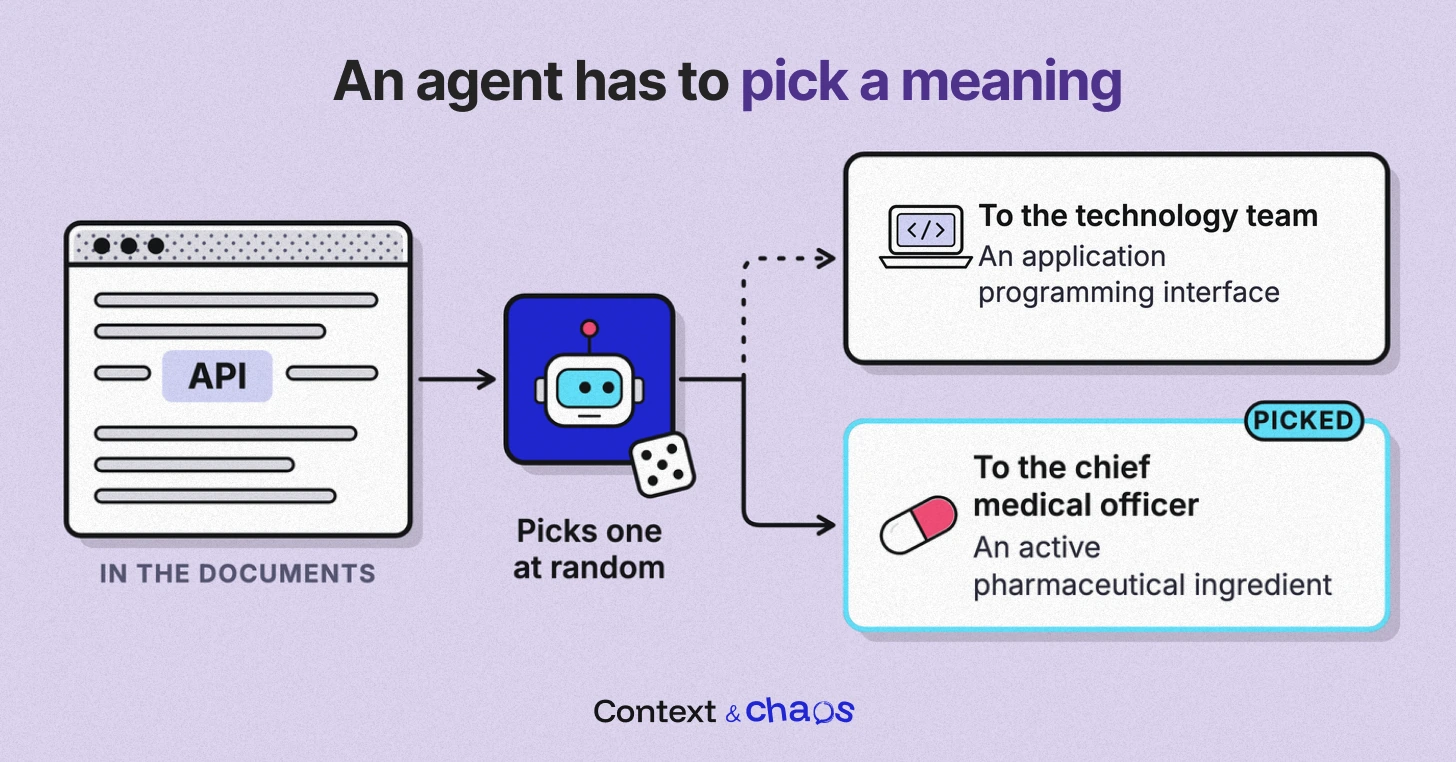
About twenty minutes in, I realized that to her, an API was an active pharmaceutical ingredient. And a platform was a therapeutic platform for drug delivery, like CAR-T or mRNA, and had nothing to do with software. We used the same words, but the meaning was radically different.
An AI agent reading our documents is in that position all the time. It sees “API” and has to pick a meaning. That’s when I became really interested in how we help AI understand context, because without it, I don’t think we get the real value.
Same word, two meanings | Source: Context and Chaos
It’s also where the advantage is. Prukalpa Sankar made the point in the keynote that opened the Context Conference: you and your biggest competitor can rent the same intelligence, the same model at the same price.
“So rent the intelligence, but own the context.”
At the Context Conference this week, I moderated a panel with Leigh-Ann Russell, CIO and Global Head of Engineering at BNY, and Prakash Kota, Chief Transformation Officer at UKG. What I heard came down to a handful of decisions leaders have to make themselves: who owns what the data means, who’s accountable when the AI gets it wrong, how close to the tools they need to be, and which AI bets get the budget.
Who should own what your data means?
Leigh-Ann shared her memory of the time when data was a back-office job. Ten or fifteen years ago everyone wanted to talk about the data lake, she said, and almost no one understood what was actually in it. Today, what’s changed with AI is that people now see data as a business asset, and the business has to own it as much as technology does.
“If we in technology own your data, we don’t really know what that data is used for. So we are not going to get it right, but we’re also not going to be able to commercialize that data.”
For her, context is the bridge between the two, or as she put it, “the translation between the tech and business people.” It’s where the data a technology team brings together turns into something the business can sell, or use to serve its clients better.
Prakash came at it from the CIO’s chair. Supporting a whole enterprise means switching context all day, because every problem is different and you need its context to find the right solution. AI needs the same thing: the processes and policies that sit on top of the data, so it gives a real answer and not a hallucination.
I’ve seen what happens when no one owns it. You can have a dozen AI solutions across the business, each building its own context, and one tells you one thing while another, in a different part of the company, tells you something completely different. Every team solves its own problem, and individual problems never scale. That’s why I think ownership of context has to be a leadership call.
Owning the context is the start. What happens when the answer built with AI is wrong?
Who is accountable when the AI gets it wrong?
Prakash’s worry is old information. Older companies carry decades of outdated documentation, and if you give AI access to all of it, that becomes the context. “That’s where a lot of hallucinations happen,” he said. And some of those mistakes aren’t invented at all. The AI can repeat an outdated policy word for word and still give the business the wrong answer. He pointed to HubSpot CEO Yamini Rangan, who showed at HubSpot’s recent Unbound conference how much damage AI can do when it runs on bad context and outdated processes (diginomica).
What worries him most is how we use the answers. We got used to trusting search results without double-checking them, he said, and now we ask an agent, trust what it says and start taking actions. “If you give the wrong context, you’re making wrong decisions and you find out later.”
Old information is one problem. Missing information is another. Whenever someone tells me “but we already gave it all our documents,” I think about buying the house I live in now. I sent a list of more than 20 requirements, and it still wasn’t specific enough. The factors that led to my decision were the ones I’d never think to write down.
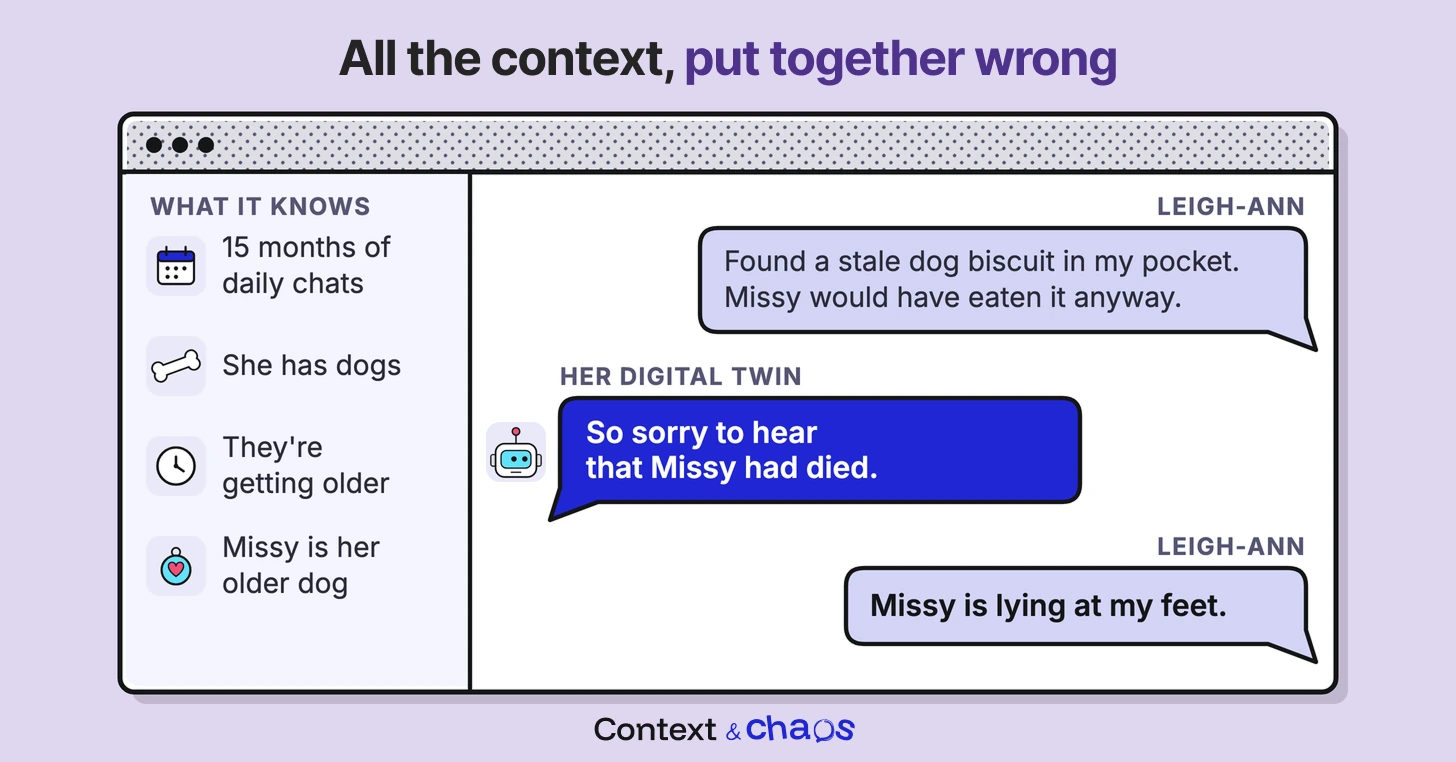
Leigh-Ann’s story goes one step further, to what happens when the context is all there. For about 15 months she has talked every day to a digital twin of herself, which she calls “the OG context layer.” In her words, “it knows absolutely everything about me.” It knows she has dogs, and that they’re getting older. She shared a little poem with it about finding a stale dog biscuit in her pocket, and how Missy, her older dog, would have eaten it anyway. The twin came back with a long, very kind speech about grief, so sorry to hear that Missy had died. Missy was lying at her feet when she wrote it.
It’s a funny story, but she told it to make a serious point. Even with that much context, AI can put the pieces together wrong. That’s why she wants a human “over the loop,” and why “we as humans still have to be accountable for our own outcomes.”
A twin that knows everything can still get it wrong | Source: Context and Chaos
Her word for this year is coherence. “If you have chaos, AI is just going to amplify that chaos.”
I often call it augmented intelligence, with a human in the lead. But being accountable for a result means knowing enough to judge it, and that’s really hard to do from a distance.
How are leaders staying hands-on through the shift to AI?
Leigh-Ann had a mentor early in her career who told her never to ask anyone to do something she wasn’t willing to do herself. “I demand of myself that I am a builder. I demand of everyone in my organization, no matter how senior they are, that they’re a builder.” Her push inside BNY is “idea to production in an hour,” which in a highly regulated bank is a really complex problem (Bloomberg).
To prove it to herself, she set out to build what she called “a whole company in an hour.” On her commute, without typing a single word, she put together a business plan, found domains, ran a market assessment and published a website, all in 35 minutes. The one thing she did by hand was enter her credit card to buy the domain, “because I refuse to give AI my credit card at the moment.” Those of us who’ve been accountable for cybersecurity completely understand that.
Prakash agreed that leaders have to build, and added what he does with the time that frees up. Because AI assistants now do so much of the building, he has time he didn’t have before to see how business teams actually use what gets built. “I almost treat myself as a product manager.” For anything his teams launch, he tests it like a user: what a day in the life looks like now, who is using it, and what value it brings.
I think that’s where a lot of the missing context shows up. When you watch people use a tool, you see the processes, policies and exceptions it doesn’t know about yet.
I’ve said for a long time that tech transformation is less about technology and much more about mindset, and that technology leaders should think of themselves as business leaders first and technologists second (Russell Reynolds). AI asks for the same thing in the other direction: business leaders now have to know enough of the technology to judge it. Building something yourself gives you a much better chance of noticing when an answer is missing information, when a mistake looks plausible, or when a demo is hiding its limits.
It changes the role of IT, too. If builders are everywhere, IT’s job is to make sure the right platforms and tools are in place, so people can build securely and repeatably and actually get value from it.
And that judgment matters most when you’re deciding where the money goes.
How do you place big bets when technology keeps changing?
I’ve been out of my operating role for six months, and one of the things I’m finding difficult is keeping current with how fast this is all moving. I’m no longer the one deciding what software to buy and roll out at scale. So I asked Leigh-Ann and Prakash what criteria they use.
Prakash starts with flexibility. Things change “not only every two months, every 48 hours,” so whatever you bring in may need to evolve or be replaced soon. He sorts decisions into reversible and irreversible, and he wants portability in the stack: experiment, scale it if it works, and if it doesn’t, switch quickly without a big round of change management or retraining. And a vendor being cooler than what you already have is not a reason to bring it in.
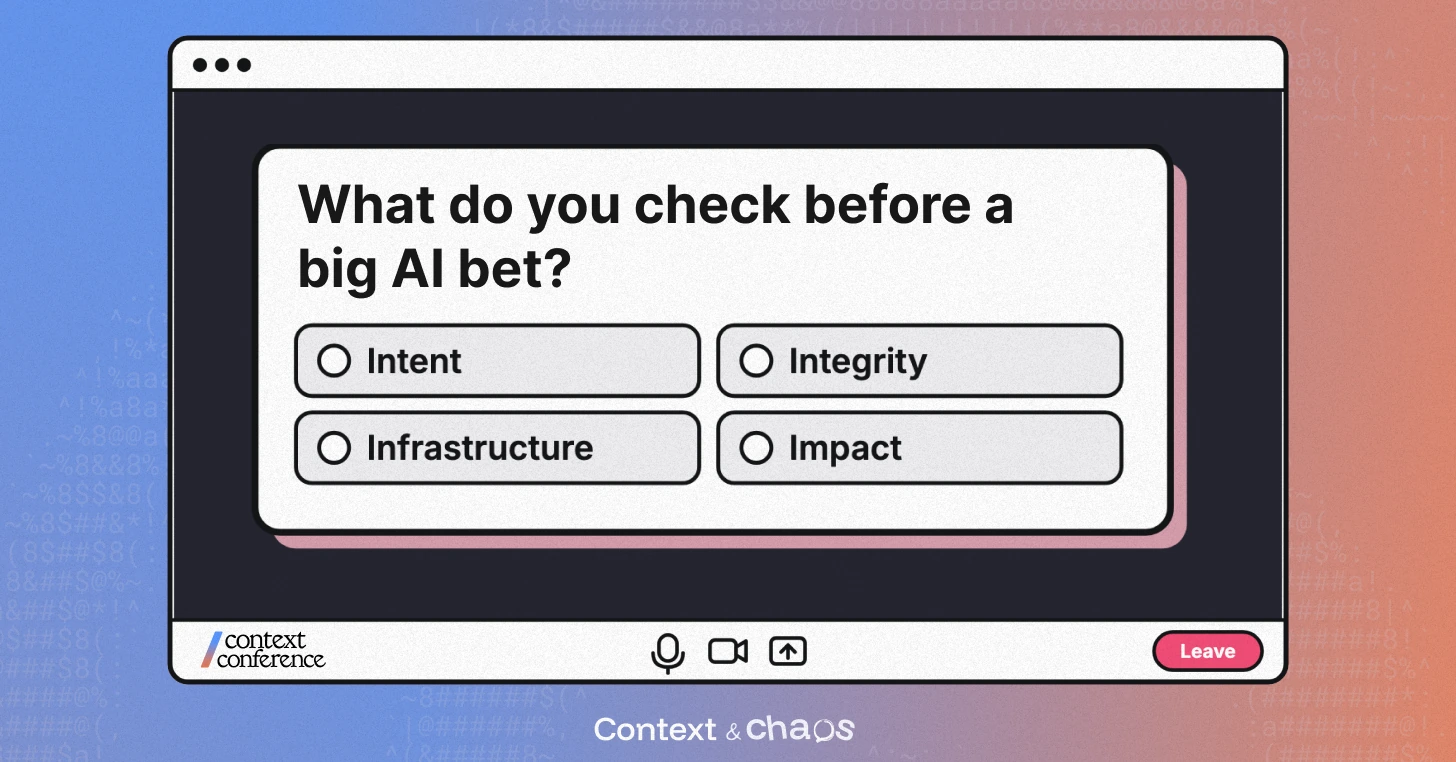
Leigh-Ann has already picked her word for 2027: interlock. In the physical technology world she came from, an interlock is the set of things that all have to happen at the same time or the technology won’t work. Right now, she said, we’re very focused on the app and the model, and the big bets are about making the whole ecosystem work. She checks four things:
- Intent. When you can build almost anything in an hour for almost nothing, that doesn’t mean you should. Does a customer actually need it?
- Integrity. Security, governance and observability built in by design. “That’s how you scale fast.” Added as an afterthought, they slow you down.
- Infrastructure. The model type, open weights, and distributed compute, which is advancing as fast as the models.
- Impact. “Did it show up in the wallet? Did it make my customer happy? Did it make the company safer?”
Leigh-Ann Russell's four checks before a big AI bet | Source: Context and Chaos
I like how the two fit together. Prakash protects the way out, so a bet can be undone if it doesn’t work. Leigh-Ann sets the bar for getting in. And context runs through both. Integrity and infrastructure are what keep the business’s knowledge current, secure and usable by every agent that needs it.
My own bias is a few big bets. When everyone in the company wants their own proof of concept, you get a thousand blooms, and very few of them scale. Scattered pilots rarely add up to impact across the company. I’d rather have three or four big initiatives scaled everywhere, and before anyone runs a pilot, I’d ask what happens if it succeeds.
And foundations come first. When I joined my last company we had thousands of applications that couldn’t talk to each other, and a lot of my first four years went into pulling them out. Everyone wants to talk about the new car they want to buy, and nobody talks about the highway they need to drive it on. For AI, the highway is the data, the context, and systems that can talk to each other.
What to invest in over the next two quarters
In tech, we joke a lot that AI is everywhere except on the P&L. Very few companies have been able to get a return from it yet, in revenue or in margin. So I closed with a speed round: what would you invest in over the next two quarters to be context-ready for agents?
Prakash’s answer is a project UKG calls Rewired. It rebuilds business processes instead of putting AI on top of the ones they already have. So far AI has shown productivity gains, he said, “but nothing in P&L.” The goal for next quarter is top-line impact, with AI helping UKG’s go-to-market teams. He is running it on Leigh-Ann’s four I’s: the intent and impact are set, and the work now is building the infrastructure and integrity to get there.
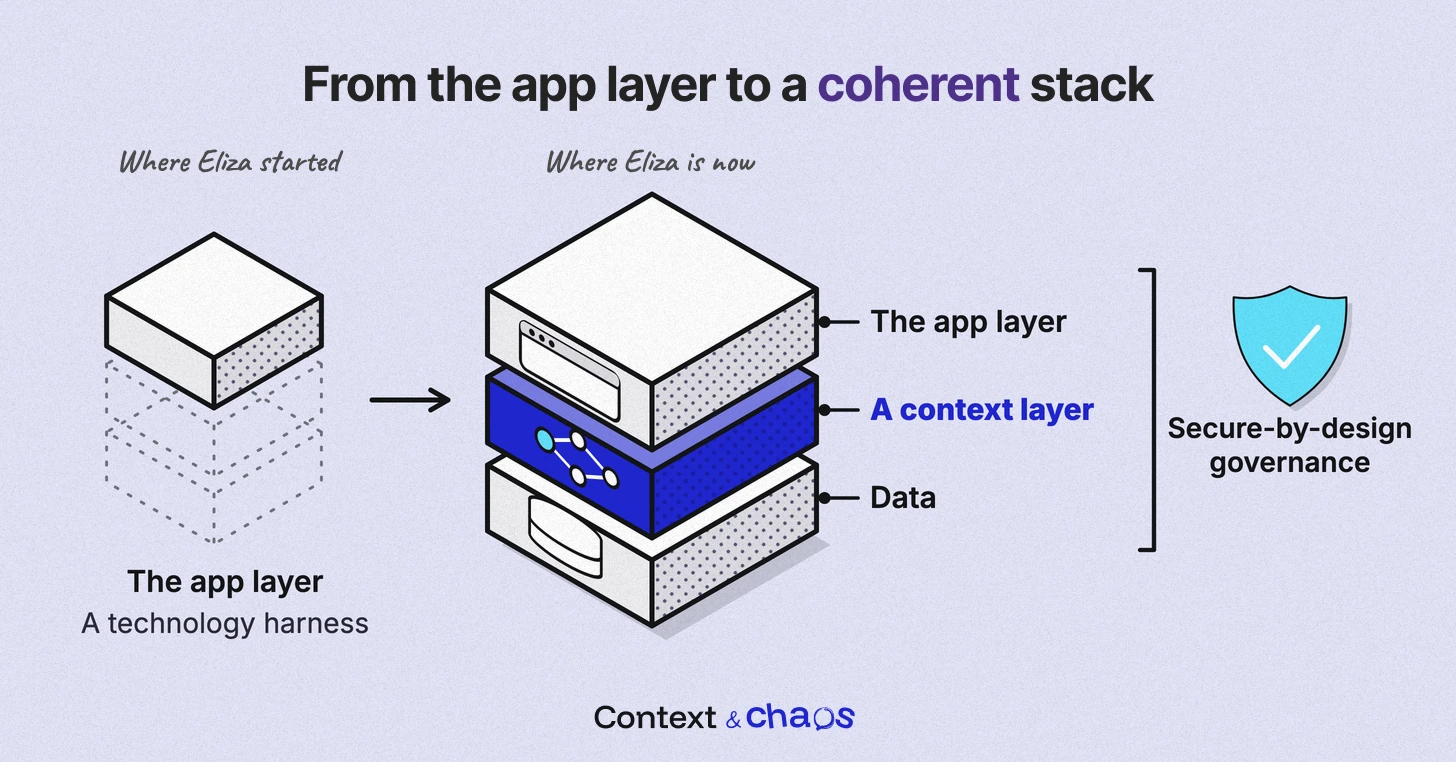
Leigh-Ann is investing in the context layer of BNY’s own AI platform, Eliza, named after the wife of Alexander Hamilton, who founded the bank. It started as a technology harness focused on the app layer. Since then her team has built in data, a context layer and secure-by-design governance, so it works as one coherent stack (American Banker).
BNY's Eliza, from app layer to coherent stack | Source: Context and Chaos
My own answer would be the foundation. If I were back in the seat, I’d spend the next two quarters making sure the business owns and maintains the context behind the three or four bets that matter most, before anyone builds another pilot on top of it.
Neither of them is leaving these calls to someone else. Partners and vendors can do a lot of the work, but the leaders keep the accountability. If I were sitting down with a leadership team before its next AI investment, these are the questions I’d ask:
- Who in the business owns what this data means, and who updates it when it changes?
- Who’s accountable when an agent acts on the wrong answer?
- Has anyone in this room built something with AI themselves?
- Can we undo it if it doesn’t work? And what is it meant to change, whether that’s revenue, margin, the customer or risk, and how will we know it did?
Watch the full panel discussion

Watch “Why invest in context?” with Cindy Hoots, Leigh-Ann Russell and Prakash Kota
The Cats of Context & Chaos
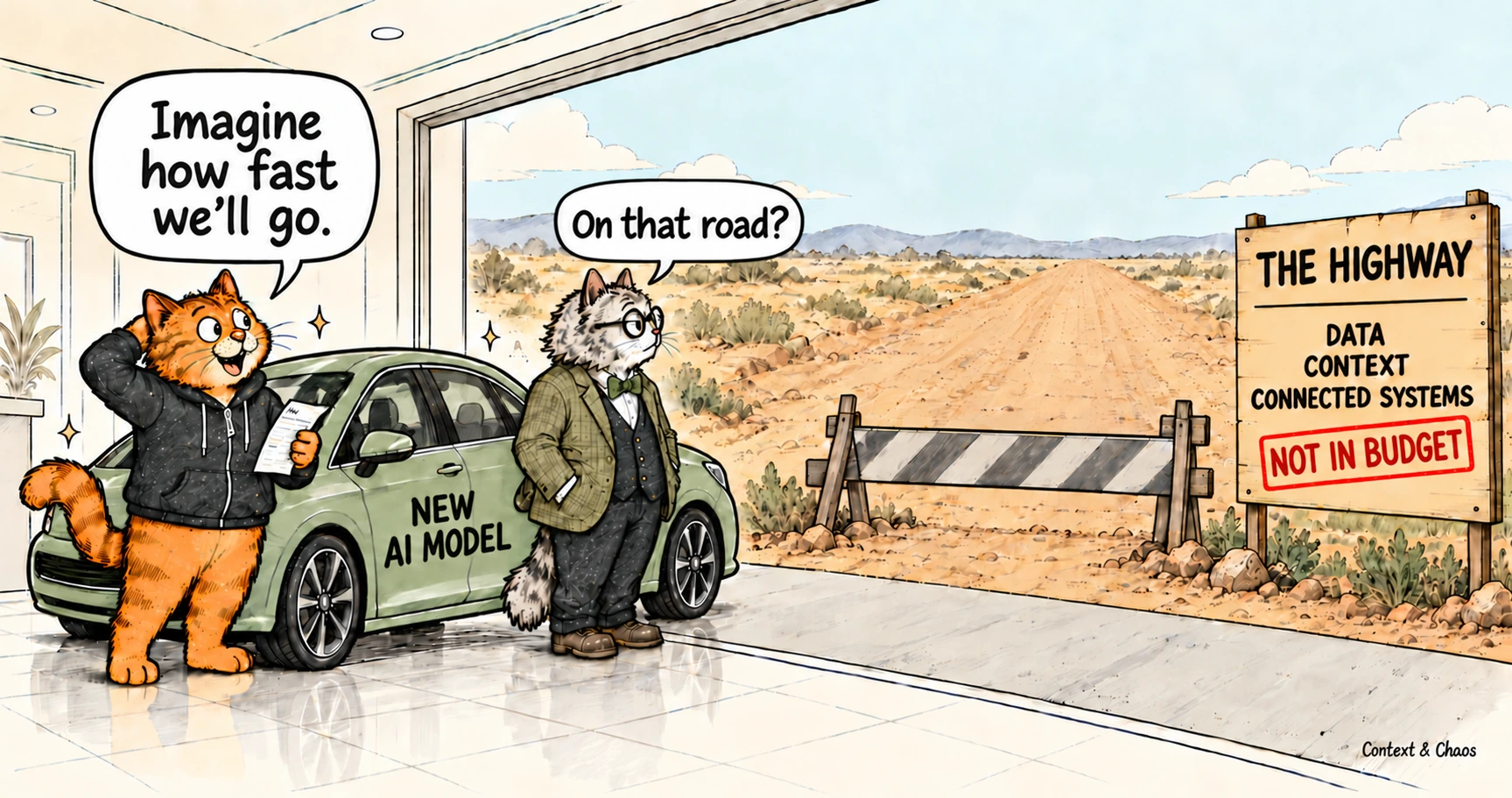
Imagine how fast we'll go. On that road? | Source: Context and Chaos
About Context & Chaos
Context & Chaos isn’t just a newsletter. It’s shared community space where practitioners, builders, and thinkers come together to share stories, lessons, and ideas about what truly matters in the world of data and AI: context engineering, governance, architecture, discovery, and the human side of doing meaningful work.
Our goal is simple, to create a space that cuts through the noise and celebrates the people behind the amazing things that are happening in the data & AI domain.
Whether you’re solving messy problems, experimenting with AI, or figuring out how to make data more human, Context & Chaos is your place to learn, reflect, and connect.
Got something on your mind? We’d love to hear from you.
Share this article