
I recently got “the call.” You know the one.
It’s from a leader at an organization that, about 18 months ago, celebrated a massive Data Governance Go-Live. They had the matching swag. They had the ribbon-cutting for their shiny new data catalog. They had a steering committee that met every Tuesday like clockwork.
And yet, 18 months later, adoption has flatlined. The metadata is stale. The steering committee has disbanded into the ether of other priorities. The catalog has become what most catalogs become when governance is treated as a project: a collection of dead links and VARCHAR(255) definitions that mean nothing to the people actually trying to do work.
The kicker? This same organization now wants to build an “AI Context Layer.” They saw the potential at a recent industry conference, read the analyst reports, and moved context from a buzzword to a primary budget line item.
But they’re trying to build it using the exact same project mindset that failed them the first time.
What the Autopsy Looks Like
I’ve walked into enough of these post-mortems now that I can describe the scene before I even open the catalog.
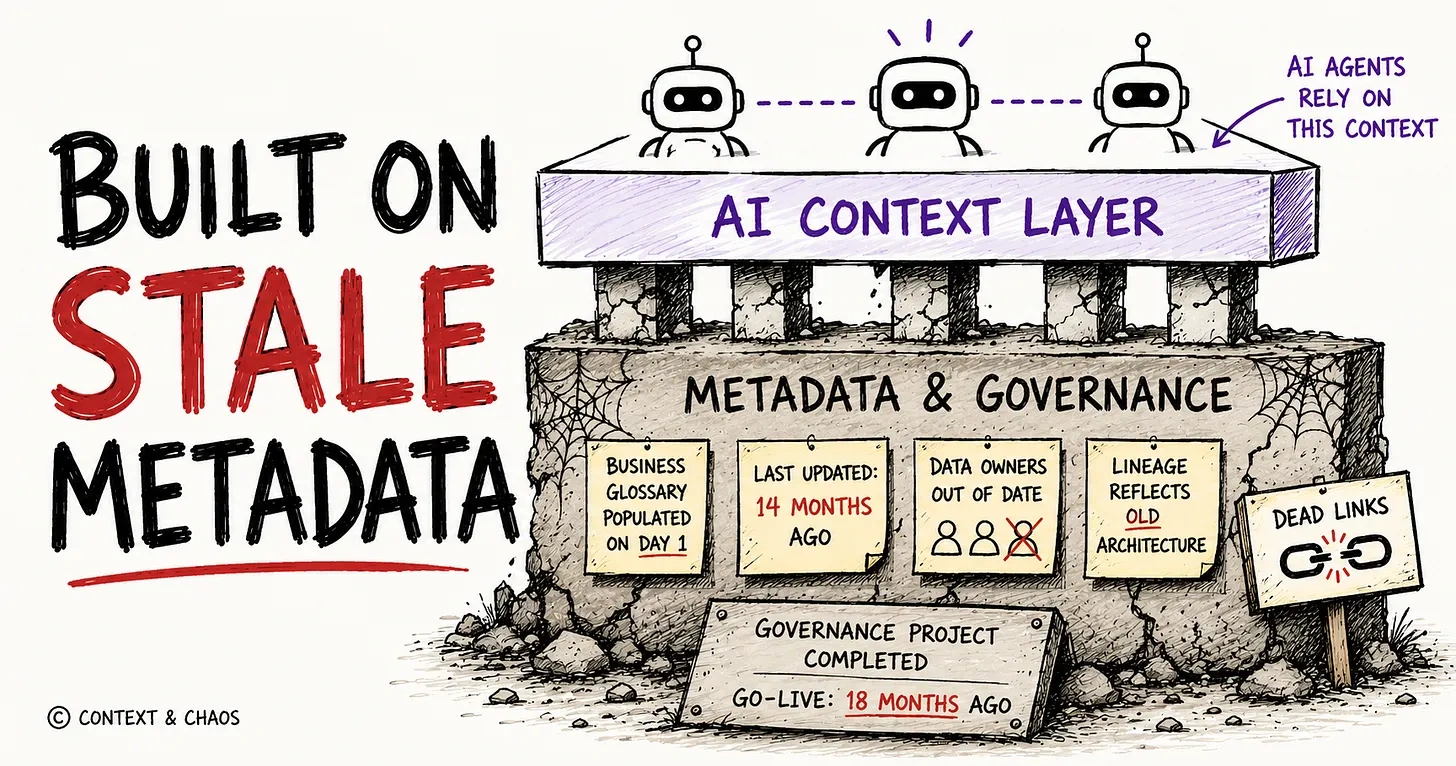
The definitions exist, technically. Thousands of them. But when you start clicking, you realize nobody’s touched most of them in over a year. The business glossary was populated during the initial sprint by a team that has since rolled off. The data owners listed? Half of them have changed roles. The lineage diagrams reflect an architecture that was refactored six months ago.
And the people still doing the work, the analysts and engineers actually building pipelines and dashboards, have quietly routed around the catalog entirely. They have their own Slack channels, their own tribal documentation, their own “ask Sarah, she knows how that table works” workflows.
The governance didn’t fail because the team was incompetent. It failed because the organization treated governance as a deliverable. Discipline is what it actually requires.
At one financial services client, we found 11,400 business term definitions in the catalog. When we ran the freshness audit, 64% hadn’t been updated since the original implementation sprint, 14 months earlier. Of the data owners listed, 38% had changed roles or left the organization. The lineage was accurate for the architecture as it existed at go-live. The architecture had been refactored twice since then.
The catalog was wrong because nobody’s job depended on keeping it right. That’s a different problem from people not caring
The Project Trap: Why Governance Dies at Go-Live
In the corporate world, we love projects. Projects have a start date, a finish line, and a capital expense (CapEx) budget. You select a tool, you configure it, you hold a training session, and you declare victory.
Governance is a capability, not a tech implementation.
When you treat governance as a project, you are essentially building a house and then firing the maintenance crew the day you move in. The moment the project team disbands, decay sets in. Definitions shift. New data sources emerge. Business intent evolves.
If your governance ends when the project ends, you aren’t building a foundation. You’re building on sand.
Why AI Makes This Existential
We’ve tolerated stale metadata in our catalogs for a decade. It was annoying, but a human analyst could usually spot a weird number and ask a teammate for clarity.
AI agents only know what we tell them. Tribal knowledge doesn’t transfer.
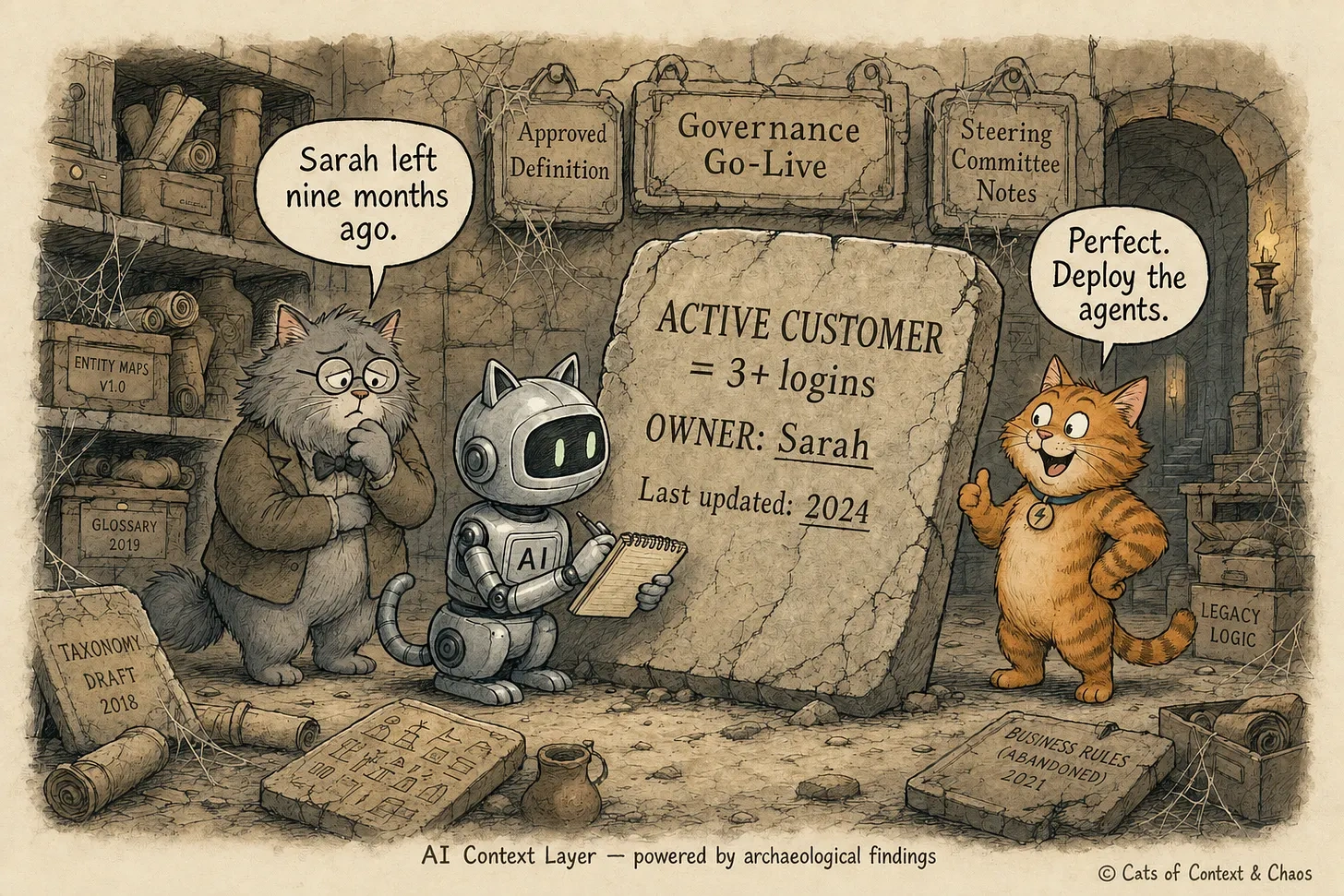
Stale context fed to an AI agent stops being annoying and starts being dangerous. If your “Active Customer” definition changed last week but your governance project ended last quarter, your agent is now making autonomous decisions based on a lie.
I saw the stakes of this up close last year. A regional insurer was piloting an AI agent for a customer retention workflow. The agent was pulling “At-Risk Customer” definitions from the catalog to identify who to flag for outreach. Those definitions had been written during the governance project, before the product team revised the activation criteria following a policy change.
The agent ran for six weeks before anyone noticed something was off. It had been targeting a segment the business had already reclassified, flagging customers as at-risk who the product team had specifically decided not to pursue. The catalog said one thing. The business had moved on. The agent didn’t know.
No catastrophic outcome in this case. But six weeks is a long time for an autonomous workflow to operate on a definition that no longer reflects reality.
Think about what that means at scale. Definitions shift. Use cases evolve weekly. Agents need current context to operate safely, and a context layer built on a project that already ended is a layer that is already decaying.
The Shift: From Project to Operating Discipline
If we want to survive the era of AI Agents, we have to stop thinking about governance as a project with a finish line and start thinking about it as a continuous operating discipline. Something that doesn’t finish. Something that runs in the background, updates itself, and manages the relationship between your data infrastructure and the applications consuming it.
That’s what an AI context layer actually is, when you build it right: the continuously maintained fabric of governance, metadata, and feedback loops that sits between your data stack and the AI applications consuming it. A living layer that keeps updating itself.
Here is what that shift looks like in practice.
Discovery can’t be a one-time data haul. It needs to be event-driven and automated. If a schema changes in production, your context layer should feel the pulse immediately, not wait for the next quarterly review.
Stewardship can’t be a side-of-desk hobby for your best analysts. It needs to be a dedicated role, or at minimum a heavily incentivized function, with a seat at the business table. The organizations where governance survives past go-live are the ones where someone’s performance review actually depends on it.
Feedback loops need to replace annual audits. Waiting six months for a bias audit is a lifetime in AI years. You need monitoring that catches a hallucination or a PII leak before it hits the end user, not after the quarterly review surfaces it in a slide deck. In practice: watch how AI actually uses your definitions in production. When an agent misapplies a policy or surfaces something unexpected, that’s your governance signal, route it back before the next user feels it.
And the funding model has to change. Stop funding governance with one-time project budgets. It needs ongoing operational funding. It’s a utility, like electricity or the internet. You don’t finish paying for the lights.
One organization I worked with made this shift after their second failed governance implementation. They dissolved the project team entirely and converted two data steward positions into permanent operational roles, with coverage rate and definition freshness built into performance reviews. They also moved the governance budget from a capital project line to an operational utility line, same category as their data infrastructure.
Twelve months later, their catalog freshness rate had moved from 31% to 74%. More importantly, the stewards were being included in AI scoping conversations from the start. Not handed a catalog to populate after the fact. The pattern that kills governance programs, build it, ship it, walk away, broke because someone’s job now depended on it not breaking.
The Bottom Line
When organizations ask me what’s changed in the data landscape, my first question is always the same: When your governance project ends, does the governance end with it?
If the answer is yes, you aren’t ready for AI.
AI agents scale our successes at machine speed. But they scale our failures even faster. Don’t build a project. Build discipline. Because in 2026, the context your AI operates on is only as current as the last time someone bothered to maintain it. And if nobody’s job depends on that maintenance, nobody will.
The organizations that survive this era won’t have figured out a smarter playbook. They’ll have stopped running the playbook entirely.
The Cats of Context & Chaos
About Context & Chaos
Context & Chaos isn’t just a newsletter. It’s shared community space where practitioners, builders, and thinkers come together to share stories, lessons, and ideas about what truly matters in the world of data and AI: context engineering, governance, architecture, discovery, and the human side of doing meaningful work.
Our goal is simple, to create a space that cuts through the noise and celebrates the people behind the amazing things that are happening in the data & AI domain.
Whether you’re solving messy problems, experimenting with AI, or figuring out how to make data more human, Context & Chaos is your place to learn, reflect, and connect.
Got something on your mind? We’d love to hear from you. Hit Reply!
Share this article