Getting AI tooling does not make you a frontier company. So what does? Our learnings.
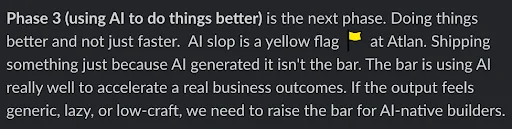
I Sent That to Our Team a Year Ago.
I sent that to our team a year ago, after watching something strange take hold. More and more of the work at Atlan was arriving as polished, AI-generated artifacts. Enablement material that once would have been a document became an interactive website. Ideas became prototypes in hours. There were tabs upon tabs of things that looked finished. At first, it felt like progress. AI usage was rising. People were building. The work often looked better than it had before.
But much of that material went unused — or was discarded soon after. We had lowered the cost of making something without raising the odds that it would matter. And the low-value output was not harmless. It became context for the next person — or the next model — to build on. Slop produced more slop.
The word builders in that note is the whole point. The model generated the artifact, but a human chose the problem, accepted the quality, and decided it deserved other people’s attention.
Not using AI might make one person slower. Using AI without judgment can make the whole organization slower.
The Adoption Trap.
I can recite all of our AI numbers: licenses provisioned, weekly active users, tokens consumed, agents created, hours supposedly saved, artifacts shipped. Our investors routinely tell us we’re in the top 1% of AI adopters. But those numbers measure whether people are using AI. They don’t tell us whether the company is getting more capable.
An enablement site only matters if it changes how the field sells. An agent only matters if it improves a consequential decision. A campaign only matters if it earns attention and trust — not because it produced more assets than a human team could have.
When creation was expensive, a polished artifact signaled commitment. The effort was a natural brake. AI has removed most of that brake, and our instincts haven’t caught up. We still read volume and polish as evidence of value. Left unchecked, the result is a new kind of organizational theatre: AI output theatre.
So What Makes a Company Frontier?
AI is usually described as a tool to adopt. That understates the change. It’s a foundational capability you can redesign work around — and the real question isn’t whether people use it. It’s whether the organization can turn a new capability into a new behavior, and then into a new outcome.
I saw this while building slides for my recent AI Engineer talk. In the previous year alone, the AI architecture of our Customer Success team changed four times, each version making the last obsolete.
The models were not the variable. What changed each time was how much of the customer the system could actually see: at first only the documents you pasted in yourself, then real call notes, then product and health signals judged agent by agent, and finally all of it at once under one shared memory layer. Same job, four attempts, and the output gets more useful as the context deepens. The last version is the first that can raise a risk or an opportunity nobody asked it about.
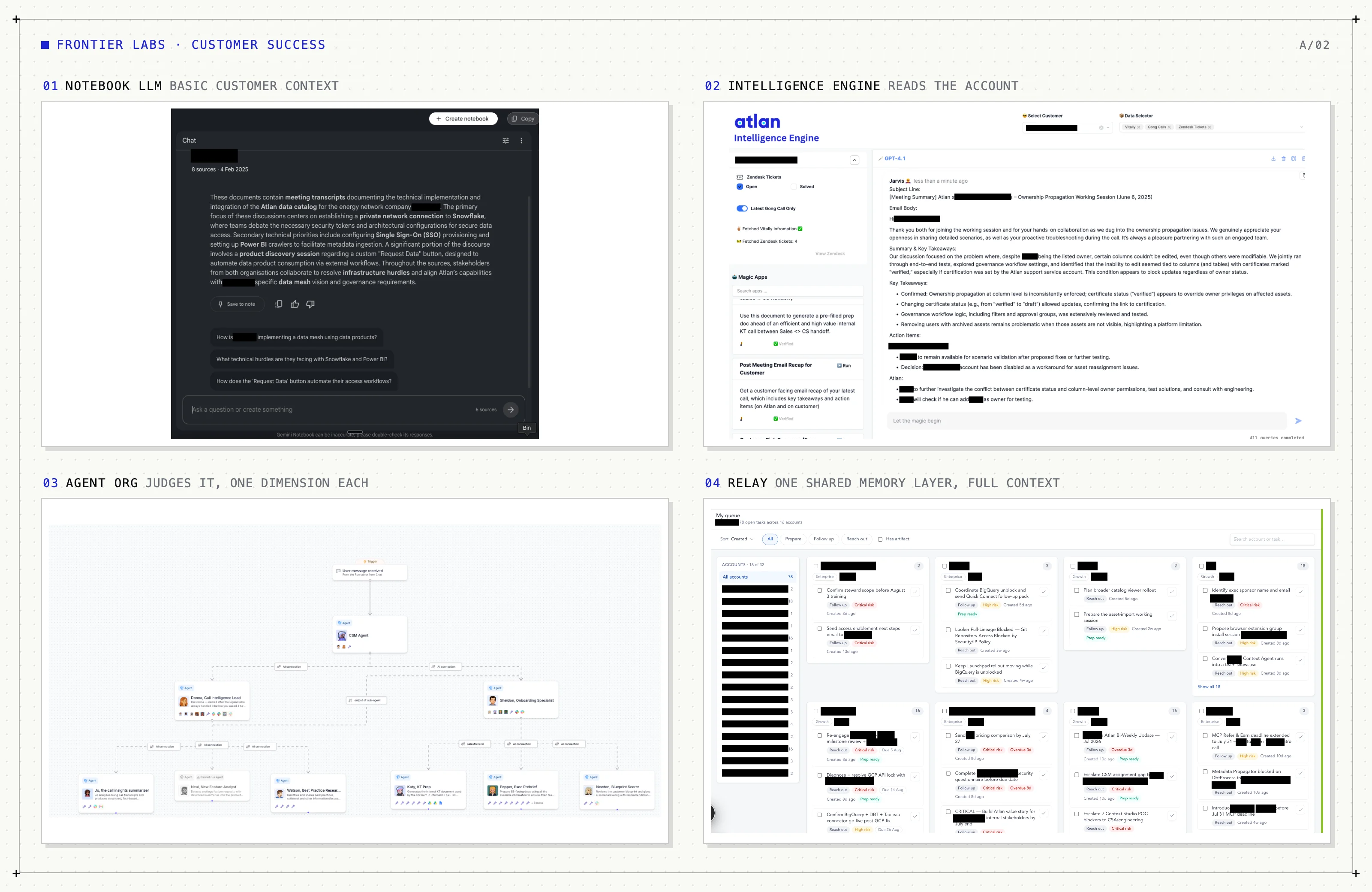
Do I regret rebuilding that architecture four times? Not for a second. For a company operating at the frontier, that might be the point.
Here’s the belief I’ve landed on. The models will change. The tools will change. Today’s frontier workflow will be tomorrow’s default.
The durable advantage is organizational metabolism: how quickly you can notice a new possibility, test it against reality, absorb what you learn, and change how you work.
Change the outcome, not just the output
Frontier Companies Get More Ambitious, Not Just More Efficient.
Most conversations about AI productivity focus on multipliers: more code, more campaigns, more content, more work per person. Efficiency matters. But if the result is ten times as many emails, slides, or lines of code, we have confused greater production with greater capability.
The old question: How can AI help us do this faster?
The new question: If today’s capabilities had always existed, would we have designed this task, role, or team at all?
One of our marketers recently made that question real by building a personalized web experience. It uses intent signals to infer a visitor’s company, pulls together the context we already have about that account, and generates the experience as the visitor arrives. Instead of sending everyone through the same set of pages, it gives each visitor the information most relevant to who they are.
This is not pre-generating a hundred landing-page variants. It changes the unit of work: from producing pages to assembling an experience around a person’s context — where what helps the visitor most turns out to be what converts fastest.
It’s still an experiment, not a proven growth engine. We also need to learn where personalization becomes inaccurate, invasive, or untrustworthy — and what review and stopping rules it demands. But it changed the question I was asking — from how to make more landing-page variants to whether every visitor can arrive to an experience built around who they are. That shift, from producing more of the old unit to imagining a new one, is what greater ambition looks like.
The Organization Has to Absorb the Change.
New capability does not transform a company until the organization moves with it. Knowledge work has long divided complicated outcomes among specialist functions, each connected by handoffs. That structure created scale and protected expertise. It also fragmented ownership and turned the movement of context into a job of its own.
AI gives one person access to capabilities that once lived across functions. A marketer can build. A product manager can prototype. An operator can create internal software. That does not make deep expertise irrelevant. It changes where expertise must sit — and forces us to ask when a handoff is still worth its cost.
Some boundaries should stay. High-stakes claims still need independent review. Deep technical work still needs deep expertise. Privacy, security, and brand risk still require accountable owners.
Remove a handoff when it exists mainly to transport context. Preserve independence when it exists to challenge judgment, control risk, or contribute scarce expertise.
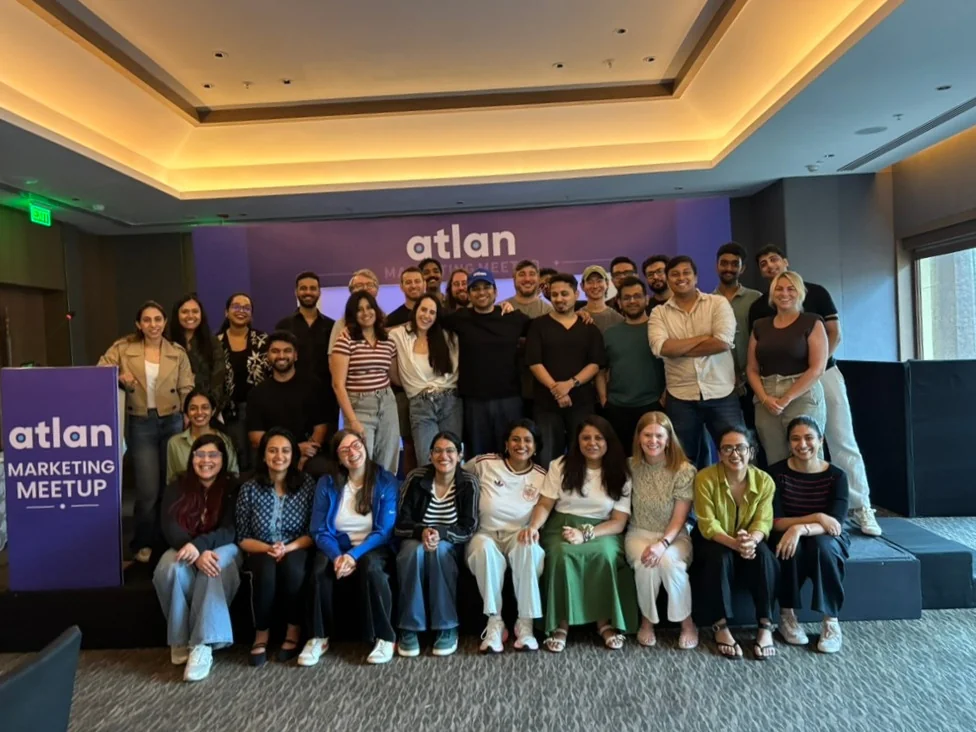
In February, our marketing team reorganized into pods built around outcomes instead of functions. The pod structure is still an experiment, but there are early signs it’s working. I just came back from our marketing retreat expecting to hear how the team was coping without traditional management structures. Instead I mostly heard gratitude — and a common refrain: they couldn’t believe they’d ever worked the old way.
Is the Real Frontier Human?
The more powerful AI becomes, the more the human operating it matters. Give two people the same model. One produces ten acceptable versions of an existing asset. The other asks whether the asset should exist, reframes the problem, and attempts an outcome that used to be beyond an individual’s reach. AI supplies the leverage; the human chooses the direction. Judgment decides what’s worth doing, taste recognizes what excellent looks like, ambition sets the altitude. To work at the frontier, an expert has to keep consenting to become a beginner.
This is why we’ve started rethinking human skills directly. One tool is a simple grid with two axes — human skills and AI leverage — as a way to start thinking about where human impact actually comes from.
The next few years may feel like fight, flight, or freeze: roles will change, familiar skills will become abundant, and the boundaries people use to define their professional identity will move. But fear cannot be the operating principle for people trying to thrive in this new world. And this is where the organization has responsibilities too: to create room for learning, make changing expectations explicit, and help people develop the skills the new system requires.
AI supplies the leverage; the human chooses the direction.
The human frontier is not simply whether individuals can adapt quickly enough. It is whether a company can increase machine leverage without diminishing human agency.
Why Frontier Labs?
We’re trying to build Atlan into a truly frontier company. We haven’t finished, and I don’t think anyone has a finished playbook — the primitives are being invented while we use them. What happens to the role of the manager? How should AI-native work be measured? What does a 100× outcome look like without becoming a 100× productivity treadmill? Which kinds of expertise matter more, and which handoffs disappear?
These are hard to answer from only one side of the frontier. Many of the companies writing most openly about AI-native work were born in the AI era, with no pre-AI organization to unwind. That isn’t the situation most of us are in. Most companies have existing customers, roles, systems, and identities. They can’t start over. They have to transform without losing the trust, expertise, and business they’ve already built.
Atlan sits in an unusual spot between those worlds. We’re rebuilding our own company around AI while building the technology that helps some of the world’s largest enterprises do the same. We see the questions emerging inside AI-native startups in the Bay Area, and the very different reality of making those capabilities work inside institutions with decades of history.
There’s one more reason to write this in the open. Social media has turned AI transformation into a highlight reel — companies share what’s working and hide the failed experiments, the abandoned architectures, and the quiet fear about what new systems mean for people’s jobs.
Atlan will be our laboratory, not the hero of every story.
I fully expect our views to change as the evidence changes.
The frontier company will not be the one that uses the most AI. It will be the one that can responsibly shorten the distance between a new capability and a better outcome — and keep changing its form without losing its purpose.
Maybe the ultimate frontier isn’t technological at all? That’s the question we’ll keep testing at Frontier Labs.
We’d love for you to follow our journey.