Atlan’s Intel Engine wasn’t built for scale. Here’s how we turned it into a network of AI agents wired into real revenue workflows. By Mohammed Fadil.
The Intel Engine: Built by Human, Not for Scale.
In Atlan’s early days in 2021-2022, long before we had enough scale for quantitative analysis to mean anything, every qualitative signal mattered — each call carried a piece of insight we couldn’t afford to lose. Our thesis: whoever learned the most from every one of those signals would build the fastest-learning organization. That was our goal.
To achieve it, we ran a program called the Intel Engine. It was a conscious commitment to listen to every call with our first 100 customers, and I was one of two people running it. With every customer averaging 20 to 30 calls with our team, each lasting 30 to 60 minutes, I sat through nearly 3,000 conversations. And then, my job was to turn all of that unstructured signal into insights.
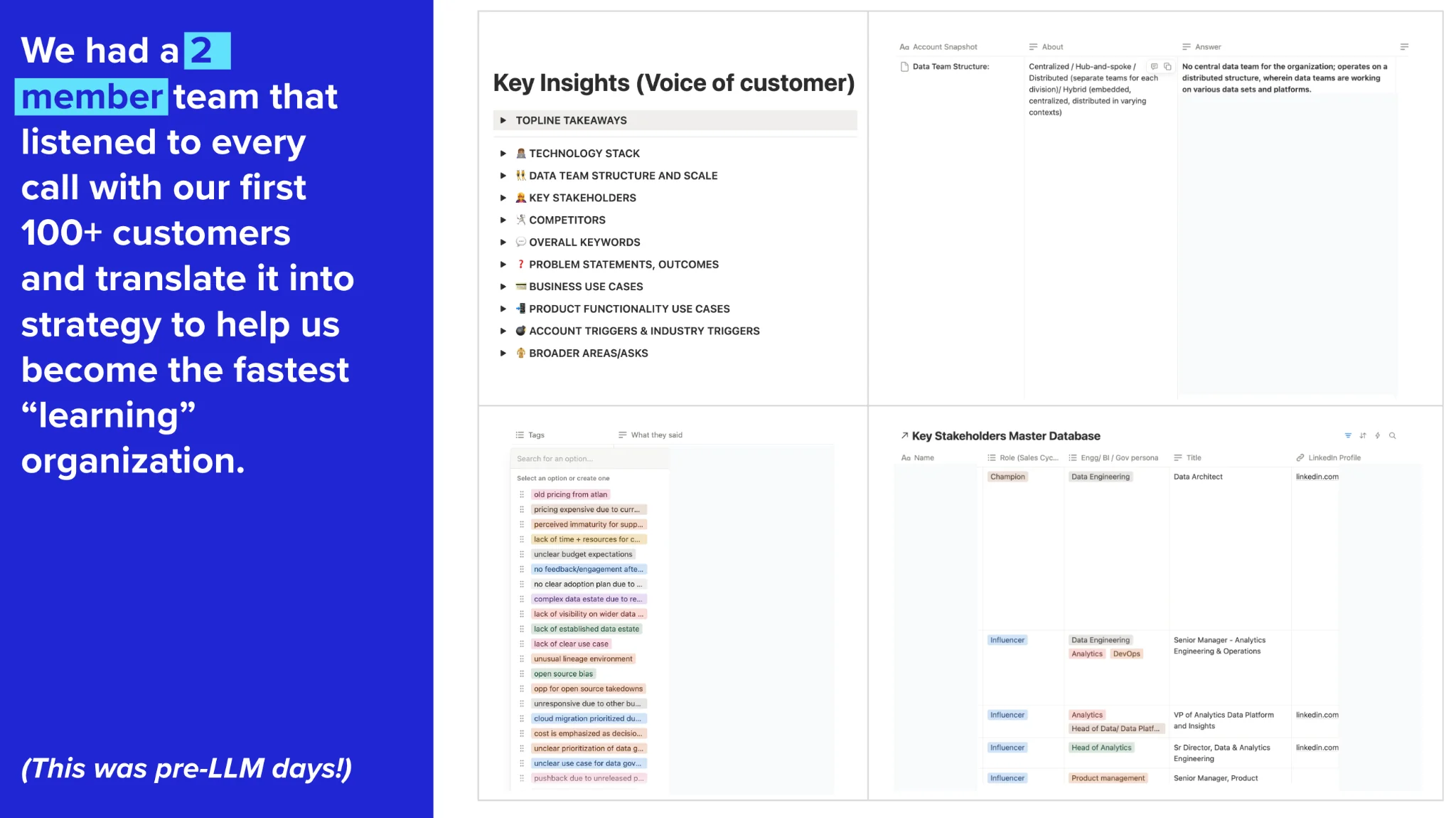
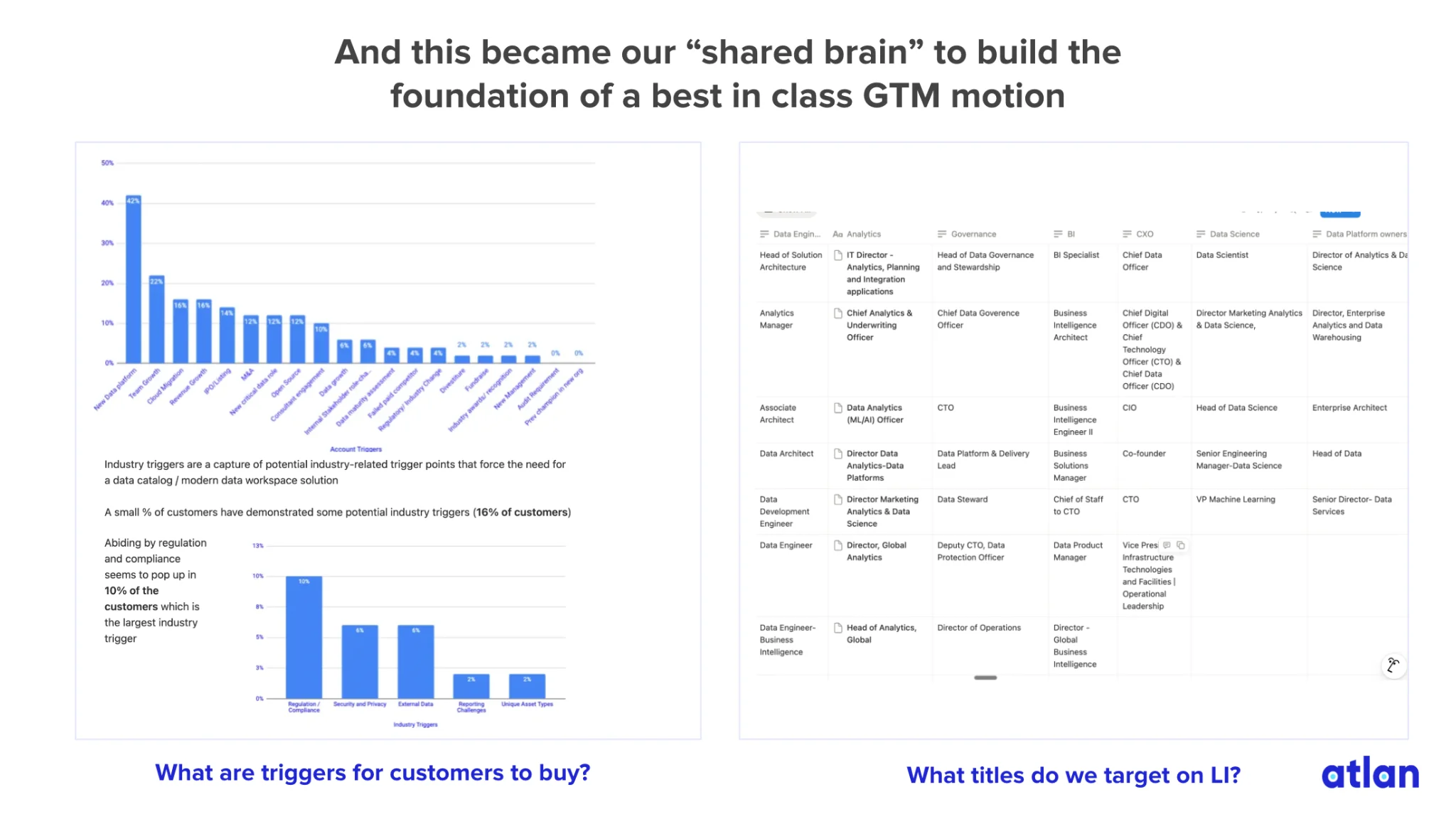
What were the buying triggers? What titles and keywords should we target? What were the use cases? How could we improve the product? In effect, I was the human version of what an LLM does today.
The output built the foundation of our GTM playbook. A 200-slide master sales playbook replaced each rep’s individual narrative with one shared language. An 11-use-case framework crystallized how the company created value and gave Customer Success its implementation foundation. The Command of the Message selling methodology leveled up the field team’s communications to match the language of C-suite buyers. A competitive program turned scattered institutional knowledge into a motion everyone could run, delivering a competitive win rate above 75%.
But we were intentional. So after the first 100 customers, we sunsetted the Intel Engine program in its original form.
Rethinking Revenue Intelligence in an AI-Native World.
The end of the original Intel Engine wasn’t the end of our GTM intelligence needs. As we scaled, Atlan’s leadership kept running into questions like “which forecasted deals are truly at risk, and why?” and “why did we really lose this opportunity?”
When an issue arose, like a shift in win rate, it would start a causal debate. Could it be a pipeline quality issue? Reps who weren’t fully ramped? The wrong channel mix? Did our competitors finally catch up to us? Each question led to an ad hoc dashboard that provided static insights, which was insufficient.
To capture the reality of the business, we needed both halves of the picture — not one instead of the other. CRM fields told us what happened: stage, amount, close date. They rarely told us why: the pain that surfaced on a call, the champion who went quiet in Slack, the objection buried in a support ticket. Most GTM truth lives in that second, unstructured layer — call transcripts, Slack threads, customer emails, support tickets, escalation threads — but on its own it’s just as incomplete as the CRM fields were. The two had to be fused, and neither traditional dashboards nor a shared spreadsheet could do that.
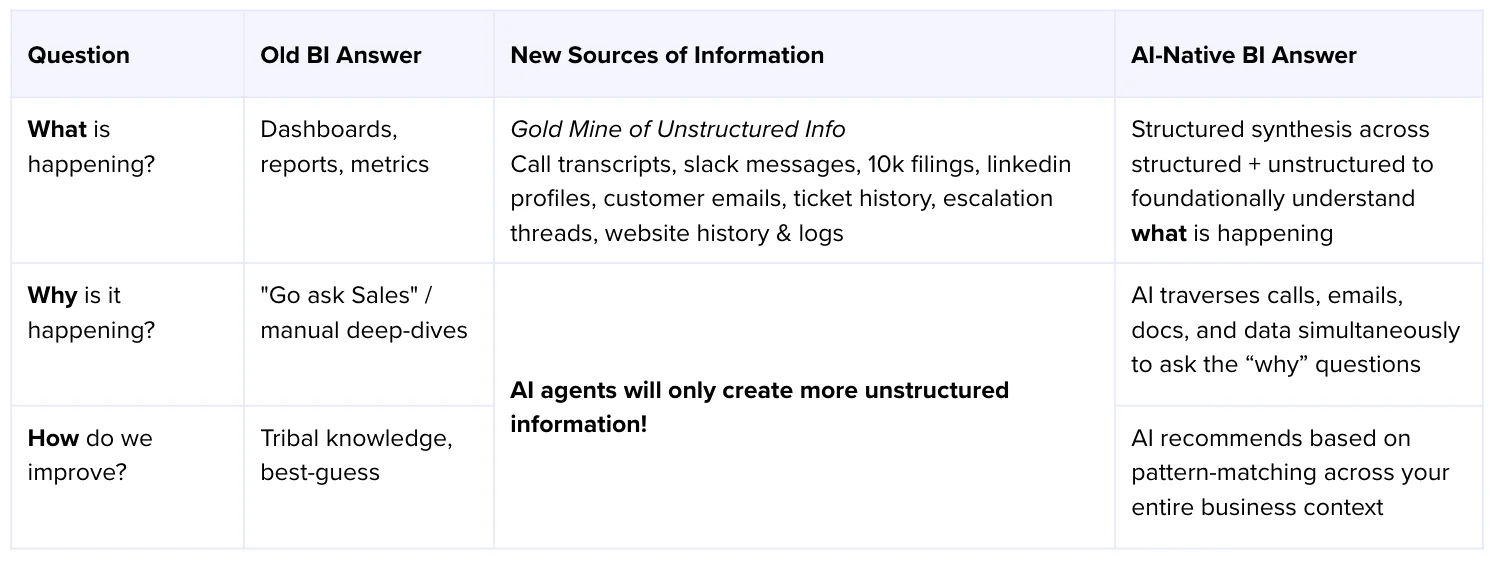
We began treating unstructured GTM data as a first-class asset, and rebuilding our existing intel engine as a system of agents that could use it. The first question, though, was where to even start?
We knew the intelligence we needed lived in unstructured data, but we didn’t yet have a scalable way to use it. That changed when reasoning models like OpenAI O3 became capable of synthesizing that context reliably. The path into an AI-native revenue intelligence system quickly became clear: start with one recurring revenue question that we were struggling to answer, and build the first agent around it.
Deal Health Agent: Data-Driven Deal Forecasts.
Every sales team wants forecast calls to run on evidence, not narrative. The hard part is making that the default, not the exception. The strategy behind the Deal Health Agent came directly from a question posed by Atlan’s CEO, Prukalpa Sankar: “What’s the most data-driven way to understand the health of our active, forecasted deals?”
The problem to solve: deal risk surfaced reactively in 1:1 meetings and forecast calls. By that time, Sales was already playing catch-up. Issues weren’t documented, so deal health was narrative-driven, not data-driven. No tool, including Gong’s native deal health monitor, stitched together calls, emails, tickets, and POV documents into a single, cross-system snapshot. As a result, teams spent days reviewing a single forecasted opportunity.
The solution: the Deal Health Agent runs a weekly batch of all active forecasted opportunities. Each is fed into a rubric that scores deal health across five categories: qualification, stakeholders, commercial, competitive/product, and sales execution. Each category receives a rating of red, yellow, or green, along with rationale. The original iteration was a shared sheet for adoption velocity, but today it’s an intuitive dashboard built in Claude Code. Now, any Sales rep or leader can self-serve full deal context, so deal health monitoring is proactive.
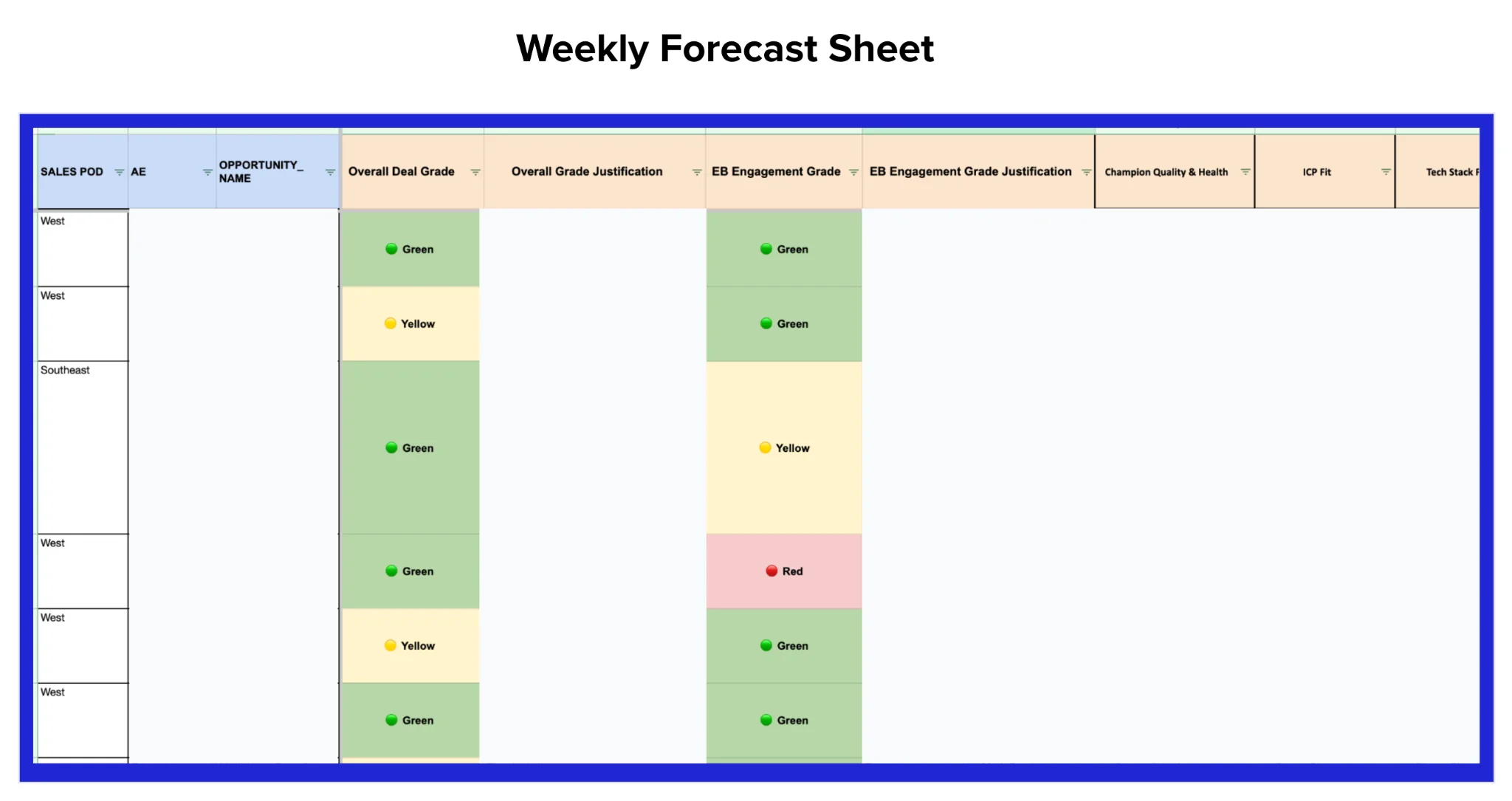
The impact: the forecast calls have shifted from narrative-heavy to evidence-led. In every forecast call, our founder Prukalpa asks us for the link to the AI analysis — and tells us she can’t imagine a forecast call without it.

The sales coaching is grounded in specific dimensions like champion depth or POV execution, not just “work the deal harder”; and account strategy is more accurate and specific. In Q4 2025, a quarter after the Deal Health Agent went live, we had our biggest quarter ever as a company: we beat our own aggressive Q4 forecast and recorded our highest ever competitive win rate (91%), 2xing our overall win rate from Q2 to Q4.
Closed Lost Agent: Deal Loss Post-Mortems.
Losing a deal is an inevitability. The question is: what can we learn from this? Lost deals are the clearest mirror of go-to-market reality. They expose unmet customer needs, competitor moves, and execution gaps. But at most companies, post-mortems are slow and unscalable.
The problem to solve: Salesforce’s “Closed Lost Reason” field was effectively a picklist of closed-lost categories to choose from. Its interpretation differed from rep to rep, and it offered a one-dimensional view of why we lost. A root-cause analysis that could get to the bottom of a loss required a week of piecing together emails, support tickets, Slack threads, Google Drive docs, and 20-30 Gong calls — a process that was only feasible for about five marquee cases per quarter. Any learnings from our losses were missed opportunities.
The solution: the Closed Lost Agent’s trigger fires the moment an opportunity is marked Closed Lost in Salesforce. For all qualified-stage (i.e. early) losses, the agent applies Atlan’s hand-built, human-defined loss taxonomy and generates a structured loss reason. It also creates a two-page root cause analysis for late-stage losses, which includes an executive diagnosis, red-signal clusters, qualification and playbook gaps, competitive and product takeaways, and three to four concrete playbook upgrade recommendations. With this solution in place, loss reasons sync directly back to Salesforce for reliable deal loss reporting. Root cause analyses are delivered as Confluence pages, emails to the deal team and leadership, and Slack alerts within hours of the stage flip.
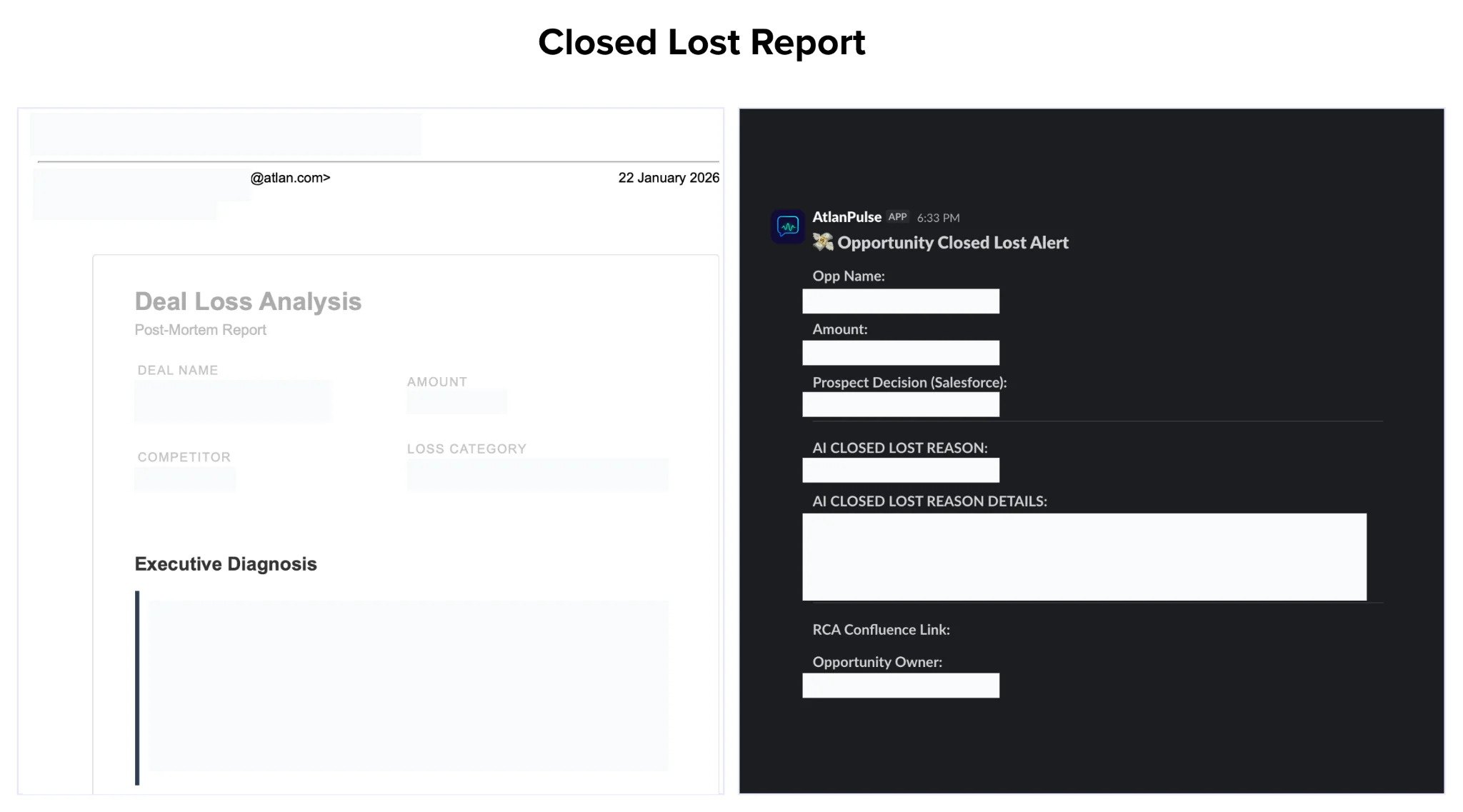
The impact: we used to have the capacity for 20 deep root cause analyses per year, as each deep dive used to take days or weeks to execute. Now, the Closed Lost Agent takes less than two minutes to run end-to-end, increasing RCA throughput by more than 25x. The agent allows us to run pattern analysis at a scale that was previously impossible, and late-stage post-mortems are now standard, not exceptions. Learnings from deal losses are no longer lost: they now feed weekly coaching themes and competitive intelligence.
“These RCAs are good. There’s always nuance, but the general learnings are a great reflection tool and foster good conversations.” — Andrew E., Atlan Regional VP Sales
Partner Win-Wire Agent: The Win-Side Complement.
Each deal with a partner has lessons to share and people to recognize, but someone needs to mine those stories. Winning deals with strategic partners like Snowflake, Databricks, GCP, and AWS helps joint customers accelerate adoption and maximize their investments.
The problem to solve: hand-written narratives required partner managers to pull the relevant Gong calls, read through transcripts, write up the use case, draft a win-wire email, and update a partner sheet by hand. If they were running a partner relationship across dozens of active opportunities, this could take hours. The result was high effort and low coverage: high-profile wins got documented while the rest fell by the wayside.
The solution: when an opportunity tagged with a partner is marked as closed-won, it fires a trigger for the Partner Win-Wire Agent. The agent extracts customer context, the joint use case, and the impact narrative from Gong calls and internal notes, then populates a structured row in Atlan’s partner use case sheet. Simultaneously, the agent automatically drafts a win-wire email for the partner manager to review and send.
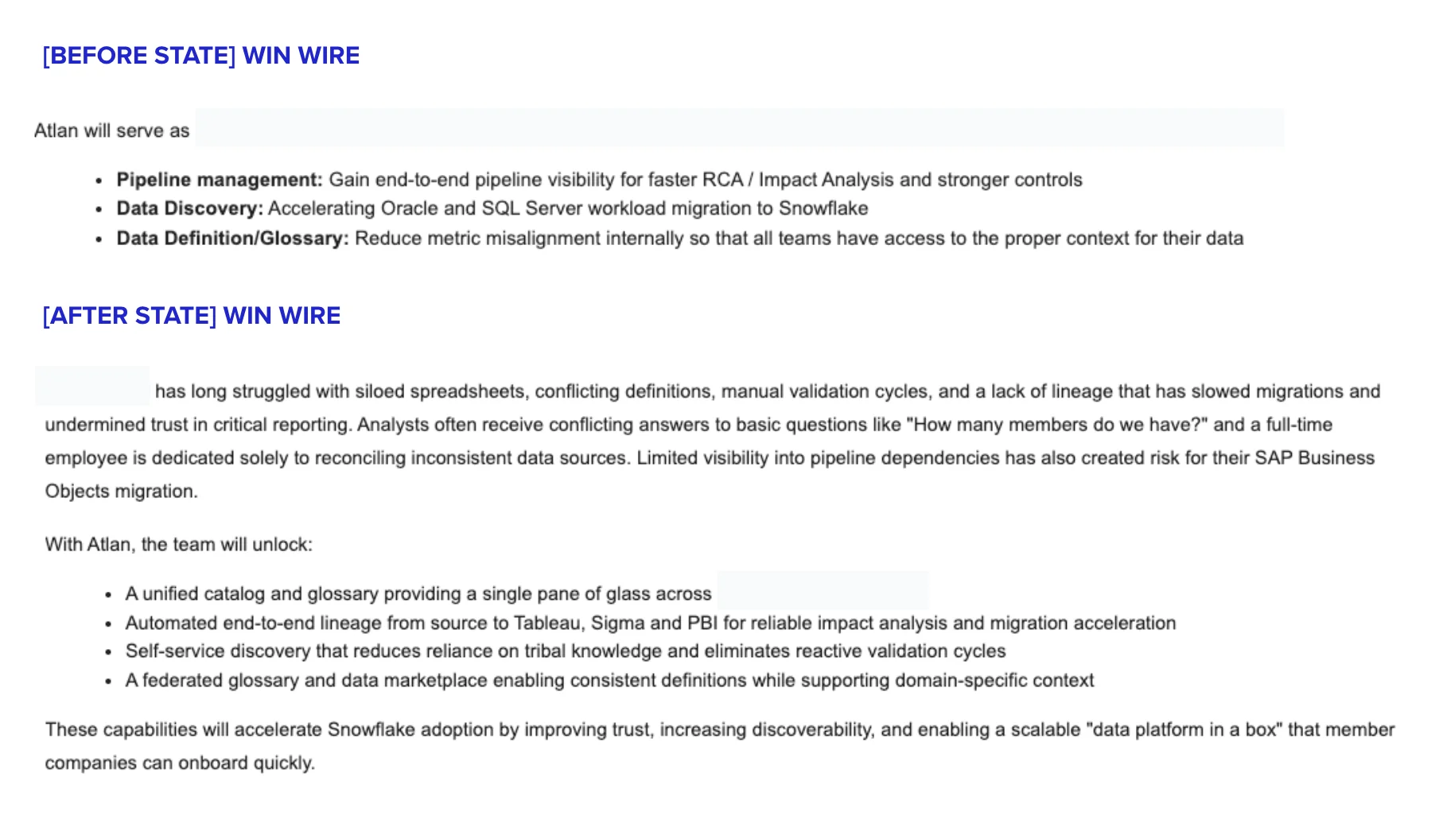
The impact: the Win-Wire Agent gives partner managers back their time, and gives their stories more depth. Charlie Freeman, Snowflake’s partner sales manager, estimates it saves him at least an hour per win-wire, time he now reinvests in higher-leverage partner work. This becomes even more critical at end of quarter, when logos close in waves and manual write-ups would otherwise fall behind.
It scales effortlessly as volume grows within a partner, and extends just as easily across others. It also raises the bar on quality: because the agent mines full Gong transcripts rather than relying on rep memory, the resulting narratives are noticeably richer and more detailed than what manual write-ups typically produce. Together with the Closed Lost Agent, it closes the loop on both ends of the GTM learning cycle, supplying critical, real-time feedback that informs how we adapt based on closed-won and closed-lost deals.
What We Learned Building GTM Agents.
To be the “fastest learning organization,” top-down designs wouldn’t work. By the time we found flaws, it would take even more time to unravel them. We needed to build incrementally, focusing on one problem, agent, and iteration at a time. With hindsight on our side, these are the principles that consistently emerged throughout each cycle.
GTM data is structured and unstructured, and neither works without the other. Every agent that produced real ROI ran on both: the Salesforce fields told it what stage a deal was in; the calls, emails, and tickets told it why. Structured data with no unstructured signal is a dashboard nobody trusts, and unstructured signal with no structured anchor is just noise with good stories in it. The leverage was never in picking a side. It was in building agents that could read both together and land on one answer.
Centralizing context means the data and its meaning, fused in one place. Gong calls, Zendesk tickets, Salesforce fields, and Slack threads each lived in a separate system, each requiring a live fetch to retrieve. Moving that data into Snowflake solved where it lived. It did not solve what it meant: data without context is as unusable as no data at all, since something still has to define what each field represents and how the pieces connect. Only once both existed together, the data and its context, could every downstream agent reliably retrieve the right information and act on it.
Domain expertise plus evals built the framework, not the model. The rubrics, exit criteria, and scoring dimensions came from years of doing this manually ourselves: that depth is what taught us what “good” actually looks like before a single prompt existed. We encoded it into a first version of each prompt, then ran evals against it and sharpened it from there. Hand an LLM the same reasoning job with none of that groundwork, and it invents its own definition of “good”: generic, and rarely the one your business actually runs on.
Tie the agent to a business outcome, not an interface. The failure mode is never a bad model. It’s an agent with nowhere to land except a dashboard nobody’s job depends on. Deal Health became real when it changed forecast calls, not when it shipped a UI. Closed Lost became real when its RCA joined the loss debrief, not when it wrote a row to a table. Attach agents to meetings, not dashboards: a forecast call, a 1:1. That’s where the outcome actually gets decided. No meeting, no adoption, no matter how good the model is.
Agents surface evidence; humans make the calls. It’s easy to lose this in the building process. The system doesn’t decide which deals to focus on, which reps need coaching, or what the competitive strategy should be. It compresses the research so that the people making those decisions are working from evidence rather than memory and narrative. The judgment, relationships, and strategic calls should all stay with humans, by design.
What’s Next?
These three agents already deliver real impact: forecast calls run on evidence, losses get analyzed at a scale no team could match by hand, and partner wins get documented without manual lift. Here’s what we’re building toward next.
Context resolution: conflicting sources need a rule, not a guess. Centralizing the data didn’t solve what happens when two sources disagree: a blank Salesforce field with the same answer sitting in a Gong transcript, and the agent guessing wrong. What’s ahead is systematic: a trust rule for fields that can be arbitrated, and removing the ones that can’t. Not one fix. A standing discipline, field by field.
Context retrieval: more context is not more accuracy. Pile every Gong call and ticket into one context window, and accuracy slips before it even fills. Context rot. The fix: give the agent just enough, fetched just-in-time, not everything at once. Just-in-time loading, summary compaction, sub-agent isolation, retrieval by identifier, not dumping instructions and hoping.
Skills: build the rubric once, stop re-deriving it every time. Each agent’s rubric was a one-off prompt, wired into a single pipeline, useless to anyone outside that specific workflow. Turning it into a skill changes that on two fronts. First, other skills can build on it instead of re-deriving it: the logic for filtering emails became its own skill, so did ticket triage, and the deal-scoring skill was built to depend on both rather than duplicating either. Second, a person can pick it up directly: a BDR who wants that same qualification check doesn’t need a new agent built for them; they run the skill against their own list.
Evals and traces: how we keep it honest as it evolves. Domain expertise got these agents right on day one, but that knowledge goes stale as the business changes. Evals score every new version against known cases before it ships; traces watch what it actually did in production, catching drift before a rep has to flag it. That’s the difference between good-on-day-one and staying good.
InsightsClaw: insights move from pull to push. Attaching an agent to a meeting was one level; someone still had to show up to the meeting. What if we eliminated that meeting? Claw removes that step: Deal Health and Closed Lost signals now combine into a weekly brief that reaches a rep automatically, no meeting or dashboard required. A rep opens their laptop Monday and it’s already there.
Agents surface evidence; humans make the calls. The judgment, the relationships, and the strategic calls stay with humans, by design.