Skip to content

We didn't add AI to marketing. We rebuilt marketing around it

01 The offsite

No Decks. A Room Full of People Building .

In early July, our marketing team came together from around the world at the foothills of the picturesque Nandi Hills, outside Bangalore, for our H2 kickoff. Except, this one was different. There were no presentations, QBRs, planning or strategy decks. Instead we did two things.

First, we debated what marketing means in an AI Native world. When execution is not a bottleneck, how do we raise the bar by focusing on taste, judgement and ambition?

Second, we broke into thematic groups for a hackathon. Over the next 36 hours we built, pushed each other, ideated, dreamt, ending with a showdown of the demos.
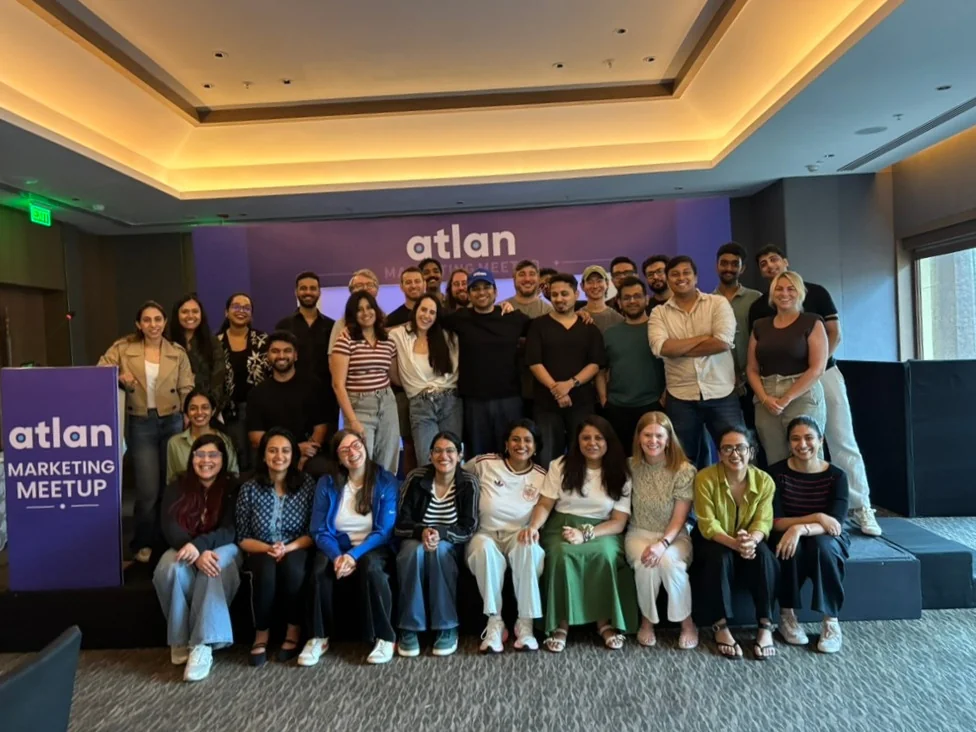
The Atlan marketing team at the H2 kickoff, gathered on and around the stage.
The H2 kickoff at Nandi Hills. No decks, no reviews: a hackathon and a showdown of demos. Atlan marketing meetup · July 2026

This didn't happen by accident. It started with a bet.

02 The bet

The Bet We Made .

As ChatGPT hit the world in November 2022, I remember thinking: this will change everything, including how we build and run companies. Fast forward 18 months, and the question we were asking ourselves was: if we want to start 2026 as one of the most AI Native companies in the world, what do we need to do today?

The question behind the bet Could a 30-person team do what usually takes a 300-person team?

As we started 2026, we decided to rebuild the marketing team from scratch. Foundationally, this translated into two things: adopting a pod structure instead of a functional org, and building Marketing OS, a shared context layer that humans and agents both work from.

03 Tasks to outcomes

From Tasks to Outcomes .

Marketing teams, like any other knowledge work, are usually organized around specialised functions. Content develops a story, design gives it form, web publishes it, events create the experience, operations connect the systems, and so on.

Function builds incredible depth. But it leaves you with task owners and no outcome owner.

A pod owns the outcome, and carries enough cross-functional context to take something from idea to completion.

Here's a real-world example. In Q2 2026, our Media & Community pod carried three flagship moments: Activate, our biggest virtual product launch, and our presence at two of the biggest industry events, Snowflake Summit and Databricks Summit.

Executing events is tricky. Executing them flawlessly at scale requires superhuman coordination. There are hundreds of moving parts, a dozen functions, and many hops between them. Each hop adds friction, and collaboration across timezones slows every feedback loop.

This year, we flipped it. The pod became a cross-functional unit that owned the whole outcome, and the Marketing OS acted as the foundation on top of which the team built and executed experiences cutting across digital and physical worlds. An event can be reduced to a few primitives: the theme, the brand guidelines, the personas, the channels. Once we standardized those, the humans and agents could build everything on that foundation.

With most of the execution handled by agents, the team focused where humans matter most: the experience, the programming, the quality bar. Fewer handoffs, less friction, and a team free to raise the bar on quality and ambition. As a result, Atlan Activate, which ran on April 29, became our biggest product launch yet, with several thousand people joining, overshooting our goal by more than 60%.

04 The context layer

The Shared Context Layer for Humans & Agents .

Pods reduce friction. They don't fix context on their own. Put five functions in one room and they still need a single source of truth: the story, the brand, the personas, the offers, the proof points. Without it, you've just moved the handoffs inside the pod instead of removing them. Enter Marketing OS.

The simplest way to describe it: the Marketing OS is the marketing team's brain. One shared context layer for our team and fleet of agents. It has access to all the tooling, data, systems of record, and platforms. On top sits a curated knowledge and skills layer that captures the tribal knowledge: every definition, method, process, and playbook, maintained by its owner.

It also contains the guardrails, what great looks like, and evals, making it easy for agents to orient themselves and work backwards from the goal, much like a team member would. Skills stack up like Lego blocks with other skills to form a workflow.

For example: to launch a registration page for an event, we daisy chain skills for brand, messaging, positioning, copywriting, personas, past performance, page build, and design critique, drastically reducing the effort required and producing a high-quality output that can be polished further.
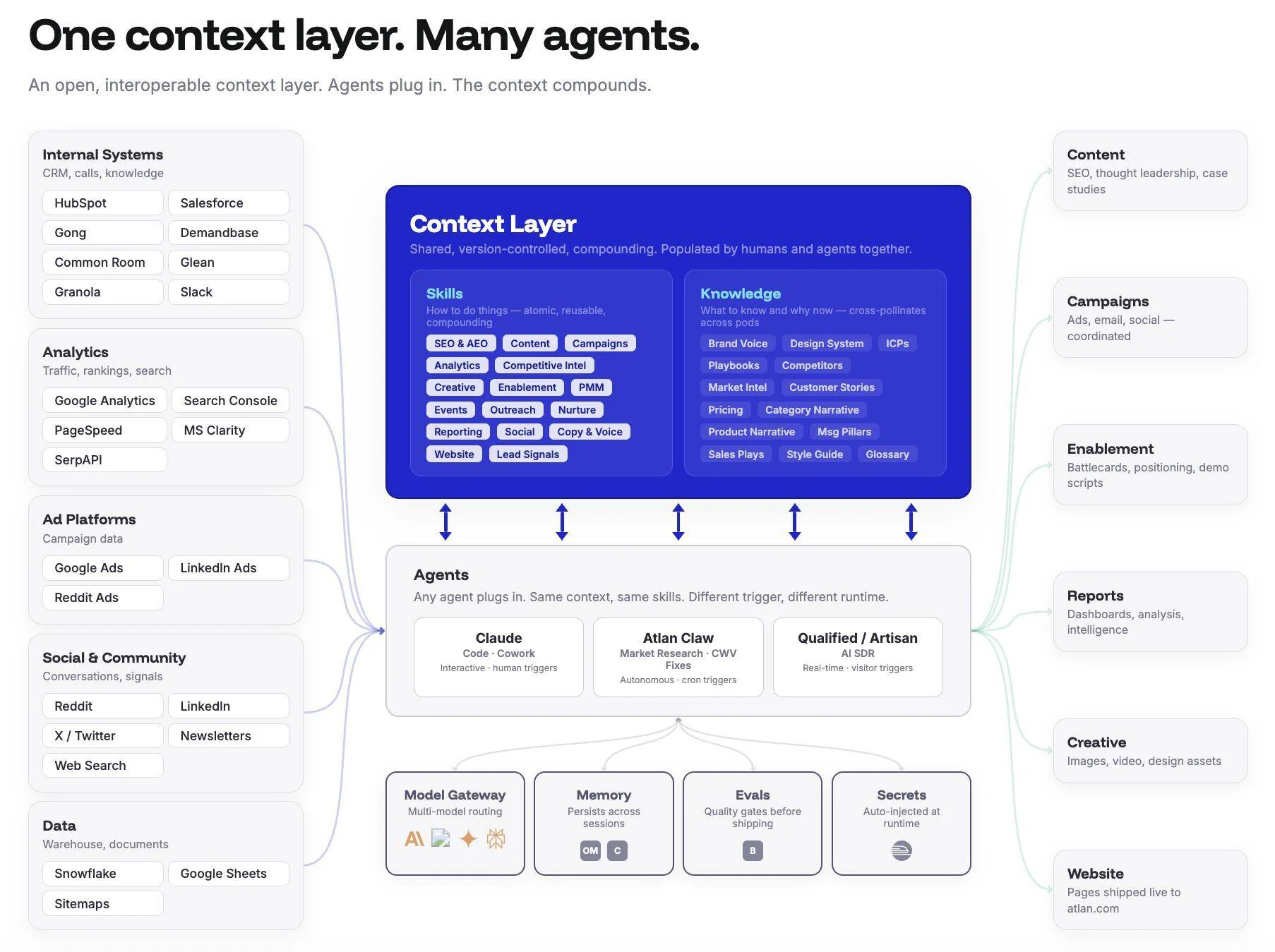
The Marketing OS architecture: internal systems, analytics, ad platforms, social, and data sources feeding one shared context layer of skills and knowledge, with agents plugging in and outputs flowing to content, campaigns, enablement, reports, creative, and the website.
One context layer, many agents. Shared, version-controlled, compounding: populated by humans and agents together.

Context compounds over time. With every campaign, report, product launch, article, and creative, the feedback flows back into the Marketing OS, so it stays current and keeps improving. In the last few months we have created and refreshed over 300 skills, and growing. This ensures we aren't starting from a blank slate, working from stale context, or leaning on outdated knowledge.

As Bret Victor noted in his famous talk "Inventing on Principle," creators need an immediate connection to what they create. It helps them iterate faster and improve the output. Marketing OS does something similar: it reduces the time and effort between having an idea and seeing it come to life.

05 AI-native

What "AI-Native" Actually Means .

Most of what gets called "AI-native" is really AI-adjacent: broad tool access, high usage, a wall of experiments, a productivity number to point at.

Usage is not the standard. If it were, the winner would be whoever burned the most tokens.

The real standard, I think, is whether new capability turns into new behavior, whether the organization changes its shape around what it has learned it can do, and raises its quality bar to match. We didn't get faster or more efficient at the old marketing. We changed the shape of the team, and then changed what we held ourselves to. This is what we believe it means to be a truly frontier company.

06 Learnings

What We Got Wrong .

Plenty. Here are some of our learnings so far.

We built too many skills, too quickly. This created redundancy and made quality hard to measure. At one point there were three versions of a copywriting skill: one for web pages, one for ad campaigns, one for announcements and blogs. The better way is one copywriting skill that imports others, like tone and voice, and complements downstream skills like ad copy.

We let skills grow too long, and quality degraded. Skills work best modular and chained toward the outcome. We initially had one skill for generating our weekly review deck: it packed in data analysis, sprint review, deck building, and posting to Slack, and over time models started missing instructions. We split it into chained skills for analysis, review, and the artifact, and the quality improved a lot.

Just because we said it doesn't make it so. Early on, our content system invented pricing for another company's product. The page got picked up by AI summaries in search, and assistants started repeating our mistake back to people as fact. This happened despite having guardrails in place. The lesson: build solid checks and evals from the start. Over time we've added evals to make it more robust.

Agents discover skills differently than humans. Humans often start with an open-ended problem and invoke skills along the way. Agents start with a specific goal and load skills upfront, and every harness loads a different set of files in a different sequence. Architecting the Marketing OS so it delivers the same quality across harness and model combinations is a work in progress.

Scaling taste and judgement with AI is hard. Enforcing quality is straightforward when the task has a verifiable output: monitoring the health of our website and catching regressions is 100% agent-driven. The same is not yet true for writing the title of an event.

07 What's next

What's Next ?

Marketing OS will continue to evolve with more skills and agents, and that's where the immediate focus will be. Setting up evals to tighten the feedback loop for skills is high on the list: early experiments show that skills provide a measurable lift over depending on the model alone.
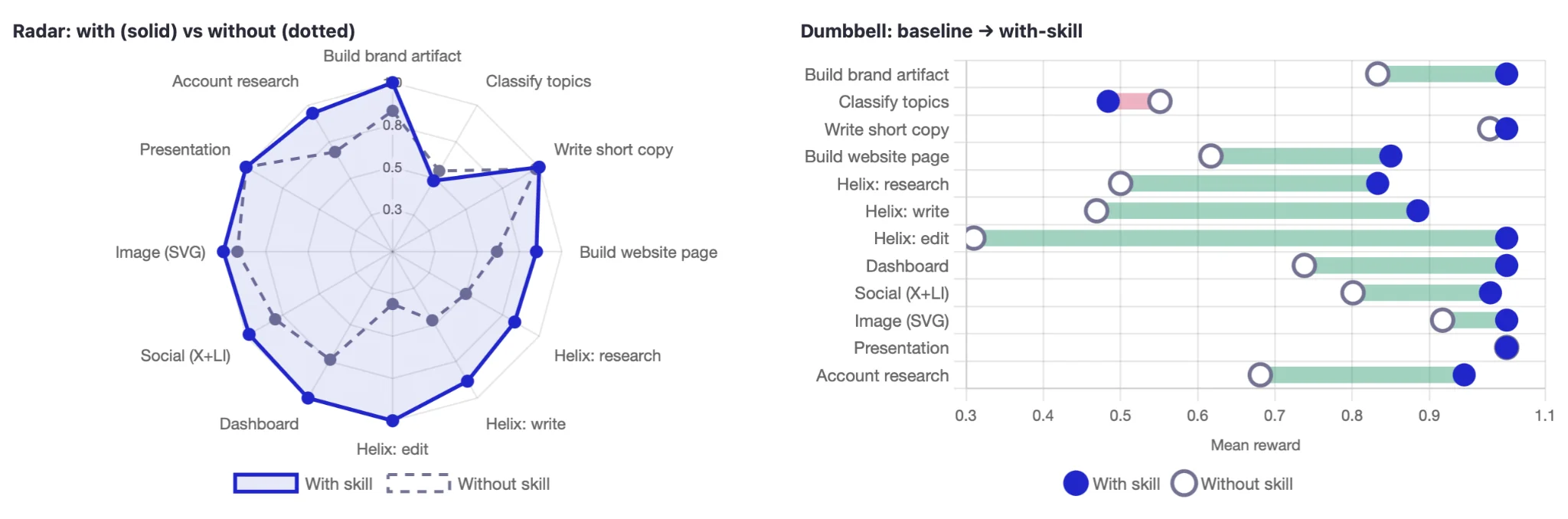
Benchmark charts comparing agent performance with and without skills across twelve tasks: a radar chart and a dumbbell chart both showing higher mean reward with skills on nearly every task.
Early benchmarks, task by task: the same model scores higher with a skill than without one on nearly every job we tested.

Agents will continue to become more autonomous, and setting up great feedback loops for continuous improvement will be critical to driving that autonomy. One of the most interesting demos from the hackathon, and my personal favourite, was a new agent named Argus: it evaluates our skills and agents continuously and sends personalised feedback and recommendations to the team on how to improve.

Execution is not a bottleneck. We're in an era of infinite marketing. So, back to the question we started the offsite with: what does it mean to be a marketer in this era?

Taste, judgment, ambition, agency: we believe these are the new human frontiers.
FRONTIER LABS · ESSAY 003 · 1,451 words · end
Written by Surendran Balachandran Marketing · Atlan

Surendran leads Atlan's marketing AI taskforce and the Marketing OS: the operating model that rebuilt the team around cross-functional pods and one shared, governed context layer.

How a bet made at the start of Q2, cross-functional pods, and one shared context layer changed what our marketing team is for. By Surendran Balachandran.

In early July, our marketing team came together from around the world at the foothills of the picturesque Nandi Hills, outside Bangalore, for our H2 kickoff. Except, this one was different. There were no presentations, QBRs, planning or strategy decks. Instead we did two things.

First, we debated what marketing means in an AI Native world. When execution is not a bottleneck, how do we raise the bar by focusing on taste, judgement and ambition?

Second, we broke into thematic groups for a hackathon. Over the next 36 hours we built, pushed each other, ideated, dreamt, ending with a showdown of the demos.

The Atlan marketing team at the H2 kickoff, gathered on and around the stage.

This didn’t happen by accident. It started with a bet.

The Bet We Made.

As ChatGPT hit the world in November 2022, I remember thinking: this will change everything, including how we build and run companies. Fast forward 18 months, and the question we were asking ourselves was: if we want to start 2026 as one of the most AI Native companies in the world, what do we need to do today?

Could a 30-person team do what usually takes a 300-person team?

As we started 2026, we decided to rebuild the marketing team from scratch. Foundationally, this translated into two things: adopting a pod structure instead of a functional org, and building Marketing OS, a shared context layer that humans and agents both work from.

From Tasks to Outcomes.

Marketing teams, like any other knowledge work, are usually organized around specialised functions. Content develops a story, design gives it form, web publishes it, events create the experience, operations connect the systems, and so on.

Function builds incredible depth. But it leaves you with task owners and no outcome owner. Pods solve for that. A pod owns the outcome, and carries enough cross-functional context to take something from idea to completion.

Here’s a real-world example. In Q2 2026, our Media & Community pod carried three flagship moments: Activate, our biggest virtual product launch, and our presence at two of the biggest industry events, Snowflake Summit and Databricks Summit.

Executing events is tricky. Executing them flawlessly at scale requires superhuman coordination. There are hundreds of moving parts, a dozen functions, and many hops between them. Each hop adds friction, and collaboration across timezones slows every feedback loop.

This year, we flipped it. The pod became a cross-functional unit that owned the whole outcome, and the Marketing OS acted as the foundation on top of which the team built and executed experiences cutting across digital and physical worlds. An event can be reduced to a few primitives: the theme, the brand guidelines, the personas, the channels. Once we standardized those, the humans and agents could build everything on that foundation.

With most of the execution handled by agents, the team focused where humans matter most: the experience, the programming, the quality bar. Fewer handoffs, less friction, and a team free to raise the bar on quality and ambition. As a result, Atlan Activate, which ran on April 29, became our biggest product launch yet, with several thousand people joining, overshooting our goal by more than 60%.

The Shared Context Layer for Humans & Agents.

Pods reduce friction. They don’t fix context on their own. Put five functions in one room and they still need a single source of truth: the story, the brand, the personas, the offers, the proof points. Without it, you’ve just moved the handoffs inside the pod instead of removing them. Enter Marketing OS.

The simplest way to describe it: the Marketing OS is the marketing team’s brain. One shared context layer for our team and fleet of agents. It has access to all the tooling, data, systems of record, and platforms. On top sits a curated knowledge and skills layer that captures the tribal knowledge: every definition, method, process, and playbook, maintained by its owner.

It also contains the guardrails, what great looks like, and evals, making it easy for agents to orient themselves and work backwards from the goal, much like a team member would. Skills stack up like Lego blocks with other skills to form a workflow.

For example: to launch a registration page for an event, we daisy chain skills for brand, messaging, positioning, copywriting, personas, past performance, page build, and design critique, drastically reducing the effort required and producing a high-quality output that can be polished further.

The Marketing OS architecture: sources feeding one shared context layer of skills and knowledge, with agents plugging in and outputs flowing to content, campaigns, enablement, reports, creative, and the website.

Context compounds over time. With every campaign, report, product launch, article, and creative, the feedback flows back into the Marketing OS, so it stays current and keeps improving. In the last few months we have created and refreshed over 300 skills, and growing. This ensures we aren’t starting from a blank slate, working from stale context, or leaning on outdated knowledge.

As Bret Victor noted in his famous talk “Inventing on Principle,” creators need an immediate connection to what they create. It helps them iterate faster and improve the output. Marketing OS does something similar: it reduces the time and effort between having an idea and seeing it come to life.

What “AI-Native” Actually Means.

Most of what gets called “AI-native” is really AI-adjacent: broad tool access, high usage, a wall of experiments, a productivity number to point at. Usage is not the standard. If it were, the winner would be whoever burned the most tokens.

The real standard, I think, is whether new capability turns into new behavior, whether the organization changes its shape around what it has learned it can do, and raises its quality bar to match. We didn’t get faster or more efficient at the old marketing. We changed the shape of the team, and then changed what we held ourselves to. This is what we believe it means to be a truly frontier company.

What We Got Wrong.

Plenty. Here are some of our learnings so far.

We built too many skills, too quickly. This created redundancy and made quality hard to measure. At one point there were three versions of a copywriting skill: one for web pages, one for ad campaigns, one for announcements and blogs. The better way is one copywriting skill that imports others, like tone and voice, and complements downstream skills like ad copy.

We let skills grow too long, and quality degraded. Skills work best modular and chained toward the outcome. We initially had one skill for generating our weekly review deck: it packed in data analysis, sprint review, deck building, and posting to Slack, and over time models started missing instructions. We split it into chained skills for analysis, review, and the artifact, and the quality improved a lot.

Just because we said it doesn’t make it so. Early on, our content system invented pricing for another company’s product. The page got picked up by AI summaries in search, and assistants started repeating our mistake back to people as fact. This happened despite having guardrails in place. The lesson: build solid checks and evals from the start. Over time we’ve added evals to make it more robust.

Agents discover skills differently than humans. Humans often start with an open-ended problem and invoke skills along the way. Agents start with a specific goal and load skills upfront, and every harness loads a different set of files in a different sequence. Architecting the Marketing OS so it delivers the same quality across harness and model combinations is a work in progress.

Scaling taste and judgement with AI is hard. Enforcing quality is straightforward when the task has a verifiable output: monitoring the health of our website and catching regressions is 100% agent-driven. The same is not yet true for writing the title of an event.

What’s Next?

Marketing OS will continue to evolve with more skills and agents, and that’s where the immediate focus will be. Setting up evals to tighten the feedback loop for skills is high on the list: early experiments show that skills provide a measurable lift over depending on the model alone.

Benchmark charts comparing agent performance with and without skills across twelve tasks: higher mean reward with skills on nearly every task.

Agents will continue to become more autonomous, and setting up great feedback loops for continuous improvement will be critical to driving that autonomy. One of the most interesting demos from the hackathon, and my personal favourite, was a new agent named Argus: it evaluates our skills and agents continuously and sends personalised feedback and recommendations to the team on how to improve.

Execution is not a bottleneck. We’re in an era of infinite marketing. So, back to the question we started the offsite with: what does it mean to be a marketer in this era?

Taste, judgment, ambition, agency: we believe these are the new human frontiers.

Becoming FrontierAn open laboratory fromAtlan

Notes from inside the attempt. The record behind this site is real commit history from this lab's own repositories.

[Website env: production]