

Mastercard’s governance architecture was years in the making. When AI arrived, it turned out to be exactly the right foundation.
A foundation built for BI and beyond
Most organizations have invested for years in data governance to support their BI and analytics programs. They’ve built catalogs, set up lineage, and assigned ownership to make sure their intelligence is accurate and trustworthy. It’s such an established function that by now, it seems like table stakes.
What many teams haven’t fully realized is that governance originally built for BI is exactly what AI now needs. Mastercard saw the connection early. At the 2026 Databricks Data and AI Summit, Mastercard’s Vivek Radhakrishnan, SVP of Data & Analytics, and Brian Piel, Vice President, explained how that meant when AI arrived, they weren’t starting from scratch. They were drawing on years of work that began paying dividends in a new way.
“Mastercard impacts every one of us — people, businesses, governments,” reflected Vivek Radhakrishnan, SVP of Data & Analytics at Mastercard. “And improving our data practices can and does have a global impact.”
That belief shaped a governance approach built not just around compliance requirements, but around the need to work consistently at scale, regardless of what technologies or trends emerge. Mastercard’s question: what does that data infrastructure actually look like?
The six drivers of Mastercard’s governance approach
To get to the answer, the company needed a diagnosis. Vivek named six forces driving Mastercard’s governance evolution: the rising demand for responsible data and AI; multi-cloud sprawl across public, private, and sovereign environments; exponential data growth through partnerships and acquisitions; the compounding cost of duplicated truth across federated teams; rising compliance complexity; and the recognition that centralized governance can’t keep pace with any of it.
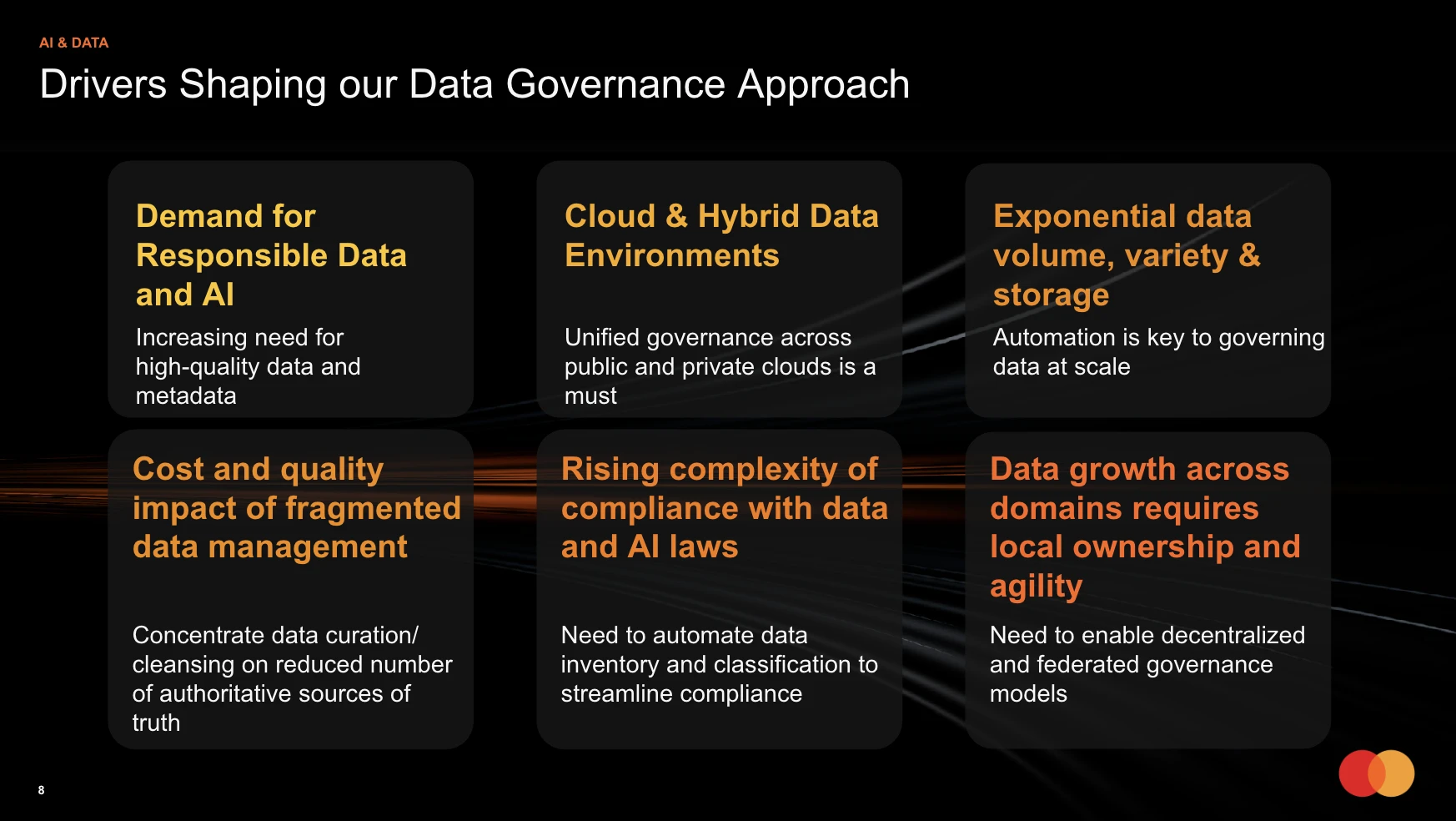
“Historically, we would think we could manage it centrally,” Vivek recalled. “Given the sprawl, the amount of data, and the need to move quickly, the only way to do it is by federating work to a bunch of different groups while keeping some amount of centralized control.”
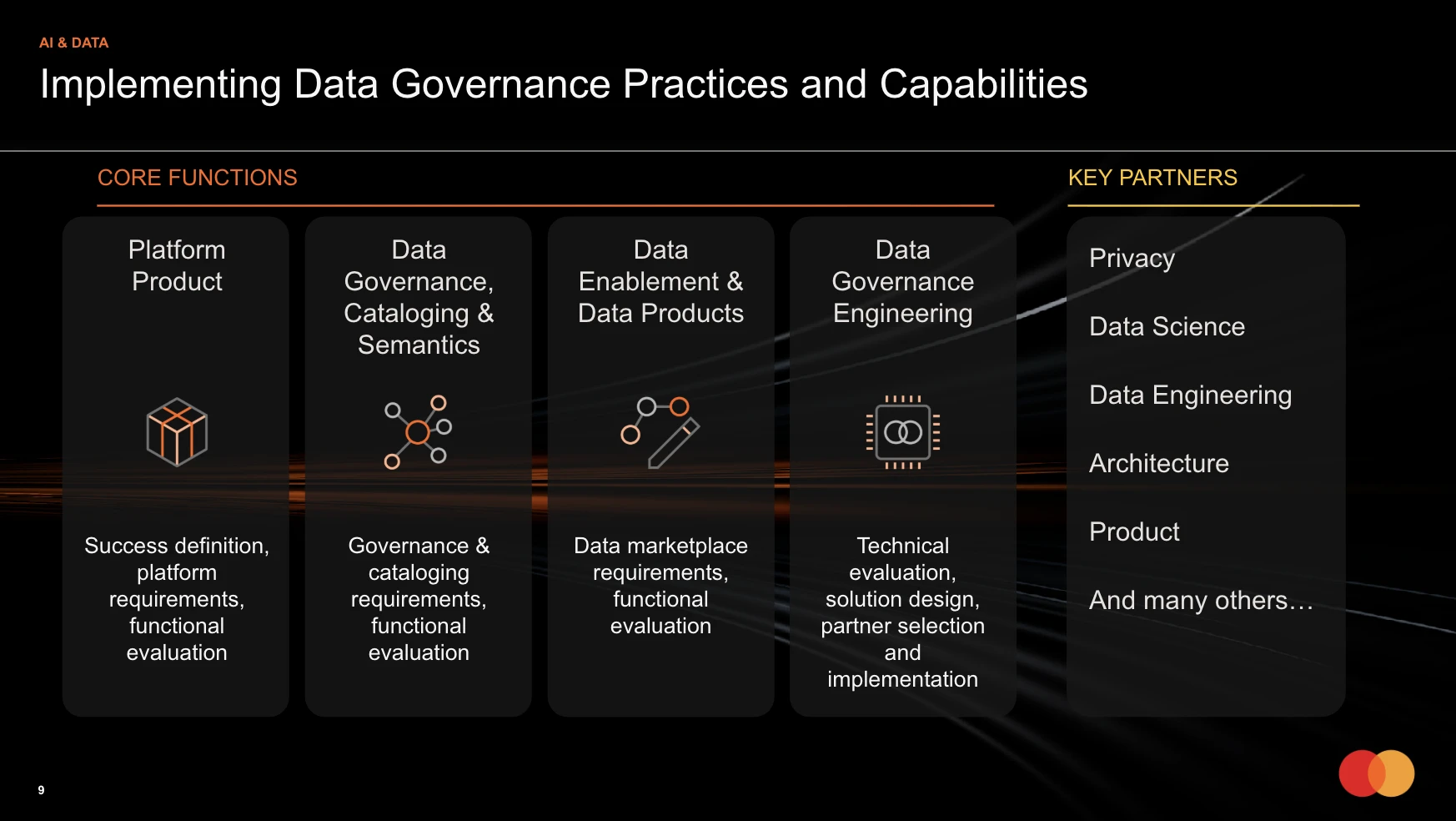
To operationalize that, Mastercard built four core functions: a platform team, a semantics and cataloging team, a data products team, and a data governance engineering team. And from the start, governance wasn’t a data team problem to solve in isolation.
“You can’t just lock yourselves up in a room and say, ‘We’re gonna solve it and no one else,’” Vivek explained. “You need to bring friends along the way — privacy, data science, security. It’s difficult, but you need to get them onboard early, because otherwise you’re never going to succeed.”
Building on the Medallion Framework
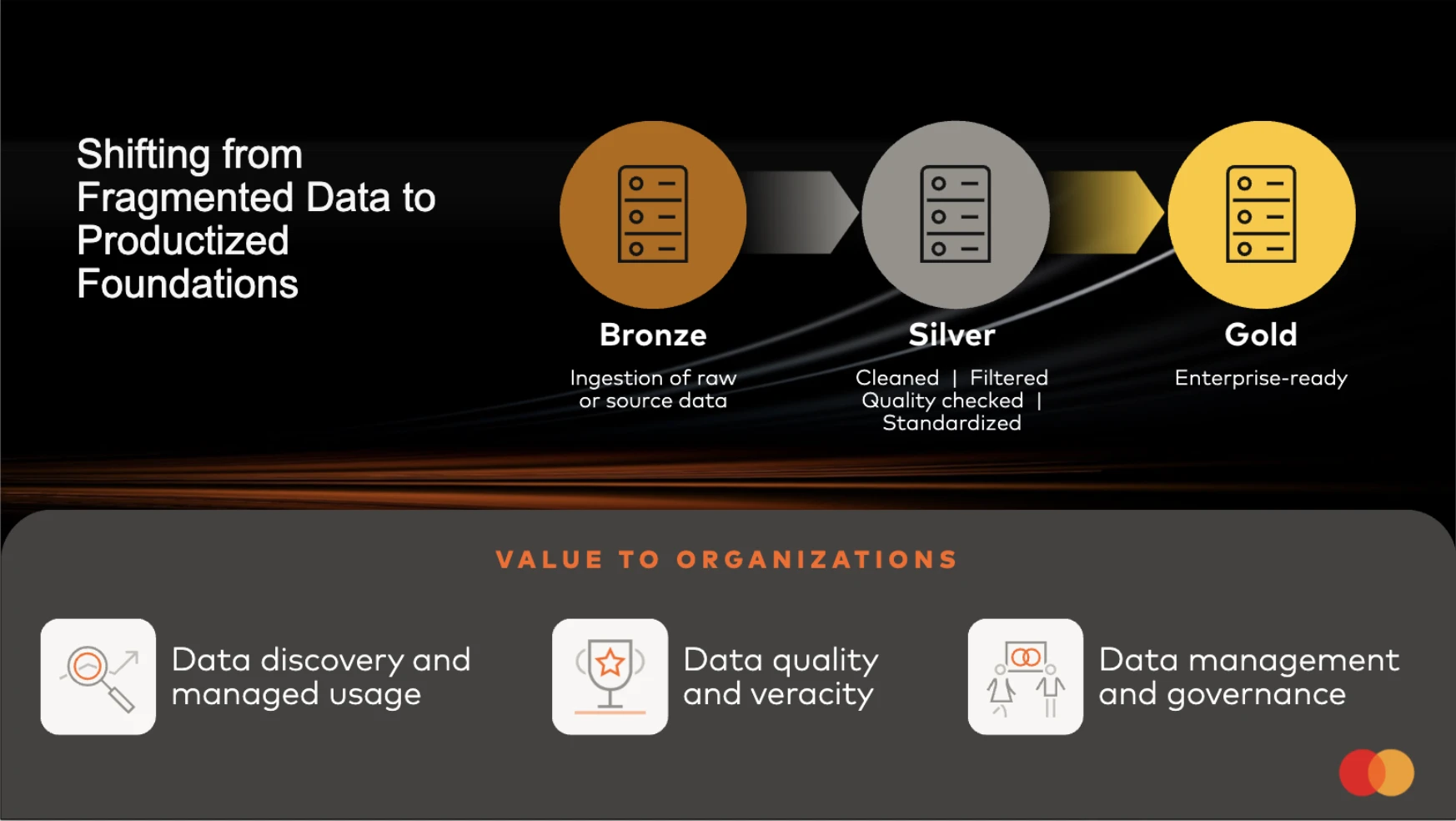
Mastercard’s Medallion framework underpins how the company categorizes its data. Using tiers like “raw” and “curated,” the Medallion mindset helps make sense of Mastercard’s distributed environment and improve decision making, while maintaining data security and governance.
As the company shifted from fragmented data to packaged, reusable data products, Medallion was a core architectural component. But according to Brian Piel, Vice President at Mastercard, Medallion was a means, not an end. The end state is one in which consumers and models receive governed data products, when they need them, with no friction.
“When we talk about enterprise-ready data for AI, we’re talking about adding the right context and making sure that everyone agrees upon that,” Brian described. “So we really think about: what is the data about, how’s it being used, how can it be used, and really understanding the governance of that.”
Context is critical to federating data products at a highly regulated organization like Mastercard because it ensures consistent governance as models scale. The process starts with agreement. Data stewards collectively define what each asset means, who owns it, and what it can be used for. That gets baked into every data product when it’s created, not applied retroactively or enforced by separate governance teams. The context is the product.
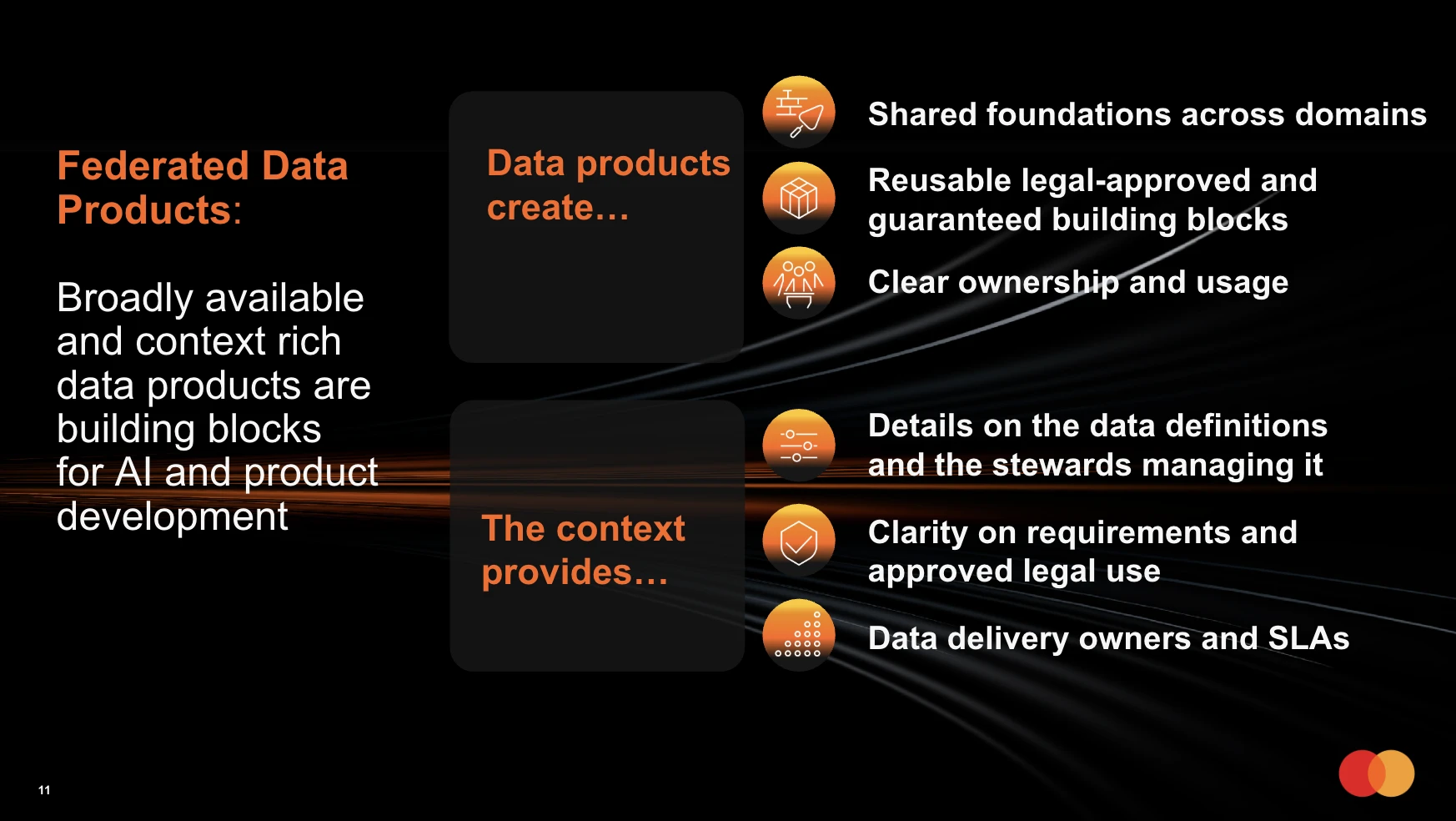
From there, the process runs like an assembly line. Data stewards and stakeholders agree on context, which is recorded in Atlan. Assets are created via the Medallion framework, and data contracts provide quality guarantees. Context-embedded data products are published into a marketplace, built with Atlan, so any team or model can discover them. Across business units, users have clarity about what data is and whether they can use it.
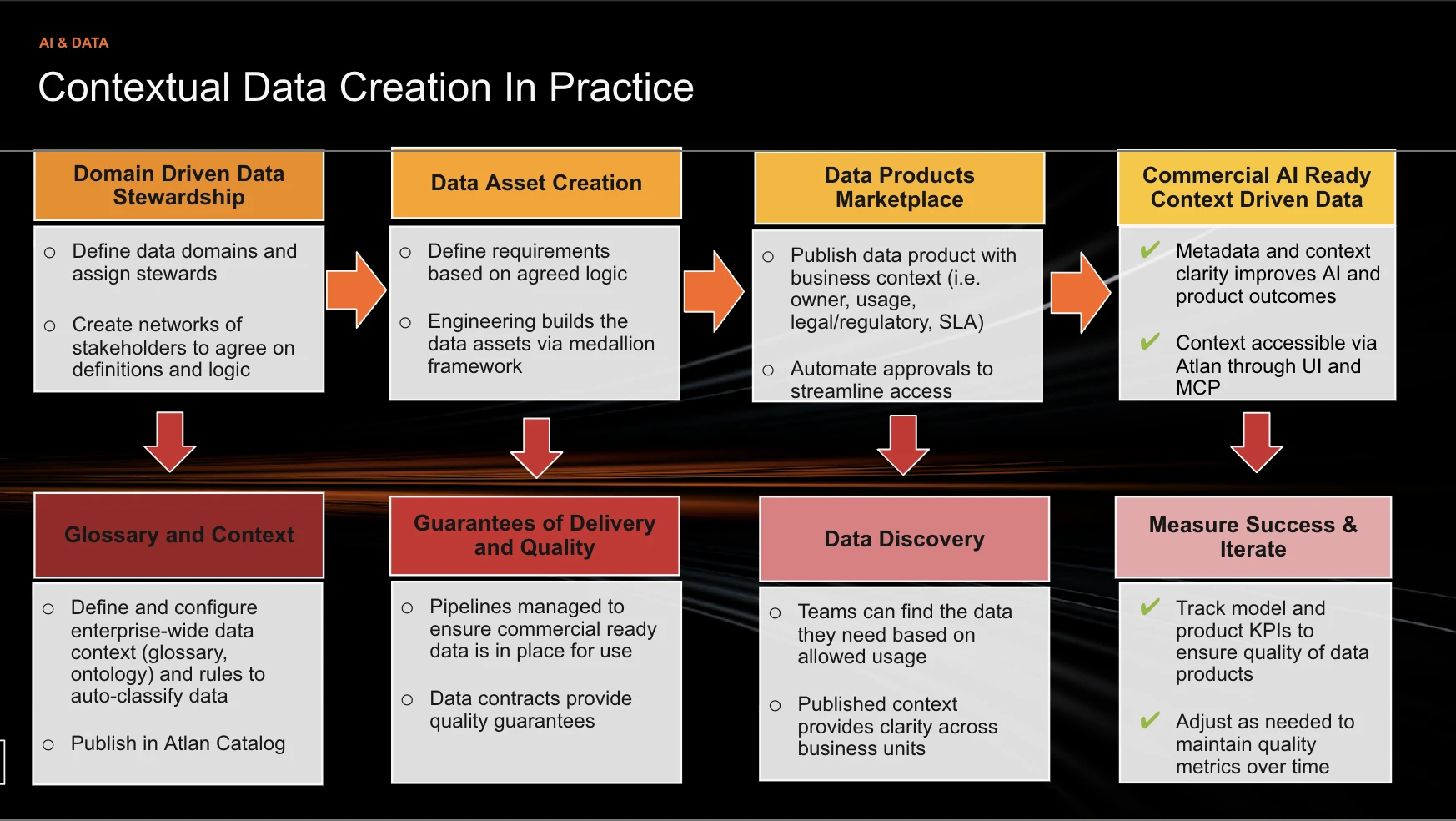
“As new data products are being built, someone can come find the right data for use, point their models to that, and now you have that consistency and the regulatory components built in,” Brian explained. “The key here is consistency across the board on definitions, the context of that data, and faster time to insights. Avoiding duplication is key for us because of the scale of the data that we have.”
The marketplace is the compounding return on the architecture. Every data product published to it is reusable, and every new team building a model finds what it needs without starting from scratch. The governance work done for the BI era applies seamlessly in the AI era.
Extending BI foundations to AI models
Mastercard’s existing architecture is now being put to work for AI. As the company moves to build and scale internal agentic workflows, the data products, lineage, and steward-confirmed definitions already in Atlan have become the substrate for something newer: Context Agents.
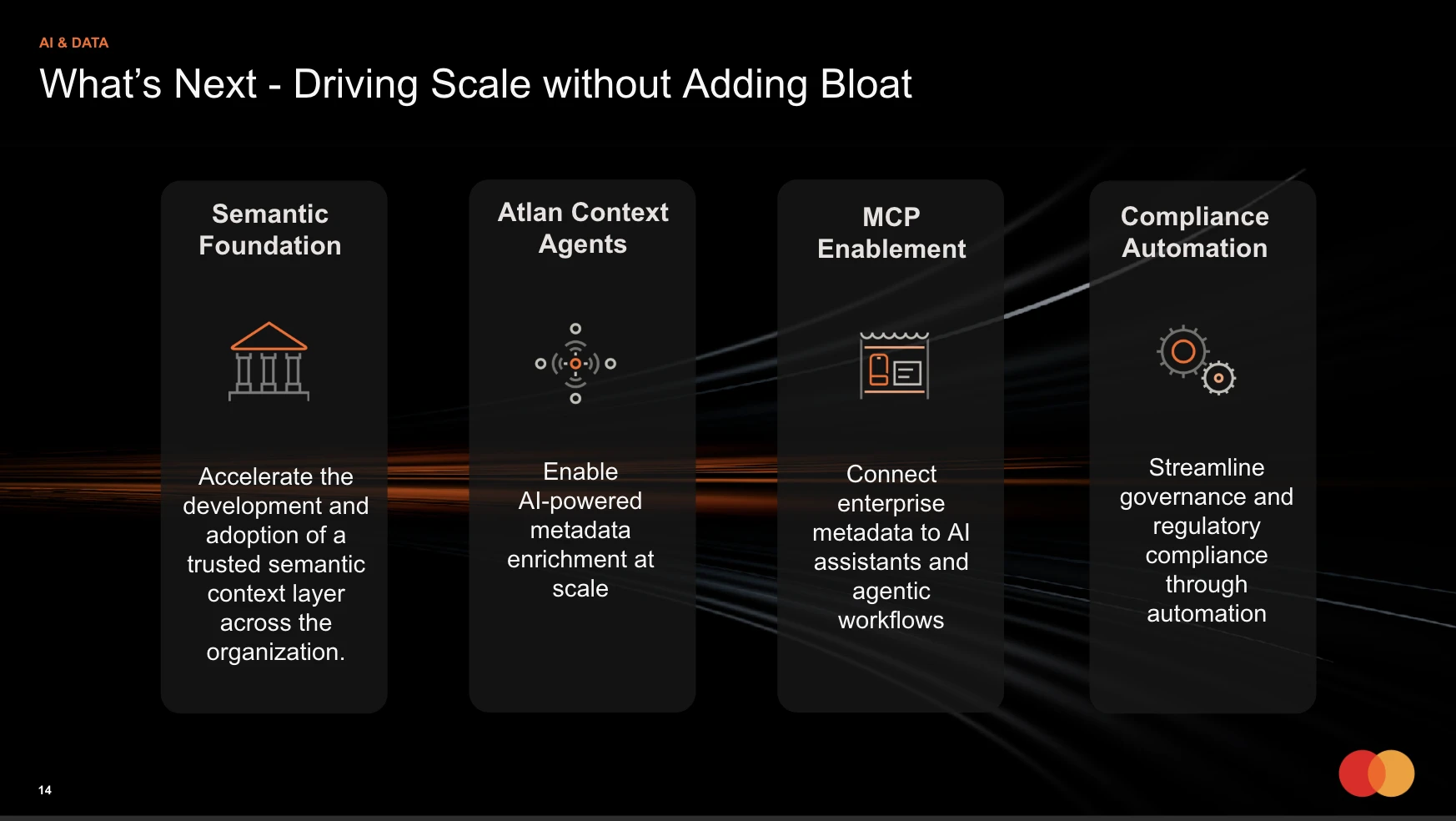
Mastercard’s context agents automatically enrich and document data assets at scale, running against a catalog that’s already governed. The work may be recent, but the foundation it ran on is not.
When context agents run against Mastercard’s asset catalog, they don’t enrich assets in a vacuum. They draw on SQL intelligence and lineage already in Atlan — the result of years of cataloging, data steward agreements, and data product publishing. Because the lineage was mapped and the ownership was assigned, the agents generate accurate descriptions about the asset and which dashboards it feeds, which models consume it, and what it touches downstream.
“With AI-powered metadata enrichment at scale, we [saved] over 6,000 hours. So that’s 30,000-plus assets enriched and metadata-ready, compliant for usage,” Vivek noted. “That was just the start. It really leveraged a lot of the data that we’d already put in through upfront effort to give us a lot of good returns.”
The 6,000 hours saved is a return on an investment made years before context agents existed. The lineage, integration, and governance work they’d already done to gain an end-to-end understanding of data assets gave Mastercard rich connectivity and a clear line of sight for context agents. Saving 6,000 hours on context bootstrapping isn’t the payoff. The fact that context compounds and each new agent can build on the one-time foundation without starting from scratch is.
Leveraging Atlan’s MCP, that governed context now reaches Mastercard’s internal agentic workflows directly.
“The metadata, the context, and clarity — all of that is easily surfaced through the Atlan UI,” Brian reflected. “And working with MCP, we can have all that available on demand to our models.” Every agent draws from the same foundation the data stewards built, the engineers automated, and the marketplace made discoverable.
Most organizations have governance foundations built for BI. When that work is done thoroughly up front, it can bridge to AI and accelerate production of reliable, governed data products and agents. It’s not a separate initiative, but a natural extension of what was already there. Mastercard built the data steward networks, Medallion framework, marketplace, and lineage before context agents emerged. Now they’re not just ahead of the curve, but they’re compounding on it, with each new data product and AI model faster and more reliable than the last.
See all key takeaways from the 2026 Databricks Data + AI Summit
Read the recap →