

Task success rate measures how often an AI agent completes a task correctly against a defined outcome. It separates genuine success from responses that merely look complete. Atlan, the Context Layer for AI, gives agents and evaluators the same approved definitions so success is judged against the right outcome, not just a finished workflow.

A trustworthy task success rate measurement depends on five elements:
- Precise success criteria
- Atomic pass/fail rubrics
- Calibrated human or LLM judges
- Real questions with known-correct outcomes
- Versioned business definitions
Why isn’t task completion the same as task success?
Task completion is an execution signal. Task success is an outcome judgment. An agent can return an answer, finish its workflow, and log no errors while still failing the user’s request.
Consider an agent asked to report Q3 annual recurring revenue by region: it retrieves the data, generates a table, and returns a response, and the system records a completed task. But if it uses the wrong revenue definition, omits a region, or applies an outdated calculation, the outcome has failed.
| What the system records | Completion result | What outcome evaluation must establish |
|---|---|---|
| Response returned | Complete | Is the answer correct and complete? |
| Tool call executed | Complete | Did it use the right source and rules? |
| Workflow closed without errors | Complete | Did the result satisfy the user’s actual goal? |
According to Salesforce, nearly one in seven interactions that appeared successful in system logs had failed the user. It calls these “phantom successes”: the system records a win, but the user receives an incorrect, incomplete, or unusable result, a failure mode hallucination detection also targets.
The gap appears when teams grade observable activity instead of the final outcome. A response is not proof of an AI agent’s accuracy: the outcome must also match the approved definitions and scope, follow the expected format, and meet the acceptance criteria.
This is where Atlan, the Context Layer for AI, becomes relevant: agents and evaluators share the same approved definitions, so success is judged against the outcome, not whether the workflow finished.
Measuring task success rate takes four steps, starting with defining what a correct outcome looks like, precisely enough to grade.
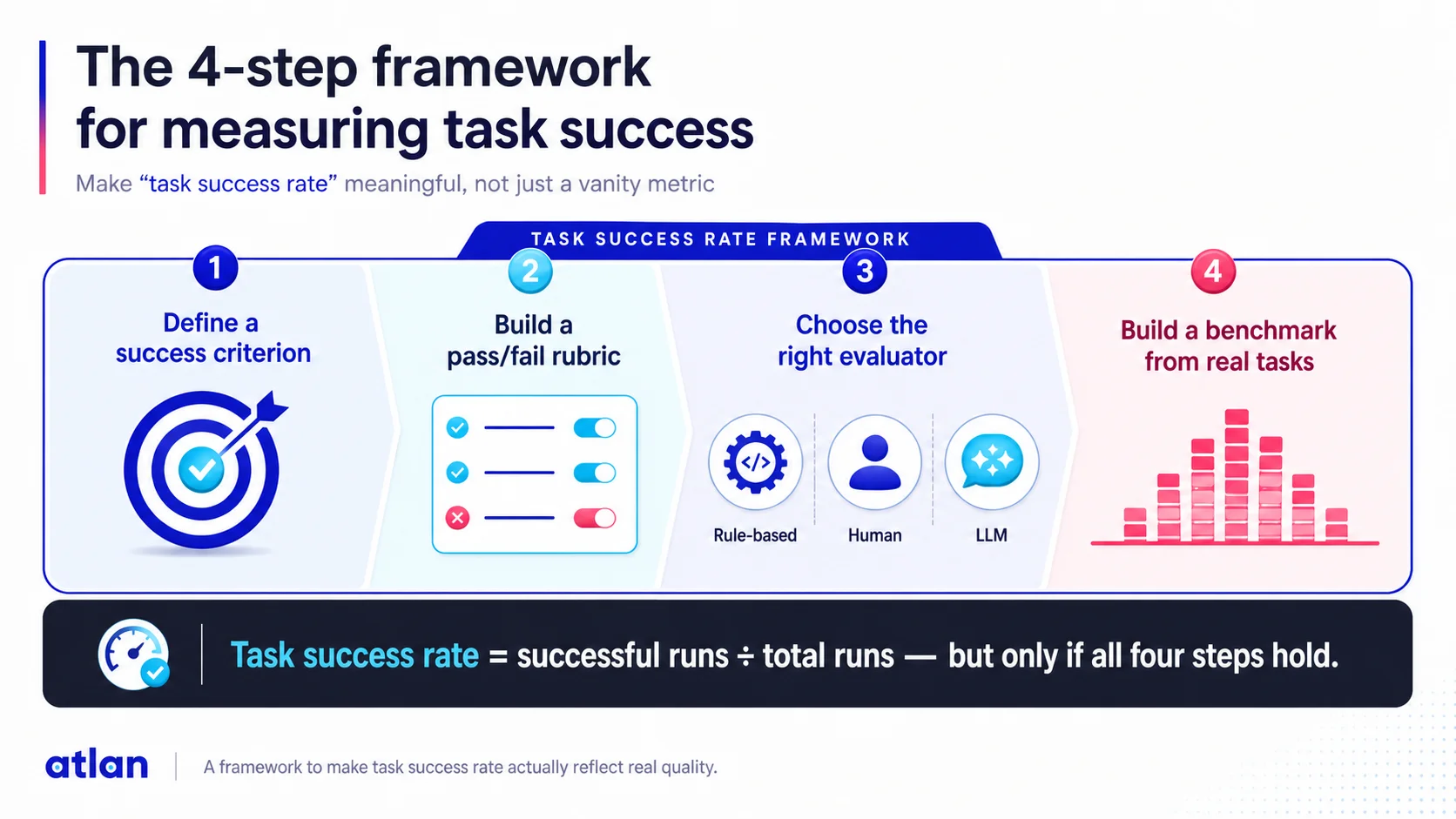
Step 1: How do you define a success criterion?
A success criterion describes the outcome an agent must produce for a task to pass. Define it before choosing a rubric or judge.
An ideal success criterion should specify:
- Expected result
- Required fields and scope
- Approved definitions and sources
- Acceptable tolerances
- Disqualifying errors
Teams should also include context quality testing for AI agents to confirm that the definitions and sources behind the criterion remain reliable, typically maintained inside an enterprise context layer.
For example, “the agent answered the revenue question” is too vague to grade. A stronger criterion would be:
Returns Q3 annual recurring revenue by region, calculates year-over-year growth using the finance team’s approved definition, and includes every required region.
This criterion defines success for the complete task; Step 2 turns it into pass/fail checks that show exactly where the outcome succeeded or failed.
Step 2: How do you build a pass/fail rubric?
Turn the success criterion into separate checks, each testing one observable aspect of the outcome. Define the exact conditions for passing and failing before running the evaluation.
For the revenue-reporting example, the rubric could be:
| Rubric criterion | Pass condition | Fail condition |
|---|---|---|
| Reporting period | Uses Q3 2025 data only | Uses another quarter or mixes reporting periods |
| Revenue figures | Values match the approved source within the accepted tolerance | Values exceed the tolerance or come from an unapproved source |
| Growth calculation | Uses the approved year-over-year formula and comparison period | Uses the wrong formula or comparison period |
| Regional coverage | Includes US, EU, and UAE regions | Omits one or more defined regions |
For task success rate, the complete task needs a binary result: success only when every mandatory criterion is met. Optional quality measures can be scored separately, but a strong score shouldn’t offset a failed requirement.
Anthropic’s 2026 guide to evaluating AI agents explains that a task can use multiple graders, each applying several assertions, and distinguishes binary, weighted, and hybrid scoring. For task success rate, binary checks keep the result clear while showing which requirement caused the failure.
This structure also makes failures easier to diagnose when teams test an AI agent harness. The rubric defines what must be checked.
Ebook — Inside Atlan AI Labs & The 5x Accuracy Factor
See the benchmark data behind a measured jump in agent accuracy when governed context replaces guesswork in the rubric and the benchmark itself.
Get the EbookStep 3: How do you choose who grades the outcome?
Match each rubric criterion to the evaluator best suited to check it: rule-based checks for conditions verified through exact comparisons, formulas, or predefined logic; human evaluators for expert judgment; and LLM evaluators for free-form outputs graded at scale.
| Evaluation method | Best suited for | Main limitation |
|---|---|---|
| Rule-based check | Exact values, required fields, database state, formulas, and tolerances | Cannot judge nuance or open-ended quality |
| Human evaluator | Domain rules, ambiguous cases, and baseline examples | Slow, expensive, and difficult to scale |
| LLM evaluator | Completeness, relevance, tone, and other free-form criteria | Non-deterministic and sensitive to rubric wording |
| Hybrid evaluation | Outcomes containing both verifiable facts and judgment-based criteria | Requires routing rules and ongoing calibration |
For the revenue-reporting example, a SQL comparison could verify the figures and reporting period. An LLM evaluator could check whether the explanation is complete, similar to how teams surface RAG accuracy problems. A finance expert could establish the reference examples and review disputed results.
Anthropic’s 2026 guide to evaluating AI agents distinguishes code-based, model-based, and human graders, and recommends calibrating model-based evaluation against expert human judgment.
In practice, most production evaluations need a hybrid: automate objective checks, use LLM evaluators for language judgment, and keep humans in the loop for calibration, the same pattern behind evaluating RAG systems.
Step 4: How do you build a benchmark from real tasks?
A benchmark is a standardized evaluation suite used to measure an agent consistently over time. It combines representative tasks, expected outcomes, grading rules, and a common scoring method.
A useful benchmark includes:
- Representative tasks: Production questions, recurring workflows, historical failures, and high-risk scenarios
- Reference outcomes: Known-correct results from approved reports, SQL queries, dashboards, or operational systems
- Grading rules: The success criteria and pass/fail rubrics applied to every task
- Balanced coverage: Different task types, difficulty levels, input formats, user roles, and exceptions
- Consistent scoring: The same calculation and pass conditions across evaluation runs
GAIA (Mialon et al., 2023) is a useful example of outcome-based benchmark design: its questions have verifiable answers but may require reasoning, external tools, and multiple steps. Humans achieved 92% on the original benchmark while an early GPT-4 system with plugins achieved 15%, showing how sharply performance differs when success is judged against the completed outcome.
One global enterprise spent six weeks manually spot-checking an analytics agent and still could not tell whether testing was close to complete. A repeatable benchmark makes coverage visible and lets teams rerun the same evaluation after changes to the model, tools, or the agent’s harness.
The benchmark is only as reliable as the data behind its reference outcomes: incorrect or incomplete reference data can turn a valid response into a false failure, or let an incorrect response pass.
After grading the benchmark, calculate:
Task success rate = (successful task runs ÷ total task runs) × 100
A task run succeeds only when it meets every mandatory rubric criterion. Record environment or evaluation-system failures separately, not silently removed from the calculation.
Because agent outputs vary between runs, repeat important tasks and report results by task type, difficulty, and risk level, since one aggregate percentage can hide where the agent performs well and where it stays unreliable.
A representative benchmark turns the first three steps into a measurable result that task length and complexity affect next.
Tool — AI Agent Context Readiness Checklist
Check whether your agents already have the definitions, sources, and exceptions a benchmark assumes before you grade a single run.
Get the ChecklistWhat causes task success rate to fall?
A task’s success rate can fall because the task got harder, or because the standard judging it changed, though each needs a different fix.
Why do longer tasks perform worse?
The longer a task is, the more chances an agent has to make a mistake:
- Retrieve the correct data early, then lose a constraint
- Call the wrong tool
- Mishandle an exception
- Fail to recover from an error
The workflow can still complete even if the task fails.
METR’s 2025 study of long software tasks found that agent success rates were negatively correlated with the time skilled humans needed to complete the same tasks, a decline well described by an exponential model, with longer tasks generally producing lower success rates.
The study measures task length by human completion time, not agent steps, and focuses primarily on software tasks.
Report results separately for short, medium, and long tasks, or another measure of complexity. Task success rate shows whether the outcome passed; trajectory evaluation helps identify which tool call, decision, or recovery attempt caused the failure.
Why does performance drift over time?
The expected outcome can change even when the agent does not. Definitions, approved sources, policies, and exceptions may be updated, making an old success criterion unreliable without tracking context freshness alongside it.
For example, if the definition of an “active customer” changes, an old rubric may mark an outdated answer correct, or fail one that’s now correct. The success criterion and rubric must be versioned and rerun whenever definitions or sources change.
The NIST AI Risk Management Framework treats ongoing monitoring as part of managing AI risk, and Context drift detection helps teams identify when evaluation context has changed.
How do you know if your task success rate can be trusted?
Trust the number only if you can explain what was tested, how it was graded, and what counted as success.
Use this checklist:
- Is success defined before evaluation? Each task needs a specific expected outcome, not a general instruction to answer correctly.
- Are the pass and fail conditions explicit? Every mandatory requirement should state what passes, what fails, and which tolerances apply.
- Does each criterion use the right evaluation method? Rule-based checks for exact conditions, LLM evaluators for language judgment, human review for calibration or hard cases.
- Does the benchmark represent the agent’s actual workload? Common tasks, difficult tasks, historical failures, high-risk scenarios, and known reference outcomes.
- Are results reported clearly? State total task runs, record evaluation-system failures separately, and break results down by type, difficulty, and risk.
- Can the evaluation be reproduced after something changes? Version the tasks, outcomes, rubrics, sources, model, and tools used for every run.
- Does production evidence support the result? Compare benchmark scores with user feedback, corrections, escalations, and abandoned workflows, the production side of AI observability. A large mismatch may mean the benchmark no longer represents what users need.
This belongs to the AI agent governance process:
- AI agent observability and ongoing AI agent monitoring compare offline results with production behavior
- AI agent guardrails and a guardrails checklist limit unsafe actions, but neither proves the task was correct
If a check fails, treat the rate as incomplete until the evaluation design is corrected.
How does Atlan support the measurement of task success rate?
A reliable task success rate depends on context engineering for AI agents: agents and evaluators need the same approved definitions, sources, exceptions, and reference outcomes to stay context aware. Atlan, the Context Layer for AI, keeps that context shared and versioned across the evaluation process.
| Evaluation requirement | How Atlan supports task success measurement |
|---|---|
| Clear success criteria | Context Repos store versioned metric definitions, approved sources, exceptions, and ownership information. |
| Consistent definitions | Context Agents identify conflicting definitions that could cause false passes or false failures. |
| Shared evaluation context | Context Lakehouse delivers the same approved context to agents and evaluation tools through MCP, A2A, SQL, and APIs. |
| Representative benchmark | Context Engineering Studio uses BI dashboards and production SQL to generate evaluation questions with known-correct outcomes. |
| Learning from failures | Compounding Learning Loops return reviewed corrections and evaluation failures to the shared repo. |
These capabilities do not replace the rubric, evaluator, or benchmark. They provide the reference context those elements depend on, anchored in a metadata lakehouse that keeps definitions and lineage in one place, so teams judge results against current definitions rather than plausible-looking outputs.
Tool — Context Layer ROI Calculator
Estimate what a shared, versioned context layer is worth in hours saved across evaluation, debugging, and rework once success criteria actually hold.
Calculate ROIWrapping up
The framework for measuring task success rate comes down to four steps: define a precise success criterion, turn it into a pass/fail rubric, choose the right evaluation method, and build a benchmark from representative tasks.
The hard part isn’t the rubric format or the evaluation technology; it’s defining what “correct” means for this task, right now. A rubric defines how an outcome is graded. Shared, current context determines whether that definition of success holds.
If your team is measuring task success rate, start by asking whether the context behind the metric is versioned, shared, and testable enough to call the agent enterprise-ready.
Explore how Atlan’s Context Layer for AI can help build that foundation.
FAQs about task success rate in AI agents
1. What is the difference between task success rate and accuracy?
Task success rate measures whether the agent accomplished the specific goal it was asked to do, judged against a defined success criterion. Accuracy typically measures whether the final answer matches a reference. The distinction matters because an agent can produce a response that is technically accurate in isolation yet fails the actual task: wrong format, missing dimensions, or incorrect business rules applied.
2. How many test cases do you need for a reliable task success benchmark?
There is no universal minimum. The benchmark should represent the agent’s common tasks, difficult scenarios, historical failures, and important exceptions. A narrow-domain agent may need fewer cases than a general-purpose one, but every major task type and risk level needs coverage. Expand the benchmark when production failures reveal scenarios it doesn’t yet represent.
3. How do you keep a success criterion up to date as business definitions change?
Version your success criteria the same way you version code. Track when a business definition changes, tie rubric versions to criterion versions, and re-run benchmarks whenever the underlying context shifts. Without this discipline, a pass from a previous run may not mean the same thing today.
4. Should you use a human judge or an LLM judge to grade agent outcomes?
Use the evaluation method that fits each criterion. Rule-based checks work best for exact values, required fields, formulas, and tolerances, while LLM evaluators grade language-based qualities such as completeness and relevance. Human evaluators establish the baseline, calibrate LLM grading, and review ambiguous or high-impact cases. Most production evaluations use a hybrid of all three.
5. What is the difference between task success evaluation and trajectory evaluation?
Task success evaluation checks whether the agent produced the required final outcome. Trajectory evaluation examines how the agent reached that outcome, including its tool calls, decisions, retries, and recovery attempts. Task success rate tells teams whether a task passed; trajectory evaluation helps explain why. A complete evaluation program may use both, but they answer different questions.
