

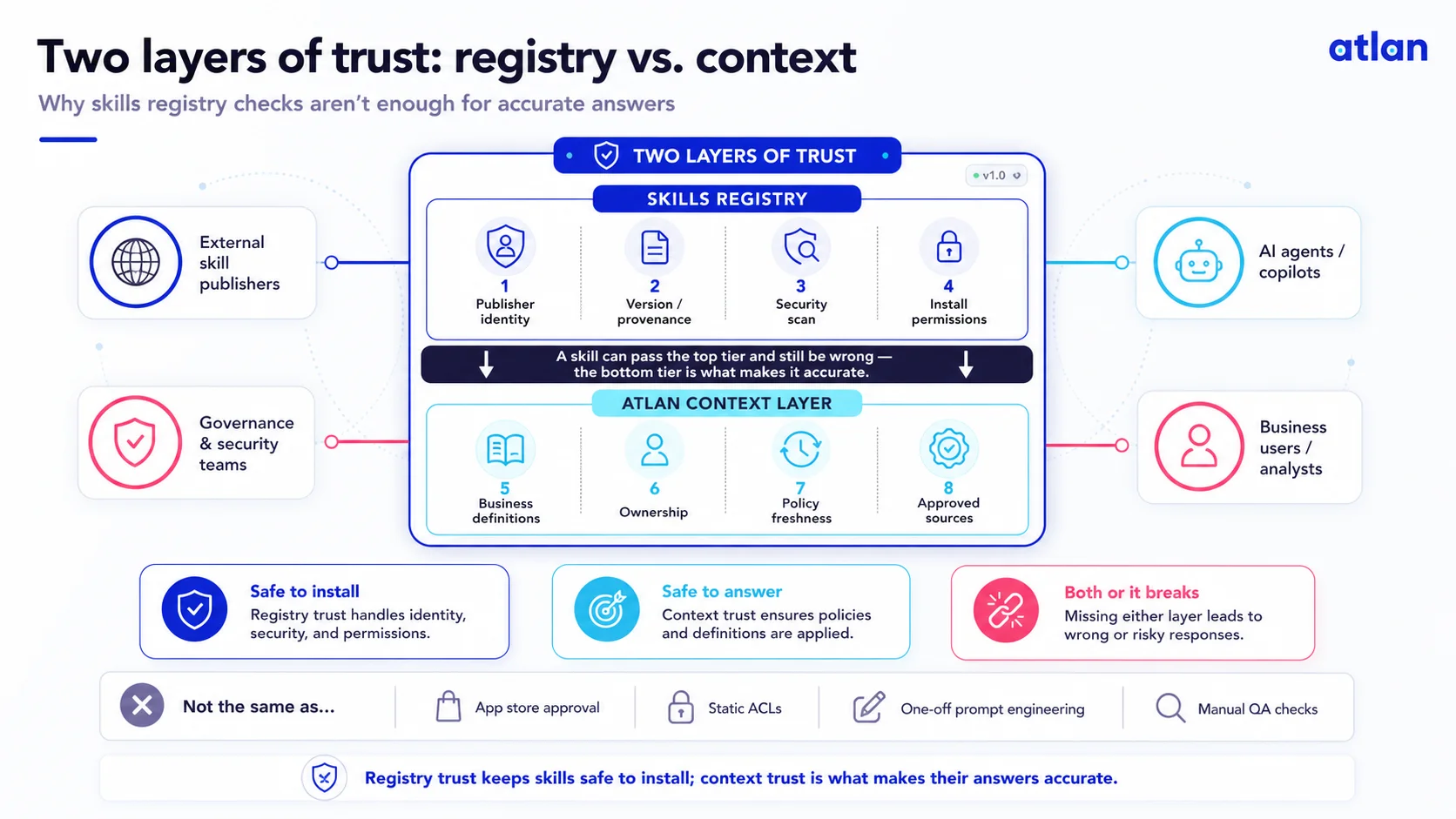
Atlan sits one layer below any skills registry a team adopts. A registry handles publishing, discovery, versioning, and installation. Atlan’s context layer for AI agents governs whether the business knowledge inside an installed skill is still accurate: the right definition, the current policy, the certified source. The two layers solve different problems, and an enterprise needs both.

| Field | Value |
|---|---|
| What It Is | A catalog adding discovery, publishing, ownership, and version control on top of the open Agent Skills format |
| Key Benefit | Where a skill came from, who maintains it, which version is approved |
| Core Models | Platform directory, community directory, curated public registry, private enterprise registry |
| Known Risk | Snyk found 36.82% of 3,984 scanned skills carried a security issue |
What problem does an agent skills registry solve?
An agent skills registry solves the fragmentation that appears when reusable skills spread across multiple agents, repositories, and teams: a common record of which skills exist, who maintains them, and which version is ready to install.
Keeping a skill in a Git repository may work for a small team, but at scale, copies appear across repositories and local agent folders, and two skills can share a name with different instructions or versions, the same drift agent skill best practices is designed to catch before it reaches production. At the enterprise level, teams need a system that holds versioned skills or indexes an authoritative external source, connecting publication and discovery with evaluation, installation, and updates.
For Atlan, the Context Layer for AI, this distribution record establishes one part of trust: where a skill came from and how it reached an agent, not whether the operational knowledge inside it is still accurate.
What a registry can add at each stage of the skill lifecycle:
| Lifecycle question | What a registry can provide |
|---|---|
| Where was the skill published? | A named publisher, owner, source, and description |
| How can people find it? | Search, categories, compatibility information, and usage signals |
| Which version should be installed? | A source reference, version or tag, approval status, and installation path |
| What can be checked first? | Package contents, provenance, requested permissions, and available security evidence |
| What has changed? | Version history, content digests, update notices, and retirement signals |
| Who can distribute it? | Access rules, review workflows, and audit records when the registry supports them |
That is different from what an agent skill actually is: a skill packages the instructions and resources for repeatable work, the discipline how to write an agent skill walks through end to end. Hosting solves file storage; a registry solves coordination around those files.
How does Anthropic’s Skills Directory differ from the open standard?
The Agent Skills open standard defines how a portable skill is structured, the same lineage covered in what skill engineering actually is. Anthropic’s Skills Directory is a catalog within Claude where users can browse and install skills that follow this structure.
The Agent Skills specification defines a folder containing a required SKILL.md file with a name, description, and instructions. It can also include scripts, references, assets, and compatibility information, the same folder shape skill engineering vs. prompt engineering traces back to its origin. The standard does not define a central marketplace, publication process, approval workflow, or installation method.
Anthropic’s directory is primarily a user-facing discovery and installation experience. Team and Enterprise customers can also provision skills centrally across an organization, but this does not make the directory a general-purpose private enterprise registry. Its distribution, access, and audit behavior remain specific to Claude.
A skill does not need to appear in Anthropic’s directory to follow the open standard. The same format can be distributed through Git repositories, other public directories, private registries, or compatible agent platforms.
What types of skills registries exist?
Skills registries generally follow four operating models:
| Registry model | How it works | Main benefit | Main limitation |
|---|---|---|---|
| Platform directory | Lists and distributes skills through one platform’s directory | Native discovery and installation | Controls do not carry across platforms |
| Community directory | Indexes skills from public repositories or other open sources | Broad selection, fast discovery | Ownership and security evidence vary |
| Curated public registry | Maintainers select, review, scan, or modify skills before publishing | Stronger provenance, consistent quality | Smaller selection, reliant on curator |
| Private enterprise registry | Approved publishers distribute skills to authorized teams | Access control and internal review | Org remains responsible for testing |
These models overlap. skills.sh combines a broad public catalog with curated first-party skills and security-audit results, and Chainguard offers organization-scoped registries storing skills as tagged, authenticated artifacts.
Installing directly from Git is different: the repository provides files and history, but the installer must handle discovery, identity, version selection, and update policy alone.
A team can combine models too: discover a skill publicly, test it, pin an approved revision, then distribute it through a private registry, the same staged-promotion pattern behind enterprise skills governance.
Inside Atlan AI Labs & The 5x Accuracy Factor
A curated registry with strong scanning still only tells you a skill's artifact is clean. See how governed context, not just a better-reviewed package, drove a 5x accuracy gain in real production agent systems.
Get the EbookHow do skills get versioned and updated?
The Agent Skills format does not prescribe semantic versioning or a universal update system. Its optional metadata field can contain a version value, but registries and installers decide what that value means and how a new version is selected.
That makes the source identity as important as the version label. Two registries can publish skills with the same name but different owners, instructions, and update histories, the same confusion agent skills vs. tools warns against when two artifacts look interchangeable but are not.
A dependable version record needs four parts:
-
Qualified identity: Record the publisher, source, and skill name together, not the name alone.
-
Immutable reference: Pin an exact release, commit, or artifact revision when reproducibility matters.
-
Lock record: Preserve the resolved source and dependencies in a reviewable file or deployment record.
-
Update policy: Define who approves updates, whether patches can add permissions, and how rollbacks work.
Andrew Nesbitt’s analysis of skills registry threat models notes that many loaders treat the current Git branch as the effective version, and some installation records preserve a skill’s name and version without recording the exact files received. A version label alone does not make an installation reproducible.
When a new version becomes available, teams follow the same discipline context layer evaluation criteria applies to context sources feeding an agent:
- Compare instruction, script, dependency, and permission changes.
- Rerun tests and security checks.
- Approve the version.
- Retain the previous reference for rollback.
If two registries contain a skill with the same name, the installer should treat them as different skills unless publisher, source, and version match, and require an explicit source instead of silently selecting one listing.
What does a registry’s trust model check?
A registry’s trust model defines what evidence it collects about a skill, its publisher, and the artifact being installed. The depth varies: a community directory may provide only a source link, while a curated registry verifies publishers, scans files, and removes unsafe listings.
Snyk’s ToxicSkills study (2026) found 1,467 of 3,984 skills scanned from ClawHub and skills.sh (36.82%) carried at least one security issue, including 534 with a critical one, a finding that applies to that dataset, not to every registry, the same distinction top AI guardrails tools compared makes when scoring scanners against different skill populations.
Source identity and version integrity establish which artifact is being evaluated. A registry’s trust model must then address three more questions:
| Trust question | What a registry may check | What remains an enterprise responsibility |
|---|---|---|
| How was the skill admitted? | Publisher verification, submission review, reputation signals | Whether the publisher can define the organization’s procedure |
| Is the skill safe to install? | Prompt injection, scripts, dependencies, secrets, permission signals | Whether its access fits the target data, credentials, runtime |
| Is the skill correct for its use? | Schema validation, compatibility checks, test evidence | Current definitions, approved sources, ownership, and drift |
Trust requires more than a one-time scan. Microsoft’s Visual Studio Marketplace security model combines initial scanning with post-publication rescans, publisher verification, and removal procedures. Skills need similar lifecycle controls, but their natural-language instructions create another risk: they can influence agent behavior directly, the same exposure covered in prompt injection attacks on AI agents. As Nesbitt put it, a user’s approval model often “doesn’t cover loader commands that run before the agent reaches the prompt.”
Even these checks do not prove a skill is correct. A verified skill can still use an outdated definition or follow a policy the business has replaced. Registries establish distribution-layer trust; they cannot establish that a skill’s operational knowledge remains accurate.
That second question belongs to the governed context underneath a skill: ownership, approved sources, domain evaluations, and freshness checks. First examine how the registry protects the artifact, then determine which internal controls keep the skill trustworthy.
How should an enterprise choose a registry?
An enterprise should choose a registry according to the consequences of installing an untrusted or inaccurate skill. Catalog size matters less than the sensitivity of the procedure, the access granted to the agent, and the controls required across teams.
Three factors should guide the decision:
-
Operational risk: Public discovery may be sufficient for low-risk experiments conducted in isolated environments. Skills that can modify production systems, access credentials, or trigger business processes require stronger review and runtime restrictions, the same threshold how to secure multi-agent systems in the enterprise applies once several agents share a skill library.
-
Information sensitivity: Skills containing proprietary procedures, internal policies, or customer-specific instructions are better distributed through a private registry with controlled access.
-
Administrative control: Enterprise skills governance requires approved publishers, staged promotion, installation records, revocation, and rollback capabilities for organization-wide deployment, backed by an AI governance framework that defines who signs off at each stage.
A team can still use public registries for discovery. It can review a skill, pin the approved revision, test it in an isolated environment, and then distribute that revision internally.
A private registry creates a stronger control boundary, but it does not replace security scanning, AI agent governance, domain evaluations, or governed business context.
How Mature Is Your Context Layer?
Choosing the right registry model still leaves the harder question open: whether your organization has the ownership, evaluations, and freshness checks a skill needs at runtime. Score your context maturity in a few minutes.
Take the AssessmentHow does Atlan govern skills and the context underneath them?
A registry governs how a skill is published, installed, and updated. Atlan’s context layer for AI agents addresses the knowledge-layer problem instead: whether the business context a skill uses is current, approved, and consistent across agents, the same standing requirement AI agent memory governance applies between sessions.
Atlan capabilities map to the gaps registry controls leave open:
| Established need | Atlan capability | Practical effect |
|---|---|---|
| Grounded starting point | Context Agents | Draft definitions and candidate skill content from lineage and usage signals for human review |
| Test and approve context | Context Engineering Studio | Package definitions, policies, and evaluations in versioned units with rollback history |
| Consistent context delivery | Context Lakehouse and Atlan MCP | Serve the same approved context through MCP, A2A, SQL, and APIs |
| Improve with runtime evidence | AI agent observability | Surface disputed answers, then approve changes before deployment |
These capabilities do not replace registry checks. A registry can establish that a refund skill came from a verified publisher and has not changed since installation. Atlan’s Context Layer for AI provides the current refund policy, eligibility definitions, and regional exceptions the skill needs when it runs.
The registry protects the skill’s distribution lifecycle. Atlan keeps the knowledge underneath it governed and reusable across agents through a shared context engineering framework, instead of embedding separate copies of context inside each skill, the same model behind Atlan’s approach to AI agent memory. Teams comparing registries against an AI registry or a model council find the same pattern: distribution-layer trust and knowledge-layer trust are governed separately, by design.
Skills are not the only artifact governed this way. These cover the adjacent server-registry problem:
- Why MCP matters for AI agents
- MCP vs. function calling
- MCP vs. A2A protocol
- Building MCP servers in-house
A skill and its server share the same stack:
- Agent harness engineering
- The enterprise context layer
- A context graph vs. knowledge graph choice
- Implementing an enterprise context layer for AI
Is Your Context Ready for Agents Like These?
Choosing a registry model still leaves the harder question open: whether your organization governs the context underneath every skill and agent. Check where your own agent context stands.
Get the ChecklistWhat should teams do next?
Start with one high-value, bounded skill and validate it before broader deployment:
- Confirm its publisher and source.
- Pin the approved revision.
- Scan its instructions and dependencies.
- Test it in an isolated environment.
Then assign an owner to the business context the skill uses, including its approved definitions, policies, exceptions, and evaluation cases. Promote the skill only when both the artifact and its operational knowledge have been reviewed, with separate monitoring for skill updates and context changes.
FAQs about agent skills registries
1. Is Anthropic’s Skills Directory the same as the Agent Skills standard?
No. The Agent Skills standard defines a portable skill-folder format centered on SKILL.md. Anthropic’s Skills Directory is a Claude product surface for discovering and installing skills that follow that format. Other compatible platforms can support the same standard without using Anthropic’s directory.
2. Does a verified or signed skill guarantee accurate output?
No. Publisher verification establishes identity, and a signature establishes artifact integrity. Security checks may catch known hazards, but none of these controls proves the instructions reflect current business rules or use the correct sources. Accuracy requires domain evaluations, approved context, ownership, and ongoing review.
3. Can an enterprise run a private skills registry?
Yes. A private registry can restrict who publishes and installs skills, distribute proprietary procedures, and support staged promotion and audit records. Private distribution does not make a skill inherently safe: the enterprise still needs scanning, version pinning, testing, runtime restrictions, and incident response.
4. What happens if two registries list a skill with the same name?
The name alone is not enough to identify a skill. Treat its publisher, source, and version as part of its identity. If any of these identifiers differ, the installer should require an explicit choice instead of silently selecting one listing.
5. How is a skills registry different from an MCP server registry?
A skills registry distributes reusable instructions and supporting resources that guide agent behavior. An MCP server registry indexes metadata that clients use to discover and connect to servers exposing tools or data. A skill may explain how to use tools from an MCP server, so the two registry types serve different but complementary purposes.
