Use Case Guide: Compliance Management
A guide to managing data compliance in Atlan—covering sensitive data identification, access controls, audits, and proactive monitoring.
- Type
- Guide
- Length
- 8 slides
- Read time
- 6 min
-
-
-
-
-
-
-
-
-
End of the guide
That’s all 8 slides.
Keep a copy, or start again from the top.
Up next: Guide: Activate Data Mesh
About this guide
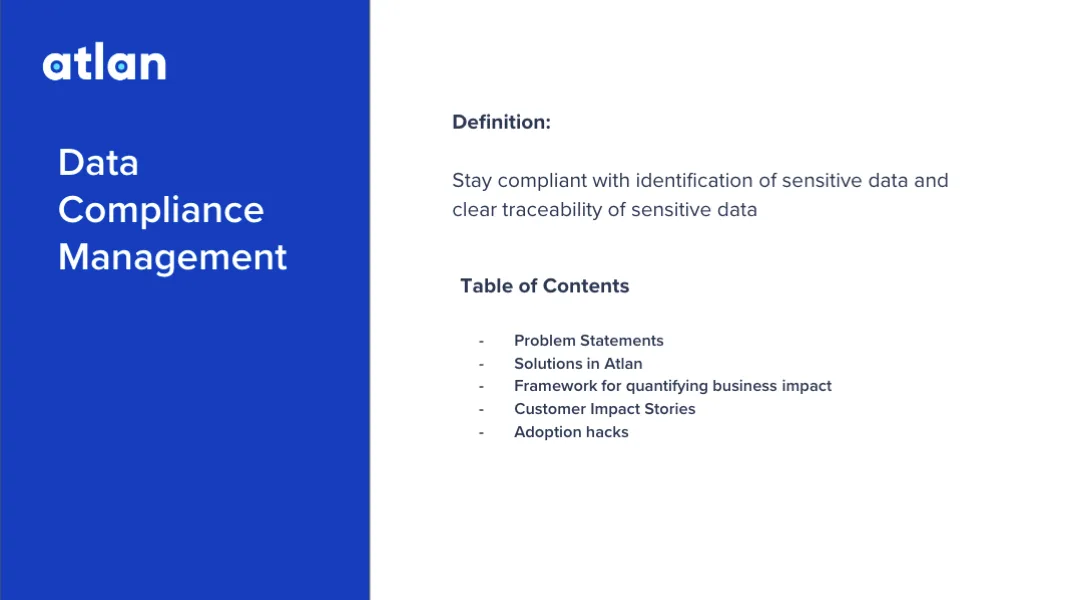
This resource is a detailed guide to data compliance management in Atlan, showing how organizations can meet regulations like GDPR, CCPA, and HIPAA by identifying, securing, and monitoring sensitive data. It highlights the risks of poor compliance—legal fines, breaches of trust, and unauthorized access—and provides a clear playbook for reducing those risks.
The guide introduces four sub-use cases built on Atlan’s governance features.
-
Sensitive Data Identification: Using Atlan tags to classify sensitive assets, either by importing existing tags from systems like Snowflake, applying bulk rules with playbooks, or manually tagging with human context. Classifications can be propagated downstream via lineage, ensuring full coverage (page 4).
-
Access Controls: Enforcing the right permissions on sensitive data by syncing Atlan tags with data source policies (e.g., Snowflake masking), leveraging BYOC to inherit source-level access, or creating policies natively in Atlan (page 5).
-
Auditing Sensitive Data: Giving compliance teams visibility into all sensitive assets using Atlan’s Reporting Center, filters, and APIs. Lineage diagrams further show where sensitive data flows into or out of systems, enabling thorough audits (page 6).
Proactive Monitoring: Setting up alerts for schema or metadata changes on sensitive assets via EventBridge or webhooks, so compliance and security teams are notified of changes instantly (page 7).
The guide also provides a framework for quantifying business impact, including time spent tagging sensitive assets, time taken to respond to auditors, and costs of non-compliance. It encourages measuring audit closure times, headcount dedicated to compliance, and organizational risk reduction (page 8).
By following these practices, organizations can move from reactive compliance to proactive governance. Atlan’s capabilities allow teams to centralize sensitive data management, enforce access controls, simplify audits, and monitor changes in real time—reducing legal exposure and strengthening trust across the business.