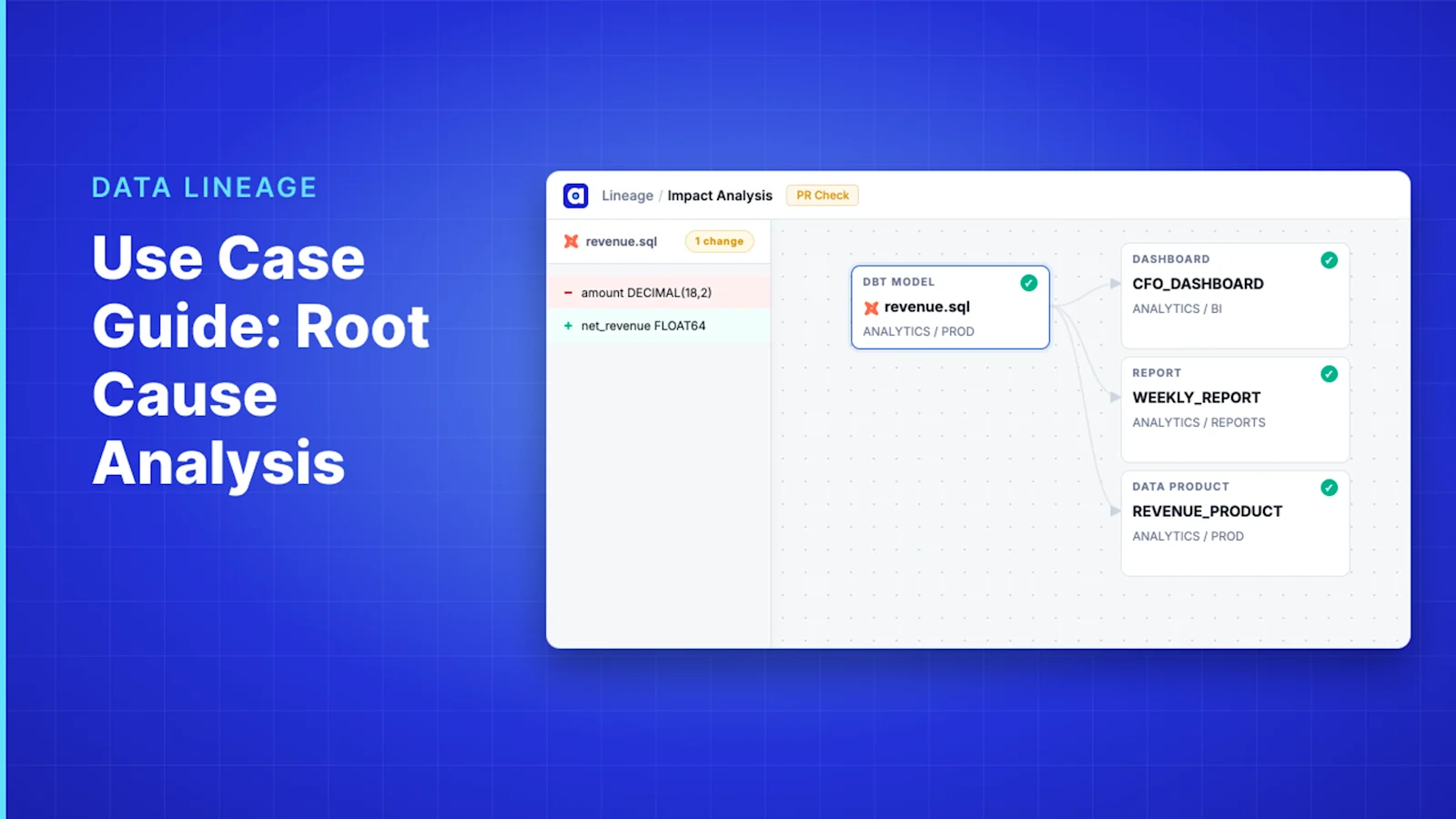
Use Case Guide: Root Cause Analysis
A guide to using Atlan’s lineage and tool integrations to speed up root cause analysis, reduce downtime, and boost data team productivity.
- Type
- Guide
- Length
- 6 slides
- Read time
- 3 min
-
-
-
-
-
-
-
End of the guide
That’s all 6 slides.
Keep a copy, or start again from the top.
Up next: Use Case Guide: Data Exploration
About this guide
This resource provides a detailed playbook for performing root cause analysis in Atlan, helping teams identify and resolve data issues faster. It addresses the common pain of troubleshooting faulty dashboards, discrepant metrics, or broken pipelines—issues that often consume significant time and reduce data engineering productivity.
The guide begins by outlining the problem space: lack of end-to-end visibility across the data landscape makes it difficult to trace issues to their origin. This not only delays resolution but also contributes to team frustration and burnout, with studies showing high rates of attrition among data engineers.
It then presents two levels of solutions. At Level 1, teams use Atlan’s end-to-end lineage to visually trace upstream dependencies—tables, columns, and dashboards—of an affected asset. Column-level lineage in Atlan’s UI allows users to pinpoint the faulty upstream asset quickly and accurately (page 4). At Level 2, teams extend analysis to operational tools. Through Atlan’s custom metadata capabilities, metadata from pipeline orchestrators (Airflow, dbt) and data quality platforms (Monte Carlo, Great Expectations) can be surfaced alongside assets. This context reveals whether issues stem from pipeline failures, failed tests, or transformations (page 5).
The playbook also introduces a framework for measuring business impact, with metrics such as time to complete root cause tickets against SLAs and mean time to recovery for breakages. These metrics provide a clear way to demonstrate reduced downtime, faster resolution, and improved trust in data systems (page 6).
By combining lineage with tool integrations, Atlan enables organizations to move from reactive troubleshooting to proactive problem-solving. The result is faster recovery, less wasted engineering time, and a stronger foundation for reliable, trusted data.