

Last year at Summit, we said context is king. This year, Snowflake shipped CoWork and CoCo, and proved why.
CoWork is a desktop agent for every knowledge worker. CoCo is a coding agent for builders. The quality of the answers they deliver is only ever as good as the context they can access - and for most enterprises, that context is scattered, undocumented, and deeply specific to how their business actually works.
Before we get into our latest launches, it’s worth being precise about what “context” actually means.
What is context?
Consider a knowledge worker at a quick service restaurant chain who opens CoWork and types: “Why is drive-through time up this week?”
It sounds like a straightforward question, but before any agent can answer it correctly, it needs three distinct types of information that don’t live anywhere in the data itself.
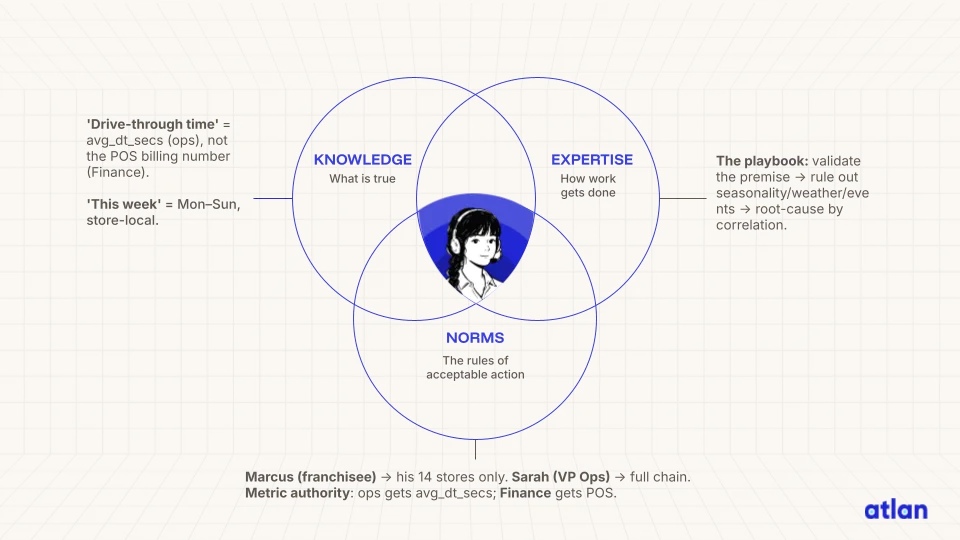
Knowledge: the map of the business. “Drive-through time” means avg_dt_secs in the ops system, not the POS billing number that Finance pulls, and “this week” means Mon-Sun in store local time, closed Sunday at 11:59 PM local time, not a rolling 7-day window. These are facts about how this particular company talks to itself, and no off-the-shelf agent knows them by default.
Expertise: how work actually gets done. There’s a diagnostic playbook for a question like this: validate the premise first, rule out seasonality, weather, and recent product launches, then hunt for root cause by correlation. An agent that skips straight to root cause will routinely arrive at the wrong answer and deliver it with complete confidence.
Norms: the rules of acceptable action. A store manager is scoped to his 14 stores, a VP of Ops sees the full chain, and ops gets avg_dt_secs while Finance gets POS metrics. The agent needs to know who’s asking and what they’re authorized to see before it responds, not after.
Context is the intersection of all three. Without it, even the best model is working with an incomplete picture. Here’s what we shipped this week to help enterprises build it.
Context Agents: Bootstrap your context layer in weeks, not years
Most enterprises simply don’t have this context in a usable form yet. Documenting a typical data estate manually, at the quality level agents require, takes a year or more, which is why most organizations never finish and the agents they deploy end up running on context that’s incomplete and unverified.
One CDO at a Fortune 500 retailer put it plainly: “Building the agent takes 5 minutes. Giving it business context takes 5 months.”
Context Agents close that gap by mining your entire data estate, from systems of record through your data warehouse and down to BI, and automatically generating table descriptions, preferred joins and filters, metrics, and ontologies. They synthesize column-level lineage, SQL, usage patterns, existing human annotations, and semantic logic from BI tools simultaneously, which is why the output reflects how your business actually operates rather than what a model might generically infer.
Across hundreds of customers, 89% of AI-generated context is rated equal to or better than what a human analyst would write, and what used to take a year typically takes two weeks.
“The output felt like it had been written by someone who understands our business. That’s when I stopped thinking about this as a time-saving tool and started seeing it as a strategic capability.” - Izabela Wilczyńska, Data Governance Officer, PayU
“I expected boilerplate - instead, it inferred business context I never explicitly provided, correctly describing how an asset fit into our customer journey just from column names and lineage.” - Swatilekha Saha, Data Architect, DAT Freight & Analytics
“With single-digit hours of effort from our team, we were able to accomplish work that would have taken months for a larger team to finish - and realistically, we likely would not have ever started it.” - Lexie McGillis, Senior Manager, Data Governance
Context Engineering Studio: The SDLC for context
Getting context into your agents is only half the problem, because once it’s deployed, you have to keep it trustworthy as your business evolves, and that’s where most teams run into a wall they weren’t expecting. Building Semantic Views is a manual and slow process, and testing them before deploying to make sure they’re accurate? Almost impossible.
Teams build out definitions, metrics, and business rules, push them live, and then spend months debugging why the answers are still wrong, with no lineage to trace when something breaks and no version to roll back to.
One VP of AI at a top-5 insurer described it: “When an agent gets it wrong, I can’t trace which piece of context caused it, let alone roll it back.”
Software engineering solved this problem decades ago by giving code a development lifecycle, and context needs the same discipline. Context Engineering Studio is that environment: AI builds you a context repo that’s bounded, versioned, and portable, like a GitHub repo for your business knowledge, and simulates it against real business questions before anything goes live.
The lifecycle runs build, test, review, approve, deploy, learn, with AI handling the bootstrapping and simulation while humans stay in the loop to resolve ambiguity, add tacit knowledge that no crawler will find on its own, and sign off before deployment. Every interaction feeds back into the layer, so the context compounds over time and each new agent you build is smarter than the last.
Workday, which runs on Snowflake and Atlan, is already building this way.
“Atlan captures Workday’s shared language to be leveraged by AI via its MCP server. As part of Atlan’s AI Labs, we’re co-building the semantic layer that AI needs.” - Joe Dos Santos, VP, Enterprise Data & Analytics, Workday
MCP Servers: Context everywhere agents work
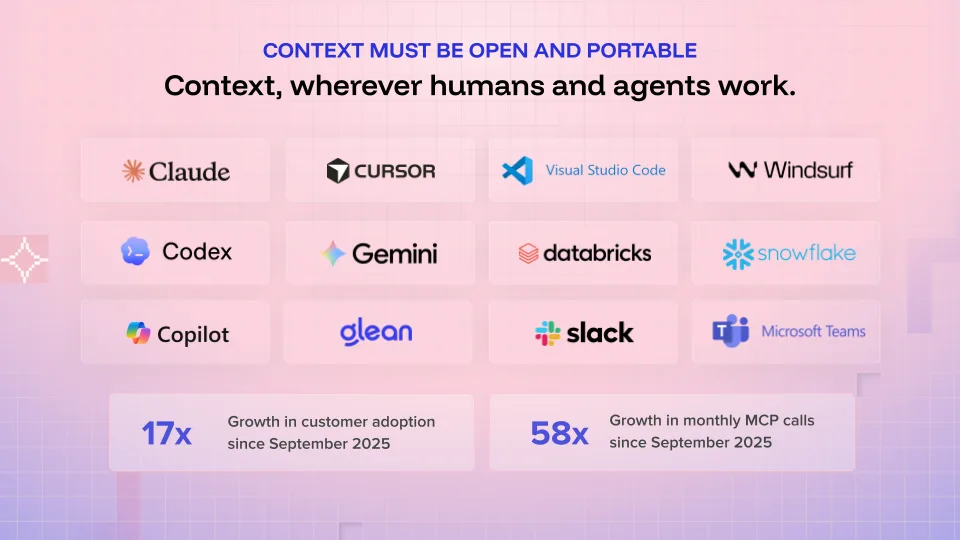
CoWork and CoCo are at the top of every conversation this week, but you’re never going to run just one agent harness. You already have Claude, Copilot, Cursor, Glean, and more running across your organization, and that list will keep growing.
If each agent platform develops its own understanding of your business context independently, they diverge. One agent learns that “revenue” means bookings, another learns it means ARR, and a third has no reliable definition at all.
Atlan’s MCP Servers address this by delivering context from a single layer to every agent harness through one open protocol, so CoWork and CoCo get the same grounded understanding of your business as Claude, Cortex, Copilot, Cursor, Gemini, Glean, Slack, and every other agent in your stack.
And because context portability means context ownership, your business knowledge stays yours rather than becoming locked into any single platform. Since September 2025, customer adoption has grown 17x and monthly MCP calls have grown 58x.
Context is King. And it’s also your business IP.
Last year we said Context is King. This year, every knowledge worker and builder getting an agent means context is what determines whether any of it actually works.
The companies that invest in creating context, build it with a lifecycle, and keep it portable across every agent they run will compound that investment in a way that’s genuinely difficult to replicate later. The context layer gets smarter with every interaction, and that cumulative knowledge becomes a real moat.
Context is King. And now it’s also your most valuable business IP. Keep it open. Keep it interoperable. Keep it yours.
Atlan is at Snowflake Summit 2026. See Context Agents, Context Engineering Studio, and MCP Servers live.
Visit the Summit Page →