

Enterprise RAG chatbot frameworks fall into two families: developer frameworks like LangChain and LlamaIndex, and chatbot-native platforms like Rasa and Microsoft Copilot Studio. Most comparisons stop at pipeline features: retrieval accuracy, connectors, licensing. This one adds conversational-context durability: whether context stays accurate, current, and permissioned as the session runs long, not just on turn 1.
What is an enterprise RAG chatbot framework?
An enterprise RAG chatbot framework orchestrates retrieval-augmented generation inside a live, multi-turn conversation, not a single exchange. A pipeline answers one question; a chatbot does that repeatedly while a token budget shrinks and earlier retrievals go stale.
Developer frameworks (LangChain/LangGraph, LlamaIndex, Haystack, Semantic Kernel) give full control over the RAG architecture but require building memory and channels yourself. Chatbot-native platforms bundle dialogue management natively. This page skips general orchestration frameworks, covered in Atlan’s agent-framework comparison, and vector database selection.
| Field | Content |
|---|---|
| What it is | Software orchestrating retrieval and generation inside a multi-turn chatbot session |
| Two categories | Developer frameworks vs. chatbot-native platforms |
| Key differentiator | Conversational-context durability across turns |
| Frameworks profiled | 8 |
| Out of scope | Vector databases, general agent orchestration |
Comparison table at a glance
The table below scans all 8 options on standard pipeline criteria plus the conversational-durability angle.
| Tool | Type | Open source | Best for | Conversational memory approach | Starting price | GitHub stars |
|---|---|---|---|---|---|---|
| LangChain / LangGraph | Developer | Yes (MIT) | Agentic workflows, RAG as one node | LangGraph checkpointer (thread-scoped) plus store (cross-thread) | Free; LangSmith Plus $39/seat/mo | ~147K |
| LlamaIndex | Developer | Yes (MIT) | Retrieval-heavy document chat | ContextChatEngine, condensed blocks |
Free; LlamaCloud credits | ~52.2K |
| Haystack (deepset) | Developer | Yes (Apache 2.0) | Agent workflows and auditable RAG pipelines | InMemoryChatMessageStore (in haystack-experimental) |
Free; Haystack Enterprise Platform custom | 26,537 |
| Microsoft Semantic Kernel | Developer | Yes (MIT) | Multi-agent, .NET/Python (v1.x supported; new work goes to Agent Framework) | Agent-level orchestration memory | Free OSS | 28,574 |
| Rasa | Chatbot-native | Yes (Apache 2.0, core) | Regulated, rules-plus-LLM | Tracker state + SearchAndReply |
Free tier; Pro ~$35K/yr | ~21.3K |
| Microsoft Copilot Studio | Chatbot-native | No | Microsoft-ecosystem bots | State store, <30-day, last-10-turn | $200/tenant/mo | N/A |
| Google Dialogflow CX | Chatbot-native | No | Google-ecosystem, telephony | Session params feeding Gemini | $0.007/request | N/A |
| Botpress | Chatbot-native | Partial (core OSS) | RAG-native low-code | Node-based flows, state variables | Free tier; Plus $89/mo | ~14.8K |
GitHub stars and pricing reflect each project’s own pages as of mid-2026.
What makes the best enterprise RAG chatbot framework?
Six criteria separate a demo from a production system: retrieval quality, multi-turn state, streaming reliability, deployment lock-in, channel/handoff support, and context governance.
Criterion 1: Retrieval quality
We scored hybrid retrieval, reranking, and chunking strategy directly. Neither LangChain nor LlamaIndex publishes a head-to-head retrieval-accuracy benchmark, and the third-party comparisons that circulate name no methodology, so no scored number appears in this row.
Criterion 2: Multi-turn state management
A 2025 arXiv survey found performance degrades as conversations lengthen; we scored native history-compression, fitting agent memory architectures; see also the best AI agent memory frameworks of 2026.
Criterion 3: Streaming reliability
We scored whether streaming is documented as a first-class capability or bolted on, and whether it survives being combined with conversation history and tool calls in each framework’s own docs.
Criterion 4: Deployment, licensing, lock-in
Apache 2.0 and MIT licenses are enterprise-safe; Copilot Studio and Dialogflow CX are proprietary SaaS; we scored self-host options and lock-in.
Criterion 5: Channel deployment and handoff
Rasa documents an ActionHumanHandoff Slack pattern; developer frameworks provide none of this natively; we scored native connectors versus bring-your-own.
Criterion 6: Context freshness and governance
This is the criterion the rest of this page’s comparisons skip, covered in full after the profiles below.
A note on GitHub stars as a proxy. Ecosystem size correlates with tutorial availability, not production fit. Several teams profiled below chose their framework "because of the tutorials and the stars," then hit a wall once real conversation history, streaming, and observability entered the picture. Star count tells you how easy a framework is to start with, not how it behaves at message 200 of a live session.
The 8 best enterprise RAG chatbot frameworks at a glance
- LangChain and LangGraph: agentic workflows
- LlamaIndex: retrieval-heavy document chat
- Haystack (deepset): auditable pipelines
- Microsoft Semantic Kernel: multi-agent orchestration
- Rasa: rules-plus-LLM dialogue
- Microsoft Copilot Studio: low-code Microsoft bots
- Google Dialogflow CX: telephony-heavy
- Botpress: RAG-native, hybrid deployment
LangChain and LangGraph
LangChain and its extension LangGraph are the most widely adopted developer framework for conversational RAG, about 147k stars as of September 18, 2026, 1.0 GA’d 22 October 2025.
Pros:
- Largest ecosystem and tutorials here, with 1,000+ documented integrations
- Documented memory path through LangGraph persistence: a thread-scoped checkpointer plus a cross-thread store with optional vector indexing
Cons:
- The 1.0 cut moved legacy chains and the
langchain-communityre-exports into a separatelangchain-classicpackage, so older tutorials will not run as written - No native channels or handoff
Pricing: Free (MIT). LangSmith Developer is $0 for one seat with 5,000 base traces a month; Plus is $39 per seat per month with 10,000 base traces and one free small serverless deployment. Compute and storage meter separately (as published 18 September 2026).
- Official: langchain.com
- GitHub: github.com/langchain-ai/langchain (~147k stars, 18 Sep 2026)
- Docs: docs.langchain.com
See also: LangChain vs. LangGraph, LangGraph memory vs. Mem0.
Inside Atlan AI Labs & The 5x Accuracy Factor
Learn how context engineering drove 5x AI accuracy in real customer systems, whether your agent is one-shot RAG or a multi-turn chatbot.
Download E-BookLlamaIndex
LlamaIndex is the retrieval-first developer framework, built around indexing and chat engines; its ContextChatEngine retrieves relevant text per turn as system-prompt context.
Pros:
- Built retrieval-first: indexing, chat engines, and reranking are the core abstractions, not add-ons
- Memory blocks condense history into a bounded string, since performance degrades in unwieldy conversations
Cons:
- Less opinionated about orchestration beyond retrieval
- No native channels, handoff, or streaming UI
Pricing: Free (MIT); LlamaCloud Starter free with 40K credits/month.
- Official: llamaindex.ai
- GitHub: github.com/run-llama/llama_index (~51K stars)
- Docs: docs.llamaindex.ai
This connects to LLM context window limitations and lost in the middle.
Build Your AI Context Stack
Get the guide to assembling a production-ready AI context stack, from vector retrieval to governed context.
Get the Stack GuideHaystack (deepset)
Haystack is deepset’s open-source orchestration framework for agent workflows and RAG pipelines, with a native Agent component, lifecycle hooks, and tool execution built in. It is the auditability-first option here, built for teams that need to inspect every pipeline step. Note the version: Haystack is on the 3.x line (3.0 shipped 20 July 2026 as a breaking release; latest 3.1.1, 3 September 2026), which removed AsyncPipeline, the legacy Generators and ToolInvoker, and moved tool execution into the Agent. Haystack 1.26 reached end of life on 11 March 2025.
Pros:
- Apache 2.0 licensed, no legal ambiguity
- Inspectable design; debug exactly which step failed
- Native
Agentwith lifecycle hooks (before_run,before_llm,before_tool,after_tool,on_exit,after_run); 3.1 addedAgentToolfor multi-agent systems - Official
mcp-haystackintegration, maintained by deepset
Cons:
- Smaller community (26,537 stars, 18 September 2026) than LangChain
InMemoryChatMessageStoreships inhaystack-experimental, not core, so it carries no stability guarantee- No native channels or handoff
Pricing: Free (Apache 2.0). Haystack Enterprise Platform, deepset’s commercial offering, is custom-priced. deepset’s SOC 2 Type II, ISO 27001, GDPR, HIPAA and CSA Star Level 1 posture is scoped to that platform, not to the Apache-2.0 framework.
- Official: haystack.deepset.ai
- GitHub: github.com/deepset-ai/haystack (26,537 stars, 18 Sep 2026)
- Docs: docs.haystack.deepset.ai
Microsoft Semantic Kernel
Semantic Kernel is Microsoft’s open-source multi-agent orchestration framework, not a chatbot platform. It sits as a coordination layer, routing a message to the right retrieval or summarization agent.
Pros:
- Enterprise-ready: dependency injection, telemetry built in
- Native memory-store integrations (Azure, Pinecone, Qdrant)
Cons:
- Not a chatbot framework alone; channels live outside it
- Multi-agent abstractions are powerful but complex
Pricing: Open-source and free.
- Official: Microsoft Semantic Kernel documentation
- GitHub: github.com/microsoft/semantic-kernel (28,574 stars, 18 Sep 2026)
Rasa
Rasa is the most mature chatbot-native platform here, built around explicit dialogue management, with RAG integrated into its conversation-tracking system via SearchAndReply.
Pros:
- Tracker-based state controls exactly when RAG triggers
- Documented Slack handoff pattern (
ActionHumanHandoff)
Cons:
- Open-source core now in maintenance mode, focus shifted to CALM
- Real-volume pricing starts around $35,000/year
Pricing: Open Source free; Rasa Pro (Enterprise) from ~$35,000/year.
- Official: rasa.com
- Pricing: rasa.com/pricing
- GitHub: github.com/RasaHQ/rasa (~21.3K stars)
Microsoft Copilot Studio
Microsoft Copilot Studio is a fully hosted, low-code platform for enterprise chatbots, pairing tightly with Azure AI Bot Service. Its RAG pipeline: query rewriting, retrieval, summarization, safety validation.
Pros:
- Most formalized safety pipeline here: moderation, grounding validation
- Native connectors: SharePoint, Dataverse, Azure AI Search
Cons:
- Per-tenant pricing escalates quickly at scale
- Deep Microsoft integration is also the lock-in risk
Pricing: $200/tenant/month for 25,000 messages; packs at $200 each.
- Official: Microsoft Copilot Studio
Google Dialogflow CX (Conversational Agents)
Google Dialogflow CX, reorganized into the Conversational Agents console in late 2025, is the Google-ecosystem chatbot-native platform, calling Vertex AI’s Gemini natively.
Pros:
- Generators debuggable via a simulator showing the resolved prompt
- Strong telephony and contact-center integrations
Cons:
- Pricing per text request, so cost scales with length
- Tight Google Cloud IAM coupling limits portability
Pricing: $0.007 per text request; new customers get up to $300 in free credits.
- Official: Google Cloud Conversational Agents
- Pricing: cloud.google.com/dialogflow/pricing
Botpress
Botpress is a chatbot-native platform built around an advanced RAG system, managing state through node-based flows. It raised a $25M Series B in June 2025.
Pros:
- RAG is a first-class capability, not an add-on
- Flexible deployment: on-premises, private cloud, or hybrid
Cons:
- Enterprise pricing can exceed $2,000/month at scale
- Smaller community than Rasa or the developer frameworks
Pricing: Free tier (500 msgs/month); Plus $89/month; Enterprise $2,000+/month.
- Official: botpress.com
- GitHub: github.com/botpress/botpress (~14.8K stars)
How does conversational-context durability separate these frameworks?
Every framework above can answer a question. Conversational-context durability asks a harder one: does the answer at turn 12 still rest on context that’s accurate, current, and permissioned? The scorecard covers Criterion 2, 3, 5, and 6, deciding whether a framework holds up once real users are talking to it.
| Tool | Multi-turn state handling | Streaming under memory load | Human handoff | Channel breadth |
|---|---|---|---|---|
| LangChain / LangGraph | Documented: thread-scoped checkpointer plus cross-thread store | Documented as first-class | Not documented | Not documented |
| LlamaIndex | Strong, purpose-built (condensed memory blocks) | Supported at chat-engine level | Not documented | Not documented |
| Haystack | Inspectable message store, in the experimental package | Supported, integration-dependent | Not documented | Not documented |
| Semantic Kernel | Agent-level, orchestration-dependent | Supported via model APIs | Via orchestrated agents only | Not documented |
| Rasa | Strongest explicit state (tracker-based) | Supported via connectors | Documented (Slack ActionHumanHandoff) |
Native, multi-channel |
| Copilot Studio | Formalized (last-10-turns rewriting, <30-day state store) | Supported via Azure APIs | Contact-center integration | Native, Microsoft ecosystem |
| Dialogflow CX | Session parameters and contexts | Supported via Vertex AI | Legacy ES pattern (endInteraction) |
Native, strong telephony |
| Botpress | Node-based flows and state variables | Documented less specifically | Platform-level, details vary | Native, broad library |
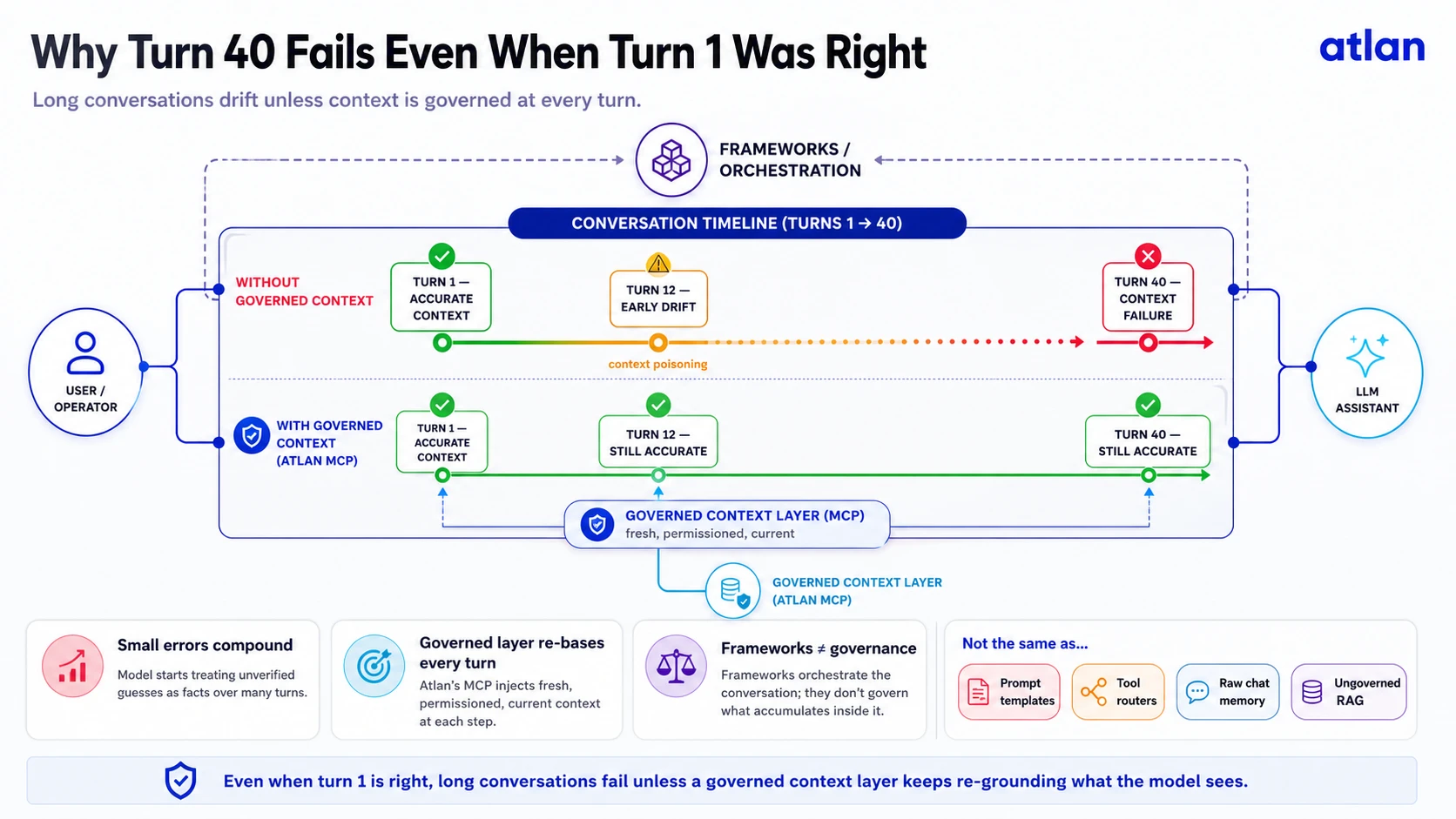
It’s worth naming the honest counter-argument here: a vocal segment of practitioners argues the fix for conversational durability isn’t more governance or a heavier platform, it’s less abstraction. Their position, sometimes shorthanded as “just use requests and pydantic,” is that hand-rolling a thin orchestration layer directly over a raw model API gives a team more direct control over what accumulates in a session than any framework’s built-in memory management, and removes a layer of opaque behavior that’s harder to debug when something breaks. This is a coherent, defensible choice for a team with the engineering capacity to build and maintain it, not a slogan to dismiss. It doesn’t contradict the point above so much as sharpen it: whichever layer you choose, thick or thin, bought or built, something still has to keep the context accurate as the session grows.
Which framework should you choose for your enterprise chatbot?
The decision isn’t “which framework is best,” it’s build vs. buy vs. hybrid.
| If you need… | Consider… | Why |
|---|---|---|
| Max control, chat as one node | LangChain / LangGraph | Largest ecosystem, stateful workflows |
| Retrieval-first architecture | LlamaIndex | Indexing and chat engines are the core abstractions; purpose-built condensed memory |
| Auditable pipelines and agent workflows | Haystack | Modular, inspectable, native Agent; Apache 2.0. Compliance certifications belong to deepset’s commercial platform, not the OSS framework |
| Microsoft-centric multi-agent backend | Semantic Kernel (v1.x) | Deep Azure integration. Microsoft directs new projects to Agent Framework, GA 3 April 2026 |
| Explicit dialogue control plus RAG | Rasa | Tracker-based state, but weigh maintenance-mode |
| Fast Microsoft 365 deployment | Copilot Studio | Formal safety pipeline |
| Telephony or Google-ecosystem | Dialogflow CX | Vertex AI grounding |
| Low-code, hybrid deployment | Botpress | RAG-native, on-prem/cloud |
No engineering team: Copilot Studio, Dialogflow CX, Botpress. Platform team: LangChain/LangGraph, LlamaIndex, Haystack. Regulated industry: Haystack’s/Rasa’s auditability, or Copilot Studio’s moderation pipeline.
By use case: support leans Rasa or Botpress; an internal knowledge assistant leans LlamaIndex; a broader multi-agent system leans LangGraph.
What none of these frameworks solve alone
Every framework above orchestrates a conversation. None govern whether the context accumulating inside it stays correct, unlike the single-shot failures in RAG accuracy problems: wrong retrievals compound, a pattern called context poisoning, treating unverified answers as ground truth.
None of the 8 tools have a mechanism for context drift detection mid-session, catching a changed policy or deprecated source while a conversation is open. That gap sits inside what AI agent context requires, and explains why a chatbot correct on turn 2 starts fabricating by turn 15.
A governed context layer sits upstream of whichever framework you choose. Atlan exposes governed, freshness-monitored context to any of the 8 frameworks through its MCP Server, so a LangChain chatbot, a Copilot Studio bot, and a Rasa assistant retrieve from the same certified source, the layer determining whether answers stay trustworthy as sessions run long.
Real stories from real customers: Governed context behind conversational AI
"We're excited to build the future of AI governance with Atlan. All of the work that we did to get to a shared language at Workday can be leveraged by AI via Atlan's MCP server...as part of Atlan's AI Labs, we're co-building the semantic layer that AI needs with new constructs, like context products."
— Joe DosSantos, VP of Enterprise Data & Analytics, Workday

"Atlan is much more than a catalog of catalogs. It's more of a context operating system...Atlan enabled us to easily activate metadata for everything from discovery in the marketplace to AI governance to data quality to an MCP server delivering context to AI models."
— Sridher Arumugham, Chief Data & Analytics Officer, DigiKey

See how governed context compounds across every agent you ship
Whichever framework you choose, the context feeding it needs its own maturity check.
Assess Context MaturityWhy the framework is not where your RAG chatbot will fail
Every one of the 8 tools here can produce a working chatbot demo. The gap shows up elsewhere: whether the context feeding turn 40 is as accurate as the context that fed turn 1. Frameworks orchestrate the conversation; they do not, on their own, govern what accumulates inside it.
Pick the framework matching your team’s capacity and channel requirements from the profiles above. Then treat the context feeding it as infrastructure needing its own freshness monitoring and access governance, not a problem the framework solves implicitly. Teams that get this backwards spend months tuning memory-summarization on a foundation that was never governed, then wonder why the pilot’s chatbot drifts at real volume.
FAQs about enterprise RAG chatbot frameworks
1. What is the best framework for building an enterprise RAG chatbot?
There is no single best framework. LangChain/LangGraph suit agentic workflows; LlamaIndex leads on retrieval; Rasa, Copilot Studio, Dialogflow CX, and Botpress bundle dialogue management natively.
2. Is LangChain or LlamaIndex better for a conversational RAG chatbot?
LlamaIndex is built retrieval-first, with purpose-built memory blocks that condense history into a bounded string. LangChain offers a larger ecosystem and more mature agentic workflows via LangGraph. No published head-to-head benchmark from either vendor separates the two on retrieval accuracy, so choose on workflow shape rather than a scored number.
3. Can you build an enterprise RAG chatbot without writing code?
Yes. Copilot Studio, Dialogflow CX, and Botpress support low-code deployment, with RAG configured through a console instead of pipeline code.
4. How do RAG chatbots handle conversation memory across turns?
Approaches vary: LlamaIndex condenses history into token-limited blocks, LangChain 1.x persists through LangGraph’s checkpointer and store, Rasa relies on tracker-based state, and Copilot Studio retains memory under 30 days.
5. Why do RAG chatbots hallucinate more in long conversations than in single-shot answers?
Two problems compound: models degrade as context grows, burying information mid-history (lost-in-the-middle), and early wrong retrievals go uncorrected, so the model treats its own earlier answers as fact, context poisoning.
6. Is Rasa still a good choice for LLM-based chatbots in 2026?
It depends. Rasa’s open-source core is now in maintenance mode, focus shifted to its CALM engine and “Hello Rasa” platform. Its dialogue control and handoff pattern remain genuine strengths for rules-based guardrails.
7. What is the difference between a RAG chatbot framework and a RAG pipeline framework?
A RAG pipeline framework answers a single question. A RAG chatbot framework does that repeatedly in one session: tracking what was asked, a shrinking token budget, and keeping context accurate throughout.
8. How much does an enterprise RAG chatbot framework cost?
Costs range widely. Open-source developer frameworks are free to run, costs concentrated in infrastructure and LLM usage. Chatbot-native platforms charge per message, tenant, or request: from $200/tenant/mo (Copilot Studio) to ~$35,000/yr (Rasa enterprise).
Sources
- LangGraph v1.0 GA, GitHub, 2025
- LangGraph persistence: checkpointers and stores, LangChain docs
- LangChain pricing
- Rasa pricing
- Rasa GitHub repository
- Copilot Studio pricing, CloudZero
- Google Cloud Dialogflow pricing
- Botpress review, SiteGPT
- Microsoft Semantic Kernel GitHub
- Haystack GitHub, deepset
- Haystack 3.0 release notes, deepset
- Haystack Agent documentation, deepset
- Haystack Enterprise Platform, deepset
- Multi-turn LLM interactions survey, arXiv
- Conversational memory frameworks, Pebblous
- Enterprise RAG platforms comparison, Atlan
