

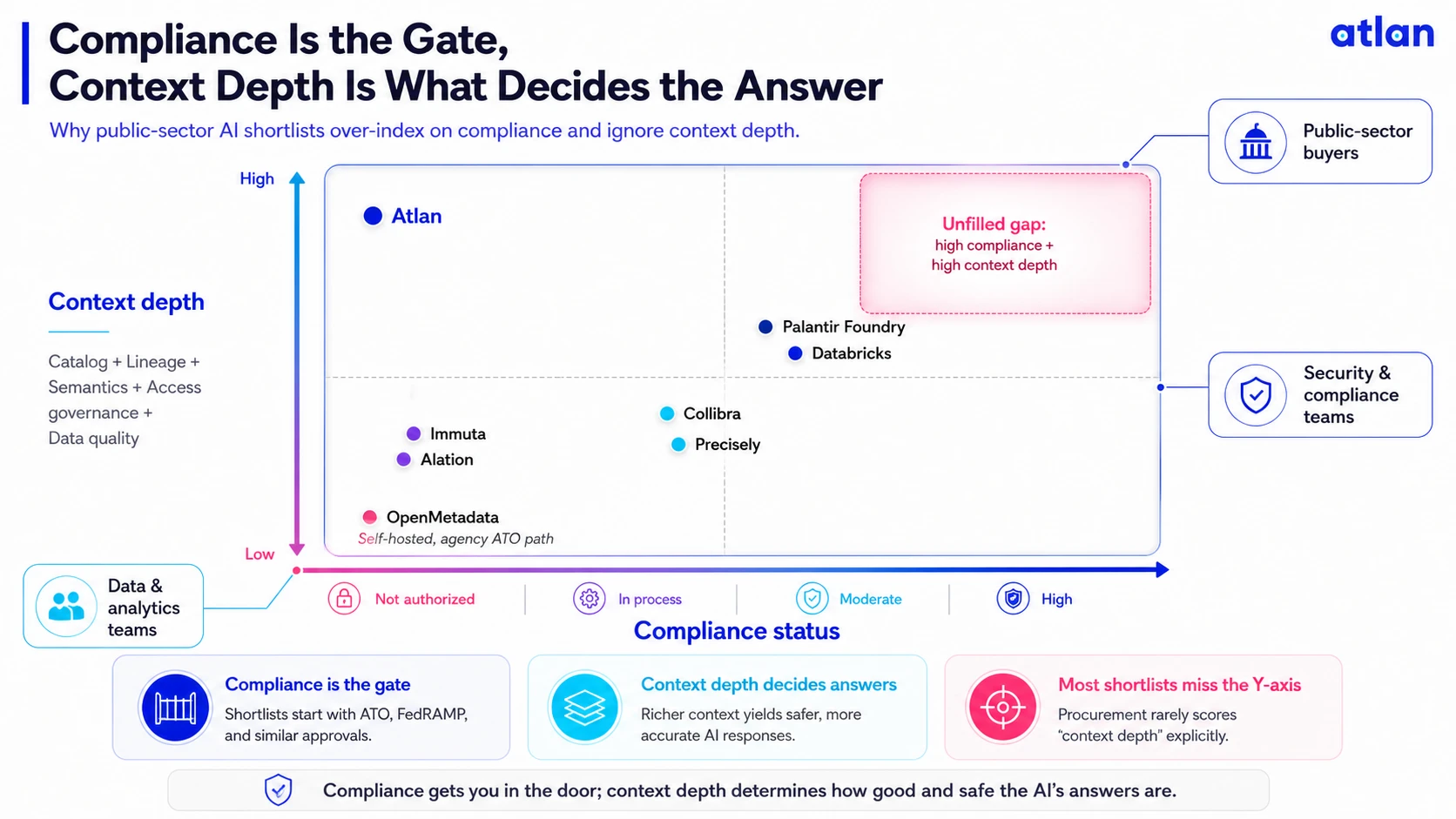
Most public sector shortlists for AI-ready data tools stop at one question: is this tool FedRAMP or StateRAMP authorized. According to Gartner (2026), at least 80% of governments will deploy AI agents for routine decisions by 2028, and platforms like Collibra, Palantir Foundry, Databricks, and Atlan each answer that question differently. Authorization says a tool can legally touch agency data; it says nothing about whether that data means anything to an agent once inside the gate. This guide scores 9 tools on both axes: compliance status, and context depth across catalog, lineage, semantics, access governance, and data quality.
AI-ready data for a public sector agency is not simply clean data. It carries catalog coverage, traced lineage, shared definitions for terms that mean different things across programs, enforced access policy, and a quality signal an agent can check before acting. Dashboards tolerate an analyst filling gaps the data does not cover; agents do not have that fallback. That is also why data sovereignty and PII handling for AI pipelines sit inside this evaluation, not a separate conversation.

| Fact | Detail |
|---|---|
| Tool categories evaluated | Data catalog, lineage, semantics or metadata, access governance, data quality |
| Compliance frameworks | FedRAMP, StateRAMP (rebranded to GovRAMP in 2025 to cover state, local, tribal, and education buyers) |
| Tools compared | 9 |
| FedRAMP High authorized today | Palantir Foundry, Databricks on GovCloud |
| Strongest context depth | Atlan, evaluated outside a current FedRAMP or StateRAMP authorization |
| Tool | Category | Compliance status | Context-depth strength |
|---|---|---|---|
| Palantir Foundry | Mission data platform | FedRAMP High, IL5 | Strong ontology, heavier platform |
| Databricks (Unity Catalog) | Data platform, catalog | FedRAMP High, IL5 | Strong on-platform, narrower beyond |
| Microsoft Purview | Governance, catalog | Azure Gov FedRAMP High, IL2 and IL4 | Solid catalog on the Microsoft stack; no policy enforcement on non-Microsoft sources |
| Collibra | Catalog, governance | FedRAMP Moderate | Strong catalog, governance |
| Precisely | Quality, lineage | FedRAMP Moderate | Deep quality, lineage; not a catalog |
| Alation | Catalog | FedRAMP In Process | Strong catalog, narrower lineage |
| Immuta | Access governance | Not yet FedRAMP certified | Deep access policy; not a catalog |
| Atlan | Context layer | Not yet authorized | Strongest: unifies all five |
| OpenMetadata | Catalog (open source) | Self-hosted; own ATO | Solid catalog, self-managed burden |
What makes a data tool actually AI-ready for government?
Two questions determine whether a tool is genuinely AI-ready, not just legally deployable. The first is compliance: has it cleared FedRAMP, StateRAMP, or the emerging GovRAMP baseline. The second, underserved by nearly every ranking page on this query, is context depth: catalog coverage, traced lineage, shared semantics, enforced access policy, and a quality signal once the tool is inside the gate.
“Government CIOs are under growing pressure to embed AI into decision-making capabilities rapidly and responsibly,” said Daniel Nieto, Sr. Director Analyst, Gartner (2026). Gartner also found a lack of AI-ready data (2025) is the biggest reason AI projects underperform, mapping onto agency estates spanning legacy systems and decades-old records, the fragmentation covered in systems of record for AI.
Four criteria separate a genuinely AI-ready tool from one that only clears compliance:
- Compliance and deployment fit. FedRAMP High, Moderate In Process, StateRAMP or GovRAMP, or a self-hosted deployment under the agency’s own authorization.
- Catalog and discovery coverage. Can it find and describe data across the agency’s actual systems, the discovery problem covered in enterprise search with AI.
- Lineage and auditability. Can it trace a number to its source and every transformation between, what makes an AI-generated answer defensible in an audit.
- Semantics, access, and quality depth. Shared definitions for terms like “case,” enforced least-privilege access, and a quality signal for what an agent can safely act on.
Treat #1 as the gate and #2 through #4 as what decides whether the agent answers correctly once inside it, the part every FedRAMP-badge listicle skips.
The best AI-ready data tools for public sector at a glance
- Palantir Foundry for FedRAMP High and IL5 mission data
- Databricks (Unity Catalog on GovCloud) for hyperscaler-native governance
- Microsoft Purview for governance inside Microsoft
- Collibra for FedRAMP Moderate catalog and governance
- Precisely for authorized data quality and lineage
- Alation for catalog depth, in-process federal path
- Immuta for access governance, pre-authorization
- Atlan for unified context depth
- OpenMetadata for a self-hosted, air-gapped catalog
Palantir Foundry
Palantir received FedRAMP High Baseline Authorization for its Federal Cloud Service suite, including Foundry, in December 2024, per the FedRAMP Marketplace listing, with IL5 on Azure Government.
Palantir Foundry pros:
- FedRAMP High and IL5 cover the highest sensitivity tiers federal agencies typically require.
- Strong ontology and enterprise-ready operational-workflow depth.
Palantir Foundry cons:
- A heavier platform commitment than a point catalog tool; strongest fit is defense and intelligence-adjacent missions.
Best for: defense and intelligence agencies needing the highest compliance tier alongside deep operational modeling.
Databricks (Unity Catalog on GovCloud)
Databricks reaches FedRAMP High and DoD IL5 through AWS GovCloud, an authorization AWS documents on its compliance pages, with Unity Catalog available inside.
Databricks pros:
- FedRAMP High and IL5 through an established hyperscaler compliance path.
- Strong catalog and lineage for data already inside the lakehouse.
Databricks cons:
- Governance is strongest for Databricks-native workloads; agencies report it does not extend as cleanly outside Databricks.
Best for: agencies already standardized on Databricks as their primary data platform.
Microsoft Purview
Microsoft’s compliance scope documentation lists Microsoft Purview in Azure Government at FedRAMP High, DoD IL2, and DoD IL4. It is not listed at IL5 or IL6. Read the row itself before you plan around it: the scope table names “Microsoft Purview (incl. Data Map, Data Estate Insights, and governance portal),” which is the classic feature set. Unified Catalog is not named in that row, and Microsoft does not say whether it falls inside the authorization.
Microsoft Purview pros:
- Rides Azure Government’s established authorization rather than requiring a separate vendor effort.
- Data Map registers a broad source list, including Snowflake, Amazon S3, Oracle, and Teradata, for agencies standardized on Microsoft.
Microsoft Purview cons:
- The scope table is a compliance grid, not a capability list, so it does not establish what Purview does; it establishes where it is authorized.
- Purview’s own source grid shows a “Can apply policies” column answering No for every non-Microsoft source, including Snowflake, Oracle, BigQuery, Salesforce, and Tableau. The only non-Azure “Yes” is SQL Server on Azure Arc, a Microsoft product. Plan access governance for non-Microsoft sources elsewhere.
- Auto-classification is uneven: Yes for Snowflake, Oracle, Teradata, and Amazon S3, No for BigQuery, Redshift, Salesforce, Tableau, Looker, and SAP S/4HANA.
Best for: agencies already running primarily on Microsoft 365 and Azure at IL4 or below, who want governance bundled in and can source access enforcement for non-Microsoft systems separately.
Collibra
Collibra Platform for Government holds FedRAMP Moderate Authorization. Collibra states it is “certified with a Moderate compliance level and has Authority to Operate (ATO) from a Federal Agency” and describes Collibra Platform for Government as a FedRAMP authorized solution, delivered through Collibra Public Sector, an independently operated US subsidiary. Collibra also offers Collibra Platform Self-Hosted for on-premises deployment.
Collibra pros:
- Moderate Authorization clears the compliance gate for most non-defense federal workloads.
- Established governance workflow built for multi-program organizations.
Collibra cons:
- Moderate, not High, so higher-sensitivity data needs a separate check. Collibra publishes no implementation-duration guidance anywhere, so budget that from your own scoping rather than from a third-party figure.
Best for: federal agencies whose data sits at Moderate impact level.
Precisely
Precisely’s Data Integrity Suite for Government is FedRAMP Certified at Moderate, per the FedRAMP Marketplace, focused on quality and lineage over catalog and discovery.
Precisely pros:
- Authorized at Moderate today, with deep lineage and data quality capability, the categories agencies most often underweight on compliance alone.
- Strong fit for agencies whose readiness gap is trust and traceability, not discovery.
Precisely cons:
- Narrower focus than a full catalog; agencies still need a separate discovery layer.
Best for: agencies whose readiness gap is data quality and lineage, not a full catalog replacement.
Alation
Alation holds FedRAMP In Process status at the Moderate impact level, per Alation’s own announcement. Alation’s security page states it “continues to pursue full authorization with updates provided upon request.”
Alation pros:
- Strong catalog and discovery tooling, with a federal partnership path underway.
- A clear roadmap toward Moderate baseline authorization for agencies planning ahead.
Alation cons:
- “In Process” is not “authorized.” Agencies needing FedRAMP in hand today should treat this as near-term, not current.
Best for: agencies with a longer procurement runway who can accept an in-process timeline.
Immuta
Immuta Federal is listed on the FedRAMP Marketplace, shown as not yet certified there, with attribute-based access control that consolidates fragmented role-based policies.
Immuta pros:
- Policy-as-code access control that scales better than hundreds of hand-maintained roles.
- Real-time monitoring gives an audit trail of exactly how data was accessed.
Immuta cons:
- Not yet FedRAMP certified, an early-stage authorization status agencies needing a cleared tool today should weigh alongside its access-governance depth.
Best for: agencies whose readiness gap is enforcing least-privilege access, not cataloging.
Atlan
Atlan is a context layer that unifies catalog, lineage, semantics, access governance, and data quality in one substrate, built for agencies whose mission data spans dozens of legacy and cloud systems with no shared vocabulary connecting them.
Atlan pros:
- Unifies all five evaluation categories in one place instead of stitching together point tools.
- Active, AI-generated context reduces the manual documentation load agency teams report as their biggest constraint, a gap covered in preparing enterprise data for AI agents.
Atlan cons:
- Today’s public sector fit is agencies outside a mandatory FedRAMP or StateRAMP requirement, such as pilots or state and local agencies without a GovRAMP mandate yet. Agencies needing an authorized tool in hand today should start with the authorized options above.
- Public sector proof points are earlier stage relative to Atlan’s commercial-enterprise footprint.
Best for: agencies clearing compliance through a separately authorized cloud, needing the Enterprise Data Graph underneath to make that data legible to an agent.
OpenMetadata
As an open-source catalog on GitHub, OpenMetadata is self-hosted rather than sold as authorized SaaS, sidestepping FedRAMP for agencies deploying inside their own air-gapped or on-premises boundary. It is Apache 2.0 licensed, verified from the LICENSE file at the repository root, and carries 15,256 GitHub stars as of 19 September 2026. Version 2.0 shipped in August 2026 under the banner “the open context layer for AI,” with 2.0.2 following on 16 September.
OpenMetadata pros:
- No vendor FedRAMP timeline; the agency’s own ATO governs the deployment.
- Genuine catalog and glossary depth at no licensing cost.
OpenMetadata cons:
- Self-hosting means the agency owns the operational and security burden a SaaS vendor would otherwise carry.
Best for: agencies with an air-gapped requirement, or the capacity to operate an open-source catalog.
Context Maturity Assessment
Score your agency's data estate against the five categories this guide evaluates: catalog, lineage, semantics, access governance, and data quality.
Take the assessmentHow do you choose the right tool for your agency?
Tool choice depends less on feature checklists and more on where your agency sits today: cleared for authorized tools only, building the compliance case, or free to pilot non-authorized software in a sandbox first.
| If you need… | Consider… | Why |
|---|---|---|
| FedRAMP High today | Palantir Foundry, Databricks on GovCloud | Only these two have completed FedRAMP High |
| FedRAMP Moderate today | Collibra, Precisely | Both are certified at the Moderate baseline |
| A path while authorization is pending | Alation, Immuta | In Process (Alation) or pre-certification (Immuta) |
| An air-gapped or self-hosted deployment | OpenMetadata | Sidesteps FedRAMP via the agency’s ATO |
| The deepest context layer once compliance clears elsewhere | Atlan | Strongest depth; not yet authorized |
Federal agencies should narrow to authorized tools first, before any feature comparison. State, local, tribal, and education agencies generally work through GovRAMP, StateRAMP’s 2025 rebrand, with more flexible timelines. Regulated verticals outside government already live this tension: AI agents in healthcare and AI agents in finance both pair a compliance floor with a context-depth ceiling.
Fragmentation makes the context-depth half harder than it looks. Agencies whose data spans nine or ten departments, each with its own definition for “case,” face a harder evaluation than one program standing up its first catalog, exactly what semantics and knowledge graphs for agents exist to reconcile before an agent inherits the disagreement.
What should you evaluate first: compliance or context?
An authorized tool on fragmented, undocumented agency data is still not AI-ready in practice. If nobody has reconciled what “case” means between two departments, an agent inherits the ambiguity an analyst would otherwise resolve manually, the gap most FedRAMP-focused guides never name. The same logic applies to AI agents for legal teams and AI agents for insurance, where a compliant tool without shared definitions still produces confidently wrong answers. The context-layer-requirements-for-vertical-ai-agents framework scores both dimensions side by side.
See a governed context layer in action
Watch how a context layer connects catalog, lineage, semantics, and access policy into one substrate an AI agent can actually use.
Watch a live demoReal stories from real customers: governance at scale
"AI initiatives require more context than ever. Atlan's metadata lakehouse is configurable, intuitive, and able to scale to hundreds of millions of assets. As we're doing this, we're making life easier for data scientists and speeding up innovation."
— Andrew Reiskind, Chief Data Officer, Mastercard

"Context is the differentiator. Atlan gave our teams the shared vocabulary and lineage to move from reactive data management to proactive AI enablement."
— Kiran Panja, Managing Director, Cloud and Data Engineering, CME Group

Neither customer is a government agency, worth stating plainly. Both speak to the problem this guide evaluates: shared vocabulary and traced lineage across a large estate is what turns cataloged data into something an agent can use.
Score compliance and context separately, not just the FedRAMP badge
The public sector AI-ready data market rewards buyers who ask one question and punishes buyers who ask only that question. FedRAMP, StateRAMP, and the incoming GovRAMP baseline decide whether a tool can touch agency data at all; treat that as non-negotiable. Context depth, the catalog, lineage, semantics, access governance, and quality underneath that authorization, decides whether the agent gives a correct answer or a confidently wrong one. Buyers who score both axes honestly, including where a tool like Atlan currently stands on each, end up with a shortlist that survives a real audit, not just a compliance review. Weigh your own environment against the why AI agents need an enterprise context layer framing before your next demo, so you know which category your next tool actually needs to fill.
FAQs about AI-ready data tools for public sector
1. What does AI-ready data mean for a government agency?
AI-ready data for a government agency has catalog coverage, traced lineage, shared definitions across programs, enforced access policy, and a quality signal an agent can check before acting. Clean data alone is not enough; an agent also needs to know what a field means, where it came from, and who is allowed to see it.
2. Which government AI data platforms have FedRAMP authorization?
Palantir Foundry and Databricks hold FedRAMP High authorization (Databricks via AWS GovCloud, with IL5). Collibra holds FedRAMP Moderate. Precisely is FedRAMP Certified at Moderate. Alation holds FedRAMP In Process status at the Moderate baseline. Immuta is listed on the FedRAMP Marketplace but is not yet certified.
3. Do state and local governments need FedRAMP-authorized tools, or is StateRAMP enough?
State, local, tribal, and education buyers generally work through StateRAMP, which rebranded to GovRAMP in 2025 to formally cover that broader buyer set. StateRAMP or GovRAMP is generally sufficient for non-federal agencies; federal agencies handling federal data require FedRAMP specifically.
4. Is a data catalog alone enough to make agency data AI-ready?
No. A catalog gives an agent an inventory of what data exists, but it also needs traced lineage, explicit semantics for shared terms, enforced access policy, and a data quality signal before it can answer correctly. A catalog without that depth still leaves an agent guessing at meaning.
5. How long does it take to stand up an AI-ready data catalog in a government agency?
Timelines vary widely with how fragmented an agency’s systems are and how many programs must agree on shared definitions. Cross-agency efforts spanning multiple departments typically take longer than a single program’s rollout, since most of the work is aligning definitions and access rules, not installing software.
6. What is the difference between BI-ready and AI-ready data?
BI-ready data supports a dashboard because an analyst supplies the missing context and judgment calls a chart cannot show. AI-ready data carries that context explicitly, as documented semantics, traced lineage, and enforced policy, because an agent has no human judgment to fall back on.
Sources
- Gartner Predicts at Least 80% of Governments Will Deploy AI Agents by 2028, Gartner
- Lack of AI-Ready Data Puts AI Projects at Risk, Gartner
- Prioritizing Data Readiness in Federal AI Adoption, FedTech Magazine
- Predictions 2026: AI Moves From Hype to Hard Hat Work, Forrester
- GovRAMP Program Participants, GovRAMP
- Collibra Platform for Government, FedRAMP Marketplace
- Alation Earns FedRAMP In Process Status, GlobeNewswire
- Immuta Federal, FedRAMP Marketplace
- Palantir Federal Cloud Service, FedRAMP Marketplace
- AWS FedRAMP Compliance, Amazon Web Services
- Azure Services in FedRAMP Audit Scope, Microsoft Learn
- OpenMetadata, GitHub
