
Most data leaders have lived some version of this story. You launch a catalog with a big push. Six months later, half the descriptions are blank, the business has stopped logging in, and the catalog shows the data estate as it looked on launch day.
That was never a failure of effort. It was a failure of design.
We believe the catalog can finally live up to its promise. Its next chapter is an agentic data catalog: one that builds its own context, answers questions from both people and AI, and gets better every time it is used.
Why catalogs kept failing
Every catalog has two sides: supply and demand. Supply is the context someone has to write down: descriptions, definitions, owners, metrics. Demand is the questions people bring when they need to find, understand, or trust data. A catalog works only when the two meet, and keep meeting as the business changes.
Traditional catalogs broke on all three counts:
- Supply was manual. Every description depended on someone who already had a full-time job. Data estates grow faster than any team can document them, so documentation was always behind.
- Demand was siloed. Context lived in a destination, separate from where work happened. People had to come to it, guess the right keyword, and hope. Most stopped coming.
- Learning was static. It had no way to learn what people needed, or whether the context it held actually helped. Teams documented what they guessed mattered, and the business moved on without them.
Solving it one piece at a time
We built Atlan because we lived these problems. We failed to set up a data catalog three times, and each attempt broke on the same three flaws. That experience became our roadmap: take the burden off the people writing context, bring context to where people already work, and make it open enough to keep up with the business.
Release after release, we pushed on each flaw:
- Manual became automated. Playbooks brought rule-based automation to metadata at scale. In 2023, we launched Atlan AI to suggest descriptions instead of waiting for someone to write them.
- Siloed became collaborative. We embedded context in Slack, Teams, BI tools, and the browser, and personalized it by role and domain, so people didn’t have to leave their flow to find it.
- Closed became extensible. Open APIs, SDKs, webhooks, and a package marketplace let teams wire it into real workflows, from legal notifications to data deletion to observability alerts.
Each step made a real difference. But each one improved a single side of the problem. Supply got faster without knowing what mattered most. Demand got closer without revealing what was missing. Until the two sides could inform each other, the gap between what was documented and what people actually needed kept coming back.
Three questions that redefine the catalog
Today, three questions that once sounded far-fetched are finally within reach:
- Can a catalog build context on its own?
- Can people get what they need just by asking?
- Can a catalog learn and improve by itself?
As the answers move toward yes, something new starts to emerge. Together, they define the agentic data catalog.
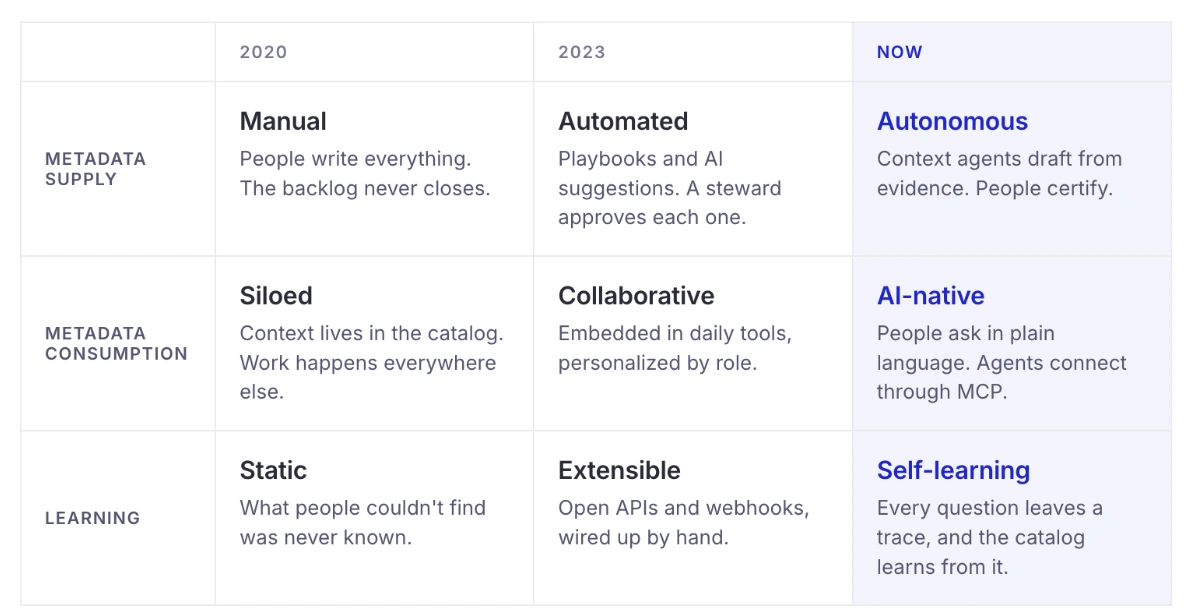
1. Autonomous: agents write, people certify
In an agentic catalog, supply no longer waits on people. Context agents draft descriptions, glossary terms, and metric definitions from the evidence a data estate already holds: how each table is queried, where it sits in lineage, what the BI layer says it means, and what the glossary already defines.
There’s a reason this wasn’t possible before. Catalogs were built as systems of record for people: a page per asset, read one at a time. Agents need something different. To draft context from evidence, they have to read lineage, query history, and usage across an entire data estate at once, and retrieve exactly the right slice at the moment they reason. The signals were right. The storage was wrong. An agentic catalog runs on a metadata layer built for machines, which is why we rebuilt ours as a Context Lakehouse: open, versioned, and queryable at the scale agents work.
Context also compounds. Each layer an agent builds, from descriptions to popular joins to the questions the business asks most, becomes evidence for the next one, until metrics, relationships, and a working ontology start to emerge.
Volume was never the hard problem. Any model can write a million descriptions overnight. The hard problem is whether the people who own the data trust them enough to put their name on them. That comes down to three choices: a bounded scope small enough to review properly, real evidence for the agent to draw on, and experts who certify before anything ships.
People don’t disappear from this picture. Their role moves up. Instead of writing from a blank field, data stewards review, correct, and certify. We see this as the rise of the context engineer: the steward’s role evolving to own whether an organization’s data is ready for AI.
2. AI-native: ask anywhere, get the same trusted answer
Outside of work, the way people find things has quietly changed. Instead of typing keywords and scanning results, they ask for what they need in plain language and expect an answer. Now they expect the same from their data.
A keyword is a guess about what someone wants. A question is the need itself, in full: the metric, the time range, the team, and often the decision behind it. “EMEA revenue on the exec dashboard dropped 30% last week. Is that real?” says far more than “revenue” ever did. Keyword search still matters, and plenty of people know the table name and want to go straight to it. But many real questions don’t fit a search box.
People aren’t the only ones asking anymore. AI agents ask too, pulling context through protocols like MCP whenever they need to reason about data. An agentic catalog serves both from the same governed context, so a person and an agent asking the same question get the same answer.
That makes the assistant interchangeable, but not the context behind it. Ask in Atlan, Claude, or ChatGPT, and the answer can only be as right as the context it reaches. And questions come in different shapes: a half-remembered table needs search by meaning, a sudden revenue drop needs reasoning, and an impact question needs one precise slice of lineage. A catalog has to handle all three, wherever the question is asked.
3. Self-learning: every question makes it better
This is the trait that changes everything, because it finally connects supply and demand. In the software world, we had to guess what people were looking for. In the AI world, traces tell us.
Every question leaves a trace: what was asked, what context was found, and whether the answer held up. Traces show, for the first time, exactly where context is thin. Simulations can take this further. They ask the questions people in each role are likely to ask, so gaps surface before anyone hits them.
This matters because when AI gets an answer wrong, it does so confidently, and the failure can live in one of three places: the context was never documented, the retrieval picked the wrong path, or the model wasn’t good enough for the question. Each has a different fix. Traces make the diagnosis possible. Without them, a wrong answer usually gets blamed on the model, and the real fix, often a missing definition or a search that looked in the wrong place, never gets made.
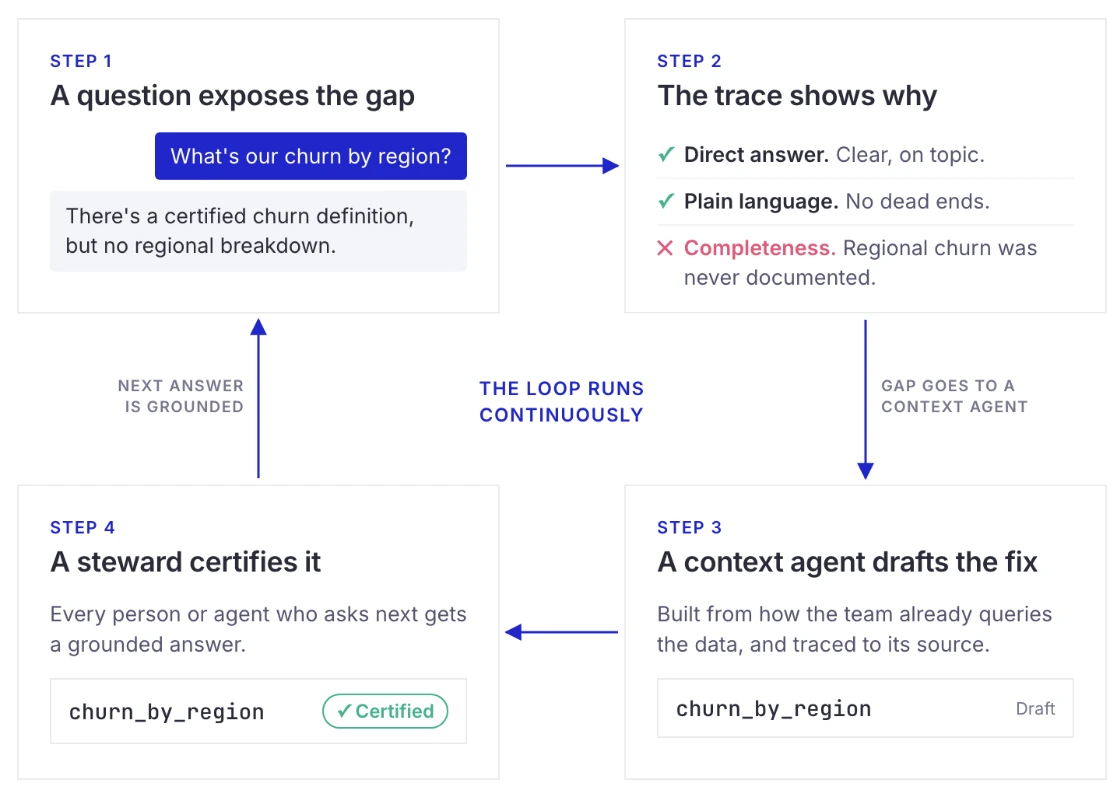
Take “What’s our churn by region?” There is a certified churn definition but no regional breakdown, even though an analyst computes one every week. The trace exposes the gap. A context agent can draft the missing definition from that query history. The steward who owns churn certifies it. Everyone who asks next, person or agent, gets a grounded answer.
Demand starts to tell supply what to build. The more people ask, the better the catalog gets.
The self-improving data catalog
That loop also changes how success is measured. Traditional catalogs were measured by coverage: assets documented, terms defined, users onboarded. Those numbers described inventory, not whether any of it helped. Agentic catalogs are measured by answers: did the person or agent find what they were looking for, and if not, why not? (Our guide to data catalogs for AI has a ten-question test for exactly this.)
For years, data teams could only measure coverage. So they documented what seemed to matter most, with little way of knowing how that context was used, or what people searched for and never found. Much of it came down to educated guesswork.
That black box is finally opening. Every question now shows a data team what to fix next, and an agent can draft the fix before anyone has to go looking for it.
Work that took days per domain now takes minutes per asset. Stewards are becoming context engineers, spending their time on the judgment calls only they can make. And the context they build serves people and AI agents alike, at a speed and scale that wasn’t possible before.
The catalog was always meant to help people do their best work with data. An agentic catalog can finally deliver on that, and help humans and AI do their best work together. The real test is simple. Look at the questions people asked your catalog last month. Do you know which ones went unanswered, and why? For most teams, that has always been unknowable. Now it is the first thing an agentic catalog can tell you, and the place where every improvement starts.