

Today Microsoft announced that Purview Data Governance is retiring, with end of support on Nov. 12, 2027, and governance moving into Microsoft Fabric with the OneLake catalog.
If you run governance on Purview Data Governance, you probably had one question when you read the news: what happens to everything we built?
It’s the right question. Someone on your team sat through the meetings where finance and sales argued about what “active customer” means, until there was one definition everyone signed. Someone tracked down an owner for every domain, one email at a time. Someone turned the tables finance relies on into data products other teams could trust. None of it happened fast, and it matters more now than when you started: in a poll of 250 executives by MIT Technology Review Insights, 35% named governance, risk, or IP concerns as the top challenge holding back AI progress. Losing that work now would mean rebuilding your AI’s foundation at the moment you need it most. You don’t have to.
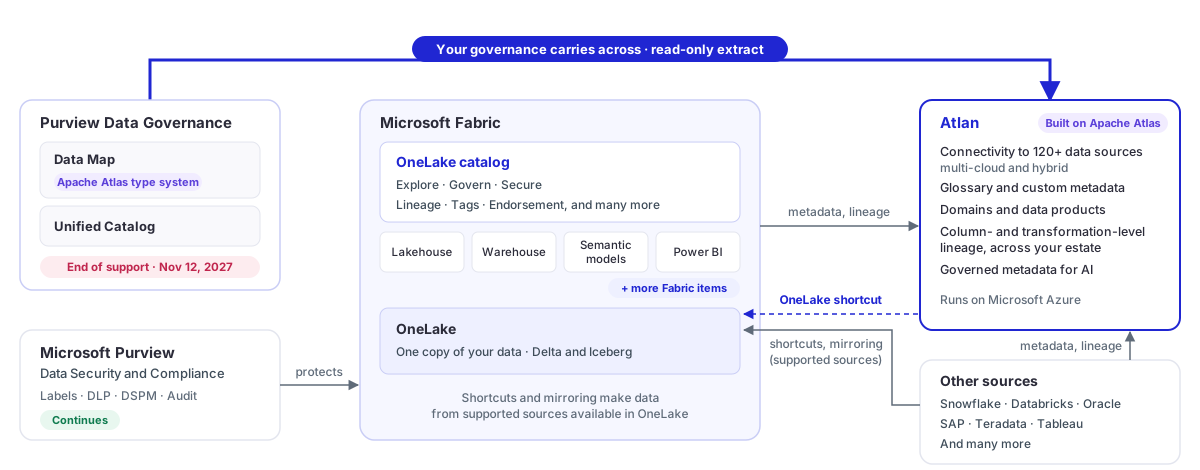
With Atlan, a Microsoft strategic partner, the work your team built in Purview Data Governance comes with you. Your glossary, custom metadata, classifications, and lineage carry across on the same open Apache Atlas model, so your team doesn’t rebuild anything from scratch. The OneLake catalog governs what lives in Fabric, and Atlan extends governance to every other system you run. Then Atlan turns that governance into context your AI agents can use.
"AI is only as trustworthy as the context behind it. Microsoft Fabric and OneLake provide a unified data foundation with governance in OneLake Catalog. Atlan's approach to metadata and governance helps customers extend trusted context beyond Fabric and across their entire data ecosystem."

Your questions, answered:
- What is changing in Purview and what isn’t?
- Do you have to start your governance work over?
- How should you plan your migration?
- How does Migration Studio move your work?
- Is the OneLake catalog enough for your governance needs?
- How can you build a data catalog that’s ready for AI agents?
- Where should you start?
What is changing in Purview and what isn’t?
What Microsoft announced. Purview Data Governance reaches end of support on Nov. 12, 2027. That covers Microsoft Purview Unified Catalog, the Data Map, and classic Azure Purview. Governance for data in Fabric moves to the OneLake catalog.
What isn’t changing. Microsoft Purview Data Security and Compliance isn’t retiring. Your sensitivity labels, Data Loss Prevention policies, Data Security Posture Management, and Audit stay with Microsoft Purview and keep protecting your data, in Fabric and beyond. Atlan works alongside them.
What you need to decide. Where the governance work your team built in Purview Data Governance goes next: your glossaries, domains, data products, custom metadata, owners, and lineage.
- RetiringPurview Data GovernanceUnified Catalog, the Data Map, and classic Azure Purview. End of support Nov. 12, 2027.
- ContinuingPurview Data Security and ComplianceSensitivity labels, Data Loss Prevention, Data Security Posture Management, and Audit
- Your decisionYour governance workGlossaries, domains, data products, custom metadata, owners, and lineage
Do you have to start your governance work over?
No. Today Atlan is announcing Migration Studio, which moves your Purview Data Governance work into Atlan with read-only access, and your team approves every step before anything moves. Your work carries across closely because Purview’s Data Map and Atlan both build on the Apache Atlas type system, so your classic glossary, classifications, and managed attributes map closely, and you don’t redesign them on the way in. Governance domains and data products from the Unified Catalog land as Atlan domains and data products.
What comes with you
Permalink to “What comes with you”- Glossaries, categories, and terms, with their synonyms, acronyms, related terms, status, resources, and the assets they describe. Classic Data Map glossaries stay their own glossaries.
- Governance domains and sub-domains, which become Atlan domains and glossaries, so every term keeps its home
- Data products, with their status, sensitivity, owners, assets, terms, and documentation links
- Custom attributes, both the definitions and the values. Fields with a fixed set of values become dropdowns in Atlan.
- Critical data elements, which arrive as custom metadata on every object they’re linked to
- Objectives, which become glossary terms with their key results, linked to the data products they cover
- Classifications on your assets, both your own and Microsoft’s built-in ones, which become Atlan tags
- Descriptions and display names on your assets
- Owners and owner groups, matched by email, with your experts and stewards recorded alongside them
- Lineage your team drew by hand, wherever both ends of it are in Atlan
What Atlan builds fresh from your sources
Permalink to “What Atlan builds fresh from your sources”- Your assets and their technical metadata, which Atlan keeps current from then on. For a source Atlan doesn’t crawl yet, Migration Studio creates the assets with all their curation, and moves that curation onto the crawled assets once Atlan connects the source.
- Lineage, which Atlan crawls from your sources down to columns and transformations wherever the source exposes them, and mines from query logs
- Data quality rules, which your team sets up again in Atlan with Atlan’s help
How should you plan your migration?
You have a year, which is enough time to do this well and not enough to leave it for later. The teams that migrate cleanly make a few decisions early.
- Take stock of what you’ve built. Map your glossaries, terms, domains, data products, and custom fields, and note which ones your teams actually use. Expired terms and draft domains are worth a deliberate call: bring them across or leave them behind. To bring a draft domain across, publish it first. Expired domains stay behind.
- Decide how your domains map. Purview’s governance domains can become Atlan domains, glossaries, or both.
- Line up your owners. Owners carry across when Atlan can match them to your Microsoft Entra ID users. Check who has left or changed teams before you migrate.
- Line up two admins. A Microsoft Entra administrator registers a read-only app for Migration Studio, and a Purview administrator grants it two reader roles. Nobody grants Atlan an administrator role.
- Connect your sources first. Atlan writes your governance onto the assets its connectors crawl, so connect the systems your glossary describes before you move the glossary itself.
- Run both systems side by side. Keep Purview Data Governance running until your team has checked what landed in Atlan and is ready to switch.
- Plan past the migration. Most of your estate probably sits outside Fabric, and your AI agents will need your governance as context. Decide now where both of those go next.
How does Migration Studio move your work?
Atlan built Migration Studio to move a whole Purview Data Governance estate in one guided flow, with your team approving every step. Atlan’s migration team, a Microsoft partner you already work with, or your own team can run it.
- Extract and analyze
- Review
- Move
- Run it again
- Extract and analyze. Migration Studio connects to Purview Data Governance with read-only access and extracts your estate for you, with no export files to wrangle. Pre-flight checks confirm it can read your Data Map and Unified Catalog before anything runs. The analysis report then counts everything it found and flags what needs attention: anything that would block the migration, anything that would drop data, and every decision your team needs to make.
- Review. Your governance lead decides where each kind of object lands in Atlan: glossaries and terms, domains and data products, custom metadata, tags, connections, and hand-drawn lineage. Keep what you want and change what you don’t. Nothing is written until you approve.
- Move. Migration Studio moves your governance first: glossaries, terms, domains, data products, custom metadata, tags, and lineage. Where a term, domain, or product with the same name already exists in Atlan, you choose which values win. A validation report then reads Atlan back and reconciles it against your plan. Then Migration Studio writes descriptions, owners, tags, and custom metadata onto your tables, columns, and Power BI reports, rewrites links that still point at Purview Data Governance, and adds owners as they join Atlan.
- Run it again. While both systems run side by side, extract a fresh snapshot whenever you need one. Migration Studio adds what’s new without duplicating what already landed, and keeps every decision your team made in Review.
At every step, you can check the work:
- Atlan never changes Purview Data Governance. It reads with read-only access and writes nothing back.
- The analysis report tells you what carries across and where your team will decide, before anything moves.
- The validation report puts what you planned next to what landed in Atlan.
- Every migrated term, domain, data product, and asset records where it came from in Purview Data Governance, so you can trace any object back.
- You keep Purview Data Governance running until you’re ready to switch.
Is the OneLake catalog enough for your governance needs?
The OneLake catalog comes with Fabric and governs your Fabric items. If your data lives almost entirely in Fabric, it may be all you need.
Most teams that invested in a governance tool did it because their data lives in more than one place. Your customer data might sit in Snowflake, your models train in Databricks, and finance runs on SAP. Atlan governs those systems where they run, across more than 120 sources, including Oracle, Teradata, and Tableau. Lineage follows your data at column and transformation level, from source systems through Fabric into Power BI, so when a number looks wrong in a report, anyone can trace it back to where it started.
Atlan goes just as deep inside your Microsoft estate. Atlan’s Microsoft Fabric connector catalogs lakehouses and warehouses down to columns, semantic models with their measures, reports, Dataflows, and pipelines, along with Power BI, Azure Synapse Analytics, Microsoft SQL Server, and Azure Data Factory. At FabCon Europe in September, Atlan was one of four spotlight partners for Microsoft Fabric and a launch partner for Fabric Platform Lineage.
| What you need | OneLake catalog | OneLake catalog + Atlan |
|---|---|---|
| Find and trust data | Fabric items with lineage, ownership, and endorsements, also inside Teams and Excel | Plus every system outside Fabric, in one search |
| Sources | Data in OneLake, including shortcuts and mirroring of external sources | Plus Snowflake, Databricks, SAP, Oracle, Teradata, Tableau, and more, cataloged where they run |
| Lineage | Lineage across Fabric items | Column-level lineage from source systems through Fabric into Power BI reports |
| Your governance work | A full set of governance features, including domains, glossary, endorsements, discovery, and OneLake Govern insights | Your glossaries, domains, data products, and custom metadata, migrated after your approval |
| AI and agents | Copilot and agents in Fabric | Plus Microsoft Copilot Studio and any MCP-capable agent |
| Security and compliance | Microsoft Entra ID, OneLake security, network security, and Microsoft Purview Data Security | The same. Atlan works alongside all of them. |
The integration runs both ways. Atlan’s Context Lakehouse makes Atlan’s context readable from OneLake through a shortcut, in early access, so your Fabric workloads can query the definitions, owners, and lineage your team governs in Atlan. Copilot Studio agents reach the same context through Atlan’s MCP server. Atlan runs on Azure, and your team signs in with Microsoft Entra ID.
How can you build a data catalog that’s ready for AI agents?
A migration is a rare moment: you’re choosing where your governance lives for the next decade. It’s worth asking whether that place can serve the agents your company is about to build, and not only the humans browsing it today.
Gartner data shows less than 10% of agentic AI implementations capture a strong return on investment. The gap is rarely because of the model. An agent that doesn’t know what “active customer” means in your company will answer a question about active customers confidently and wrongly, whichever model runs it. Gartner’s fix is context: by 2027, organizations that prioritize semantics in AI-ready data will increase their agentic AI accuracy by up to 80% and reduce costs by up to 60%.
Your governance work is most of that context already. The definitions, owners, and lineage your team built are exactly what an agent needs to give an answer anyone can trust. But a catalog that humans browse can’t hand that context to an agent. An agent needs:
- A foundation it can query at scale
- Context written for every asset it might touch
- A way to reach that context from the tools where it runs
- A catalog that notices when an answer goes wrong, and fixes it
That’s an agentic data catalog, and Atlan builds one on top of the work you migrate.
The Context Lakehouse is the foundation
Permalink to “The Context Lakehouse is the foundation”Catalog infrastructure built to render pages for humans can’t serve agents at the speed and scale they need. Atlan’s Context Lakehouse stores everything your catalog knows as open Apache Iceberg tables in your own cloud, so agents can read lineage, query history, and usage across millions of assets at once.
- Native vectorization. Atlan vectorizes your context in place, so you don’t copy it into a separate vector database.
- One store, every kind of search. Vector, semantic, keyword, and graph search run on the same store, and Atlan picks the fastest path for each question.
- Open to any engine. Any engine that speaks SQL can query it, including Microsoft Fabric through a OneLake shortcut.
Context Agents write the context your team never had time to write
Permalink to “Context Agents write the context your team never had time to write”Context Agents read the lineage, SQL, BI usage, and source systems already in your estate, then write descriptions, READMEs, and popular filters and joins, build out your glossary, tag each asset to its business domain, and score which assets your AI can and can’t trust.
As of October 2026, Atlan’s Context Agents have written more than 2 million descriptions across more than 200 organizations and saved more than 210,000 hours. Eighty-seven percent of customers say the output is on par with or better than human-written.

"The data stewardship role didn't disappear. It got upgraded. The work moved up: less drafting, more judging, and the coverage the same team maintains went up with it."
Atlan delivers context through AI-native protocols like MCP
Permalink to “Atlan delivers context through AI-native protocols like MCP”Your humans don’t search Atlan any more. They ask it questions in plain language and get one grounded answer. Your agents reach the same certified context through the Model Context Protocol (MCP), in Copilot Studio, Claude, ChatGPT, Cursor, or any agent that supports it, under the same permissions that already govern your data. Atlan’s MCP server now handles more than 90,000 tool calls a week.
The catalog learns from every failure
Permalink to “The catalog learns from every failure”A traditional catalog tracks fields filled: how many assets have a description and an owner. That can’t tell you whether an agent’s answer was right, and a failed search leaves no trace, so nobody learns what’s missing. An agentic data catalog learns from its failures and gets better with every one.
Rex, Atlan’s simulation engine, closes that loop. Rex builds personas for your teams, from a finance analyst to a governance lead, asks the questions they would ask, and stress-tests your catalog before you roll it out to them. When an answer fails, Rex diagnoses why:
- The context is missing, such as a description or an owner.
- The data is missing, such as a metric nobody defined.
- The context exists, but the agent retrieved the wrong slice of it.
Each failure needs a different fix, so Rex sends simple gaps to Context Agents and complex ones to the person who owns them. The next time someone asks, the answer is there, and the catalog keeps improving as your humans and agents use it.
Where should you start?
Request a migration assessment
Permalink to “Request a migration assessment”The assessment uses the same read-only access as Migration Studio, so Purview Data Governance stays untouched while Atlan reads it. You get a plain-English report of:
- What carries across as it is: your glossaries, domains, data products, and custom metadata
- Where your team will decide, such as how your domains map, or which values win when a term or product with the same name already exists in Atlan
- Anything that would block the migration or drop data, found before anything moves
- A dated plan that finishes ahead of November 12, 2027, with a quote
Buy Atlan the way you already buy from Microsoft
Permalink to “Buy Atlan the way you already buy from Microsoft”Buy Atlan through Microsoft Marketplace with a private offer. Eligible purchases count toward your Microsoft Azure Consumption Commitment (MACC), so you can fund the migration from a commitment you’ve already made.
Atlan runs on Azure in your region, with Microsoft Entra ID single sign-on, so your security team reviews it on infrastructure they already know. Atlan’s compliance covers AICPA SOC, ISO/IEC 27001 and 27701, GDPR, and HIPAA, with the details at security.atlan.com.
Set the date you switch
Permalink to “Set the date you switch”Keep Purview Data Governance running while you migrate. Once your team has checked the validation report and is working in Atlan day to day, pick the date you switch, with time to spare before support ends.
The work your team put in got you here. It should come with you.
