

Today, we’re excited to share that Atlan has been named a Leader in the 2026 Gartner® Magic Quadrant™ for Data and Analytics Governance Platforms for the second time in a row, positioned highest on Ability to Execute.
From being recognized as a Visionary in the 2025 report to being named a Leader twice, and now being positioned highest on Ability to Execute, it’s been quite a journey. We believe this recognition reflects our continuous innovation in the governance category, with products like Context Agents and the Context Lakehouse, and the progress we’ve made in helping enterprises move beyond traditional data governance, toward trusted context for humans and AI agents. More importantly, we feel it reflects the trust our customers have placed in us as they make that transition.
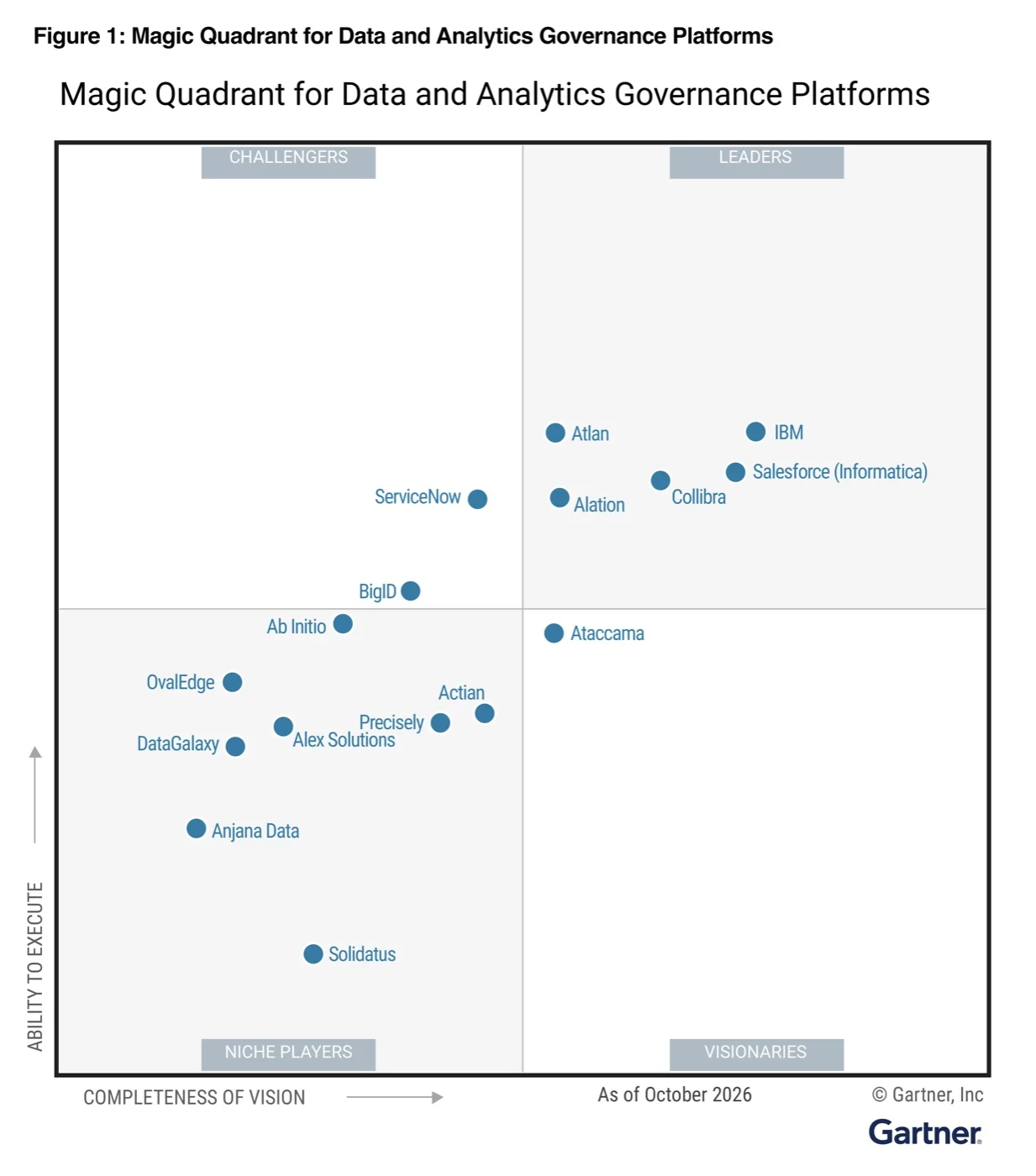
Read the full report: 2026 Gartner® Magic Quadrant™ for Data and Analytics Governance Platforms
Governance is becoming a foundational part of context for enterprise AI
Data and analytics governance platforms were built for humans. In the words of Gartner, they "serve (usually) as an abstracted, metadata-enabled layer across the multicloud, heterogeneous data ecosystem, allowing governance stakeholders, primarily nontechnical business personnel, to streamline and automate their governance tasks in collaborative workflows."¹
The governance problem hasn’t changed, but who governance serves has evolved. AI agents need the same definitions, owners, lineage and policies that people do, and they need far more of it, machine-readable and current every time the business changes. A governance program built for people to look things up can’t keep up. In a study Atlan commissioned with MIT Technology Review, 68% of organizations ranked governance, business understanding or trustworthy outputs as their number one barrier to AI.
The Gartner report names three significant innovations reshaping this market: Policy as Code for Continuous and Runtime Enforcement, Dual Plane of Context and Control for Trusted AI, and Agentic Stewardship. On the second, Gartner writes: "The market is extending its value proposition as a shared context layer that connects business definitions, policies, ownership, data quality, lineage and technical assets across structured, unstructured and AI-related data."¹
To us, those three trends describe one evolution. Governance is moving from managing data for people to providing trusted context for people and AI agents, and it is becoming a critical foundation for enterprise AI. Agents help with stewardship, people certify the results, and the same policies apply to every person and agent that uses them.
We realized early on that the governance platform we envisioned couldn’t be retrofitted onto tools built only for human users. It had to serve two kinds of users from the start: people, and the AI agents working beside them. These are the principles we’re building Atlan on.
Context is created autonomously, and certified by humans. No company has enough stewards to write down everything its agents need to know, and no program survives a two-year documentation effort. Agents should draft context from the work the business already does, in SQL, dashboards and documents, and ask people for help where judgment matters. People stay on the loop for what ships. Stewardship becomes a new discipline: reviewing, certifying and owning the context AI runs on.
Context and policy are governed like code. Gartner sees policy heading this way: "The market is moving from documenting policies to defining them as versioned, machine-readable rules that can be tested and promoted through CI/CD, and continuously reevaluated as data, schemas, code or events change."¹ We apply that discipline to all context, not only policy. Definitions, metrics, ontologies and skills get owners, versions, tests and rollback, and they improve from how agents actually use them.
Context stays open. Context is a company’s IP: how it defines its customers, measures its business and makes decisions. Companies will rent intelligence from many models. They should own their context, in open formats on storage they control, readable by every engine, harness and model they choose. Apache Iceberg made data interoperable across engines. Context needs the same. Atlan doesn’t sell compute or models, so our incentive is to keep your context portable.
Agentic stewardship: agents draft, people certify
The hardest part of governance has always been getting the business written down. Most companies have years of business logic and rules sitting in SQL, dashboards and people’s heads, and stewards who can document only a fraction of it.
Context Agents build your semantic model from the work your business already does. They read SQL history and BI formulas, then write descriptions, metrics and ontology, each with a confidence score. Your experts review and certify what goes live. Any model can draft an ontology. Making it accurate takes a context quality pipeline, the way data needed a data quality pipeline: evidence, confidence scores and owner review before anything ships.
87% of customers say Context Agents’ output is on par with or better than human-written. Once context is certified, Atlan’s MCP server carries it to the AI agents you run, and when a definition changes, the agents get the change.
Mastercard’s AI and data governance team enriched more than 30,000 assets in two weeks, saving 6,200 hours of steward time, with stewards reviewing and certifying every draft.
The accuracy gains are larger still. On Atlan’s analytics benchmark of 107 real business questions, five frontier models working from a bare schema scored between 29% and 40%. Switching models moved accuracy by 11 points. Adding certified metrics and verified queries, generated by AI from past SQL, took accuracy to 83% with no human intervention. Our forward deployed engineers have published the method behind those numbers as an open-source playbook for analytics agents.
Our approach matches where Gartner sees agentic stewardship today: "The market remains largely agent-assisted rather than fully agentic, with leading solutions combining automation with confidence scores, evidence, human review, permissions, audit trails, exception handling and rollback."¹
“All of the work that we did to get to a shared language amongst people at Workday can be leveraged by AI via Atlan’s MCP server,” says Joe DosSantos, VP of Enterprise Data and Analytics at Workday.
A Context Lakehouse architecture built to serve humans and agents
In Atlan, people and AI agents work under the same governance: the same definitions, the same policies and the same certifications.
Data owners and stewards write policies as versioned rules tied to the glossary terms and assets they govern, so one change reaches every asset it covers. Trusted data ships as certified data products, with contracts and quality indicators attached. An analyst browsing the marketplace and an agent querying through MCP see the same certification and the same restrictions.
Underneath it all is the Context Lakehouse, an open, interoperable context store built on Apache Iceberg. Atlan stores everything it knows as open Iceberg tables in your own cloud, so agents can read lineage, query history and usage across millions of assets at once. Context is vectorized natively, so there’s no separate vector database to keep in sync. One store runs vector, semantic, keyword and graph search, and Atlan picks the fastest path for each question. Any Iceberg-compatible engine can query it with SQL, every historical state stays queryable for audit, and agents reach it through MCP, A2A, SQL and APIs.
“Atlan’s metadata lakehouse is configurable across all our tool sets and is flexible enough to get us to a future state,” says Andrew Reiskind, Chief Data Officer at Mastercard.
Govern your whole stack through an open ecosystem
No governance team starts from zero, so Atlan is built to add to the stack you already have.
Atlan’s open App Framework runs partner- and customer-built apps as first-class parts of the platform. The security, classification and quality tools you already own keep working inside your governance program. With 120+ connectors, and go-to-market partnerships with the cloud data platforms and hyperscalers you already run on, the ecosystem reaches well past the platform.
How the agentic era is forcing governance to evolve
At Atlan’s flagship Context Conference in October 2026, we said that enterprise AI is now multi-harness, multi-model and multiplayer. People work across Claude, ChatGPT, Copilot, Slack and Teams. Teams build agents on several platforms at once, and each platform keeps its own memory, so two agents can give two different answers to “what was revenue last quarter?” Governance has to cover a connected system with three parts:
- Actors: people, and the agents working beside them.
- Artifacts: the skills, tools, metrics and ontologies that hold how the business works.
- Activity: the traces, outputs and feedback from every run.
In that system, governing AI means governing the artifacts behind it. When finance changes a refund policy, every support agent that uses the refund skill should get the new rule the moment it’s approved. When an analytics agent keeps missing on the same metric, the trace should reach the metric’s owner, who fixes it once for every agent. Agents learn from each other only when they share the same governed artifacts.
That’s why we open-sourced AI Registry, an open standard for AI registries released under Apache 2.0. It does for AI context what npm did for code distribution and Apache Iceberg did for data. A registry is a set of files in one open layout, on storage you already own like a Git repo, so every harness and agent can find the current, approved version of a skill or agent. Skills and agents work today, with MCP servers and metrics next.
And it’s why we built and announced Atlan Trident, the shared context workspace for humans and agents. Trident brings skills, metrics and ontologies into one place, finds the agents and skills already running across Claude, ChatGPT and other tools, and manages them like code: versioned, scanned on arrival, and pinned for critical agents until a new version passes evals. Every run flows back to the artifact’s owner, so context gets better with use. Trident also gives one view of every agent, its cost and whether anyone uses it. We ran it on ourselves first: 130 agents in production, 53 of them active in the last 30 days.
Evolve your data governance strategy with Atlan
We’re grateful to the customers who build with us, and to the governance teams doing the crucial work of helping AI understand their business. As companies move from AI-ready to agent-ready, that work decides whether AI agents get the answer right. We’re building Atlan so it does.
You can download a complimentary copy of the 2026 Gartner® Magic Quadrant™ for Data and Analytics Governance Platforms on our website.
¹ Gartner, Magic Quadrant for Data and Analytics Governance Platforms, 12 November 2026, Anurag Raj Et Al.
Gartner does not endorse any company, vendor, product or service depicted in its publications, and does not advise technology users to select only those vendors with the highest ratings or other designation. Gartner publications consist of the opinions of Gartner’s business and technology insights organization and should not be construed as statements of fact. Gartner disclaims all warranties, expressed or implied, with respect to this publication, including any warranties of merchantability or fitness for a particular purpose.
Gartner and Magic Quadrant are a trademark of Gartner, Inc., and/or its affiliates.
This graphic was published by Gartner, Inc. as part of a larger research document and should be evaluated in the context of the entire document. The Gartner document is available upon request from Atlan.
