
About this demo
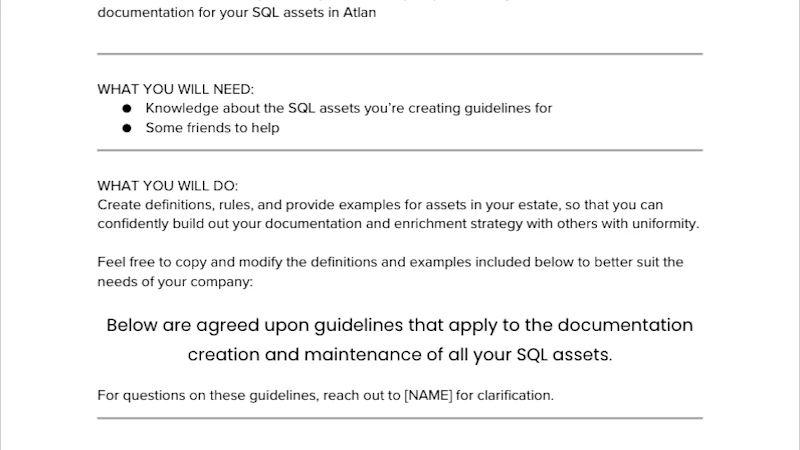
This resource provides a ready-to-use SQL Asset Guidelines Template, designed to help organizations establish clear, consistent, and effective documentation practices for their SQL assets in Atlan. It offers detailed instructions, rules, and examples to ensure teams can confidently name, describe, certify, and govern SQL assets while maintaining uniformity across the organization.
The guide begins by defining what SQL assets are—tables, views, and models that store and manage data—and sets standards for naming conventions. It recommends creating business aliases that are descriptive, distinct, jargon-free, and formatted in title case, ensuring that names are both intuitive and aligned with best practices (pages 1–2). It also emphasizes ownership by requiring asset creators and admins to assign themselves and others as responsible parties, preventing duplication and ensuring accountability (page 3).
Documentation standards form a major part of the template. It provides guidance on writing asset descriptions that are full sentences, clearly describe content, and include examples of the data stored (pages 3–4). It also covers the use of Announcements to flag issues, share updates, and notify users of warnings, with structured categories like information, issue, and warning (pages 4–6).
The template further outlines governance tools such as Tags, which group related assets for easier discovery and access control (page 7), and Certificates to indicate asset reliability with statuses like Verified, Draft, or Deprecated (page 8). It also highlights the importance of assigning and transferring Ownership with clear processes, approvals, and knowledge transfers (pages 9–10). Finally, it introduces Linked Assets, showing how SQL assets can be connected to glossary terms and metrics to improve transparency and alignment across the organization (page 11).
By following this template, organizations can improve data clarity, reduce duplication, ensure accountability, and scale governance practices. It serves as both a training aid and a practical reference for building out robust SQL asset documentation strategies that align with business needs and foster data trust.