Episode three of WTF is the Context Layer? David Mariani explains what a semantic layer did in the BI era and why it matters more now that agents ask the questions. He separates the semantic layer from ontologies and transformation, demos Claude answering sales questions through a semantic engine, and closes with advice to start from your highest-priority use case.
0:00So welcome everyone. I am so excited to be back after a very jam-packed June with Databricks Summit, Snowflake Summit. I think I was on the road every single week. Dave, I'm sure you were as well.
0:11I'm really excited to be joined today by Dave Mariani, who's the co-founder and CTO of AtScale. We're gonna dive into all things semantic layer versus context layer. But first just some housekeeping. Where are we at today? What are we talking about? This is the WTF is a semantic layer or a context layer webinar. There's so many terminology being there's so much terminology being floated around the industry right now, whether it's semantic layers, context layers, context graphs, ontology graphs, graph databases, knowledge graphs, you name it. I think there's a new one every single week and it doesn't get any more helpful whenever there's vendors obviously adding to this as well.
0:49And so what we're trying to do is just establish expertise across certain topics and that's what we're gonna do today with semantic layers in particular. Some fundamental questions that hopefully we can leave today answering more confidently, which is, how is a semantic layer different from an enterprise context layer? When every platform you're probably utilizing is shipping some form of a air quotes semantic layer who ends up owning that business logic? And then lastly, the semantic layer existed probably longer than I've been in data and analytics and around the industry. I think in the early nineties was the first time semantic layers came about in some of the original BI platforms. So why now?
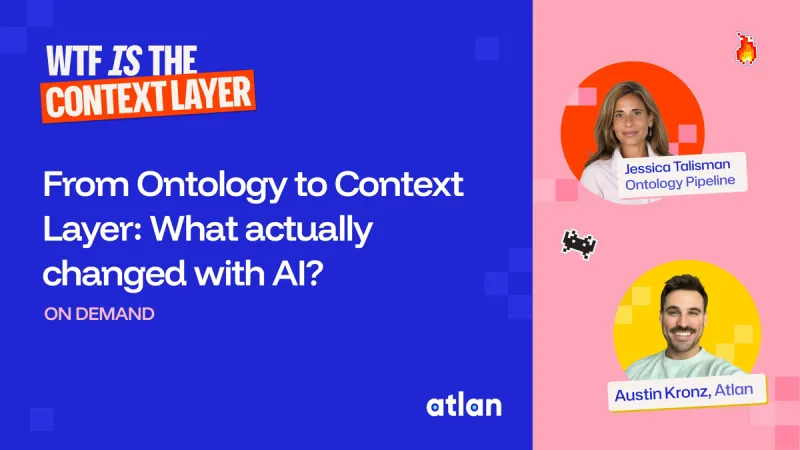
1:29What has changed in the AI era that these are sort of back in style or have become mission-critical yet again? And before we get into the episode and I stop sharing screens and get to the, the real content, I do wanna plug our next episode where we'll be talking probably one of the next hottest topics in the space right now about ontologies. So we'll be joined by Jessica Talisman, who's the founder of the Ontology Pipeline, to talk all things ontology. And with that, let's get rid of these slides and get into what you came here for. Dave, thank you so much for joining us today. I'm excited to work with you again.
2:04You and I have crossed paths back in my Gartner days. So if Mm-hmm... Can please just give a quick intro of yourself and, and AtScale, and then we'll get into the questions.
David Mariani
2:13Yeah. Thanks. Thanks, Austin, and and thanks everybody for listening. But yeah, my name is Dave Mariani, CTO and co-founder of AtScale. AtScale is a a universal semantic layer platform vendor. So we started the company thirteen years ago, so not quite thirty years in semantic layers, but semantic layers have been around forever. But the concept of an independent semantic layer is one that was new, and it was one that we in, that we sort of introduced to the market. So we've been working for the last thirteen, fourteen years talking about how the importance of the semantic layer, and I think I've talked to Austin a lot when he was at Gartner about that.
2:58And it really wasn't until, I guess, Gartner Summit, like in the, the, not the last summit, but the summit before, where Gartner actually said, "Yeah, semantic layers are important in this new era of AI," which is what we're gonna talk about.
Austin Kronz
3:13That's awesome. Yeah, I, I, I know I've said it many times. I'm very excited about this topic. I think in my conversations with customers, the, the number one thing that comes up definitely is how do we provide the right semantics to, to AI? And I think every customer also has some version of it, right? Where that lives and if it's universal or not is probably the bigger question.
3:33Before we get into some of the baseline of this, just if I say what is the semantic layer's job in the AI era, what have you been telling customers?
David Mariani
3:42Yeah. So in the AI era so well, let's just, let's just talk about what it did in the BI era because I think it is important to to make the connection. So you know, when we founded the company it was, what we, what we saw that was confounding enterprises is that you know, with the introduction of sort of self-service BI tools the data estate went from one that was sort of controlled and centralized to distributed and and federated.
4:16And so people started to create their own versions of the truth. And the semantic layer was really sort of the way to sort of bring back that single source of truth, that control over what a metric means, what, what the business semantics means, mean but also still allow the, the business users to be able to create their own data products. So that single source of truth, that grounding that's even more important now with AI because the grounding was important in the BI era because you had humans using their tools like Tableau, like Power BI, to ask questions.
4:57Now you have agents and there's no oversight, there's no human oversight there, and they can ask a lot more questions a lot more quickly than our, than us humans could ever ask. So I think it's, it's much more relevant now in the AI era just because the velocity has changed, but the, the, the focus of truth and and, and single source of truth, that goal has not changed for enterprises. Definitely not changed in the AI era. So I think that our position is like when, in terms of context layer, we think that the context layer is a stack. It's a stack, and ontology is, ontologies are part of that stack.
5:41But we think that the semantic layer is like the load-bearing component of the context layer stack, and it's the tier, it's the component that is, that makes AI deterministic. And that means that, that means that you can trust the number. So you're not letting AI Go after your raw data and, and basically come up with your metrics. You are giving it a curated set of metrics with which its, its AI can be creative and probabilistic, which is what you want it to be, but not probabilistic when you're calculating revenue or gross margin.
Austin Kronz
6:25Yeah. That's, that's really helpful. Yeah, I, I think as novel as the AI components are that, you know, coming into a board meeting and finance and sales have two different definitions of revenue has been something that we've been dealing with in the BI era for a very long time. And now you just have, I think you said, the, a significant increase in volume of those types of questions, so that's helpful. So let's maybe get to some fundamentals, right? Like, what does the semantic layer actually provide? When organizations are doing this, like, how are they even accomplishing this without a semantic layer today?
David Mariani
7:04Yeah. So I mean, look, the, there, there's, there are, and, and, and it was the same sort of, there's the same sort of options, some of the same options you had in the sort of BI era for semantic layers. So what, what, what are some of the, what are some of the what do some of the, some organizations do without a semantic layer? Well, what they could do is what they've always done, which is basically hard-code those definitions into the analytics tools. And so in the BI era, that was basically making Power BI your semantic layer, even though you may have Tableau users, and so you have semantics over there.
7:41That sort of created that semantic sprawl and created that, all the sort of the lack of trust that enterprises had in the, in the BI era. Well, in the AI era, you could also do the same thing. You can hard-code those semantics into your agents as skills. I, I think everybody's, a lot of people saw the Anthropic blog post where they sort of used skills to build their semantic layer, what they're calling their semantic layer. Well, you could do it that way and that may work for that use case, but gosh, is that brittle and is that not scalable across a larger enterprise.
8:21You could also, today, is you could build those semantics into your pipelines. But the problem is, is your pipelines aren't queryable. So you can sort of transform data and create a gold layer but then you gotta again, let your agents traverse that gold layer and hope that it gets and selects the right columns and, and calculates that revenue and gross margin correctly. And you know, you can you can also go with some of the data platform options. So Databricks and and Snowflake introduced their their version of semantic views. Now the problem with those approach is that you're now tied to those data platforms.
9:05So we kind of risk repeating the same sins of the past where we tied semantics to the BI tools. Well, now we're talking about tying semantics to the data platforms. So it comes ball back, Austin, to that whole universal concept. We think it's really important that your semantics live independent of the data and independent of the consumption style.
Austin Kronz
9:33Yeah, makes sense. You're talking about tied to the individual platforms, you know. I think, you know, every large enterprise, you talk to someone who says, "Hey, we're, we're all on Snowflake," and then you find out and actually it's Snowflake, Databricks, they're still on-prem in some areas, they're in Google for other area. There's, it's hard to find a true shop anymore. Like, you're rarely on, on one platform. Very heterogeneous tool landscapes and, and large customers.
David Mariani
9:58Well, you know, Austin, it's not just where you are today, it's also where you're going or where you will be. So, you know, with, with Iceberg as a format, as a independent format, now, you know, every company I talk to is looking to land their data in Iceberg format. Now why are they doing that? They're doing that because they wanna be independent of the data platform. They wanna choose the cheapest and best engine for the job, which means they don't want to be tied into Databricks or into, into Snowflake. That's why they're doing Iceberg.
10:33So, so it's, it's we don't know, just like we don't know how, how our analysts or business users or any users are gonna query the data in the future because there's new tools popping up all the time. We also don't know what engines are gonna be available to actually access and store that data. And so it's really important not just to what, the, to deal with what you have today and the, all the heterogeneous mess that that is, but also anticipate the future and not lock yourself into one particular consumption style or storage format.
Austin Kronz
11:13Yeah. I think Iceberg was a catalyst for a lot of different things, and there's a lot of parallels. You mentioned context as a stack.
11:20At Atlan, we kind of see the same thing in terms of how do you become the most interoperable and future-proof platform in an enterprise. Well, it's allow you, whatever your agentic development platform may be, there should be sort of this agnostic context layer that if you want to pivot from one, you know, you're building everything in Genie today, you want to move into more operational LangChain agents, or you're building in Google, in ADK or AWS, like wherever it might be, today, tomorrow, there's even some maturity there. You should be able to,... Leverage the context in any one of those platforms or systems or tools.
David Mariani
11:55Yeah. Y-y-yeah, I mean, completely agree. And you think about, Austin, like what is more important than the semantics of your business? I mean you know, there was a, a big hubbub because Alex Karp went on CNBC and talked about your alpha and talked about how how AI's— about, about AI sovereignty and how important it was to not basically share your your competitive and competitive knowledge with these frontier models. You're giving it away. It's, it, it is. It's your it's your competitive corpus is your semantics of your business and how it runs. So why would you want to give that to a single vendor or a single platform?
12:42It's yours to own and yours to protect because it is what differentiate, differentiate you from your competitors.
Austin Kronz
12:51Yeah. I, we, I think very similar to what Alex was saying, context is IP almost. When— Mm-hmm. If models are commoditized, if you have access to the same model as your competitor, well, the intelligence is relatively commoditized. The thing that makes you different is just how you do business. And in the agentic world, how you do business gets codified into semantics, skills, knowledge all these types of things. So I, I completely agree.
13:20You mentioned— Yeah. It's, it's... I was gonna say, it seems like everyone has agreed that, at least for now in the agentic era, that semantic models are very helpful, but the semantic layer piece is something that... Where do you see customers kind of coming to that realization? Do you have to go down the path of, sure, build it in an individual tool first and then you'll realize the pain of trying to switch? Or, like, how are you working with customers to build out more of a semantic layer strategy rather than just understanding that semantics are important?
David Mariani
13:53Yeah, you know, I mean, look, it's like it's a, it's a big, you know, it's a big thing to, to bite off, but because it's like a, a lot of companies are just not you know... They're, they haven't invested in semantic layer because they've been been able to get by with with process and humans and, and just deal with the fact that numbers are wrong some of the times. A-and it, it just, it just, you just can't, in this AI age, we that's just not, that's not acceptable. It's... And, and no enterprise, as you know, is gonna let AI just crawl over their data and generate generate wrong answers fifteen percent of the time.
14:35I mean, you, you, you went to the, the Databricks conference, right? And Ali is on stage saying, you know, "Ontology, Genie Ontology gets it right eighty-four and a half percent of the time." It's like, what? So you're gonna be wrong more than fifteen percent of the time? You're gonna get fired if you're wrong more than fifteen percent of the time. That's just how it's gonna be, and you can't make decisions that way. So so I, I think it's important for so for, for customers to to, if they wanna get started, right, is to really think about what... First of all, identify your most important metrics.
15:10One of our customers is, was, had a really good process where they went and started with the people, the people first. And they said, "Okay, first of all, what are our core metrics? Let's figure out what those are, and then let's figure out who owns those core metrics. And then once we figure out who owns those core metrics, then we can start to put a, put those into semantic models, and then we know who, who actually owns those metrics, so that when they change, we know who's the, the, the, the, the owner of that change and, and the, and has the ability to actually change that definition when the business changes."
15:49And just starting with that was a really good place, was. And then encoding it into semantic models, so then you can unleash it on BI and AI, was sort of the next step. But you can't skip that first step, is what I'd argue.
Austin Kronz
16:06Makes sense. Yeah, I completely agree. I, I wanna get into, you know, the, the whole point of this webinar series, podcast series is kind of there's a lot of terminology out there, and the one thing I've noticed in conversations are I could be ten minutes into a conversation, and I have to very purposefully kind of check myself to say, "I know we're both saying semantic layer right now, but what do you mean when you say semantic layer?" And so maybe if you could just level set with us, like where does the semantic layer start and end? What do you view as not the responsibility of the semantic layer?
16:37Just give some information on like how do you view it and when you're working with customers.
David Mariani
16:42Yeah. So, so our definition of a semantic layer is that a semantic layer has a semantic engine meaning that it computes... So some semantic layers describe metrics.
16:56We think a semantic layer needs to compute metrics. That's a big difference, right? So describing revenue is different than answering a query that's when somebody's asking for revenue and computing the revenue. And so, so that's the big difference between our definition of a semantic layer. What it does is it has a semantic engine. So, so let-let's just go through, I think, what the haves and have-nots. So what they, what a semantic layer does and what it doesn't do. So a semantic layer definitely is defines metrics and calculations about your business. It doesn't do storage or compute. That's the warehouse lakehouse layer.
17:42A semantic layer does aggregations and controls grain and the grain of those, of those aggregations. It doesn't do cataloging and discovery and all the lineage, the stuff that you guys do, right? So we're complementary in that. So we're, we're not gonna do that, create those, just, you know, basically crawl your data and and, and catalog that for you. The semantic layer does and figures out how to to, to join data. So not all data is just left join, right join, inner join. There is semi-additive measures. So you have inventory. You can't just sum up inventory. Inventory is a first and last issue.
18:27So if you wanna know what the inventory for July is, you don't sum up all your SKUs for July, 'cause that tells you how much you had in your warehouse all during July. You wanna know what your, what your, your inventory level was for a SKU on July 1st, that's your first, and, and July 31st, that's a last. That's a semi-additive metric, which is really important when you then bake it into a further comp-compu-computation. Many to many joins. It's very important to be able to handle those constructs. So that's what the semantic layer owns. It doesn't own unstructured data or documents. That's, that's RAG. So a semantic layer is not gonna deal with unstructured data.
19:11It's gonna deal with pretty much semi-structured or well-structured data. A semantic layer's job is to deliver deterministic query results. And it's not its job to reason and plan on which queries to run. That's what the agent or the LLM does. We want the agent to be really creative and a-ask questions and then get the results, explore, and and ask deeper questions. We want it to do that, but we don't want it to compute revenue. We want it to ask a question about revenue. We don't want it to compute its own version of revenue. And then security and governance. So it's really important for a semantic layer to, to, to govern.
20:01And so what that means is that whether Jimmy is building a Tableau dashboard if Jimmy can only see the Western region or Pacific Northwest because that's all he has providence on, then when Jimmy then turns those dashboards into an a an agent that they run through Claude Cowork and it ends up, you know, instead of, you know, producing dashboards, producing a set of alerts that then get emailed to him every day, we wanna make sure what that agent is doing also is only looking at acting as Jimmy, who only has access to the Pacific Northw-Northwest region. So it's really important that the semantic layer governs that.
20:51But the semantic layer is not gonna do pipeline, data pipelines. It's not gonna do data transfer, transformations. It's not gonna create your bronze and silver layer.
21:01It could become your gold layer, 'cause you could use a semantic layer as your gold layer but it's not gonna do all your data pipeline work. That's the job of the data transformation tools like DBT and the like. Does that help?
Austin Kronz
21:16That's perfect. Yeah. I... Like I said, sometimes we're talking past one another on calls, and so it's good to say, like, this is the, this is the precedent going forward for the rest of the conversation. So I think that's really good. You brought up an interesting piece about, like, recurring questions and getting the same answer multiple times. There's probably some tangent we can go on about at what point do you not need an LLM for this use case? Like, is there still a place for more deterministic kind of BI type like reporting, consistent reporting? Or do you think everything— Yeah, I guess—... Is going the language route?
David Mariani
21:50So what, what I've seen is that, so we're working on a benchmark right now where we don't just measure the accuracy, we measure the determinism of the accuracy. Meaning we run the, we run, we run the, the question multiple times and see if it comes up with the same answer all, all times. Because what we see here is, like, the problem with LLMs is it, it can get it right on Monday and then do something completely different on Thursday. So when you think you got it covered, you really don't.
22:20And so the, the true measure of a of a semantic layer's accuracy when it comes to AI is that you just don't get a one shot at success, that you need to get, you need to get success every time. So it's gotta be deterministic not just one time, it's gotta be deterministic every time, every day, and every time it's asked. And, and, and of course, people ask the same question in different ways. So so, so, so we're gonna be talking a lot about that in the future is, is coming up with a way of measuring accuracy that's not just a one shot, but it's a, you know, to measure determinism across time.
Austin Kronz
23:03That's really... Yeah, the accuracy piece is, is really interesting. Over the temporal element of accuracy is really interesting. You also I've been following a lot of the blogs you've been writing over the past couple months, and you talk about cost too, right? Like an LLM just repeatedly trying to go find something, the cost can rack up. Can you share a little bit about how semantic layers might help with not only accuracy, but kind of the cost piece?
David Mariani
23:28Yeah. And, and, and I have to again go back to the, the BI era. So what happened when, when, when customers moved from on-prem Oracle to Snowflake in the cloud? Well, you know, everybody's like thought, "Oh, I've solved all of my performance problems with Oracle 'cause I now have cloud compute and it's endless, and I can just use as much compute as I want and it'll solve all my, my, my performance problems." No it didn't. They still had to build extor— Tableau extracts or still do Power BI import mode.
24:00So a semantic layer is not just answering computing metrics. It's not just that semantic engine. That semantic engine also needs to manage performance. Which means in the warehouse, you can't be scanning... We have customers with seven hundred and fifty billion row fact tables, multiples of those. There's no way that you can do and answer a question, an AI can answer a question, a BI tool can answer a question if you're scanning seven hundred and fifty billion rows. It just doesn't work. So the semantic layer also has to compute aggregates and then use those aggregates where appropriate. And so now that carries right over into the AI space.
24:44So when you're looking at costs, you're looking at two dimensions of cost. The, the first dimension of cost is your, your data platform cost, your compute cost to actually go and get the query. The second piece is your token cost. How much is it, how many turns does it take to actually generate the query that it thinks it wants? And so the semantic layer helps on both fronts. It reduces the compute cost because we're not scanning tables over and over again. And we have a semantic engine to get right to the right answer in the lowest cost way.
25:22And because we provided simplicity to the agent, we've made it so that it takes less turns to get to the answer, and so we've lowered token costs. So it's on those two fronts, Austin, on compute on the data platform side and on token costs on the AI side.
Austin Kronz
25:43Yeah, that's really helpful. I do wanna talk about again, the sea of terminology that's out there. Like you said, you and I were both at the, the Databricks conference. I was at Snowflake conference as well. You know, there's some announcements with AtScale and Snowflake together as well. Semantic layers and ontologies. It seems like Snowflake getting more into the semantics world. People are working with semantic views, and now there's Cortex Analysts, Cortex Agents, Coco, Cowork, you know, et cetera. And Databricks, I think, announced everything. They do everything now.
26:21Are you getting questions first and foremost about semantic layer versus things like ontology? And how do you navigate these types of conversations or how do you see the difference, the relationship, better together kind of piece here?
David Mariani
26:33Yeah. Let me... Do, do you mind if I share something Austin?
26:37Okay, let's go ahead and let's do a share. Let's see. Tell me if you if you can see my slide here.
Austin Kronz
26:46I can. I see. Yep. How semantic— You see it? Yep.
David Mariani
26:50Okay. Okay, so sorry, I'm gonna break this down. So so this is this is how a semantic engine, a semantic layer works when it comes to context, right?
27:01And so there's a lot of confusion over ontologies and, and, and, and, and part of the confusion is that we actually use an ontology to actually do the translation of logical to physical. Okay, so an ontology, in this case, let's just begin on the left. Here's, we have our data sources. So ontologies could be a data source 'cause an ontology could, provides the entities and the relationships of those entities. We also have the physical schema, the tables and the columns and the comments and the primary keys and the foreign keys. This is all context that can then go in to build a semantic model.
27:40So the the semantic model does is it basically ties together the logical and the physical. So the ontology could be, is the logical, the schemas are the physical. So now it has that map, and you can build that semantic model, those semantic models, you can build them with humans, with agents or a little bit of both, right? So we've now sort of incorporated that. So an ontology could be a component that, that, that is part of a semantic layer in, or informs the semantic layer. Now then what happens with AtScale, this is the way we do it.
28:19What we do is we take that semantic model, which is a YAML file, and we compile it into a knowledge graph. It's a weighted directive, directed graph. Why is it weighted? Remember I talked about those aggregates, is that the semantic layer needs to manage performance. Well, an aggregate is a node in the graph. So if we think we can give you your answer against using an aggregate table rather than the seven hundred and fifty billion row table, well, our, our knowledge graph will then, will, will point us to that. So our internal knowledge graph, which is a dimensional knowledge graph, is used to then construct the physical queries that it sends to the warehouse.
29:05So now you have, you know, you have your applications and your BI tools talking to your semantic engines. Your BI tools are talking, Excel is talking MDX, Power BI is talking DAX Tableau is talking SQL, notebooks are talking are, are talking data frames, and now you have agents which are speaking MCP. And and by doing that, we're then taking these logical questions, they're coming in through agents, applications or tools, and then translating them into more complex queries, so that's where things become deterministic. Okay, so what is the alternative to that? The alternative to that is this.
29:52So I can go ahead and have, the agent can have direct access to that corpus of information that you have.
29:59And then what that's gonna do is that then the agent is gonna use that to go and directly access and form queries against your warehouse. That is, in our, in our view, that's where things can get off the rails Austin. Because—. Because, because now you're counting on the agent Understanding the business context and computing the metrics itself, and generating queries against your raw data in your warehouse. By having the semantic model and having this in between, having this layer in between, this is how we deliver deterministic determinism for those agents. Because now the agents, that semantic model to an agent looks like one table, one flat table.
30:49It doesn't worry about joins. It doesn't worry about first and last. It doesn't worry about min and max. It doesn't worry about many to many. It doesn't worry about left outer join, right outer join. It doesn't worry about what table is, revenue is in, 'cause it's in six different tables. It doesn't have to do that. We just made it really simple for them.
31:15Yeah. This is, this is really helpful. I think it, it kind of clarifies a, a lot of the questions. There are two questions in the chat that are relevant to what you're sharing, so I do want to bring them up while we have it.
31:27Someone had asked "So are you letting the agent reason over the semantic models and then send the queries directly to the database anyhow? Or are you just sending some type of semantic query to the semantic layer, and then it queries the database?" It seems like you said the, the latter. But it's also very interesting because I think there was a study that Snowflake did that they were talking about, they tried this in Cortex, and only ten percent of the time, the agent was actually using the semantic models, and the other ninety percent, it went directly to the database and just tried it.
32:04The second question, I'll just put them both out there, was about OSI, so the Open Semantic Interchange. They said, "Is this something different? Is it compliant with that?" I believe it's now Apache OSI at this point, so.
David Mariani
32:16Yeah. So so I'll answer that one first because that's easy. So we're part of we're part of the OSI incubating project. So we're, we're running some of the committees. We think that that OSI is good. It's good because it, it promotes interoperability of semantics. So it sort of breaks down sort of those walls that, that allow people to have their semantics in a format that can, they can move from vendor to vendor. So there's so you're not locking down your semantics. It solves that. You know, I said, like, you don't want to lock your, your semantics in your data platform or your, or your analytics tools.
32:50Well, you also may not want to lock them into AtScale, and so it gives you a way of, of, of, of being able to t-transfer from, from one to another. Okay. So, so let's answer the first question, and I'm not, not gonna, I'm gonna answer it by showing you.
33:03So here I, here I I got Claude. So let me go into Settings, and I'm gonna go into Connectors. And you see there's the AtScale MCP. So this is how we're connecting. And if I look at AtScale MCP, we have all these different tools. So these tools talk directly to our semantic layer. So the first thing I could do is say, "Show me show me the semantic models I can query." So this is the question of how is, where is the agent gonna send it? Is it gonna query the raw data anyway, or is it gonna is it gonna use a semantic model?
33:38Well, because I loaded that, that, that MCP, I didn't say the AtScale semantic model. I just said semantic models. And you can see that it, it came up with all these semantic models that are being served by, by, by AtScale in this case. Now this is our, we dogfood our own stuff. This is our customer three sixty, so I don't... I'm gonna direct it because I don't want it to make a mistake here. So I'm just gonna c-come up with a general open-ended question, and I'll say, "Using the internet sales model," let's see.
34:13"Tell me, tell me something about sales trends and use any dimension you want, and don't ask me for permission. Just do it." Okay. So so completely open-ended. So what this is gonna do is it, it's, So first of all, it knows all of the metadata, it knows all the metrics, and it's gonna start to sift through that by talking through MCP. That's where we got all the definitions of the metrics, and so it's gonna go ahead and do that now.
35:02So so you can see it's now describing the model, and it's gonna go, and it's actually gonna do and reason over the actual models themselves. So, so the answer is that we're letting Claude do its reasoning here. And you can see it's doing its own thing. It decided now it's gonna do sales trends, and it's gonna, it, it definitely picked year. So, and the year is, oh my God, it already did it. It did it so fast. So it actually already came up with something, and it already averaged, it already went ahead and, and did something.
35:34And it said, basically it came up with a story here that revenue doubled and that the, the, that the unit economics have changed and collapsed. That a-and and that there's I'm just gonna say tell me more because I... And, and tell me more and chart it. It, it already came up with stuff. So what is it doing now? So what it was doing is it actually ran queries against the semantic engine. So let me go back and show you the semantic engine. So here's my semantic engine, and here are the queries that we ran, or here are the queries that it's running.
36:18And you can see that it's running, it's running queries against Snowflake and it's using AGGs. So let's just look at let's look at one of these queries here. So let's look at what it's doing. Okay, so here is the cl-the, the query that Claude generated. You can see it's a very simple query, and you can see that it just looked for internet sales on, in AtScale catalogs. But this is the inbound query that the AtScale semantic engine received. Now, here is the outbound query. Here's the outbound query that was generated against Snowflake. So this is what really answered the question.
37:00This is what it took to really answer the question, and this is extremely simple, Austin. So can you imagine a an LLM getting this query right? No freaking way. So what we did is we made it very, very easy for the, for, for the for, for the LLM because it didn't have to do any joins. All it had to do was ask for the columns and add the predicates, and then do its orders in groups. Nothing else had to be done.
Austin Kronz
37:34Dave, Dave, can I just ask, when you say inbound query in this case, this is Claude using the AtScale skills to generate more of like a semantic query, and then the outbound query is what AtScale then generates and sends to the database data warehouse.
David Mariani
37:52Yeah. Yeah. Let, let, let me show it. I I went fast. Thanks Austin for for asking. So our MCP server is here, and it's exposing these tools and resources and prompts. Here's the AtScale query engine. So this is how the flow works. First the client, this is Claude that you see, is asking the AtScale MCP tool to give me the semantics. You saw it, that's when it said, it basically described the model. Once it described the model, then it constructed its logical query. And then it used a run query tool to actually submit that query from the the MCP server, then cons— can, then con pass that logical query to the AtScale semantic query engine.
38:39It then translated the query into a physical Snowflake query. It then got the results back and delivered it back to the, back to Claude. Claude then analyzed it and asked the next set of questions.
38:56So this is how it works, right? It's probabilistic over here in Claude. It's not probabilistic when it comes to computing those metrics.
Austin Kronz
39:08Makes sense. Yeah, this is really helpful. I think the inner workings of, of how, and I, maybe it's just the engine in and of itself is helpful to understand that the layer is comprised of a few different things. Yes, it is the metrics, the dimensions, the facts it's the aggregations, things like that, but it's also the execution that a semantic layer may own. Now, if I could maybe push back a little on the, the diagram. So we were talking about context and semantics, a huge piece of, I agree, the sort of stack that is involved in all things context. Another could be ontology.
39:41I'm sure there's some, we should make like a, a joint diagram somewhere that kind of explains where these things fit together. But what are, what are the other components? I think with customers, we see some of those things are ingredients to help build the semantic models themselves. But to your point, like generating the semantic model is just one piece. Like Atlan won't own the execution of anything like that, but we might be able to help you generate the semantic, semantics, the models themselves, right?
40:10We're seeing a lot of other things around like knowledge and skills and then yes, ontology kind of helps as an ingredient to some of that, but how do you view the rest of that context stack to make a customer successful with agentic AI overall?
David Mariani
40:24Yeah. So look like every one of our customers has like an Atlan or a Collibra or an Alation in addition to AtScale. So it's clear that we're complementary in terms of what we all do together. And all that context that you generate is obviously can build semantic semantic models that then can be used for query execution. So it's a nice, it's a nice combination there. So what are some of the other things? So look, I'll be honest with you, like we, there's a lot of talk about ontologies, and again, back to Palantir, they talk about their ontology, they talk about their forward deployed engineers.
41:02You know, it sounds a lot like a, a lot like like consulting to me. But it's when it comes to an ontology, ontologies have been around probably longer than semantic layers because we've been talking about OWL and RDF for how long? And they've always sort of been sort of a corner in, in academics where you print it out and you put it up on a wall. And so it's, so to me it's like with agents, agents use ontologies to be able to understand relationships and be able to basically construct the world for them so that they can actually go and do tasks.
41:42So our part of the world is that we wanna answer analytical questions, and, and so that's our part of the world. We're not going to, we're not gonna, we're, we're not gonna compile your documents and and drive some workflow that's gonna deliver emails to somebody and your customers.
42:03We're just not gonna do that. We could answer a question and say which customers you should be emailing that are at risk of churn because we can compute churn. And so an agent can use the semantic engine to compute churn and which customers are likely to churn. But we're not gonna do all the the other sort of stuff that is really more workflow related.
42:26So I don't think I answered your question, Austin, but but there obviously are a lot more components to providing context to agents— And really our focus is to deliver analytical truth to AI and AI agents so that they can do stuff like you saw Claude do in, in seconds, which would have taken any Tableau jockey, even the best Tableau jockey, days to do.
Austin Kronz
42:58Makes sense. Yeah, the, the example we come back to a lot of times, so we were using think of we created this fake burger franchise for a lot of our demo environments we call McContext.
43:10And if, I think if you think of just AI for analytics or AI for BI, some of the basic questions are relatively straightforward for an LLM to answer. But when you get into the why questions, things get a lot more complex, right? There's a lot more discovery and understanding that you need to answer a, a why question. So in this burger franchise, we always use the example of like, well, why is drive-through time up this week? In, within that question, there might be definitions that live in your semantic model, like drive-through time, and it has a definition. But the concept of like this week is this week Monday to Friday? Is it Sunday to Monday?
43:46When we do drive-through time analysis, are you a franchise owner or are you a like are you a franchise owner yourself? Are you the manager of the franchise? Are you... There's so much other context that actually a, an overall agent needs now to run the analytical question and get a r-response. Like absolutely there are other elements like semantics that are extremely important. But I do think all this like taste and tone and response and just understanding how we as a business handle procedures or procedural knowledge and skills starts to factor into the, the overall agent success as well.
David Mariani
44:24I, and, and I completely agree because, you know, look, what's a, what is, what is, what, what is Q1? Q1 means something completely different between two, two different organizations who have different physical, fiscal calendars. That's just a really super, super simple one. So y-you've got to get it right. And like what is... Like what is a unit sold? I-Is it, does it count returns? I don't know. It's like you shouldn't have to worry about that. And Claude shouldn't have to worry about that. And what is revenue? Does, does revenue, is it gross revenue or is it net revenue?
44:59But you could see like, so these, those, those questions are all, all answered. And what you could see, this is just, this is Adventure Works, Austin. Adventure Works has been around since the '90s, and every time I I do this demo, I learn something new because the LLM queries it differently. Like I've never heard that, that bikes were eighteen percent of unit, units sold, but ninety-four percent of our revenue. That's completely new. And, and so it's, that's the beauty of, of a, of these agents, is that they are probabilistic. Let them be creative, but don't let them be creative on units sold or revenue or even what two, 2008 means.
45:48Well, I, the worst part of being the host of this is playing timekeeper, but I see we're at time. If you had to leave with just one final statement, everyone's gonna go back to work today, the rest of the week, what can they tell their team and their leaders to actually kind of move forward with some of this and start to see some success?
David Mariani
46:06Yeah. All, all I would say is like don't get don't get tied up in the terminology. And don't worry about don't, don't worry about do I need the, do I need a, an ontology or do I need a semantic layer? It's like, what are you trying to do? So figure out what, what, what are the highest priority, the highest bang for the buck ways you could sort of automate your business. And like I just showed you there with what the analytics that I could, that I just did with Claude, that is a game changer in terms of productivity for your business users.
46:43So I would look at that, and then I would say, okay, given that, like what are the pieces that I need? What, what homework do I need to do to make sure that I can trust these agents on my data? And where are those gaps? So if you can't answer, if you can't say, if you can't answer yes to I can unleash an agent and I'm not worrying about exposing the wrong data or producing inaccurate answers that, that make us, drive us to do bad business, business decisions. If the answer is, is, is yes to any of those, then you can't use agents, and you can't be part of this new era.
47:26So go out and get yourself get yourself and build that context, and I would argue you should start with the semantic layer.
Austin Kronz
47:35All right. Yeah, I like it. I think if I could just echo that, I would say you cannot plan your way to success in the AI era. You need to go build something. Go build it, run into the problems firsthand, ship something, iterate. You have to just speed up to speed up in today's day and age. Dave, thank you so much. I'm definitely gonna make sure Jessica watches this episode. I'm sure she'll have some feedback on your take on ontology for our next episode. So I'd love to get everyone together at some point and kind of exchange ideas.
48:05But Dave, thank you so much for sharing your insights on the semantic layer and what you're seeing with customers. I think this has been extremely helpful for the audience.
David Mariani
48:13Thanks, and thanks Austin. Take care, and thanks, thanks everybody for listening.
Austin Kronz
48:17Thanks everyone for joining. We'll see you in the next episode.
In the context stack, the semantic layer is what makes AI's numbers trustworthy.
WTF IS THE CONTEXT LAYER
A semantic layer computes your metrics, not just defines them — so every agent returns the same number.
WTF IS THE CONTEXT LAYER
Let AI be creative in exploring your data — and exact when it computes the numbers.
WTF IS THE CONTEXT LAYER
Even at 84.5% accuracy, AI is wrong too often to trust with real decisions.
WTF IS THE CONTEXT LAYER
Your metric definitions are a competitive advantage — don't hand them to one vendor.
WTF IS THE CONTEXT LAYER
Stop debating terms — pick your highest-value use case and start building.
WTF IS THE CONTEXT LAYER
BLOG ARTICLE · EP 03
Is the Semantic Layer the Same as the Context Layer?
The semantic layer predates most of the people arguing about it. It showed up in the BI tools of the early 90s, and for thirty years it did one job: give the business a single, trusted definition of what a number means. Then agents arrived, and the stakes changed.
David Mariani, co-founder and CTO of AtScale, has spent thirteen years building independent semantic layers. His argument in episode three is blunt. The semantic layer is the critical component of the context stack — the piece that keeps the actual numbers deterministic, even when the AI producing them is not. Let the agent be creative in the questions it asks. Never let it improvise when it's computing a number like revenue.
Austin Kronz pressed on where the semantic layer stops and the rest of the context stack takes over. Here's where Mariani drew the lines.
Q: The semantic layer has existed for thirty years. Why is it suddenly mission-critical in the AI era?
The goal hasn't changed since the BI era: one trusted definition of a metric, so finance and sales don't walk into a board meeting with two different revenue numbers. What changed is who's asking, and how fast.
In the BI era, humans queried through Tableau or Power BI. There was oversight, and a natural ceiling on how many questions got asked. Agents removed both. They ask far more questions, far faster, with no human checking the output before it lands.
Ontologies sit in the context stack too, but the semantic layer is the tier that makes the numbers deterministic — so you can trust them. The agent still gets to be creative. It just doesn't get to invent the numbers.
"You are giving it a curated set of metrics with which AI can be creative and probabilistic, which is what you want it to be. But not probabilistic when you're calculating revenue or gross margin."
Q: Where does the semantic layer start and end?
Mariani's definition hinges on one word: compute. A semantic layer has a semantic engine. It doesn't just describe revenue; it answers the query that calculates revenue. Some semantic layers only describe metrics. His argument is that a real one has to compute them.
What the semantic layer owns:
Metric and calculation definitions for the business
Aggregations, and the grain those aggregations run at
The hard joins, including semi-additive measures. Inventory is the example: you don't sum a SKU across July, you take its level on July 1st and its level on July 31st.
Deterministic query results
Security and governance, so an agent inherits the same row-level access as the human it acts for. If Jimmy only sees the Pacific Northwest, the agent running as Jimmy only sees the Pacific Northwest.
What it deliberately doesn't do: storage and compute (that's the warehouse), cataloging, discovery, and lineage (that's Atlan), unstructured data and RAG, and data pipelines (that's dbt). It also doesn't decide which queries to run. That reasoning belongs to the agent.
"A semantic layer's job is to deliver deterministic query results. It's not its job to reason and plan on which queries to run. That's what the agent or the LLM does."
Q: How should a team get started without locking themselves in?
Start with metrics, not architecture. One AtScale customer went people-first: define the core metrics, name who owns each one, then encode them into semantic models so the owner is on record when a definition changes. Mariani's caution is that you can't skip that first step and hope the modeling fixes it later.
The bigger trap is where the semantics live. Hard-code them into your BI tool and you recreate the semantic sprawl of the BI era. Hard-code them into agents as skills, the way Anthropic described in a recent blog post, and it works for one use case but gets brittle fast across an enterprise. Build them into pipelines and they aren't queryable. Push them into a single data platform's semantic views and your semantics only work inside that platform.
His answer: semantics should live independent of the data and the consumption style. It's the same reason companies are landing data in Iceberg — they want to pick the cheapest, best engine instead of being locked to one platform. AtScale is part of the Open Semantic Interchange, now an Apache project, for the same portability reason.
Underneath all of it is a sharper point about ownership. Mariani called your semantics your competitive corporate corpus — the encoding of how your business actually runs. He pointed to Alex Karp's CNBC comments on AI sovereignty: hand that competitive knowledge to a single frontier model or platform, and you give it away.
"It's your competitive corporate corpus. It's the semantics of your business and how it runs. So why would you want to give that to a single vendor or a single platform?"
Q: Is a semantic layer enough for an agent to get context right?
No — and Mariani was clear that AtScale only owns one part of the stack. The semantic layer delivers analytical truth: which customers are likely to churn, what revenue was by region. It won't compile your documents, drive workflows, or send the emails. Every one of his customers runs a catalog like Atlan alongside AtScale, because the two are complementary.
Accuracy is where the argument gets pointed. He cited Databricks' own on-stage number: Genie's ontology gets it right 84.5% of the time. Being wrong more than 15% of the time isn't a rounding error — it's the kind of thing that gets someone fired. And one-shot accuracy hides a second problem: an LLM can get a question right on Monday and answer it differently on Thursday. So AtScale is now benchmarking determinism over time, not just accuracy on a single run.
Austin drew the other half of the boundary from the demo side. Atlan runs a fictional burger franchise, MEC Context, as its worked example for all of this — and there, a question like "why is drive-through time up this week?" needs the semantic definition of drive-through time. But "this week" is ambiguous, the answer depends on whether you're the franchise owner or the store manager, and the procedural knowledge and tone live outside the semantic model. Semantics are necessary. They aren't the whole context stack.
"Let them be creative, but don't let them be creative on units sold or revenue, or even what 2008 means. That's where you need the semantic engine."
Episode 4 turns to the layer Mariani kept circling back to. Jessica Talisman, who was building ontologies long before LLMs existed, joins Austin on July 30 to ask whether the context layer is a genuine evolution of the ontology or just a rebrand. Register here.
Thu, Sep 17, 12:30 PM ET
Can a Context Graph Alone Make AI Reliable?
Jaya Gupta called the context graph AI's next trillion-dollar opportunity: the reasoning behind decisions that systems of record never stored. Jaya and Austin work through what a context graph must hold.