
























Data catalogs have been established components of tech stacks for years. But as more users – technical and non-technical, human and machine – leverage data, catalogs are hitting a ceiling.
Why? Because the idea that data catalog adoption = data discovery is now obsolete. The explosion of human users and AI agents means data discovery now demands context. Without it, the data lacks business meaning – and that can stop catalog adoption in its tracks.
“One of the things I discovered when I joined this industry was that people were actually data hungry. They wanted data,” said Mauro Flores, EVP of Data Democratization at Virgin Media O2 during Atlan Re:Govern. “They believed they were using data in the right way, but they were frustrated for not being able to access the data.”
To address this, modern data discovery requires an activation layer on top of the catalog: a data marketplace where curated data products are packaged, surfaced, and consumed.
The catalog answers “what exists?” – the marketplace answers “what should I use?”
Companies like VMO2 and CME Group have transformed their catalog infrastructure into active marketplace experiences that drive real business value. Their approaches center on three things:
- Context as a feature – not an afterthought
- Engagement before adoption
- Trust through transparency
Here’s how they did it – and how you can activate your catalog infrastructure the same way.
The data inventory to data marketplace progression
Permalink to “The data inventory to data marketplace progression”Before diving into implementation, let’s clarify the relationship between catalogs, products, and marketplaces.
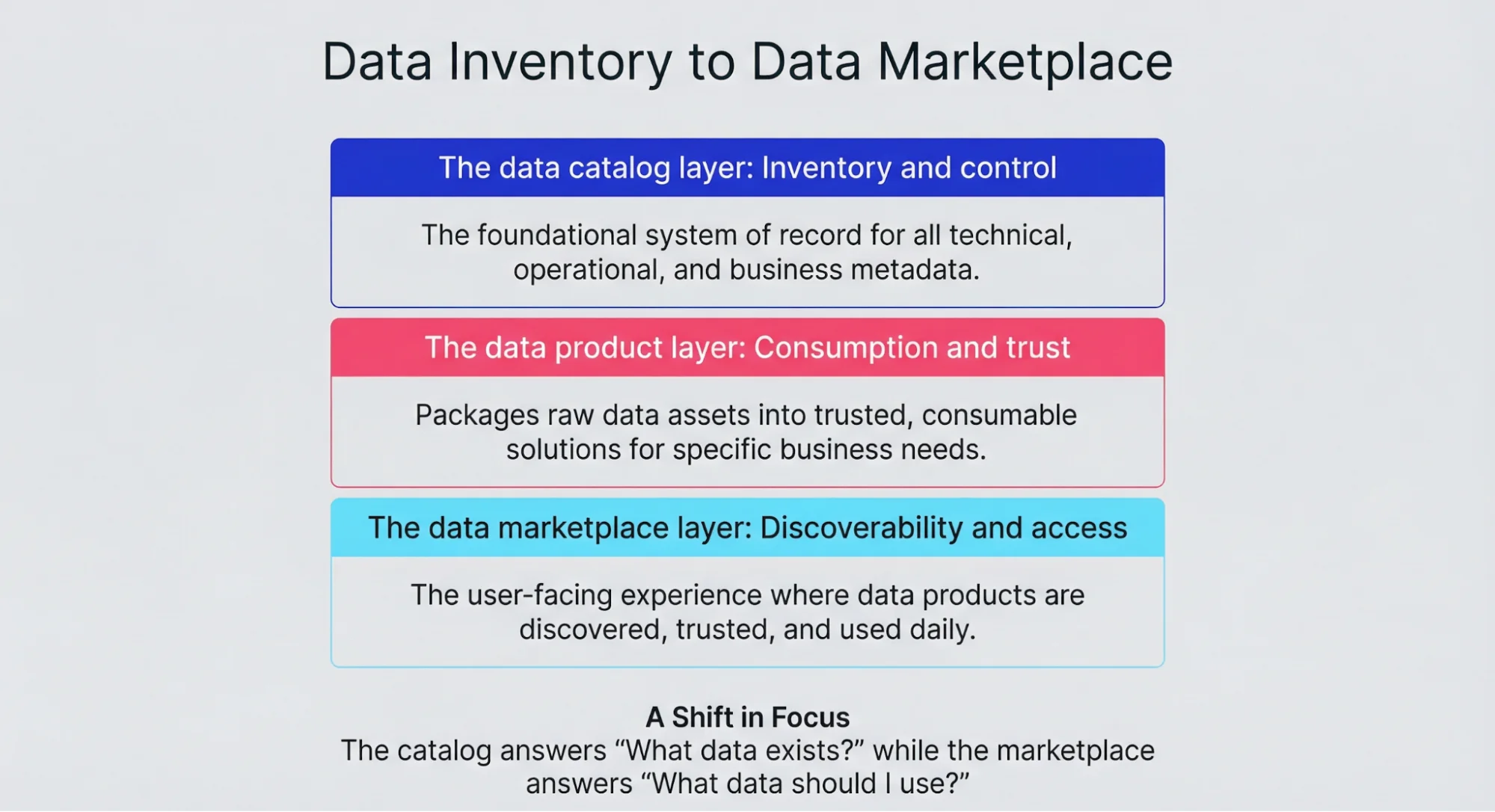
The data inventory to data marketplace progression. Image by Atlan.
The data catalog layer: The inventory and control plane
Permalink to “The data catalog layer: The inventory and control plane”A data catalog is a central, searchable inventory of all data assets: tables, dashboards, reports, models, metrics. It captures:
- Technical metadata: Schemas, types
- Operational metadata: Lineage, freshness, usage
- Business metadata: Definitions, ownership, purpose
This is your foundation – the system of record that makes data findable, understandable, and governable. And it’s critical for scale.
“We cataloged over 18 million assets, defined more than 1300 glossary terms, and we were tackling new use cases every quarter,” said Kiran Panja, Managing Director at CME Group during his Atlan Re:Govern keynote. “If we wanted to move as fast as markets we needed partners who could keep pace.”
For enterprises like CME Group, the catalog layer provides reliable metadata, lineage, and trust signals so they can confidently move faster at a massive scale.
The data product layer: From raw assets to consumable bundles
Permalink to “The data product layer: From raw assets to consumable bundles”Business users don’t consume raw data inventories. They consume data products: curated, governed bundles of assets packaged to solve specific business problems. A data product might be a set of related tables, pre-built metrics, embedded documentation, quality scores, and clear ownership, all wrapped together for a particular use case.
“You have to have a great product that people will trust so they can engage,” said Mauro Flores of VMO2. When this shift happens, focus moves from “here’s access to our data catalog” to “here are 200+ data products, each solving a specific business need.”
This data product layer inherits context from the catalog – lineage, quality signals, definitions – but packages it for consumption, not documentation.
The data marketplace layer: Where data products meet consumers
Permalink to “The data marketplace layer: Where data products meet consumers”The marketplace is the experience layer where data products are discovered and consumed. It’s organized by domains, features product cards with embedded trust signals, supports search in business language, and creates engagement loops that drive repeated use.
The marketplace doesn’t replace a catalog, but rather activates catalog context for business consumers. Think of it this way:
- Catalog: “We have 18 million data assets with complete metadata.”
- Products: “We have 200 curated solutions to business problems.”
- Marketplace: “I found exactly what I needed in 30 seconds, trust it, and come back daily.”
As DigiKey’s Chief Data and Analytics Officer Sridher Arumugham explained: “When we looked at first, I thought [Atlan] was another catalog. But I was impressed to find that Atlan was more of a context operating system.”
The three pillars of marketplace activation
Permalink to “The three pillars of marketplace activation”With that foundation clear, let’s explore how to activate your catalog infrastructure into a thriving marketplace.
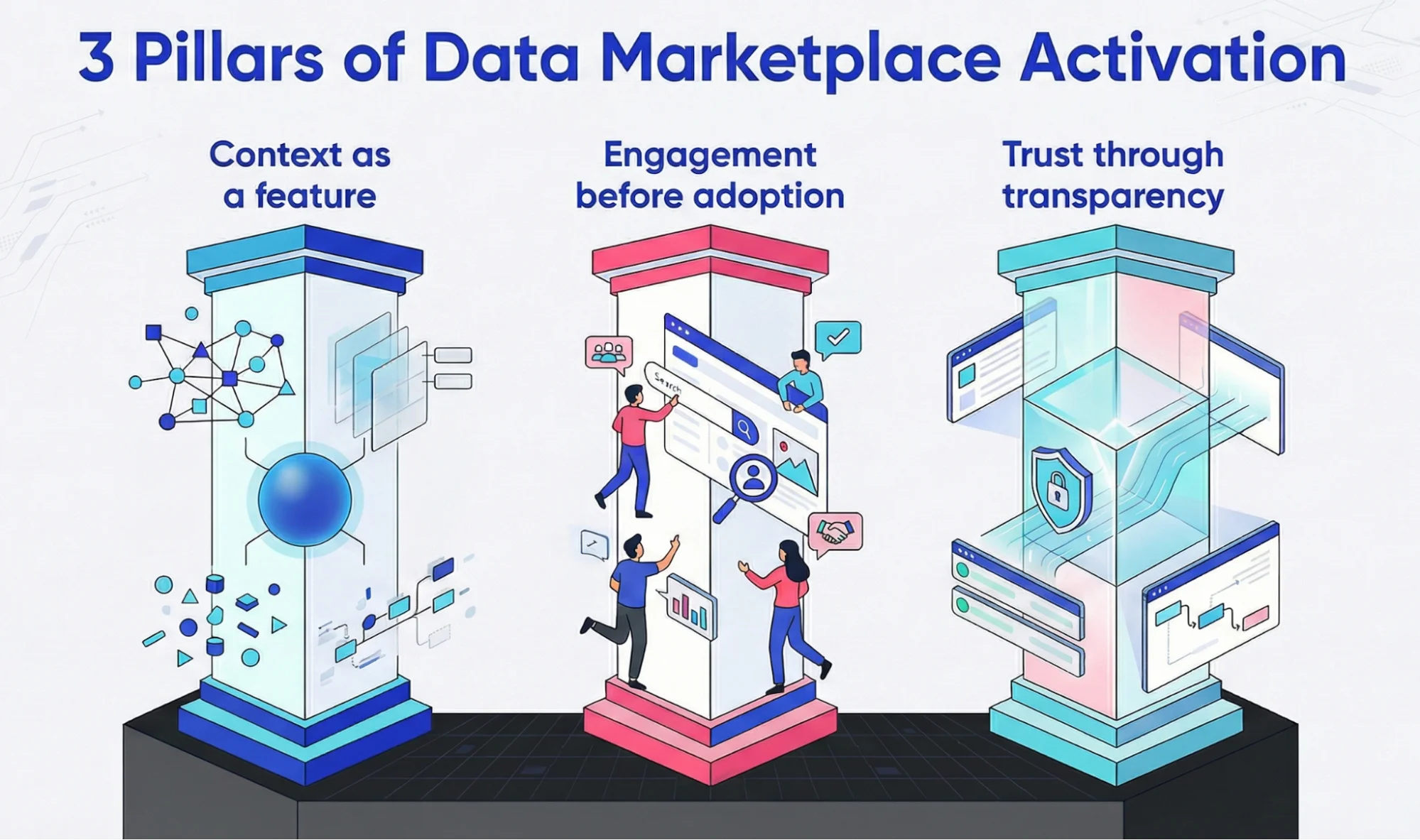
The three pillars of marketplace activation. Image by Atlan.
1. Context as a feature, not an afterthought
Permalink to “1. Context as a feature, not an afterthought”At CME Group, markets operate at nanosecond speed. But the business context needed to make that data useful took weeks to apply. As Kiran Panja explained: “Critical context had to be added manually, slowing down the availability and the usage of data products that we had at our disposal.”
This is the challenge: We can move petabytes in milliseconds, but the meaning of that data – who owns it, what it represents, and whether it’s trustworthy – still travels at human speed. And in markets where milliseconds matter, that’s a vulnerability.
This is where context engineering becomes critical. Engineering context directly into your data products from the start makes the catalog layer rich enough that the marketplace can surface data products with embedded trust signals, definitions, and lineage.
Practical steps to engineering context:
- Automate context generation: Manual documentation doesn’t scale. At Atlan, 70% of descriptions are AI-generated but human-validated, balancing automation with accuracy.
- Integrate business glossaries at creation: Don’t bolt on meaning after the fact. VMO2’s approach treats context, ownership, and governance as prerequisites for any data product. “You want that data to have context. You want that data to have ownership,” said Mauro. “You want that data to have some level of governance.”
- Build semantic layers that work everywhere: The semantic layer should connect to your catalog infrastructure but be accessible to all consumption tools, including AI agents. Joe DosSantos, Vice President of Enterprise Data and Analytics at Workday, emphasized its importance during an interview at Atlan Re:Govern, saying: “Semantics shouldn’t be for a particular use case. It just exists for everyone.”
2. Engagement before adoption
Permalink to “2. Engagement before adoption”VMO2 faced a deceptively simple challenge: How do you get 16,000 non-technical employees to not just find, but actually use data products in a marketplace?
The answer wasn’t a better catalog. It was treating the marketplace as a product that needed to drive engagement.
VMO2’s marketplace strategy centered on three key moves:
- Business-led prioritization: Instead of starting with solutions, Mauro and his team started with the problem. “Instead of me telling you what I think you need, you tell me what you need,” he said. This shift made business teams partners in defining what products appeared in the marketplace, not passive recipients of IT solutions.
- Structured enablement: VMO2 created a “Data University” with structured learning paths, ensuring teams could actually leverage the products being surfaced in the marketplace.
- Make success discoverable: “Once you build one product that is highly successful and you make it easy for them to find, then suddenly they have questions that naturally will go to the same place,” Flores explained.
The results speak for themselves: VMO2 had 6,000 active users across the company, with 1 million views in a single year. But the key metric was the network effect. More users led to more product requests, which led to more valuable products in the marketplace, which drove greater engagement.
Key metrics to track in your marketplace:
- User return rates (not just unique users)
- Time to first value
- Query success rates
- Products per active user
- Cross-domain product discovery
3. Trust through transparency
Permalink to “3. Trust through transparency”Rather than trying to perfect every data asset in their catalog before publication, focus on transparent trust signals in the marketplace. Real-time metadata syncing means users can see data lineage, understand ownership, and assess quality for themselves.
Data contracts also help, by bringing data producers and consumers together, establishing bilateral agreements in the marketplace, and making quality expectations transparent.
Ashish Bisht, Senior Manager of Data Governance at Mercury Insurance explained the value of data contracts during Atlan Re:Govern, saying: “Data producers don’t know what the data consumers are expecting. And sometimes data consumers don’t have a say in how the data product should look. We are trying to bridge that gap.”
The marketplace surfaces trust signals inherited from the catalog layer:
- Ownership clarity and accountability: Every data product has a clear owner
- Versioning and change management: Users see when products evolve
- Quality signals embedded in product cards: Users see the quality metrics and can decide if a data product is fit for purpose
- Usage and popularity: Users and owners can see which products are most used
The key is to make these trust signals native to the marketplace experience, not buried in documentation.
The technical architecture: A catalog backbone + a marketplace experience
Permalink to “The technical architecture: A catalog backbone + a marketplace experience”Building catalog infrastructure that scales
Permalink to “Building catalog infrastructure that scales”Your catalog layer needs to be robust enough to support an active marketplace on top. Traditional cataloging tools designed for documentation can’t power a real-time marketplace experience.
CME’s challenge illustrates this. They needed to sync metadata at the speed of markets, so their platform evaluation focused on marketplace activation: speed, usability, and scale.
The requirements for catalog infrastructure that powers marketplaces include:
- Real-time metadata ingestion
- Federated governance across multiple platforms
- API-first architecture that embeds context in the marketplace UI, BI tools, and AI agents
Adopting a domain-based structure in the catalog naturally maps to how products are organized in the marketplace.
Activating the marketplace layer
Permalink to “Activating the marketplace layer”The marketplace experience sits on top of catalog infrastructure but focuses on discovering solutions, not simply browsing technical metadata.
“Atlan enabled us to easily activate metadata for everything from discovery in the marketplace to AI governance to data quality to an MCP server delivering context to AI models,” said Sridher Arumugham, CDAO of DigiKey, during Atlan Re:Govern. “It’s not about documenting data after the fact. It’s about unifying, collaborating on, and activating context wherever it’s needed using Atlan.”
The technical components of the marketplace activation layer include:
- Semantic layers as universal translators: They sit between catalog infrastructure and consumption tools, providing consistent business meaning regardless of how data is accessed.
- Domain-based product views: The marketplace surfaces data products organized by business domains (finance, marketing, operations), not technical systems.
- AI-powered search interfaces: Natural-language search lowers the barrier for non-technical users to find products.
- Embedded trust signals: Data product cards show quality scores, popularity, ownership, and lineage inherited from catalog metadata.
To implement, start with high-value, narrow use cases. DigiKey began with a supply chain use case where marketplace activation could solve immediate pain points. Build incrementally with automation so you can scale, and focus on consumption, not documentation.
Lowering the barrier with AI
Permalink to “Lowering the barrier with AI”AI-powered search is quickly removing friction from marketplace adoption. Natural-language interfaces eliminate the UX challenges that traditionally kept non-technical users away from catalogs.
“Something that lowers the bar to help people adopt self-service analytics, data, and AI was really important,” said Mauro Flores of VMO2. “We believe that we are lowering that bar, that we’re making it easier for them to leverage Atlan’s power through AI, and it’s going to unlock everything else because they’re going to be able to find what they need in an easy way.”
The multiplier effect is real: each successful marketplace query drives more engagement. Users who find what they need quickly come back. They tell colleagues. The marketplace becomes the default way to discover data products instead of an alternative to Slack messages and email chains.
But AI-powered marketplace search only works when you have robust catalog infrastructure underneath. Without semantic understanding and rich metadata from the catalog layer, AI search just returns technical results that confuse non-technical users. With it, users can ask business questions in the marketplace and get business-relevant products.
Measuring marketplace success: KPIs that matter
Permalink to “Measuring marketplace success: KPIs that matter”Vanity metrics are tempting but dangerous. Total users and total assets cataloged tell you about infrastructure health, not marketplace activation.
VMO2’s measurement approach focuses on three dimensions that indicate true marketplace health:
- Engagement: Views, return visits, time spent. These signal whether the marketplace is becoming a habit, not just a one-time destination.
- Adoption: Active users across departments. Cross-functional usage indicates the marketplace is solving real problems, not just serving a niche technical audience.
- Value: Business outcomes tied to data product usage. This is the hardest to measure but the most important – it tells whether data products are driving decisions.
Taking this approach can help you tell a story about marketplace activity and impact, instead of focusing just on what’s inside.
The network effect multiplier
Permalink to “The network effect multiplier”The most important metric might be the network effect in your marketplace. How many new data products are requested by existing users? How does discovery of one product lead to consumption of others?
At VMO2, this created a virtuous cycle: “Once you build one product that is highly successful and you make it easy for them to find, then suddenly they have questions that naturally will go to the same place,” said Mauro.
The cycle is simple: More users → more product requests → more valuable products → more marketplace engagement → more users.
This is what separates marketplace thinking from catalog thinking: The catalog measures completeness of inventory; the marketplace measures consumption and value creation.
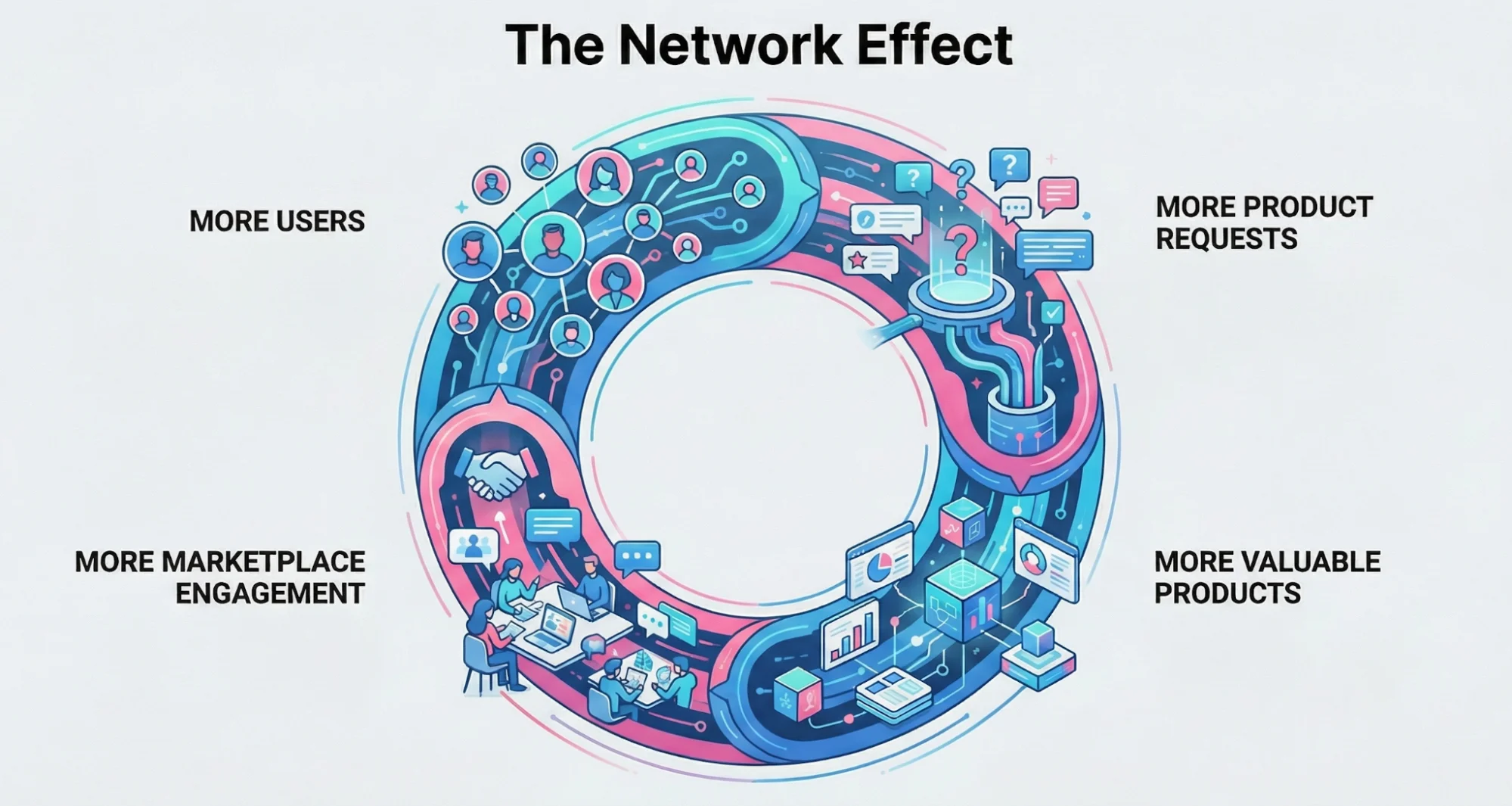
The network effect multiplier. Image by Atlan.
Common pitfalls and how to avoid them
Permalink to “Common pitfalls and how to avoid them”Stopping at catalog infrastructure
Permalink to “Stopping at catalog infrastructure”Problem: This is the most common failure mode. Leaders invest in catalog platforms, get metadata flowing, and establish governance – then expect marketplace adoption to happen organically. But changing people’s workflows isn’t easy, and that expectation quickly falls flat.
Solution: Recognize that catalog infrastructure is necessary but not sufficient. You need to build the marketplace layer on top. Assign product managers to the marketplace experience. Build feedback loops. Measure engagement religiously. Iterate based on user behavior in the marketplace, not assumptions about what metadata they need.
Underestimating change management
Permalink to “Underestimating change management”Problem: Technology is easy. Culture is hard. Building catalog infrastructure is a technical project, but building marketplace adoption is a change management project. Getting people to move away from established processes takes time, logic, and empathy.
Solution: Start with business champions. At Workday, Joe DosSantos began with finance teams because “those are the people that need trustworthiness more.” Early marketplace wins with influential stakeholders create momentum – they become advocates who pull others in.
Focusing on catalog completeness over marketplace usability
Permalink to “Focusing on catalog completeness over marketplace usability”Problem: It’s tempting to perfect your catalog infrastructure – get every asset documented, every lineage mapped, every definition standardized – before launching marketplace experiences. But as Sridher Arumugham of DigiKey noted: “Finding low-hanging fruit is always good to keep up engagement. But it’s not enough.”
Solution: Link every catalog enhancement to marketplace outcomes. When New York Life rebooted their governance capabilities, they did so with the goal of delivering business value, not checking arbitrary boxes. Build catalog richness in service of marketplace consumption, not for its own sake.
The context debt problem
Permalink to “The context debt problem”Problem: Building data products without leveraging catalog context creates context debt, a hidden liability that compounds over time. Products launched without embedded trust signals, clear ownership, or quality visibility erode marketplace trust.
Solution: Make catalog context a requirement, not a nice-to-have, before products appear in the marketplace. At VMO2, context, ownership, and governance are prerequisites to any data product going live in the marketplace.
Treating the marketplace as a one-time implementation
Permalink to “Treating the marketplace as a one-time implementation”Problem: The marketplace isn’t a project with an end date. It’s a product that requires continuous investment, evolution, and optimization based on usage patterns.
Solution: Build a product team around marketplace activation. Monitor engagement metrics weekly. Run experiments with new features, like AI search, recommendation engines, and trust score algorithms. Treat catalog infrastructure as the foundation that continuously feeds an evolving marketplace experience.
The path forward: Activating your catalog for the AI era
Permalink to “The path forward: Activating your catalog for the AI era”The journey from passive catalog to active marketplace isn’t just about better UX. It’s about fundamentally rethinking how organizations activate their data infrastructure for real consumption and business value.
The competitive advantage is clear:
- VMO2 went from centralized, catalog-only documentation to a marketplace with 6,000 active users in one year.
- CME Group drastically reduced data access time through marketplace discovery powered by rich catalog infrastructure.
These aren’t incremental improvements – they’re order-of-magnitude shifts that create strategic advantage.
If you’re assessing your current state, ask yourself three questions:
- Catalog foundation: Is your catalog infrastructure rich enough, with real-time metadata, automated lineage, business glossaries to power a marketplace experience on top?
- Product layer: Have you moved from exposing raw assets to curating data products that inherit catalog context but are packaged for consumption?
- Marketplace activation: Do you have an experience layer where business users actually discover and consume products, or are they still navigating technical catalog interfaces?
The future is already taking shape. As AI agents become first-class marketplace consumers, the requirements for catalog infrastructure will only intensify.
“Markets are evolving from algorithmic trading to trading powered by real-time analytics,” said Kiran Panja at Atlan Re:Govern. “We’re going to go from nanoseconds to picoseconds, from human directed trading to an era where AI agents will consume and act on data with minimal human oversight.”
Context isn’t optional in an AI-driven future. But context alone isn’t enough. You need catalog infrastructure that captures context at scale, data products that package context for consumption, and marketplace experiences that surface data products with embedded trust signals – all working together.
The organizations building this full stack today are laying the foundation for AI that actually works in production. The catalog tells AI what exists, and the marketplace tells AI what’s trustworthy and how to use it.
The question isn’t whether to build this activation layer. It’s how soon you can start.
Hear from more data leaders in our Re:Govern Watch Center.
Share this article