

Enterprise memory sits underneath every memory framework. It carries provenance, lineage, access control, and decision traces alongside the facts agents recall. Memory frameworks such as Mem0, Zep, and Letta address conversation continuity for a single agent. Enterprise memory answers a harder question: what authoritative source is the memory grounded in, and can you defend it when the EU AI Act’s high-risk obligations become enforceable?

Before we venture into the details of how it works and why organizations need it, here’s a quick overview of it to give you a gist of it.
Quick facts about enterprise memory
| Attribute | Detail |
|---|---|
| Definition | A persistent, governed substrate that AI agents read from for facts, history, and behavior, with provenance and lineage built in. |
| Key benefit | 3x text-to-SQL accuracy uplift when agents query data through enriched metadata, on a 145-query BirdBench evaluation with p<2e-10. |
| Best fit | Multi-agent enterprise deployments, regulated industries, and any team running long-running agentic workflows. |
| Timeline trigger | August 2, 2026: high-risk obligations under the EU AI Act become enforceable. |
| Compliance scope | GDPR right-to-be-forgotten plus EU AI Act audit trail requirements covering up to ten years. |
| Core components | Working, semantic, episodic, and procedural memory grounded in a governed metadata graph with provenance, lineage, and decision traces. |
For several organizations, Atlan’s context layer becomes the enterprise memory substrate for AI agents, including a metadata graph that already governs your data.
What is enterprise memory?
Enterprise memory is the substrate that lets AI agents accumulate knowledge across users, sessions, and systems without losing track of where each piece came from. It’s persistent, stateful, governed, and cumulative.
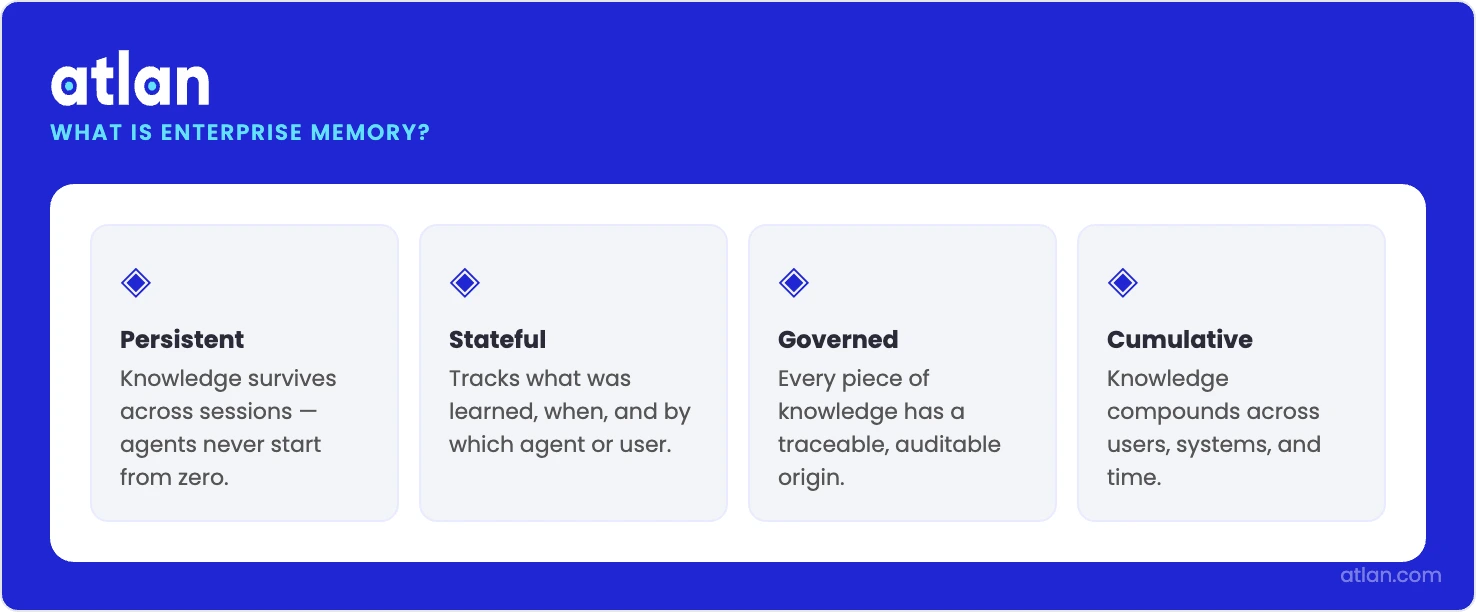
The substrate that lets AI agents accumulate knowledge across users, sessions, and systems. Image by Atlan.
But what it means for you is that:
- A fact learned on Monday survives until Friday.
- An agent that resolved a ticket last quarter can reuse what it learned from that ticket this quarter.
- Every retrieved memory carries the provenance, ownership, and access rules of the data that produced it.
- The system gets sharper the longer it runs, rather than resetting after every conversation.
The cumulative property separates enterprise memory from retrieval-augmented generation (RAG). RAG pulls documents into a model’s context window at inference time and forgets them when the response is sent. Enterprise memory writes back.
Enterprise memory is also distinct from per-agent memory. Mem0, Zep, Letta, and similar frameworks solve a real problem: how a single agent remembers a single user across a single thread of conversation. It’s a local problem. Enterprise memory is global. It is the shared layer that multiple agents read from to determine what a customer entity means, which data assets are certified, who owns the underlying table, and which policy applies to the next action.
A framework answers, “What did the user say last week?” A substrate answers, “What is true about this customer, this product, this domain, right now, and how do you know?”
Gartner’s 2026 Hype Cycle for Agentic AI reports that 17% of organizations have deployed AI agents to date, while more than 60% expect to within the next two years. These agents are evolving from basic assistants embedded in enterprise applications to task-specific agents, and ultimately a multi-agent ecosystem.
It’s important to note that multi-agent ecosystems don’t run on per-agent memory stores. They need a shared, governed substrate, or they fragment.
Why do organizations need enterprise memory?
The case for enterprise memory lives in three places production teams already feel pain: long-running agent reliability, multi-agent coordination at scale, and the audit-ready evidence regulators and risk committees are about to demand.
Long-running reliability against memory drift
Long-running agents degrade in a specific way. The agent does not invent things. It forgets the parts of the original intent that did not get carried forward as constraints. As tasks grow longer, earlier decisions blur into compressed memories, and the agent begins to optimize for local completion rather than system-level correctness. That is exactly where drift begins in the absence of enterprise memory.
The fix is architectural. If an agent re-reads canonical facts live from the catalog rather than from an extracted summary that has been compressed across ten prior turns, drift collapses.
The Atlan-Snowflake joint research on text-to-SQL accuracy with enriched metadata is the empirical version of the same argument: with bare-schema access, agents perform at baseline; with context-enriched access, including column descriptions, glossary terms, and lineage, accuracy improves 3x on talk-to-data queries across 145 BirdBench evaluations at p<2e-10.
Multi-agent coordination at production scale
Multi-agent systems coordinate through shared knowledge, or they do not coordinate at all.
CME Group, the world’s largest derivatives exchange, uses Atlan to deliver context at speed across the exchange. Kiran Panja, Managing Director of Cloud and Data Engineering at CME Group, described the scale by saying:
| “With Atlan, we cataloged over 18 million assets and 1,300+ glossary terms in our first year, so teams can trust and reuse context across the exchange.” |
|---|
An 18 million asset graph is not a memory you build per agent. It is a memory that a population of agents reads from.
The cost of skipping coordination shows up in the failure numbers. The MIT NANDA Initiative’s GenAI Divide report found that 95% of integrated AI pilots produce no measurable P&L impact. Aditya Challapally, the lead author, attributed the gap to architecture: “The 95% failure rate for enterprise AI solutions represents the clearest manifestation of the GenAI Divide. Organizations stuck on the wrong side continue investing in static tools that can’t adapt to their workflows.”
Audit-ready evidence for the EU AI Act
The regulatory clock is the part of the story that has stopped being abstract. On August 2, 2026, the high-risk obligations of the EU AI Act become enforceable under Article 113. High-risk AI systems will need to produce, on request, a record of how decisions were made: which data, which model behavior, which agent action, in what order, on whose authority.
The failure rate and the August 2, 2026, enforcement date are the same problem on two clocks. Both reward teams that picked the substrate-first architecture early.
Decision traces tied to entities in a governed metadata graph resolve the paradox. A log file doesn’t. Atlan’s AI agent memory governance covers this audit-ready architecture in production.
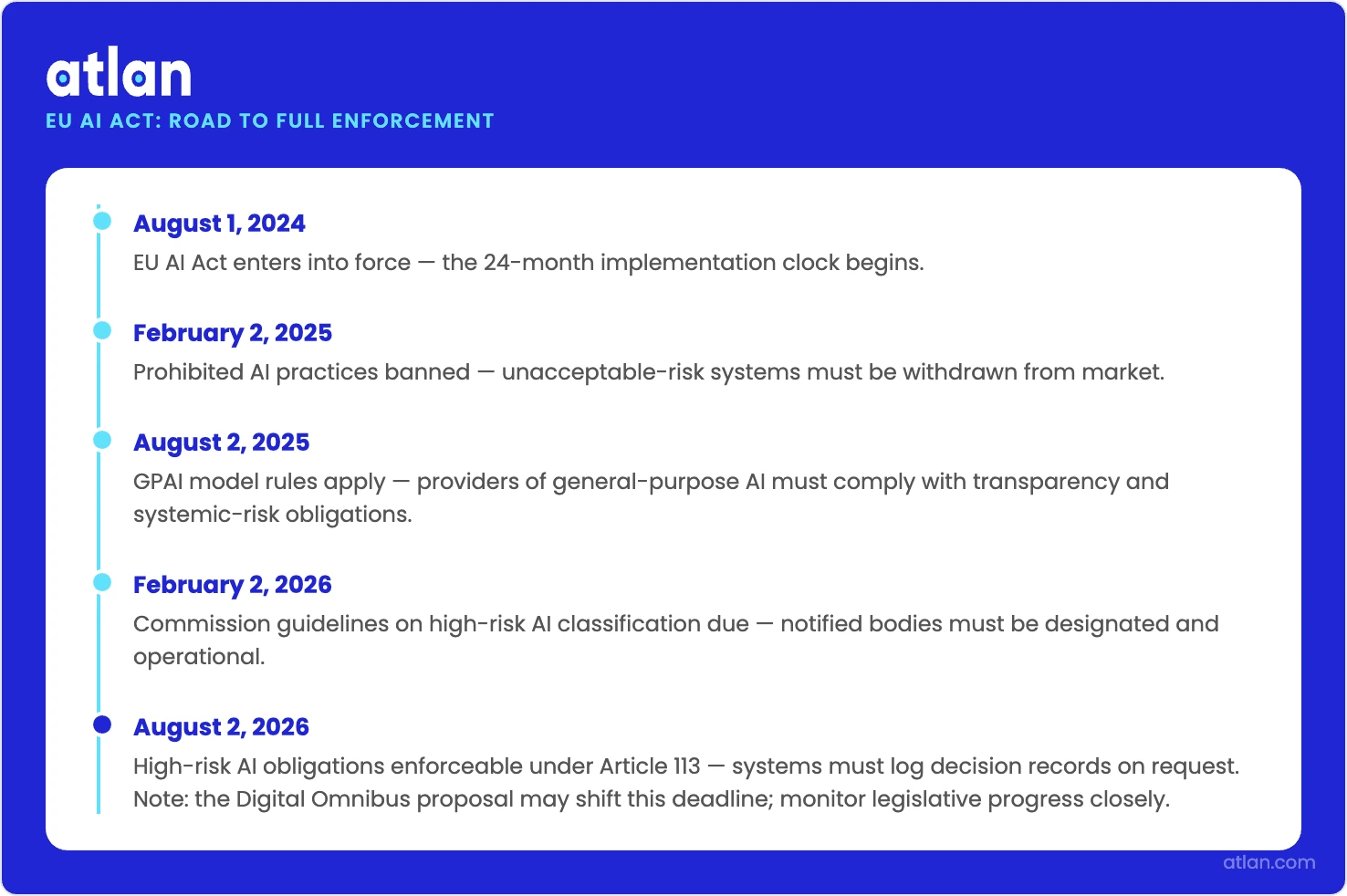
Key dates from entry into force to high-risk AI enforcement under Article 113. Image by Atlan.
How does enterprise memory work?
Enterprise memory works by separating what an agent recalls from how it is stored, governed, and audited. Four memory types describe the recall layer. A governance layer carries provenance, lineage, and decision traces. The two layers communicate through a metadata graph, which is where most enterprises already have the seed of an answer.
Below are the four memory types that describe the recall layer:
- Working memory is the active state an agent is reasoning over right now: the running conversation, the scratchpad the model sees, the intermediate variables in the current task. It clears when the session ends.
- Semantic memory holds durable facts. Entity definitions, business glossary terms, certified reference data, and the canonical meaning of “active customer” in your data warehouse. Semantic memory is where the metadata graph carries the heaviest load, because a definition without a source and an owner is not a definition you can defend.
- Episodic memory captures specific past experiences: prior sessions, resolved tasks, and the interaction trajectory of a particular user with a particular agent. Episodic memory is what lets an agent say, “The last time we ran this analysis, the answer broke at month-end close because the late-arriving facts were not yet loaded.”
- Procedural memory encodes behavioral rules and tool preferences learned over time: which API call to try first for an enrichment, which dashboard to open for a particular question, and how to escalate a refund above a threshold.
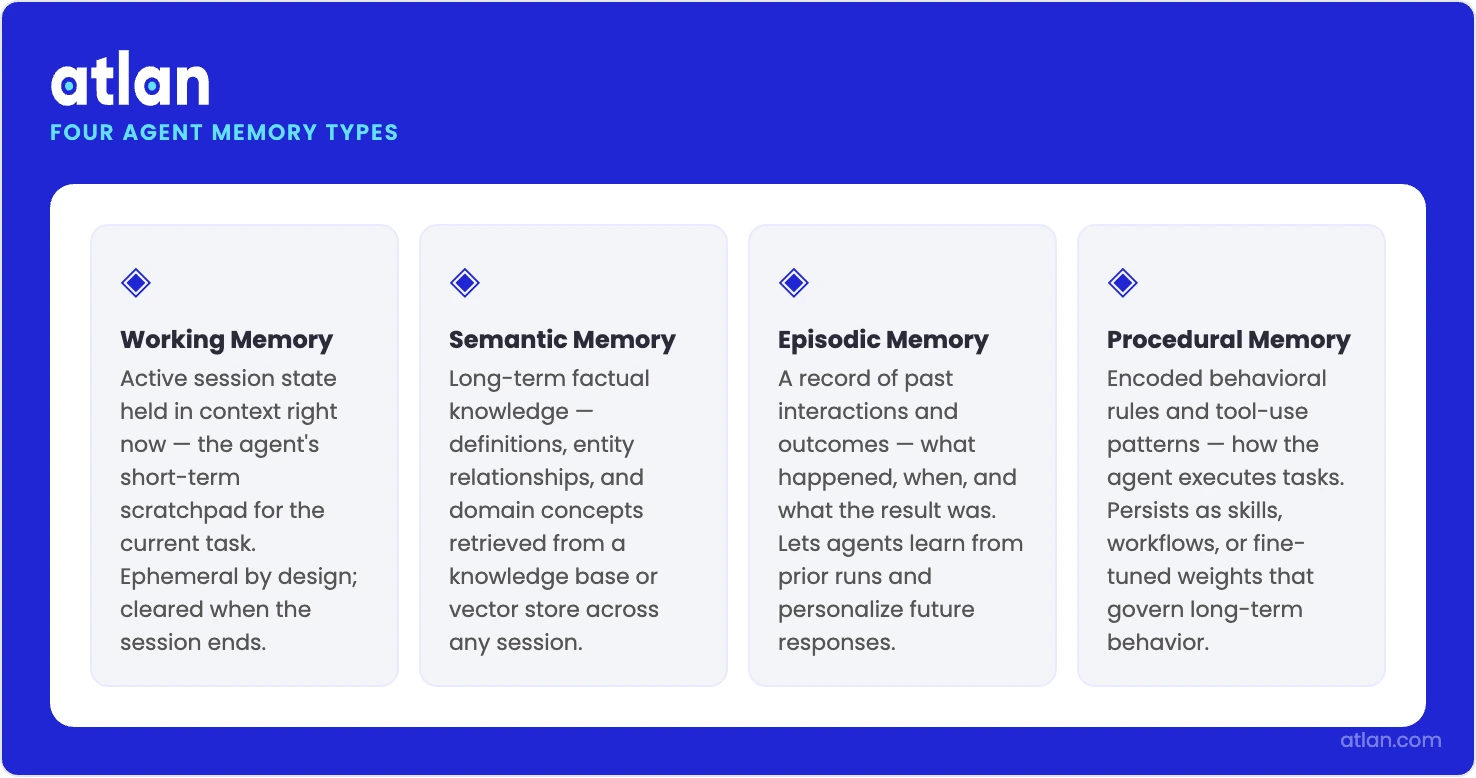
How AI agents store, recall, and apply knowledge across sessions and systems. Image by Atlan.
Procedural memory is the closest thing to an agent’s personality, and the easiest to make wrong if it is not versioned.
Memory frameworks differ in how they implement these types. Atlan’s comparison of Zep vs. Mem0 explains the differences. But framework benchmark differences obscure what actually decides production behavior: where does the framework read its facts from, and can you trust them?
Memory layer versus enterprise memory: a comparison
| Dimension | Memory layer (Mem0, Zep, Letta) | Enterprise memory (governed substrate) |
|---|---|---|
| Storage primitive | Vector store with metadata filters | Governed metadata graph with versioned semantic, episodic, and procedural layers |
| Source of truth | Extracted facts from agent conversations | Authoritative business data, glossary, and lineage in the catalog |
| Provenance | Optional, framework-specific | Inherited from upstream data assets, not bolted on |
| Multi-tenant isolation | Cache-key prefixes, routing rules | Catalog-level tenant inheritance is enforced at read time |
| Audit trail | Log files of API calls | Decision traces tied to entity IDs in the metadata graph |
| Staleness handling | TTL or manual cache invalidation | Live-read or lineage-triggered invalidation when sources change |
| Portability across model providers | Limited; framework-specific schemas | Open via MCP and standard catalog APIs |
The governance layer: provenance, lineage, and decision traces
A memory without provenance is a story without a source. Provenance is the record of where a memory came from: which dataset, which transformation, which timestamp. Lineage is the path data took to get there, and it matters because when an upstream source changes, every downstream memory derived from it must be invalidated. Decision traces close the loop.
In its February 2026 post on adaptive context for AI agents, Makarand Bhonsle, Software Engineering Architect at Salesforce, wrote that the team “re-conceptualized memory as a core platform capability, rather than a mere prompt-side technique.” He continued: “Memory now resides in a real-time data layer, distinctly separate from prompts, and possesses explicit structure and lifecycle controls.” That live, governed, structured layer is the substrate. Everything else is a client of it.
Why the structure matters: memory systems without governance hallucinate in predictable ways. Provenance reduces fabrication. Lineage resolves conflicts. Decision traces expose omissions. Together they make memory inspectable, governable, and explainable.
How to implement enterprise memory
Implementation is a substrate decision first and a framework decision second. The framework can be swapped. The substrate becomes harder to migrate once teams start writing to it.
Follow these four steps of pre-work to order the work so that the substrate decision is irreversible in the right direction.
- A working data catalog with glossary terms, ownership, and lineage. If you do not have a catalog yet, the substrate and catalog decisions are the same.
- An identity model that maps to your data access policies. Memory inherits the policies of the data it derives from, so the access model has to be coherent before the memory layer can.
- A tenant policy for any deployment that connects with more than one customer, business unit, or jurisdiction.
- An evaluation plan with at least one observable production task you can benchmark against. Memory scaling claims are only credible when the benchmark is real.
Once these are in place, you can start building enterprise memory in four steps.
1. Connect the catalog to the agent runtime through MCP or an equivalent open protocol.
The substrate has to be queryable at the speed an agent needs it. The Model Context Protocol is the cleanest way to expose catalog entities, glossary terms, and lineage to a model without proprietary glue.
2. Pick a memory framework as a client, not a foundation
Mem0, Zep, Letta, and the next generation that follows are useful for conversation continuity. Use them. But pin them to read facts from the catalog rather than re-deriving them from conversation traces, and keep the option to swap them open.
3. Derive primitives from existing context, do not re-ingest
This is the lesson of Karpathy’s LLM Wiki post compressed for the enterprise: stop re-ingesting source data into a parallel vector store. The catalog already has the entity, the glossary already has the definition, and the warehouse already has the certified table. Memory derives from those primitives.
Compilation beats re-derivation in both cost and accuracy. The Memori paper on arXiv demonstrates the efficiency gain: 81.95% accuracy on LoCoMo using only 1,294 tokens per query, roughly 5% of full context, with 67% fewer tokens than competing approaches and over 20x savings against full-context methods.
4. Connect the framework to the substrate and measure the uplift
Atlan’s joint research with Snowflake reported a 3x improvement in text-to-SQL accuracy when agents read enriched metadata rather than bare schemas, on 145 BirdBench queries with p < 2e-10.
Workday’s teams reported a similar pattern: a 5x improvement in AI accuracy after grounding agents in shared semantic layers with decision context. The uplift is reproducible because the architecture is the variable.
It’s advisable to instrument every agent action as a decision trace keyed to the entity it connects, so when the regulator or the postmortem asks why, the answer is a query, not an archaeology project.
What to look out for:
There are a few things you need to consider when you want your memory frameworks to run reliably and deliver as expected. You need to avoid treating memory as a vector-database problem, assuming framework-level isolation is enough for multi-tenant deployments, and skipping the framework portability question.
AI memory systems send your text to an LLM for extraction and classification. It might work at a small scale, but at 100K memories/month, you’re looking at $1000-$3000 in API calls just for the memory layer. The framework is being asked to do the substrate’s job badly.
FiloVenturini, the author of CtxVault, described the typical pattern on Hacker News: “Most agent architectures treat memory as a retrieval problem. Multiple agents share a vector store and rely on metadata filtering, routing logic, or prompt-level rules to control what each agent can see. In practice, this becomes hard to reason about as systems grow.” At enterprise scale, isolation should inherit from the catalog rather than from a cache-key prefix.
Additionally, frameworks change every quarter. Whatever you pick will look dated in eighteen months. The substrate has to outlast that cycle, which means it cannot be the framework.
Related: Can a vector database serve as enterprise memory?
A vector database is one ingredient, not the recipe. Similarity search is useful for retrieving close matches. It does not tell you which match is authoritative, which is stale, or which a specific tenant is allowed to see. Enterprise memory uses vector search, which helps, but the substrate decisions — governance, lineage, isolation, and invalidation — sit above it.
How to choose an enterprise memory approach
Before selecting a vendor to build toward enterprise memory, you need to ask the vendor about substrate type, provenance and lineage, tenant isolation, staleness handling, portability, and deployment model. It will give you insights to build toward a reliable architecture.
Ask these questions in your evaluation:
| Evaluation criterion | Question to ask the vendor |
|---|---|
| Substrate type | Is memory grounded in a governed metadata graph or in an extracted vector index? |
| Provenance and lineage | Does every retrieved memory carry a verifiable source and an invalidation path when sources change? |
| Tenant isolation | Is isolation enforced at the catalog layer through ownership and policy, or at the framework layer through cache keys? |
| Staleness handling | Does the system support live-read against authoritative sources, or only stored extracts with TTL? |
| Portability | Can the substrate serve multiple model providers (OpenAI, Anthropic, Google) and multiple frameworks without proprietary lock-in? |
| Deployment model | Does the substrate run where your data already runs, with the same isolation guarantees? |
To further refine the evaluation, these questions will help get the clarity you need in making a decision:
- Where does your memory layer read its facts from when the data underneath changes?
- How do I produce, on demand, the decision trace for any single agent action tied to a customer or transaction ID?
- What happens to a memory derived from a row that was deleted under a GDPR right-to-be-forgotten request?
- If we swap your memory framework for a competitor next year, what stays in place and what gets rebuilt?
- Can your system inherit access controls from our existing catalog, or does it duplicate the access model?
How Atlan approaches enterprise memory
Atlan’s answer to enterprise memory is the context layer: a persistent, versioned, portable layer of enterprise knowledge built from the business systems and data assets you already govern, queried by agents at runtime. The substrate is a metadata graph that already links technical metadata, business semantics, lineage, ownership, and policy. Enterprise Memory is the named component that exposes that graph to agents as a memory substrate, with provenance and decision traces inherited from the catalog rather than bolted on.
The full architecture, including the seven core components of the context layer, is documented and in production.
Mastercard runs on this architecture at scale. Andrew Reiskind, Chief Data Officer at Mastercard, described the arc on stage at Atlan’s Re:Govern keynote: “When you’re working with AI, you need contextual data to interpret transactional data at the speed of transaction (within milliseconds). So we have moved from privacy by design to data by design to now context by design. We needed a tool that could scale with us.”
He extended the point in a separate quote: “Atlan’s metadata lakehouse is configurable across all our tool sets and is flexible enough to get us to a future state.” Mastercard operates on more than 100 million data assets on Atlan’s metadata lakehouse.
The customer evidence at scale is what no framework-only vendor can replicate. CME Group cataloged more than 18 million assets and 1,300 glossary terms in its first year on Atlan. Also, Workday reported a 5x improvement in AI accuracy after grounding agents in shared semantic layers with decision context.
FAQs about enterprise memory
How is enterprise memory different from RAG?
RAG retrieves documents into the model’s context at query time and then forgets them. Enterprise memory writes back. A RAG pipeline answering the same question twice will repeat the same retrieval work and produce the same output, with no learning in between. Enterprise memory records what was asked, what the agent decided, and which source was authoritative, so the next query starts from a richer base.
How is enterprise memory different from agent memory?
Agent memory is local: one user, one agent, one thread. Enterprise memory is shared: many agents are reading from the same governed source of business facts. The difference shows up in coordination. Two agents working on the same customer should not arrive at two different definitions of “active customer.” With agent memory alone, they will. With enterprise memory underneath, they cannot.
Why does governance matter for an agent’s memory?
A memory without governance is unauditable. If an agent acts on a fact and a regulator asks where the fact came from, the answer needs to be a query, not a guess. Provenance ties the memory to a source asset. Lineage tracks how that source changed over time. Decision traces tie the agent’s action to the memory it relied on. Together, they make the system explainable when it matters most.
What are the building blocks of enterprise memory?
Four recall types and one governance spine. Working memory holds the current session. Semantic memory holds durable facts. Episodic memory holds past experiences. Procedural memory holds learned behaviors. The governance spine, a metadata graph, carries provenance, lineage, ownership, and policy across all four, so every memory inherits the trust properties of its source.
What happens when enterprise memory gets stale?
The architectural answer is live-read or lineage-triggered invalidation. If an upstream table changes, every memory derived from it gets flagged. The agent then either re-reads from the authoritative source or marks the memory as suspect. Without this, agents quietly act on outdated facts. Memory drift in long-running agents is rarely fabrication. It is the slow erosion of which earlier facts still apply.
What does enterprise memory cost compared to per-agent memory frameworks?
Per-agent frameworks send conversation text to an LLM for extraction and classification at write time. The cost scales with volume. At 100,000 memories per month, the API bill for extraction alone runs into thousands of dollars. Enterprise memory derives from the catalog rather than re-extracting from conversations, which compresses the cost curve. The Memori paper documented 67% fewer tokens per query against a comparable benchmark.
Who in an organization owns enterprise memory?
Ownership usually sits with the data platform or governance team that already owns the catalog. That team manages the substrate. Agent teams manage the frameworks that read from it. The split matters because the substrate outlives any one agent project, while the frameworks will be replaced every eighteen months.
The substrate outlives the framework
Enterprise memory is the substrate question, not the framework question. Memory frameworks differ in their focus on retrieval and continuity. The substrate decides whether the system is grounded, governable, and defensible at audit time.
FiloVenturini puts the right opening question on Hacker News: do we need memory to become a controllable infrastructure layer that agents integrate with, instead of every team building custom memory management each time? The answer is yes.
The infrastructure layer is the metadata graph already in production at companies like Mastercard and CME Group. Build once, connect many, audit every time. The catalog was always going to be the answer.
The August 2, 2026, enforcement date for the EU AI Act’s high-risk obligations is the deadline that turns it into an urgent answer.
