

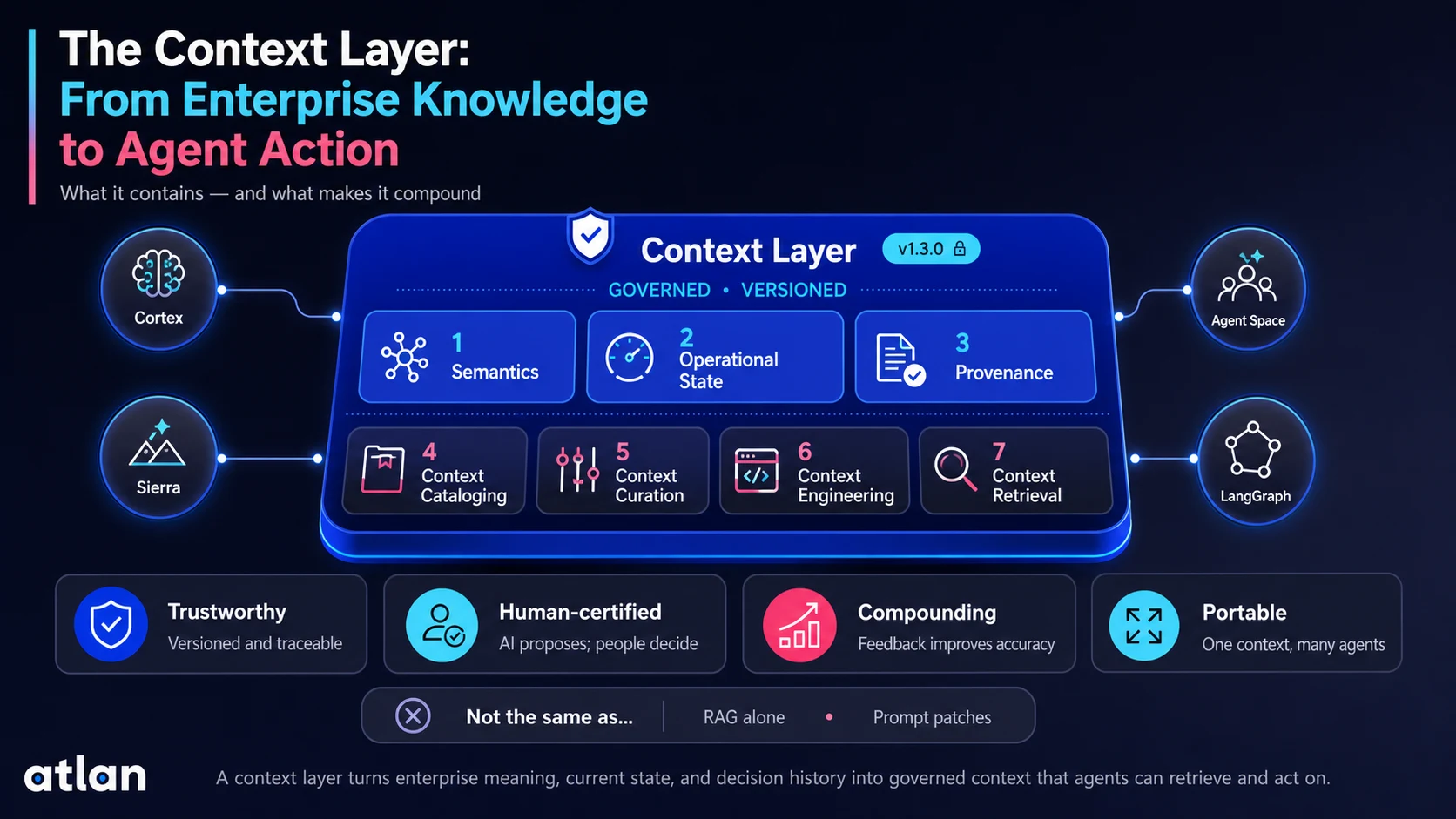
Seven components define a working context layer, and Gartner has now named the category that needs them. Its Emerging Tech Impact Radar: Generative AI calls AI context platforms the most critical enabling technology for 2027 and lists Atlan as a sample vendor. Gartner formalized the underlying problem at its 2026 Data and Analytics Summit: despite five years of AI investment, only 20% of organizations report significant value from GenAI tools, and the missing piece is a context layer. Gartner’s framework supplies three of the seven, semantics, operational state, and provenance, which say what a context layer contains.
Atlan’s context layer supplies the other four, the operational components that decide whether the layer compounds or freezes the day it ships. That distinction is the whole argument, and we have been making it for over a year: without context, agents hallucinate, contradict themselves, and produce outputs nobody can trust at enterprise scale. Hear it argued out loud in the WTF is the Context Layer series, where the people who coined the term work toward a definition that holds up.
| Quick Facts | |
|---|---|
| Gartner structural components | 3 (semantics, operational state, provenance) |
| Operational components at Atlan | 4 (cataloging, curation, engineering, retrieval) |
| Total core components | 7 |
| Gartner Impact Radar, Aug 2026 | AI context platforms named most critical enabling tech for 2027; Atlan a sample vendor |
| Proliferation window | 1 to 3 years for AI context layers |
| GenAI value realization | 20% of organizations report significant value |
| Semantic modeling adoption | 40% of organizations have implemented semantic modeling |
| Data engineering impact | Semantic modeling makes effective AI support 2.2x more likely |
| Reported context-layer benchmark | ~70% accuracy threshold cited for enterprise trust |
| Gartner 2027 outlook | Up to 80% higher accuracy and 60% lower costs for semantics-first organizations |
The layer these seven components describe
The context layer is a persistent, versioned, portable layer of enterprise knowledge, built from existing business systems, that AI agents query at runtime. It sits between your data infrastructure and your agent infrastructure, filling the knowledge gap between data systems and agents. For the runtime view of how agents actually consume it, see the context layer for AI agents.

What the context layer is not: a data catalog, a semantic layer, a vector database, or a one-time project.
What it is: living infrastructure that compounds over time, open and interoperable, governed through automation rather than manual review. It is dynamic, versioned, portable, and reachable by every agent in your stack.
Gartner names AI context platforms the critical tech for 2027
In August 2026, Gartner published its Emerging Tech Impact Radar: Generative AI and grouped AI context platforms with the enabling technologies for agentic AI. Its assessment of that group is direct: AI context platforms are the most critical enabling technology for 2027. Atlan is named a sample vendor in the category.
Gartner defines an AI context platform as software that lets data and AI engineering teams build, govern, and deliver semantically organized knowledge to AI agents, with taxonomies, ontologies, and knowledge graphs carrying the business meaning, relationships, rules, and policies behind that knowledge.
Two things in that assessment should change how you sequence the work. Gartner puts the proliferation distance for AI context layers at one to three years and rates their cross-industry mass as high, which means the category arrives sooner than most 2027 roadmaps assume. And the payoff Gartner attributes to context layer management is a schedule one before it is an accuracy one: project implementation moving from months to weeks, on the back of less manual prompt engineering and steadier agent decision making.
The full Impact Radar is Gartner subscriber research. What it settles for anyone building now is simpler than the report itself: the category is real, the window is short, and the first return shows up in delivery time rather than model quality.
Components 1 to 3: what the layer contains
Gartner analyst Afraz Jaffri describes the context layer as three structural components. These are the inventory question, and they answer what has to be present.
Component 1: Semantics
Ontologies, business glossaries, and knowledge graphs. This is internal meaning: the shared models and relationships that say what an entity is and how it connects to the rest of the business.
Component 2: Operational state
Right-time access to entities, processes, and current conditions. This is current reality: what is true in the business now, not what was true when a document was last written.
Component 3: Provenance
Tracking data, decisions, actions, and outcomes across an agent’s lifecycle. This is past lineage: where an answer came from and what it was based on.

The data behind this taxonomy sharpens the problem. Organizations that implement semantic modeling are 2.2 times more likely to support AI with effective data engineering practices, and only 40% have taken that step.
But a framework that describes what the layer contains cannot tell you how to keep it useful. Run components 1 to 3 as three parallel engineering workstreams and you get a static snapshot of enterprise knowledge that stops improving the day it ships. Components 4 to 7 are what prevent that.
Components 4 to 7: what makes it compound
Knowing what a context layer contains and knowing what you do with it are different problems, and conflating them is how context layer projects stall.
Component 4: Context cataloging
Context cataloging covers the context itself and its versioning: how and why it changed over time. This is the foundation. Knowing what enterprise knowledge you have, where it came from, and how it has evolved is what makes the context trustworthy and an agent’s decision traceable. Without versioning you have neither.
Component 5: Context curation
Context curation is the work of building, refining, and certifying a company’s specific context: business logic, tribal knowledge, metric definitions, policies. This is human-on-the-loop work, not manual metadata entry. AI surfaces the conflicts and decisions only people can settle. When finance and sales define “revenue” differently at the code level, that is a curation problem: a metrics conflict agent reads all the SQL, surfaces the discrepancy to the right people, and one human makes one call that updates context everywhere.
Component 6: Context engineering
Context engineering improves context over time until agents clear the accuracy threshold where people trust them. Across our customer work that bar sits around 70% for most enterprise use cases. This is the flywheel: simulation before deployment to answer whether you can ship, real usage feedback after to show which questions exposed gaps, then iteration. Context engineers own those loops so knowledge and quality compound.
Component 7: Context retrieval
Context retrieval is how agents pull exactly what they need at runtime, via MCP, SDK, or SQL depending on the framework. This is the portability component: the same enterprise context serving Cortex, Agent Space, Sierra, and a LangGraph workflow, with no re-engineering per platform. It is also the component that determines whether your agents can act on context or only read about it.

Components 4 to 7 are sequential and dependent. You cannot curate what you have not cataloged, you cannot engineer accuracy without a curation workflow, and retrieval is only as good as the context being retrieved. That sequence is what turns Gartner’s three-component framework into something that runs.
Where Gartner’s framework and production practice diverge
Gartner’s taxonomy comes from research and client inquiry data. Atlan’s view comes from building context layers alongside customers, where a context layer improved AI analysts’ answers by 5x and enhanced metadata lifted AI SQL accuracy by 38%. Those results, with Atlan’s context engineering framework, connect the theory to measurable reliability. The two views are complementary, and where they differ it is because practice exposes nuance a framework cannot anticipate.
Semantics: the ontology is a destination, not a starting point
Gartner identifies semantic modeling as foundational, and we agree. Production adds the sequencing. Formal ontology projects, SHACL rules and top-down knowledge graphs, are the right destination and rarely the right entry point. AI can bootstrap a usable ontology from column lineage and SQL in days, and humans refine something 60% right instead of starting from a blank page. The ontology emerges from usage rather than preceding it.
Operational state: historical signals matter as much as real-time ones
Gartner emphasizes right-time data, event-driven analytics and live access. Operational state also includes historical usage signals: which SQL queries have run against a table, which dashboards reference a metric, who touched a dataset and what they did next. Those patterns are often richer than real-time streams alone, and they are how AI learns what data means in practice rather than in documentation.
Provenance: tracking the past and learning from it are different capabilities
Gartner frames provenance as traceability and auditability, correctly. In production, provenance is also the mechanism by which context improves. Enterprise memory, the accumulated learning from agent interactions, feedback, and corrections, is what makes the tenth agent dramatically better than the first. Build provenance only for compliance and you capture half its value.
A note on “context graph” terminology
Gartner cautions against “context graph” as ambiguous terminology, noting it usually refers to the provenance component rather than the full layer. The caution is well taken.
At Atlan, “context graph” means the structured representation of enterprise data assets and their relationships: lineage, SQL history, BI semantics, classification, quality signals, business glossary. That is closer to Gartner’s semantics plus operational state, bound into a traversable knowledge structure, not just provenance.
Executives evaluating vendors should ask each one for its specific definition. Lineage tracking, an ontology, and a full knowledge graph are different things with different implementation costs.
The checklist for data leaders
Gartner’s recommended actions are sound: start with high-value use cases, adopt MCP for agent access, and get data governance foundations in place. Three additions for teams building now.
Start from your data graph, not a design document. Column lineage, SQL query history, and BI semantic definitions are not raw material waiting to be organized. They are context that already exists and that AI can activate. Two years from now you want a layer that has been compounding from real usage, not one designed from first principles and about to meet reality.
Treat the accuracy threshold as your first milestone. Context layer maturity is not measured by ontology completeness. It is measured by whether your agents perform above the threshold where people trust them enough to use them. Simulation, generating likely agent questions and scoring context before deployment, is how you check that before shipping.
Build for portability from day one. You will not be running the same agents in three years. Models change and frameworks change. The only durable investment is the context layer itself, and only if it exposes context through open interfaces any framework can consume. Engineering context into one vendor’s proprietary stack is the new version of the lock-in problem enterprises spent a decade undoing after the first wave of BI tools.
The decision that can’t wait
Gartner predicts that by 2027, organizations that prioritize semantics in AI-ready data will increase agentic AI accuracy by up to 80% and reduce costs by up to 60%. The exact figures may prove optimistic or conservative. The trend line is not in question, and the Impact Radar’s one-to-three-year window says the same thing on a shorter clock.
The decision in front of executives is not whether to build a context layer. It is how to build one that does not stall.
Treat it as a three-workstream engineering project and you will spend 18 months building something static, then wonder why the agents still underperform. Treat it as a compounding system, starting from the data graph you already have, bootstrapping semantics with AI, and investing in the memory loop that makes each agent interaction better than the last, and you will be on your third iteration of agents while others are still designing ontologies.
Gartner has now said the context layer is foundational for AI success, and named the vendors building it. How you build yours determines whether it compounds or stagnates.
Build the flywheel.
Sources
- Emerging Tech Impact Radar: Generative AI, Gartner, 7 August 2026 (ID G00842957). Gartner subscriber research, no public link. Source for the 2027 enabling-technology assessment, the one-to-three-year proliferation window, and Atlan’s listing as a sample vendor in the AI context platforms category.
- Gartner research on GenAI value realization, source for the finding that only 20% of organizations report significant value from GenAI tools.
- Gartner research on semantics and AI-ready data, source for the 2.2x semantic-modeling finding and the 2027 accuracy and cost projection.
- Atlan AI Labs: context improved AI analyst answers by 5x, Atlan
- Enhanced metadata improves AI query accuracy by 38%, Atlan
- Prukalpa Sankar on why agents need context, LinkedIn
- WTF is the Context Layer? Series, Atlan
