
Organizational model for a successful Data Governance program
Live demos
Want to watch a live demo?
Atlan engineers bootstrap, test and deploy enterprise context on real data.
See it on your own data
Walk through how a context layer would work on your stack, with our team.
Talk to usAbout this session
4 min2 speakers
Austin Kronz of Atlan asks whether decentralizing everything is feasible. Raluca's answer: a hybrid model with central policy and domain-level stewardship, reached through small steps that each create value. Regulated industries such as finance and healthcare lean central; retail often gives satellite teams more room. From The Future of Data Governance, Atlan's 2023 masterclass with Forrester.
Speakers
 Austin KronzDirector of Data StrategyAtlan · Host
- Raluca AlexandruAnalystForrester
Full transcriptSearchable
Austin Kronz
0:00 Talking a lot about decentralization and governance models, how feasible is this? I've asked this on Great Data Debates. I, I wanna ask you since you're talking with so many customers about this, right? Like, is decentralizing everything even feasible? And then if you do that, how do you balance control with the agility that we want them to have, right? Like, how can teams become self-sufficient like that?
Raluca Alexandru
0:23 Well, so I would personally stay away from the, the, like, a very strong decentralized, you know, term using in there because I, I do believe in what I said earlier, there's a bit of a hybrid approach nowadays to it. I mean, everybody's asking, "What kind of model, organizational model should I approach? What's the operational model I need for..." And everybody expects a bit of a recipe, but that's not, unfortunately, that's not possible, right? There's no solution that fits all. So the whole decentralized, centralized mixed into federated model, it has elements from everywhere.
0:52 But being able to create a layer where you can decentralize data government from a central authority, so, to, so taking away that rigidity, I would say, of the process, but at the same time, building a network of federated, well, a model, a federated model that, yeah, that creates a bit of a unified structure around data management in general but, you know, still allows independence of different domains or different teams or different stewardship roles to deal with their own data in their own way under an umbrella of enterprise regulations or policies or everything. I think that's the sort of the recipe, the combination of a hybrid model. Is it possible? Yeah. We've seen it.
1:34 I mean, I've I see it every day happening more... I mean, at different levels of maturity and level— different levels of success, so it's still, some companies are getting there, but it's definitely possible. It, it just needs, yeah, it needs a data governance by design sort of a, a shot. And a lot of clients ask, "Okay, how do you do that, and how do you get there? Is it possible, or is it feasible from a financial perspective or from a time perspective or from an organizational perspective?" It is, and you know, what you said before we started this you, you could tell people, yeah, just go big and change everything at the same time.
2:06 No, don't do that. Just start small and see where you are right now. Understand, you know, in a very realistic manner what are your... Like, do a gap analysis of what do you have, what are you still missing, where do you wanna get, and then start small from understanding what your business needs are, what is your data strategy right now. And then try to, to, yeah, to revolutionize your processes one by one by creating value at the same time so you can sustain this process, right?
2:32 So that's a little bit the sort of the change management and business transformation part of building or renewing the structure that you have in your data governance organization if you have one.
Austin Kronz
2:43 Mm-hmm.
Raluca Alexandru
2:44 So to your question, yeah, it is feasible. It is possible to decentralize but keeping a level of coherence at, at the enterprise level or, or organizational level. And that's where we, I get a lot of questions on, "Okay, but how do you do that? What's the... Are there technical solutions for it?" There's a lot of solutions out there. You just need to find what works for you, and use that to your benefit and tweak that and, you know, find the flexibility that you need that fits your organization there. And it's a very general sort of advice, but understanding where you are and where you wanna be, I think, that's number one step.
Austin Kronz
3:18 Yeah. No, I think that's super helpful. I, I think your company's maturity and really the, the industry type of data organization you have is probably gonna influence the balance between how centralized or decentralized you are. Like, there isn't a perfect formula.
Raluca Alexandru
3:33 There, yeah, there's different, of course, verticals and different industry that function different. If you look at the financial industry, industries or in healthcare, for example, they are more regulated. And there's, there's the commercial type, retail type of organizations that have sometimes more autonomy on, on, like, sort of the satellite departments.
Austin Kronz
3:51 Yeah.
Raluca Alexandru
3:51 And so there, there's different models there, but it's really, yeah, it's a trial and error and a bit of a search of that perfect mix on decentralized federated.
Related videos
2 minWho is responsible for data governance? Future of Data Governance · Clip · 2 min
2 minSetting up a data governance program for success Future of Data Governance · Clip · 2 min
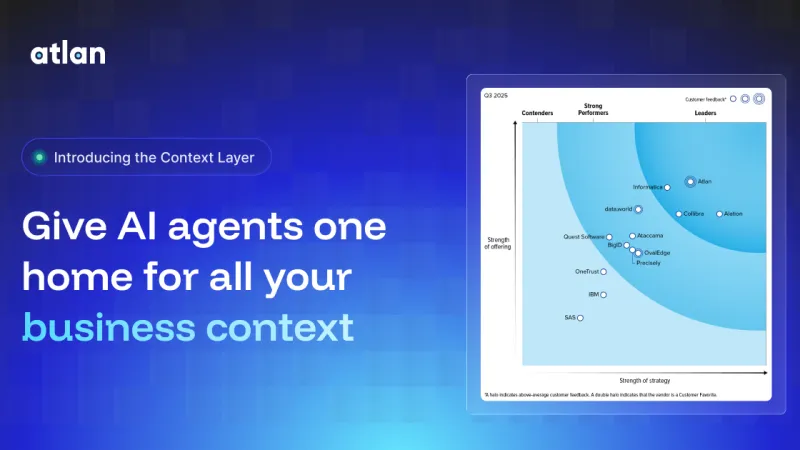 62 minThe context layer, live (product demos) Product demo · 62 min
 10 minWhy AI pilots fail in production Context library · Video · 10 min