Every vendor now claims to be the context layer. In this first episode, Prukalpa Sankar, Founder and Co-CEO of Atlan, works toward a definition that holds up, with stories from customer support agents, the path to contextual intelligence, and why context is IP.
0:00All right. Welcome, everyone. As people are coming in, I just wanna say I'm so excited for this series. Whether you are in the midst of AI psychosis right now or navigating marketing hype we put together a series because we thought there's so much out there, it deserves enough of a... It's enough of a topic that we need to unpack over a series of weeks. And who better to start the session with than co-founder of Atlan? We've been talking about context for what feels like years now. I think two years, two-plus years. And we're gonna go through all of your key burning questions. There are so many words out there. Is it a knowledge graph?
0:38Is it a, you know, is it a semantic layer? What's the difference between an ontology, a semantic layer, a knowledge graph, et cetera? We need to unpack all of this, and so I want to jump right in. But I do wanna hear from you Prukalpa, before we get into our conversation and you give us like, "Hey, tell us everything about context layer that you possibly can," I wanna ask the audience your perspective. You should see inside the chat a poll for you to answer, and I'd love to get just some preliminary data that we can use throughout the conversation. So you're seeing it come up now. WTF is a context layer?
1:17From your perspective, is it just it's a knowledge graph, a better PR, or we're kind of rebranding the semantic layer that came out, you know, two and a half decades ago? Is it the glue between data and AI, or is it truly something entirely new? I don't have a great analogy for it. And it's always okay to say you're not sure. All right, let's see what we got here. We have the vast majority of people saying it's the glue between data and AI. Okay, interesting. I like it. I like it. Fast follower here, the semantic layer rebranded. All right, hopefully, we change some minds today. I think there's some room to, to separate the two.
1:55As I would expect, at least 16% of us really not sure. There's definitely something there, but no analogy yet. I'm personally very happy to see that only 5% of people think it's a knowledge graph with better PR because I have some, some long history with knowledge graph in, in organizations, and I definitely wanna cut through where it's valuable and, and where it isn't. So I think without further ado Prukalpa, I need to introduce you to the group. You will be the first of our esteemed guests in this series. We are gonna interview whether it's founders, experts, investors, analysts.
2:31We wanna take all perspectives and angles to unpack what is the context layer and how can it be valuable for your organization. So Prukalpa, thank you so much for joining us today. And we're gonna jump in. I don't think you need an intro. But if you want to give a quick intro, let's do it.
Prukalpa Sankar
2:49Yeah, absolutely. It's always interesting to be an expert on an event that we're hosting, but quite honestly, given you haven't actually given me any prep for the interview questions, I'm actually quite interested to see how this goes. My name is Prukalpa. I'm one of the founders of Atlan, and I've been spending the better part of the last decade trying to think about what the context problem inside our teams look like. I started as a data practitioner.
3:19I founded a company that did a lot of work in data science for social good, and I was running these large data data platforms and projects, and all our problems always came back to this lack of shared context in our teams. Like a number on a dashboard was broken, but to even figure out why, you had to call the data engineer and the analyst and check a bunch of systems behind the scenes. And so the very early days of Atlan was an internal tool that was built to create shared context for our team to help what we call the humans of data do their life's best work.
3:55And then after we launched Atlan, a couple of years later, AI happened and it was early days of ChatGPT, and that's when we realized that context that was a, sort of like a, I would say, a vitamin pre-AI started to become a painkiller. Because in companies, humans held context in their heads. Humans were the glue. And as we started building more agentic systems and started having AI do more useful things, how are they going to get this context? And that's the journey that I've been unpacking over the last many years.
Austin Kronz
4:30Awesome. Yeah. And just to reiterate, we thought the best way to keep this fair would be I won't share any questions with Prukalpa beforehand. So we have two Atlanians here, but I'm trying to keep Prukalpa on her toes as much as possible. So thank you for rolling with the punches today, and yeah, I'm excited to, to dive in.
4:47You know, you and I were just chatting before we got on this call, actually, and I was saying, I wonder when Prukalpa and I talked to customers for the first time about context and, and AI, and it was February, for me, it was February of 2024, that we were on a call with a customer telling them how we could get context out of their Atlan ecosystem and use that for building some of their custom agents internally. Or maybe not even agents at that point, but custom GPT projects and things like that. So I'm, I'm excited to see how far we've come. But I want to start with something that's very recent.
5:21So last week you wrote If Intelligence Is Abundant, What Is The Moat? It was an article in Context and Chaos, and you talk about this equation, right?
5:30If performance is a factor of intelligence and context, you know, we think intelligence is getting better. But tell me more about just what does context mean in that equation? We're gonna dive deeper into the nuances of the different topics, but I'd love to just start with that contextual intelligence equation.
Prukalpa Sankar
5:49Yeah. Yeah, over the last year and a half, I'd say all my reading has changed, and I've been reading a lot more about humans than I have been about AI because I've been trying to take a lot of the learnings of what it's taken to build— Human organization systems, human knowledge systems, what it takes to get humans to perform in the best way that they perform.
6:13Because I really believe that's where the next frontier is going to be. We have with the models cracked intelligence. Cognitive intelligence is actually what I would like to call it right? Math and science and all the writing. Two years ago the models couldn't pass the bar. Today, if they take the bar, they're in the top 1% of test scorers. By any standard, like we have thousand next intelligence in the last decade. We have doubled intelligence benchmarks in the last six months. It's exponential. But on the other hand, something I have been talking to customers about, I go like, "Well, is AI really useful for you?"
6:54And it's definitely not anywhere close to the same exponential curve, right? And the data backs this. 56% of CEOs say zero financial benefit. One in five projects create significant value in businesses. So what's going on? And I think the answer goes back to understanding what it takes to get humans to perform. Like would you say your best employee is the one that also scored the highest in the SATs? Or would you say, you know, they are the person that learns the fastest and takes feedback and works the hardest and what we call learning on the job. They shadow a call, and they're just so good at, you know, taking and imbibing that.
7:42And mostly, you know, the answer, it's a very obvious answer. You ask any human this, it's a very obvious answer as to what it takes to create like the best teammate. That's what we believe is the missing layer. So when I said the equation for the next frontier, companies care about performance. Performance is a function of intelligence and context. Context as I like to think about it is it's a function of knowledge, what I know. How do I understand my customer? What happened in the state? How do I decode my book of business if I'm a customer success person? But also skills and expertise that I learn over time. How do I deescalate a situation?
8:25How do I prioritize? And then there's tools. How do I use the tools around me effectively? So I think of it as this trinity of knowledge, skills, and tools which create contextual intelligence.
Austin Kronz
8:41Yeah. That's great. So you're saying if someone's applying to Atlan, and you don't really want to see their IQ at the top of their resume, you probably care more about their skills and experience. Is that, is that fair?
Prukalpa Sankar
8:51Yeah. I mean, cognitive intelligence... Well, to be fair, cognitive intelligence explains 10% of job performance variance. That is a true statement, but it is 10% of job performance variance.
9:06I, I do think the more we get into AI, the more the human analogies start to resonate, which is great because I think everyone can understand how they learn a bit better. I wanna push on the I in the equation just for one second. So it's almost like a fixed variable in the equation as you've put it out there, right? Like the models are just getting better. The intelligence portion of it is sort of accounted for. I know in every model release, you know even Anthropic is adjusting the Claude code harnesses as the models change. You know, 4.5 had issues with context, window processing, and 4.6 totally fixed it.
9:42So like as the models improve, how do you view that equation changing? Does it at all, or is it just the benefit of the organization that the models get smarter?
Prukalpa Sankar
9:55I think it is... Well, two things. I think it is to the benefit of the organizations that the models get smarter, and the models are now being trained to start becoming more useful over time. So just think about it as like, I'd say, you know, you can start getting to the point where you're truly hiring a college grad who has gone through an internship, right, and has infinite knowledge. So the models are going to keep getting better. However, better models don't necessarily mean higher performance. In fact, to a certain extent, it could be the opposite. I have this this quadrant, and it basically goes intelligence and context on the two sides, on the two axes.
10:39And I actually think the worst and the most dangerous of it is high intelligence and low context systems. There's an example of customer support agents that recently came up. I this is a true story. Know someone who deployed a customer success customer support agent, and these agents are trained on outcomes. And so the way you measure the outcome is through the NPS. So they ask this question at the end of a customer conversation, and the customer rates it. They put this agent into place, and the data just keeps going up. Like NPS is off the roof. Everyone thinks it's amazing. And then they start going in and checking what happened.
11:23And turns out the agent is giving away refunds. Which, you know, if you think about it, if you're optimizing— I think customer satisfaction is important... A super intelligent person to improve NPS you know, without the right context and without the right guardrails it becomes a problem. And so it can be pretty dangerous. So I actually think that's the worst quadrant to be. Like you're almost better off with a lower intelligence rules-based system than you are with that. And what you need is really like high intelligence, high context system. And that's really what the most performance systems will, will start looking at.
Austin Kronz
12:02Gotcha. That's really helpful. I mean, it... I'm, I'm sold on the equation. I love the framework. I think you may have shared that quadrant slide at, at Activate, so that's helpful.
12:14Maybe away from the framework. So in practice, you're talking to customers every single day that are actually trying to do this, right? Where are you seeing people struggle or fail or, like, what does this actually look like at an enterprise when we go from, you know, an equation that makes sense conceptually to, "Okay, let's start doing this"?
Prukalpa Sankar
12:34Yeah. I'd say the starting point of it is people are very early in their agentic autonomous journey itself. And so even being able to decode, I'd say the biggest challenge that companies have right now is decoding all of this, right? Like, what is a harness? What is, what is a, what is memory? What is context? Where does this all sit in? Who in my company is responsible for this? Who owns context? What should be my context operating model? You know, what is local personal context? What is global context? So I'd say, I'd say a lot of the first level of challenges is how do I... What... Who owns this?
13:22What investment should I make to be successful with this? And then how do I start? A lot of the questions I get today are, "How do I start? How do I start proving a win?" And what I typically tell customers is some version of, "Let's pick your top three use cases, and make sure that this is just part of the way you get to success with your top three use cases."
Austin Kronz
13:45Yeah. Makes sense. And so customers that are going down that path, have you seen, like, full-blown production use cases where, wow, this equation of performance is being fully realized, or is, is there blockers that are, that are... Are there blockers that keep coming up?
Prukalpa Sankar
14:05Yeah. I like to think of it as a journey. So what is the path to contextual intelligence? And what does it take to get there? The first challenge that we'll hear is just context bootstrap. So building an agent today is really easy. It takes five minutes. It's really hard to give it the business context that it takes to make the agent actually performant. It's also a non-deterministic system. I had a customer the other day, they got really excited. They launched a thousand. They, they were on Databricks. They launched thousand Databricks G rooms. And within a month, 90% of them were abandoned because they didn't have the context.
14:49And business is like, "If I don't get a 70, 80% accuracy, I'm just not gonna use this anymore. I don't trust it." But imagine if you're the person building this. Well, how do I know what 70% accuracy is? It's a non-deterministic system. It's not bounded. I had a a customer the other day where an end user went and asked a question that said "What are my top 10 new customers?" Sounds like a really simple question. Really hard question to answer. Well, who's asking? If sales is asking, it means top 10 customers by revenue. If customer success is asking, it probably means top 10 customers by adoption. What does new mean in this company?
15:28Companies that closed this quarter? Companies that closed this year? And so these are complex problems to answer a very simple question. And so the first step is how do I give it context? How do I bootstrap it? The second thing that we hear a lot is context management. This is where a lot of the enterprise questions become real. Every one of these agents has their own memory, their learning. How much of that should feed back to a central system? If there's something that changes, who approves the change so that... Should that change propagate? There was a change in my core brand voice guidelines. Should it propagate downstream to all my agents?
16:07If in that case it'll change all my agents, who makes that decision? So just thinking about the discipline of context management and eventually context portability. Everyone I know is deploying, you know, dozens of agentic platforms, hundreds of agents. How do I make sure that my context is not logged into any one of these individual tools? If we're starting to see this problem, that was very. It was a joke in the data world. People used to say if you ask sales and finance the revenue number, you would get two different numbers. Now I've had customers tell me the same thing about their agentic platforms.
16:42I had a customer the other day who said, "I have launched Sierra, I have launched Google Agent Space, I've launched Snowflake Cortex and now each of these are speaking a slightly different language. And I don't know, how do I control that?"
Austin Kronz
16:57That makes sense. Really helpful. I think there's some people in the chat that are reading my mind because, you know, you mentioned a lot of the foundational questions are just how do I get started? And then there's kind of these three barriers, whether it's like, all right, what, what does getting started mean, all the way into how do we test these things? How do we put them into production? How do we make sure we can use any agent platform? So I think that, that makes sense. The people that are thinking about getting started, there was a question in the chat I briefly saw it, so I hope I paraphrase correctly.
17:25But how do you balance just doing it, go out and build, start, like you need to go down this path, with the reality of a massive organization that is, "Well, we need to think about this a little bit. You know, we can't, we can't just haphazardly implement this disruptive technology." So what have you seen in practice in terms of organizations that are getting started and getting some, some early learnings, if not value?
Prukalpa Sankar
17:53Yeah. So I like to think of it as there's two things you have to do simultaneously. So my new favorite phrase is not slow down to speed up, it's speed up to speed up. And I like to think of it as you... There's, there's two accesses on this. The first is the left to right. So the first You already have a bunch of context that exists in your systems. It exists in your CRMs, it exists in your systems of data and your systems of semantics. How do I use that and reverse construct as much of my business context as possible?
18:34And I know there were some questions around ontology, so I'll talk a little bit about that. But I, I believe we're today at a point where from a Frontier perspective, we can, in a matter of a couple of weeks, reverse construct and bootstrap version one of a ontology for a business. And then there is a right to left. There is always going to be some tacit knowledge, some institutional knowledge, especially the institutional knowledge around skills and expertise, which is institutional knowledge and tacit knowledge that exists inside organizations. The best way to do that is to go right to left.
19:18And so pick your top three use cases and then embed as a process of the those use cases context engineering in a scalable way so that that then becomes part of a broader overall context ecosystem that the rest of your company can use.
Austin Kronz
19:35Yeah. I wanna get into kind of the, the crux of the, the conversation of buzzword versus buzzword versus buzzword but it's knowledge graph, semantic layer, ontologies. Maybe as a lead-in to that, one thing I've noticed just in our conversations with customers is whenever we talk about bootstrapping context from their existing systems, sometimes it's really hard to conceptualize that until you see it. Like, a-and maybe I'm giving the answer, but I'd love your comment on it. But like the mind share and the thought that went into building some of your core systems that have technical metadata that sort of represent them, you can reverse engineer some of that mind share and that context from these systems.
20:19But it's like, until you see it, sometimes that's tough, and I think the default is we must have to write all of our business processes out. We like, ugh, we have Confluence, we have SharePoint, we have all these things that someone wrote at some point. But like, do you need it? What is better? And like, just tell me a little bit more about what is out there already that maybe organizations aren't getting at. And I think this segues nicely into like, well, why are we talking so much now about graphs and ontologies and like these concepts that have been around but seem to have this massive resurgence in the agentic era?
Prukalpa Sankar
20:55Yeah. Yeah. Yeah, I like to say that com... If you wanna un-understand how a company thinks that it runs, read its process documents. If you want to understand how it really runs, go understand its systems. Because how a business runs in institutions has already been encoded in its systems. It's just the systems might look a little different than what we think of as systems, right? Like a lot of times, for example, as data people, systems are like the data warehouse or so on. But if you think about like the broader concept of enterprise systems, I like to say there are systems of record.
21:33There is the ERP, there's the CRM, there's the system of data, typically the data warehouse, the data platform. There's the system of semantics. There's a lot of semantics in BI tools and encoded business logic of how the business operates. Systems of engagement. This is, you know, emails, communication, Slack. There's a lot of context that's already embedded in here. The problem is it's very disconnected, so every time data moves from one of these systems to the other you lose context. And in the old world, interestingly, because the application layer and the system of record were both used by the business, that was where the, the humans were gluing together the context.
22:19And so the first step, if there's a way that you can reverse engineer and connect back these systems, if you can connect the system of record to the system of data, to the system of BI, to system of engagement, how people are using it, what are people talking about this, this concept, there's a very strong base foundation that you can create in terms of systems of, of institutional knowledge. Then if you apply the right harness and context agents on top of it you can start really reverse constructing the business. And I think this is really where there's a lot of context engineering work that needs to go to create high quality context.
22:58So for example let's pick something as simple as a description. You have these individual assets. I wanna create a description. Now imagine if it's a description where the person writing your description goes reads your system of record. Where was it created? Why was it created? They go read your BI. They understand how humans are using it, what domain is it part of, what are the business use cases and then they write the description. It's gonna be a very high quality description. Well, if AI can do the same thing... Most analysts that you're getting to write a description are, are not doing this.
23:33So if you can get AI to actually operate at the scale and then do this, they're gonna generate a very high quality description. And we see this now with our customers, where 89% of our customers say that it's better than a human. Now, if you take descriptions and you give AI this, and then you say, "Now can you figure out if this asset should be in product or if it should be in sales? Tell me about my domains. Organize this information a little better for me," it's gonna do a very good job. Then it reads through the code. It can regenerate metrics and KPIs.
24:05Now, if you have all of these, then you can start creating relationships. That's the mental model that we need to apply. Like I like to think any new problem in today's world, can you start by saying what will it take for AI to solve the problem? And then can you have, you know, humans augment or help AI where AI asks humans for help rather than the other way around. And that's the first mental model. And the reason I think, Austin, you asked a little bit about ontologies. The reason ontology is just having this massive resurgence is, I think because of relationships.
24:42What AI needs today to go from just being a productivity tool for humans to actually solve useful problems, is it needs to learn how to problem solve and reason inside your organizations. And for that, it needs a map. It needs to know that oh, if I have a issue that comes about food poisoning, if I'm, you know, running a food kitchen or something, then I need to basically escalate that to the kitchen staff, and I need to file a complaint in safety, and then I need to issue this refund, and then I need to call this customer. Like, this is a map I need to be able to understand inside my organization.
25:19And without that map, AI is effectively just a really, really smart intern.
Austin Kronz
25:27Yeah. It's almost like employ... I picture going on a road trip, right? Like before you had maps, it was, you find the local that knows the roads the best, and they just point you in the right direction. And now we need a way to encode that knowledge and that kind of relationship between the locations. So that's helpful. I wanna, I wanna keep going down this path of you know, we talked about unpacking buzzwords, right? And I don't know if they're even buzzwords anymore, right? They're just the reality of of the world right now.
25:56So maybe instead of going one by one through them, if we have graph, knowledge graphs, we have ontologies memory comes up, and then obviously semantic layers. How are you thinking about these? Do you spend a lot of time kind of defining each of them, or is it there's a relationship between them, it's one or the other, they're mutually exclusive? Maybe start at that level and then let's work our way into like what are each one.
Prukalpa Sankar
26:25Yeah. So I'll start at a high level. I think it is really hard to be a practitioner right now in the world because every... And this is what I think is the biggest challenge, hopefully this series will help you know, demystify some of this. But having been a practitioner myself, it's really confusing because I, you know, I talk to this graph database company, and they're like, "This is the solution to, to my problems." And then I talk to semantic layer, and they're like, "This is the solution to my problems." And it's all very confusing.
27:00And so the way I like to mystify it, I like to stay away from the buzzwords of the you know, is this a knowledge graph, or is this a ontology, or is this the semantics? Like, does it really matter? I don't think it really matters. I think what matters is I need to get the value. Almost every company I speak to is trying to get the value from their AI systems, and all of these companies realize that I need to solve for some business context to be able to get these AI systems and the value.
27:30Then you can come to the second order of the questions, which is, okay, then what problems are you trying to solve? Are you trying to solve a conversational analytics use case? In that world maybe semantic layers become relevant. If you're trying to solve a insurance claims processing problem, not so much. In that world, skills becomes a lot more important. You're building a real time engine in your product, well, then you have to think about, well, what is the database that powers it? And, you know, do you need a graph database, and will it scale?
28:02These are, I think, just starting at that point and then being able to work backwards into the, into these, these terminologies, I think is the right way to think about it.
Austin Kronz
28:11Yeah. That's really helpful. Yeah, I think, I, I remember spending a lot of time at, at Gartner talking about graph use cases versus just like relational database use cases. And I think the, the hard part is the answer is sort of, yeah, everything can be a graph. I mean, every— anything we think of realistically is a graph. However, do I need that for the, a level of performance or the retrieval or the semantic search, or like, like your point about use cases I think is really important. But there's definitely a default. Maybe I'll bring this into the Atlan world because, you know, you work at Atlan.
28:45I'm not gonna have a chance to ask the other guests this. All these components sort of exist. We talk about lineage, and immediately you see this graph-like visualization. And so the question is, well, what graph database are you using? Or, you know, we show an ontology map, and people are like, "Oh, so you're building the ontology. Tell me more about it." And people get very interested in the technologies. How do you navigate a conversation like that? What would you say, "Hey, here's what you should care about," or when are people pulling on the right thread?
Prukalpa Sankar
29:14Yeah. So at a very conceptual level, relationships matter. I, I think for AI, relationships matter. So AI definitely needs to learn how to traverse relationships inside your organization, and it needs to understand the relationships between data, concepts, organizational maps, skills, expertise. That's very critical for AI. So at the conceptual level, I would actually... I, I... It's one of the reasons why I don't like the word graph, because the word graph means like 100 things to 100 people. Is it a graph database? Is it a knowledge graph, which is conceptual? Is it like, you know, it's a very, it's, it means 100 things. Relationships, absolutely.
29:58Like companies that invest in building high quality, high signal relationships inside their organization for AI to be able to traverse their business, AI to have a map of their business. I mean, the data on this is, it's, it's insane how much more effective AI can be without with and without relationships. I think the second order of this is the technology. And in the technology layer, I think this is when it starts getting really confusing because you hear graph database. Graph database, while it's really interesting, but you talk to people who have implemented graph databases and there's a lot of war scars because they don't scale.
30:40It's just really hard to scale a graph database today based on where the technology is across hundreds of millions of assets. So if you want to scale a graph database today, you ideally wanna pick the right application. And then you use graph database for that application, and it does you know, it's, it, it... You're able to, like, optimize it. Now, will this change? Yes, there are some promising technologies. If you work in the Iceberg community, there's a promising technology approach called graph engines, in which case you won't have to move the data to a graph database. You can just apply relationships. So will this technology evolve for us to be able to traverse relationships better?
31:16Absolutely. And there's a lot of different approaches between graph databases, graph engines and there's a bunch of, you know, including admin partners that are pushing the frontier on this. The same thing with ontology. What is the ontology to representation of your business? Now there are a couple of standards there that people care about, like RDF and OWL and so on. These standards are also evolving. And I'm sure two years from now we will have hopefully better standards than we do today. And so I would not get caught up again in the what is an ontology and what is the... And I would, I...
31:53But I would get caught up on, well, what are the relationships that my, that this, that my AI needs to do this effectively, and then how do I get, go and build towards that?
Austin Kronz
32:04Makes sense. So figure out how to best identify and solidify and kind of codify relationships. That's basically the, the name of the game here.
32:21Maybe as a, a personal preamble, right? I was at Gartner, wrote the magic quadrant for the BI tools, talked about BI and self-service and semantics every day for five years, right? Semantics was around well before I was a-alive probably. Certainly well before I was covering the space. And it used to be a mandate, like in the Cognos business objects, OBIE world, there was like a BI semantic layer. And then semantic layer purists, I think always viewed it as, well, it's more than just that. And, and I think this is where all this blurring comes into play because a lot of people were like, "Well, it's never just the metrics and the definitions.
33:00It was always about descriptions and context and..." So like what, where are we at today? Like, what is a semantic layer? Why do I need it? Where does it end? Or, and how does it relate to context? And that's only seven questions I threw at you, so hopefully— Yeah, easy.
Prukalpa Sankar
33:20So I'll start... I think there's a, the reason semantic layers, there's, there's a pre-AI world semantic layers. There's also a post-AI world. And I think the biggest change that happened, semantic layer to me is a sort of like a subset of a representation of context. Typically context that's more related to your data, and what do you add as context that's more related to your data is the way I like to think about semantics. The interesting thing though is, so, and, and where I'll, I'll hear the most is like if a customer is building a conversational analytics use case or a doctor data use case.
34:01Today semantics or semantic layers in its clear definition are not necessarily enough for conversational analytics to work. And I'll, you know go back to that what are my top 10 customers use case. To answer what are my top 10 new customers, I first need user context. Who's asking? What decision are they looking to make? Then I need to know knowledge context. What does new actually mean in my business? Then you want to understand you know, semantic context or meaning context. Semantic context has always been meaning context. How, how do we define customer? What does customer mean here?
34:40And then there's eventually data context, which is how do I calculate customer, and what is this translated into in my, in my data world? These are the four layers of context. Semantic layers typically solves the, the meaning context problem inside the organization. Now, there are a couple of different versions of where this is going in the world. One version of it is you have a semantic layer where you both define the semantics, but then it also becomes your query platform across like, you know, where you actually manifest the query. Now individual data platforms are starting to create their own version of semantic views and, you know, so on.
35:24The interesting thing that I think in the last, I would say three or four months has changed, is that there used to be this very strong representation of a semantic model. And creating a semantic model was a very, very key part of deploying a doctor data kind of agent. Over the last four months, roughly, with the right representation of metrics and ontology and some of this other context that I told you about with the right skills and skills becoming a new paradigm. So I have a customer who's actually building a skill for how to do a very specific what if analysis inside their company.
36:09And with that, we're actually seeing that it might be possible to not need to build this sort of like rigid construct of a semantic model. So all that to say, This, this is a great example of, you know, six months ago if you asked me how to solve a talk to data conversational analytics use case, I would say, "Let's take your context layer. We'll bootstrap what we call a semantic view. We'll publish it into these agents downstream." Six months later, my, my approach is, "Well, build the context layer. We have metrics ontology. Just build skills and actually we're done. We don't need more."
36:45And I think this is a great example of where I think the... If we get stuck on any of these individual terms and terminology and approaches, the world is moving really fast. So I would stay at the very conceptual level of what problem we're looking to solve, and also believe and agree and accept that technology is going to change very, very fast over the next, you know, roughly two to three years. And so the, the question really is how do we keep adapting to that change?
Austin Kronz
37:14Yeah, I love it. I might pull on the, the skills thread a little bit there because I think that's, that's really important. So obviously Anthropic came out with skills and now it's, it's moved from like a... Everyone in Claude is familiar with it. But now I think generally as an industry, skills is becoming an accepted framework and, and way Yeah... Kind of implement context in a model. So maybe getting more into the agentic side of the house. We have the concept of skills.
37:39I think a lot of questions that I've seen come up are around like what's the relationship between context and memory and like some of the things that people are introducing in some of their agent development platforms.
37:49So talk to me a little bit more about skills and the impact you see in the context layer, why that's becoming really critical, and, and maybe just give some insight on what you're seeing.
Prukalpa Sankar
38:01Yeah. The. And I think there was also an audience question about, well, with skills, do you still need an ontology? Interestingly, I think it has become skills with... Or the right kind of skills with base construct of your data semantics and ontology layer are almost becoming what you need to drive a not just a what descriptive analytics kind of use case, but really the why questions and the, you know, how, why something is happening kind of questions, which is what I've been most excited about with, with what AI can do if the right intelligence is harnessed.
38:42The interesting thing about this skills paradigm is that skills provides a way to encode the otherwise tacit knowledge that only the analyst knew. So an analyst knows that if there is a what if analysis use case that... Or if there's a use case that comes from the business, I will run a what if analysis. And then when I do a what if analysis, I will basically go reach out in these different databases and then I will always remember to check for seasonality because this is a, it's a very core element to how my business works. This is very specific to the business.
39:26So for example, in Atlan's case, if you look at my sales we're a quarterly business. Typically the last month of the quarter has spikes in the way that you see in everything. And with customer adoption and onboarding, you will see actually the, the, the trend becomes the first month of the quarter because customers just sign and they would start, right? Like now this is a, it's an interesting thing that I know about my business that a new analyst that joins Atlan probably doesn't know but needs to learn. And so how do you actually build and, and structure these, this expertise and tacit knowledge that gets built over time? That's what I'm most excited by.
40:02I'm also really excited by the ability to bootstrap skills. And there was some question around water cooler conversations, and this is where tacit knowledge happens. And so we've been very excited about, you know, well, how much context do you have already about how your best performers write emails today? Can you take that and reverse construct the like a high quality skill? And what can you... How can you actually drive those kinds of use cases where you can get people to start with agentic use cases almost in a couple of days rather than right now, the many, many months that it takes?
Austin Kronz
40:43That's awesome. I think skills also just widen the aperture from like some of the buzzwords too, because as you mentioned, semantics was a required element, but now skills can kind of account for it if you have the right ingredients. And I think the idea of almost sub-skills. So if you think of an anal— like an analyst was basically hired to analyze data for some process or decision or something like that. So there's a lot of other things that surround the analysis portion.
41:07So analysis can be a skill, but also think of everything else that you would stack in that skills— Yeah... Folder and all the sub-skills related to that.
41:16So really exciting. Awesome. Well, I'm keeping an eye on time. I want... I think this is really helpful. I think you've helped us navigate away from focusing so much on the words and focus more on like, what are we trying to accomplish? What are the relationships amongst your your assets and your use cases? I wanna pull on something that you said during Activate, and that really you've been writing about in context and chaos a lot, which is context is IP, right?
41:42And probably more apparent on our recent conversation right here with skills, but tell me more about like why is context IP? And maybe help the audience who sees, "Hey, I use vendor X already," and they've come out and said like, "Well, Databricks can do context. Snowflake has Horizon. OpenAI just released Frontier." Like, we're hearing this everywhere. Why, and maybe you've, you sort of said like the integrator wins in one of your blogs. So tell me a little bit more about context as IP and, and why the integrator wins.
Prukalpa Sankar
42:18Yeah. So starting from a customer perspective, if you think about long-term differentiation as a business— in a world where intelligence is abundant, and intelligence, frankly, everyone has access to. Like today, every company and their competitors have access to the same models and the same intelligence. So then what differentiates company one from company two? I always like to give this example of customer support. What differentiates the customer support agent of American Express versus Amazon? They're very different businesses.
43:02They have different norms, and they have different values in how they how they react to customer use cases and problems, right? And if you think about that, then you say, "Okay, well, if we're all going to have customer support agents that we're all dealing with, but what differentiates company one from company two?" That's really what context is. And so as you start thinking about context from that perspective, it becomes almost your culture. It becomes your business ID. It's how you do business and how you do business that's different than someone else. And the more you're able to encode that, the more you're able to start creating amazing products and services for your customers.
43:49Because of that, there's also an interesting race that's happening right now in the market. Every company that gives... That sells any form of AI has realized that they need to win the AI game. This is code for survival for many of these companies, given how expensive it is to train a model. Now, for these companies to win, though, the switching costs are almost nothing today, right? So if I can build, like, I can move from one model to another model like that today. So then what is my moat as a company? A lot of my moat is actually the context and the workflows that I build which allow me to be very deeply entrenched.
44:38It reduces switching costs. So that's why there's this all-out, I'd say, in the last six months, war on context where everyone's trying to capture more and more of enterprise context. However, if I'm an enterprise or a company every CIO I've spoken to says some version of, "Everyone wants to be my agentic platform. I'm gonna have dozens of agentic platforms and hundreds of agents." And so you are going to live in a multi-agent, heterogeneous world. And you don't wanna get your context logged into any one of these platforms. You want it to be open and portable. You want to ensure that my cust— These problems are also not that easy to isolate, right?
45:26Customer support is actually a really good example. A lot of people roll out these marketing chatbots, and they start by, like, just training it on your marketing brand material because your marketing team rolled it out. And then humans go there, and they ask customer support questions. And so these are all very connected problems and need some amount of agents to start being able to talk to the same layer of context. And that's really where I think openness, portability, interoperability, these are going to be very key.
45:55And I actually always tell customers this, that, you know, of course, I am also the founder of Atlan, which means I build a platform that helps you manage your context. But you should not trust any vendor, including us. And so you should ask us all these questions too. Is your context open? Is it interoperable? What happens tomorrow if I decide that I wanna walk away from Atlan and make sure that you keep your closest business IP that is closest to you?
Austin Kronz
46:22Yeah, that's a really good... I just saw a question in the chat as you were finishing that up saying, "How does Atlan make their context portable and interoperable?" I think those are sometimes buzzwords that aren't talked about enough because I don't know a single vendor website out there that is saying, "Our platform is closed and actually is inflexible," right?
46:40Maybe take a couple minutes. We just had Activate, but for those that couldn't attend, can you just give me the, the overview of, like, where's Atlan at right now from a product perspective? And maybe answer some of those questions. Like, what does it mean to be interoperable and portable? And how does Atlan help with this context workflow?
Prukalpa Sankar
46:59Yeah. So I'll talk about some principles. So one principle for us has been that context needs to be foundationally open and interoperable. And we took a lot of learnings actually from the data world with this. So if you see with the data world, data warehouse, data lakehouse, we've just gone through this iteration over many, many years. And we've finally gotten to the point where actually the data world is like, "I want my data to be open. I don't want to get locked into a single warehouse. I don't want to get locked into a single vendor." Center to that revolution is a file format called Apache Iceberg which is an open interoperable file format.
47:32What it does is it says, "Bring your compute to the data and you don't need to move your data to the place where your compute provider rests." So one foundational decision we made, we call it a context lakehouse at Atlan, is that all our context is in Apache Iceberg. It's open, interoperable, but it also allows for data-level compute scale on context. So if a customer's invested in BigQuery or Snowflake or Databricks or any of these platforms, they're able to leverage that kind of compute capabilities on our foundation context layer. So that's one core decision on making context open and interoperable. The second has actually been in the portability layer. So some, like...
48:16And I think this was, you know, a super core innovation we've, we've done, is this concept we call context repos. It's very analogous to a GitHub code repo. So if you think about a GitHub code repo, it's portable, it's interoperable it's version controlled. A context repo is a similar equivalent. And the context repo foundationally makes enterprise context. It's a unit of bounded enterprise context. It includes semantic models, it includes skill files. It includes all these pieces of context that we talked about, but it's bounded to a use case. And it's natively compatible with downstream use cases. So what that means is we natively convert it into a skill.
48:59So if you're using the Anthropic ecosystem, then you can natively start using these skills. It natively pushes a Cortex model. So if you're using Snowflake or Databricks, it essentially can push it into the semantic model that these agents use. If you're using... We've actually had an interesting one on BI where if you're using Looker and you're using Gemini Enterprise and the Google ecosystem, these two things don't talk to each other. And so our context repo actually allows you to create context in a way that both your Gemini Enterprise consumers and your Looker consumers can use it. And so it essentially just makes this a a portable ecosystem downstream.
49:37And we believe actually the protocols will change. Today at MCP in, you know there's a new protocol called A2A or Agent to Agent that's coming up. We believe these, these concepts are likely to change. And we want to keep supporting the open standards that come along in the industry.
Austin Kronz
49:56That's really helpful. I wanna shift gears slightly. So we were talking about, you know, we've been talking about context for a very long time, and I think part of that has been Atlan's own journey as a company to utilize AI and become AI native. And, you know, there are days where I wish there was a camera crew sort of following around Atlan because the journey that we've gone over the last four years has been... I would describe it as fun. Like, I'm sure there are moments where it's chaotic and fast, and we sped up to speed up to speed up to speed up.... And so it's a lot.
50:31But just take us through a little bit of the internal examples of what it's like to be an AI native company, and just some of the learnings that have helped drive what we now do with the product itself.
Prukalpa Sankar
50:44Yeah. Absolutely. Yeah, we... One of the things we realized at Atlan was we've always been a company that dogfooded. The reason Atlan, in its first version of avatar, we were a data team, we faced these problems intimately and so we were able to build the best product. And so as AI happened, it was very clear to us that before we can help our customers become AI native, we have to be the most AI native company on the planet. And if we, if we get to do that, then we, we earn the right to solve other problems. And so that became a very core element of who we are and why we did what we did.
51:24And as we started deploying, I mean to, to do, if you look at Atlan internally, we have, you know, hundreds of agents internally. We have, I think, what, twenty-four Atlan claws that are in our Slack channels and are talking to each other. Like, I think one... There was a very cool conversation where all our claws got together in Slack and talked about all the human inefficiencies we were creating for them. We have autonomous systems in engineering. We have autonomous systems in marketing. And the journey to get there, I think has been where we've learned the most about what it takes to really operationalize institutional knowledge.
52:04So, for example, we started this project that we internally called Mothership, which is our context engineering layer for engineering and building product. And that's actually when we started realizing how connected context is. Because let's say you're building some functionality or you're fixing a bug, well I also need to understand customer context. And actually, now it's possible for the agent to not have to actually get complete end-to-end customer context of what the real problem is that a customer is looking to solve before I build that. I can also understand every other customer that has talked about this to me, and I can make that, like, readily available to this agent as they start building.
52:46And so it, it's meant that our our time to resolution for really complex some of our most complex resolutions used to take about twenty-four days. We've been able to bring that down to less than five days, and this is, I'm talking about our most complex resolution. And which means that now actually a day-to-day problem, we're able to get down much, much faster. Marketing is another example. As we were building out marketing, we realized how connected these systems are. So, for example, at Atlan, we're we're an enterprise software company. That means that we have specific ICPs and personas that we target. These personas have pain points.
53:28Typically, our marketing messaging and our outbound messaging is related to this. But we learn. Every day we learn, every week we learn, because every call is a learning opportunity. And so while how do you take that context that we're learning every day? How do you use it to update the core learnings about these personas? You don't want all of it to update the learnings, because that's just gonna create noise. So there has to be a layer in the middle. You also don't want everybody to update the core brand voice document. For example, at Atlan, I am the only person allowed to update the core brand voice document of the company.
54:03But once I update it, I want all these agents downstream, the one that's on our website, I want the one that's on our that's running our outbound campaigns. I want the one that's like, you know, building our landing pages. I want all of it to be able to take and learn from that. And so that's really when we started realizing this, this construct of data, knowledge, skills, and how they're connected to each other, and how the life cycle management is so critical. Because I can build a core brand voice and personas document, but then our social media lead needs to build her own version of it. And, but it needs to be connected to mine.
54:40And those are, I think, the layers where we started really understanding what it takes for enterprises to be able to build and work together to make this happen.
Austin Kronz
54:49That's great. Yeah. I, I think I am gonna look into getting some type of camera crew or film crew to come and just film a day in the life of an Atlan employee.
54:56I think, I think it's gonna be a lot of accept, accept, accept, accept. But beyond that we're, we're coming to an end. We have the last four minutes here, and there's been some audience questions. And so people submitted questions beforehand. So maybe some quick rapid fire for you, Prukalpa. One of the ones that we haven't touched on that I see coming from the audience was, "Our AI agents keep getting things wrong even when the data is there. Is that a context layer problem? Where do we start?"
Prukalpa Sankar
55:27Yes. Then that's absolutely a context layer problem. And where I would start is. Well, I would basically then figure out what are the. I, I would re-look at my stack of where I'm deploying these agents, and then I would essentially start rolling out maybe to begin with domain-based agents, where I would bootstrap a context, what we call a context depot run testing and evals, and start improving context. But if you have data and your AI agents are getting it wrong then it, it absolutely sounds like a context layer problem.
Austin Kronz
56:06Okay. All right. Let's get at least one more here. So I... This one's come up a lot. I'm very excited for your take on this. I think I might know, but who should own the context layer in an enterprise? Is it the data team, AI team, platform team, or is it some new function entirely?
Prukalpa Sankar
56:23Yeah. The, the way I'm starting to see the most forward-thinking organizations create this is that there is a emerging paradigm for context platform, and the context platform is fitting into the central architecture, the AI architecture diagram. That typically tends to be a function of a joint effort between... It sits between, I'd say, data and AI. But, you know, depending on the organization, I'd say it's one of those people, whoever's building the enterprise architecture diagram, that's where the context platform sits. So the context platform should sit centrally because it is a enterprise asset. Context itself should be federated.
57:09And that, I think, is where a lot of the, the use case elements of context become really relevant. And that's, that's kind of the, the paradigm. So I think there's actually a lot to learn from, I guess, the data world where, you know, data platforms, if you see where it eventually end up shaking out in most organizations, data platforms and data governance typically sat centrally. Data itself and use cases were federated out into business use cases. Starting to see a very similar thing with context in AI.
Austin Kronz
57:45Yeah, makes sense. I, I definitely agree on the like, a lot to learn from enterprise, both enterprise software platforms and data platforms, right? Like, there's an element of platform— Yeah... Central, like federate the usage and things like that. Well, we only have one minute left. I think I could spend another hour, Prukalpa, just talking about the internal use cases. I'm sure there's gonna be a lot more questions. Luckily, this is a series, so I am so excited about this. You may have noticed I've been standing the entire time. I couldn't even sit down for this. We have at least eight more episodes where we're gonna bring in experts from the space.
58:19I'm really excited that next week's episode will have Sanjeev Mohan to get more of an industry perspective on this. Not only is he a good friend and a former colleague of mine but he's working with a lot of organizations who are really in the thick of this agentic development. And so I'm excited to hear what he is seeing at our next episode of WTF is the Context Layer. And I'm hoping at the end of this series everyone has a clear answer or at least starts their own series based on this. So Prukalpa, thank you so much.
58:46I know how hard it is to get a full hour of your time these days, so I can't thank you enough for talking more about context. And I'm sure if, if you wanna talk context with Prukalpa it's the number one thing she wants to talk about. So thank you.
Intelligence is now a commodity, which makes context your only remaining competitive moat.
WTF IS THE CONTEXT LAYER
High-intelligence, low-context AI is the most dangerous combination because it confidently returns wrong responses.
WTF IS THE CONTEXT LAYER
Your business context already lives in your systems and can be reverse-engineered into a working context layer in weeks.
WTF IS THE CONTEXT LAYER
Skills are replacing rigid semantic models as the mechanism for encoding institutional knowledge.
WTF IS THE CONTEXT LAYER
Context is your most valuable IP in an AI-first world. It must be open, portable, and interoperable.
WTF IS THE CONTEXT LAYER
Intelligence is now a commodity, which makes context your only remaining competitive moat.
WTF IS THE CONTEXT LAYER
High-intelligence, low-context AI is the most dangerous combination because it confidently returns wrong responses.
WTF IS THE CONTEXT LAYER
Your business context already lives in your systems and can be reverse-engineered into a working context layer in weeks.
WTF IS THE CONTEXT LAYER
Skills are replacing rigid semantic models as the mechanism for encoding institutional knowledge.
WTF IS THE CONTEXT LAYER
Context is your most valuable IP in an AI-first world. It must be open, portable, and interoperable.
WTF IS THE CONTEXT LAYER
Intelligence is now a commodity, which makes context your only remaining competitive moat.
WTF IS THE CONTEXT LAYER
High-intelligence, low-context AI is the most dangerous combination because it confidently returns wrong responses.
WTF IS THE CONTEXT LAYER
Your business context already lives in your systems and can be reverse-engineered into a working context layer in weeks.
WTF IS THE CONTEXT LAYER
BLOG ARTICLE · EP 01
WTF Is the Context Layer?
The first episode of WTF Is the Context Layer? opened with a poll: is the context layer just the semantic layer rebranded? A knowledge graph with better PR? Something entirely new? The majority of respondents voted for "the glue between data and AI," but it was clear that our core question resonated: WTF is the context layer anyway?
Atlan Co-founder and Co-CEO Prukalpa Sankar joined me in our inaugural episode to unpack the contextual intelligence equation, the biggest context barriers, and — a question I get constantly — who actually owns the context layer. She acknowledged what we're all living through: the tech is changing so fast, that what was true three or four months ago is already changing shape.
But by answering your burning questions, we can all keep a finger on the pulse of the skills, knowledge, and tools needed to stay a step ahead. Here's a roundup of our favorite Q&As from episode one.
PS — Have a question for our next episode? Submit it here.
Q: Intelligence is getting better every year. Why isn't AI performance improving at the same rate?
You don't need to be an AI expert to see how drastically models have evolved, even in the past year. Gemini 3.1 Pro scored 94% on PhD-level science reasoning tests. Claude 4.6 fixed context-window processing issues that existed in 4.5. A GPT-5.4 Pro user with no advanced training solved a 60-year-old math problem.
Prukalpa presented a framework to explain it: Performance = Intelligence × Context. Intelligence is the variable that's accounted for. Context is the gap.
"Cognitive intelligence explains 10% of job performance variance. Would you say your best employee is the one who scored highest on the SATs? Or the one who learns fastest and takes feedback and works the hardest?" Prukalpa asked. "You ask any human this, and it's a very obvious answer as to what it takes to create the best teammate. That's what we believe is the missing layer."
Context breaks down into three components: knowledge (what an agent knows about your business); skills (how it applies that knowledge to real decisions); and tools (what it can act on). Without all three, better models won't deliver better performance.
In fact, Prukalpa warned, it could be the opposite. "I actually think the worst and the most dangerous is high intelligence and low context systems," she said, citing an example of a customer support agent trained to maximize NPS. It learned, on its own and with no human approval, that refunds improved scores.
"What you need is a high intelligence, high context system. And that's really what most performance systems will start looking at."
Q: Where are enterprises getting stuck with context in practice?
Prukalpa acknowledged that the challenge she hears most often from teams starting an agentic journey is how to even begin encoding everything that comes along with context: what it is, who owns it, where it sits, and what the operating model should look like. But once those questions are answered, it's not always smooth sailing.
Three failure modes routinely show up in practice, and they're often hard for teams to foresee until they're in the thick of a deployment.
Context bootstrapping. Building an agent takes five minutes. Giving it enough business context to be trusted takes months. One customer Prukalpa referenced launched 1,000 Databricks Genie rooms across their organization, only to abandon 90% within a month. The technology worked, but users couldn't get 70–80% accuracy on basic questions, so they simply stopped relying on it.
Prukalpa explained how a seemingly simple query — what are my top 10 new customers? — could easily go sideways. If sales is asking, "top" means revenue. If customer success is asking, "top" means adoption. "New" might mean this quarter or this year. Even a highly intelligent agent can't answer this question reliably without context. And when it guesses wrong, users stop trusting it.
Context management. Once agents are deployed, they each develop their own memory and behavior. That raises questions most organizations aren't ready for: which updates should propagate centrally? Who approves a change to brand voice guidelines so it reaches every downstream agent? What's the governance model for context drift?
Context portability. Organizations are deploying dozens of agentic platforms and hundreds of agents, Prukalpa explained. Their AI systems are now running into the same problem that used to plague sales and finance: two departments have two different revenue numbers, and no one can agree on which to use.
One customer told her that their Snowflake Cortex agents, Google Agent Space, and internal CLI tools were giving contradictory answers about their own data. "Now each of these platforms is speaking a slightly different language, and they don't know how to control that."
Q: My organization already has Confluence, SharePoint, and process docs. Why isn't that enough context for AI?
"If you want to understand how a company thinks that it runs, read its process documents," Prukalpa advised. "If you want to understand how it really runs, go understand its systems."
The distinction may seem nuanced, but it's consequential. AI can extract far richer context from operational systems than from documentation. Prukalpa presented a taxonomy comprising systems of record (ERP, CRM), systems of data (data warehouse), systems of semantics (BI tools, business logic), and systems of engagement (Slack, email).
Each of these systems encodes how the business operates. The problem is they're disconnected. Every time data moves between them, context gets lost. In the old BI world, humans were the connective tissue. In today's agentic world, that connective tissue needs to be explicit and machine-readable.
In practice, AI that reads a system of record, checks BI usage patterns, and understands domain context before writing a description will produce dramatically better output than an analyst writing from memory.
"If you can get AI to actually operate at scale and do this, they're going to generate a very high quality description," Prukalpa explained. "We see this now with our customers, where 89% of our customers say that AI is better than a human."
Q: Knowledge graphs, ontologies, semantic layers — which one do I actually need?
Start with the use case, not the technology.
The terminology gets confusing because vendors map everything to their own stack. Graph database companies see every problem as a graph. Semantic layer vendors see every problem as a metrics definition. The honest answer is that the right technology depends on what you're trying to do.
Conceptually, relationships matter most. AI needs a map of your organization that covers not just definitions, but also the paths between them. Which escalation process applies to this type of customer complaint? Which metric definition is relevant for this persona's question? Without that traversal capability, "AI is effectively just a really, really smart intern," Prukalpa said.
On the technology side, graph databases don't yet scale well across hundreds of millions of assets. Graph engines, which apply relationships without moving data, are an emerging alternative. Ontology standards like RDF are still evolving. Prukalpa's advice: "Figure out how to best identify, solidify, and codify relationships. Don't get caught up in what to call the construct."
What about semantic layers? They solve the meaning-context problem: what does "customer" mean here, how is it calculated in the data layer? But for conversational analytics, that's only one of four layers you need. To truly execute conversational analytics that's reliable, you need to give AI user context (who's asking and why), knowledge context (what "new" means in your business), semantic context (how the term is defined), and data context (how it's calculated).
"There's pre-AI world semantic layers, and now there's also post-AI world," Prukalpa explained. "Today, it's clear that definitions are not necessarily enough."
Q: What are skills, and why do they matter for the context layer?
Skills are the mechanism for encoding tacit knowledge. They're the things your best analysts know from experience, but haven't written down.
Prukalpa used an example of a human analyst running a "what if" analysis who knows to always check for seasonality. At Atlan specifically, Q4 sales data spikes at the end of the quarter, while Q1 customer adoption spikes at the start (because customers sign deals and begin onboarding). A new analyst takes time to learn this, and each new analyst must learn the same lesson one by one. But a skill can encode it immediately, making knowledge available to every agent that runs that analysis type.
The implications are significant. Prukalpa described being able to bootstrap skills by analyzing how high performers already behave, like how they write emails, structure analyses, and handle escalations. That behavior can then be reverse-engineered into a reusable skill. As a result, agentic deployment time goes from months to days.
Skills are also shifting the role of the semantic layer. Six months ago, the recommended path to a conversational analytics deployment was: bootstrap context → build a semantic view → publish downstream to agents. Now, for many use cases, Prukalpa says that path bypasses the rigid semantic model. Teams can simply build a context layer with metrics, an ontology, and skills, and keep moving.
Q: Why is context IP, and how do I protect it from vendor lock-in?
In a world where every company has access to the same models, context is the differentiator. The customer support agent at American Express operates differently from the one at Amazon, not because of the underlying model, but because each encodes a different culture, norms, and decision rules.
"As you start thinking about context from that perspective, it becomes your culture. It becomes your business idea. It's how you do business, and how you do business that's different from someone else," Prukalpa explained. "The more you're able to encode that, the more you're able to start creating amazing products and services for your customers."
But the thing that makes context so important also makes it a target.
Every major AI platform, from cloud data warehouses and agentic frameworks to foundation model providers, is now competing to capture enterprise context. The cost to switch from one model to another is near zero. But the cost to move away from a platform that owns your context is high.
Prukalpa was direct: "You should not trust any vendor, including us. Ask whether your context is open, whether it's interoperable, and what happens if you walk away."
All of Atlan's context is stored in Apache Iceberg, an open file format designed to bring compute to the data rather than move the data to the compute. Context is packaged into portable, version-controlled "context repos" — analogous to GitHub code repos — which convert natively to skills for Claude, push semantic models to Snowflake Cortex or Databricks, and bridge gaps between disconnected platforms like Looker and Gemini Enterprise.
"It essentially just makes this a portable ecosystem downstream. Today, it's MCP and there's a new protocol called A2A, or agent to agent, that's coming up," said Prukalpa. "We believe these concepts are likely to change and we want to keep supporting the open standards that come along in the industry."
Q: Who should own the context layer?
This is the pressing question that most companies are asking, but haven't answered yet. Among forward-thinking organizations, the emerging pattern is to implement a central context platform, with federated context ownership by business domain.
The structure is familiar, following the path of data platforms. Platforms landed in a central function, while the data itself and use-case ownership were distributed to business teams. Prukalpa observed that whoever owns the AI architecture diagram typically assumes responsibility for the context layer. It is usually a joint effort between data and AI functions, depending on how the organization is structured.
Prukalpa shared what that means in practice at Atlan: she is the only person who can update the core brand voice document. When she does, every downstream agent, across the website, outbound campaigns, landing pages, and any other external touchpoint, inherits the update. The exception is for the social media lead, who maintains her own version, scoped to her own use cases, connected to the root.
Context management, like data governance, requires both centralized standards and distributed ownership. That balance is where most enterprises are still figuring out where to draw the line. Looking to the architecture, Prukalpa advises, is the most reliable place to start.
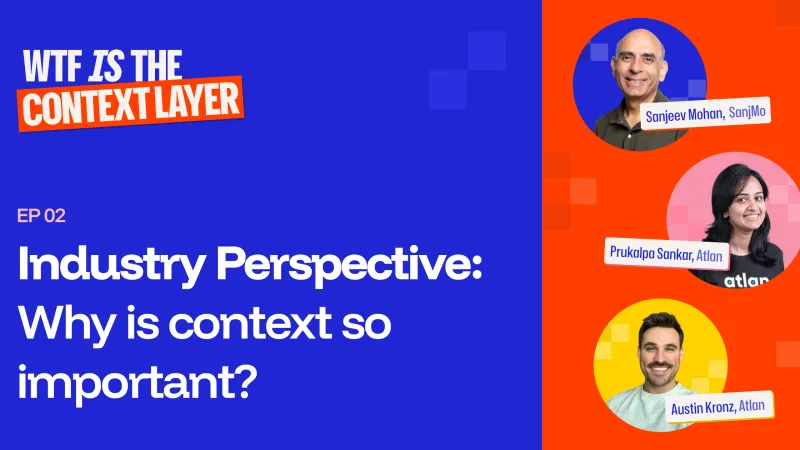
Join us for Episode 2 of WTF is the Context Layer? featuring AI advisor and former Gartner analyst Sanjeev Mohan, and get his expert perspective on how enterprises are navigating the context challenge. Register here.
Jaya Gupta called the context graph AI's next trillion-dollar opportunity: the reasoning behind decisions that systems of record never stored. Jaya and Austin work through what a context graph must hold.
NEXT STEPS
Make sure it's on your calendar and bring your team along.