

Agent skill best practices favor auditing a SKILL.md you already ship over writing a new one: 99% carry at least one flaw a routine review catches, per a 2026 UC Irvine study of 238 real skills. Anthropic, agentskills.io, and platforms like Atlan, Alation, Collibra, DataHub, and Informatica publish the checklist; few tell you how often to re-run it.
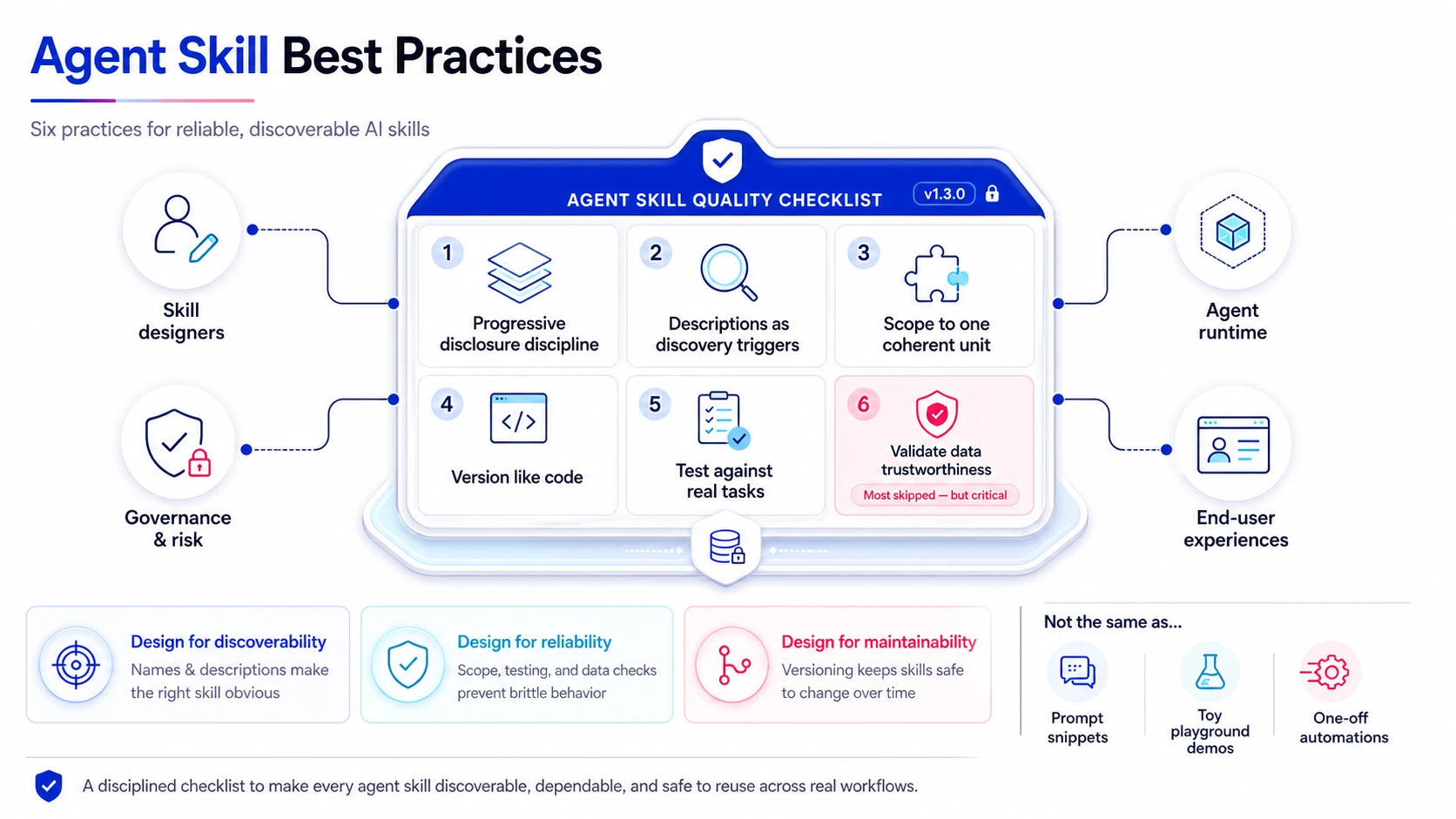
| Practice | What it prevents | Covered elsewhere? |
|---|---|---|
| 1. Progressive disclosure | Bloated SKILL.md burning context budget | Yes, Anthropic, agentskills.io |
| 2. Discoverable descriptions | A skill that never triggers | Yes, Anthropic |
| 3. Single-purpose scoping | An over-broad skill, hard to activate | Yes, agentskills.io |
| 4. Versioning | No rollback when a skill regresses | Partly; named in Atlan’s context layer |
| 5. Testing against real tasks | An untested skill that fails silently | Yes, Anthropic, SkillsBench |
| 6. Validating data trustworthiness | Flawless execution against bad data | No, zero sources name this |
Time to complete: 1-2 hours per existing skill
Difficulty level: Intermediate (assumes you’ve read how to write an agent skill)
Prerequisites: an existing SKILL.md, model access, named data ownership
Tools needed: a version-control repo, 3+ real test scenarios, an MCP Server or equivalent governed access path
Why do most agent skills fail even when they follow best practices?
A skill can pass every conventional check, load, follow its procedure, and still return a confidently wrong answer, because none of those checks confirm whether the table or API it queried is current. The clearest sign: the 26 named “skill smells” the same UC Irvine study catalogued across 238 real-world skills. The most common, the “Rationalization Loophole,” a missing guardrail against skipping a required step, shows up in 94% of them, a flaw in procedure, not data, and rarely gets corrected once introduced.
SkillsBench, a benchmark of 86 tasks across 11 domains, found curated skills raise average pass rates by 16.2 points, but 16 of 84 tasks show a negative delta. Our own reading: an unvalidated data assumption is one plausible culprit, a skill executing correctly against a bad source, reading as a well-built skill quietly making things worse.
This page is for engineers shipping agent skills into a production agent harness; new to the discipline, start with what is skill engineering. The same pattern showed up in agent harness failures and anti-patterns, the gap how to build an AI agent harness closes one rung down.
Prerequisites: what you need before auditing your agent skills
Before applying these six practices, confirm you have the access and artifacts below.
Organizational:
- [ ] An owner for each skill, accountable for both procedure and data
- [ ] A named certifier for the data source(s), the prerequisite most teams skip
- [ ] A place to record skill versions and approvers
Technical:
- [ ] A harness that supports Agent Skills, Claude Code, or equivalent
- [ ] MCP access, or an equivalent governed path, to the data the skill queries
- [ ] A way to run the skill against 3+ real historical tasks
Team:
- [ ] Skill author, who drafts and iterates the SKILL.md
- [ ] Reviewer, distinct from the author, who runs the pre-publish checklist
- [ ] Data owner, who certifies the metric the skill depends on
Time commitment: 30-60 minutes planning; 2-4 hours for a first implementation. Treat the audit as ongoing, not one-time. For the rollout version, see what are enterprise skills.
Step 1: Enforce progressive disclosure discipline
Goal: keep SKILL.md under the ~500-line, 5,000-token ceiling by pushing detail into reference files.
Anthropic’s own docs and agentskills.io both treat conciseness as scarce. A bloated SKILL.md competes for context window, the same budget problem covered in the SKILL.md file explained.
- Audit current length against the roughly 500-line ceiling.
- Push detail one level deep into a reference file, linked not inlined.
- Add a table of contents to any reference file long enough to need one.
Validation checklist:
- [ ] SKILL.md body is under 500 lines, the figure Anthropic gives for optimal performance
- [ ] Frontmatter stays inside the spec limits: name 64 characters or fewer, description 1,024 or fewer
- [ ] No reference file loads unless the task needs it
- [ ] A first-time reader can find the reasoning without opening every file
Step 2: Write descriptions that function as discovery triggers
Goal: a third-person, keyword-specific description that fires reliably on matching tasks.
A skill with a vague description never gets discovered; it’s dead regardless of content. Track trigger rate with a PreToolUse hook to find the skills that never fire, then rewrite their descriptions before you rewrite their bodies.
- Write in third person with explicit trigger language, stating when to use the skill.
- Name the exact keywords a user or agent would actually type, not paraphrases.
- Consider a gerund name like
processing-pdfs. Anthropic suggests that form and also accepts noun phrases and action-oriented names, so pick the one a reader will recognize.
Validation checklist:
- [ ] The description states when to use the skill, not only what it does
- [ ] At least one trigger phrase matches real user language, not jargon
- [ ] Tested against a near-neighbor skill for ambiguous overlap
See where skills sit in the full context stack
See how skills, harnesses, and governed data fit together end to end.
Get the AI Context StackStep 3: Scope each skill to one coherent unit
Goal: a skill sized like a well-designed function, neither too narrow nor too broad to activate precisely.
agentskills.io frames this as designing coherent units. A skill trying to do too much is functionally several skills wearing one description, the distinction agent skills vs tools, the broader AI agent primitives landscape, and what is context engineering cover.
- Draw the boundary against adjacent primitives. Is this a skill (a procedure), a discrete tool call, or an MCP-delivered fact?
- Start from real expertise. Skills synthesized from an actual incident outperform generic advice, per agentskills.io.
- Resist the same-session shortcut. Self-generating a skill mid-task shows no measurable benefit on average, per SkillsBench; Anson Biggs calls it “identical to thinking blocks.”
Validation checklist:
- [ ] The skill does one job, describable in a single sentence
- [ ] It wasn’t generated in the same session it’s meant to solve
- [ ] It’s built from a real prior case, not synthesized
Step 4: Version your skills like code
Goal: every skill roll-backable, every change attributable to a version and an owner.
Skills are a reusable, testable unit of how-to, the same discipline code gets, per why AI agents need versioned context.
- Put every SKILL.md under version control, the same discipline as application code.
- Tag versions, not just commits, so a harness can pin to a known-good release.
- Record who approved each version. Accountability and versioning are two governance capabilities in Atlan’s context layer.
Validation checklist:
- [ ] You can roll back to the prior version in under 5 minutes
- [ ] You can tell which version an agent is running
- [ ] There’s a named approver, not just an author
Not sure how mature your context practice is?
See where skill versioning and data governance stand today.
Run the Context Maturity AssessmentStep 5: Test against real tasks, not hypothetical ones
Goal: 3+ real evaluation scenarios, built before extensive docs, run across every model the skill will execute on.
Anthropic’s own methodology is evaluation-first: build 3+ evals before writing docs, then iterate with one Claude designing and another testing. But every evaluation example tests whether behavior matches an expected output for a frozen input. Eval sets rarely re-run on a schedule tied to the data itself, only to instruction changes, so a pass today says nothing about next quarter, the gap how to test an AI agent harness and how to evaluate an AI agent cover, and what Step 6 makes explicit.
- Build 3+ real scenarios drawn from actual past tasks, not invented ones.
- Test across every model you’ll deploy on. Opus may need less detail than Haiku.
- Re-run evals whenever the schema or data changes. A one-time pass catches behavior drift, not data drift, really context quality testing at the skill level.
Validation checklist:
- [ ] At least 3 real, not hypothetical, scenarios exist
- [ ] Tested on every model in your production roster
- [ ] A defined trigger to re-test when data changes, not just instructions
Step 6: Is the data behind your agent skill actually trustworthy?
Goal: confirm the skill’s procedure runs against data that is current, owned, and certified, not just well-written.
This is the practice almost every guide skips. Anthropic’s docs, agentskills.io, and the arXiv skill-smells taxonomy’s 26 named smells stop at authoring hygiene; none address whether the data queried is stale or uncertified. The ecosystem worries about different trust: per Buteau, citing Xu and Yan, 26.1% of community skills carry a vulnerability, and an unverified Hacker News report puts one fake skill at 26,000 installs. Either way: code trust asks if the skill is malicious; data trust asks if it reaches for what’s true.
| Layer | What it checks | Failure if skipped | Building for it today |
|---|---|---|---|
| Code and security | Is the skill malicious? | Prompt injection, exfiltration | Security registries, Buteau’s argument |
| Data trust | Is what it reaches for true? | Confident, wrong answer against stale data | Largely unaddressed; Atlan plus MCP |
Execution-layer verification is already named; data-layer isn’t, the gap AI agent hallucination names, and this step closes.
- Name an owner for every data source a skill queries, not just the skill itself.
- Confirm certification status before shipping, verified against real cases.
- Wire the skill through a governed access path, MCP or equivalent. Agent skills vs MCP draws this boundary.
- Re-verify on a cadence tied to data change, extending Step 5’s discipline into context freshness.
Validation checklist:
- [ ] Every data source has a named, accountable owner
- [ ] That owner has certified the source as current, not just “it worked when tested”
- [ ] The skill accesses it through a governed path, not a hardcoded query
- [ ] There’s a defined trigger for re-verification when the source changes
Atlan’s Snowflake work found a 3x accuracy gain on text-to-SQL against governed metadata versus bare schemas (data quality for AI agent harnesses), the case for AI agent governance.
How does Atlan govern the context your agent skills run on?
Teams either skip data-trust checks or bolt on ad-hoc verification per skill. Without a shared certification layer, the same table gets re-validated, or not validated at all, differently by every skill that touches it, and nobody outside that author knows which version of the truth is running.
Atlan’s context layer applies the same five capabilities, certification, versioning, accountability, lineage, and quality testing, to skills that it applies to metric definitions elsewhere. Atlan’s Context Development Lifecycle, Build, Test, Review, Approve, Deploy, Learn, is Step 5’s evaluation-first testing with an explicit approval gate. MCP is the delivery mechanism: a skill pulls governed context on demand instead of a stale copy baked into its instructions, sitting as procedural memory, alongside the semantic layer defining what the data means, and the layer AI readiness measures first.
The Atlan-Snowflake text-to-SQL study’s 3x accuracy improvement is the clearest proof point for what validated data is worth to a skill’s output. See how to implement an enterprise context layer for AI and governed context for agent skills for the full argument.
Real stories from real customers: context enterprises can actually trust
"We're excited to build the future of AI governance with Atlan. All of the work that we did to get to a shared language at Workday can be leveraged by AI via Atlan's MCP server…as part of Atlan's AI Labs, we're co-building the semantic layer that AI needs with new constructs, like context products."
Joe DosSantos, VP of Enterprise Data & Analytics, Workday

"Atlan is much more than a catalog of catalogs. It's more of a context operating system…Atlan enabled us to easily activate metadata for everything from discovery in the marketplace to AI governance to data quality to an MCP server delivering context to AI models."
Sridher Arumugham, Chief Data & Analytics Officer, DigiKey

See exactly where your data readiness gap is
See which data sources feeding your agent skills are still uncertified.
Run the Context Gap CalculatorAn agent skill is only as reliable as the data it reads
Re-run this audit quarterly, or whenever the data schema, model roster, or task pattern changes; it’s a maintained practice, not a one-time gate. Measure success by tracking trigger rate with a PreToolUse hook, alongside a data-trust measure once one exists; don’t fabricate that number, wait for real telemetry.
If you can’t do all six at once, sequence them. Start with scoping and testing, Steps 3 and 5, since they surface whether a skill is worth keeping. Then do data trust, Step 6, the highest-impact gap no other guide names. Handle progressive disclosure, descriptions, and versioning after. A skill that nails five of six and skips the sixth hasn’t been checked for the failure mode most likely to make it confidently wrong. See how to write an agent skill for the complementary process, and governed context for agent skills for the fuller argument.
Sources
- Skill authoring best practices, Claude Platform Docs
- Best practices for skill creators, agentskills.io
- Equipping agents for the real world with Agent Skills, Anthropic Engineering
- From Anatomy to Smells: An Empirical Study of SKILL.md in Agent Skills, arXiv:2607.01456
- SkillsBench: Benchmarking How Well Agent Skills Work Across Diverse Tasks, arXiv:2602.12670
- You’re probably using Agent Skills wrong, Anson Biggs
- Agent Skills Need a Trust Layer, Antoine Buteau
- Fake AI agent skill passed security scans, reportedly reached 26,000 agents, The Hacker News
- LLMSecurity/awesome-agent-skills-security, GitHub
FAQs about agent skill best practices
-
What makes an agent skill reliable?
Six practices: progressive disclosure, a discovery-ready description, single-purpose scoping, versioning, testing against real tasks, and validating that the data it reads from is current and owned. Most guides stop at five; skipping the sixth still lets a skill confidently return a wrong answer. -
How many lines should a SKILL.md file be?
Anthropic’s guidance is to keep the body under 500 lines for optimal performance. That is a performance guideline, not a spec limit, and the document sets no token ceiling. The real spec limits are on the frontmatter: name caps at 64 characters, description at 1,024. Push anything not needed every invocation into a reference file instead of inlining it. -
How do you test an agent skill before deploying it?
Build 3 or more real test scenarios from actual past tasks, and run them across every model in your roster. Re-test whenever the data changes, not only when you edit the instructions. -
Should agent skills be versioned?
Yes. Put every SKILL.md under version control, tag releases, and name an approver distinct from the author so a regression can be rolled back in minutes. -
What are common agent skill anti-patterns?
The most prevalent is the “Rationalization Loophole,” a missing guardrail against skipping a required step, found in 94% of skills in a 2026 UC Irvine study. Most concern authoring hygiene, not data trustworthiness. -
How do you know if a skill’s output can be trusted?
A passed security review only confirms the skill isn’t malicious; it says nothing about whether the data it queries is current. Trust requires a named, accountable data owner and a certification checked separately from the code.
