

Skill engineering is what you’re doing when you package a procedure into a SKILL.md file that agents on Atlan, Anthropic, Databricks, Snowflake, Cursor, and GitHub Copilot can load without a rewrite, one of the more than 40 clients agentskills.io lists. That pace says nothing about whether the data a skill reaches for is true, the gap Atlan’s context layer closes.
| What It Is | Key Benefit | Best For | Time to Adopt |
|---|---|---|---|
| A portable, version-controlled AI agent procedure | Turns tribal know-how into a reusable, testable capability | Teams standardizing repeatable agent workflows | Days to weeks per skill |
See where your context stack has gaps
The AI Context Stack brief maps every layer an agent depends on, so you can spot what's missing before a skill ships against it.
Get the AI Context StackWhat is skill engineering?
Skill engineering is the practice of packaging a repeatable procedure, the sequence of steps an AI agent follows to complete a job, into a structured, reusable, version-able unit any agent can load on demand. Every skill starts as a folder: a SKILL.md file with YAML frontmatter (name, description) plus optional scripts and reference files. Articsledge’s competing definition frames it as “the practice of packaging repeatable AI workflows… into structured, reusable capabilities,” and its thorough 16-section guide never mentions where the underlying data comes from.
That omission is not unique to one competitor. Anthropic’s own engineering blog, the tier-1 source on the mechanics, three-tier progressive disclosure, evaluation-first authoring, is thorough on structure and silent on data trust; the Claude Platform Docs carry the canonical spec. “Skill engineering” has no tier-1 claimant as a named discipline: only Tier-2 sources like articsledge and a Towards AI piece use the term.
Where does skill engineering come from? The prompt-to-skill lineage
This is the fourth and newest rung on a lineage that started with prompt engineering, moved through context engineering, and picked up harness engineering once agents needed a control system to run unattended. Skill engineering is the first rung to make procedural knowledge the portable unit. Practitioners are already blending the vocabulary before anyone named the ladder: one builder described “an autonomous research loop for Agent Skills for Context Engineering,” later cited by an OpenReview survey, “Agent Harness Engineering: A Survey,” evidence that skill, harness, and context engineering are already adjacent work, not separate topics.
| Rung | Unit of work | What it governs | Atlan reference |
|---|---|---|---|
| Prompt engineering | A single instruction | What you ask, once | Foundational rung |
| Context engineering | The active context window | What the agent knows | States it’s not a skills problem |
| Harness engineering | The control loop | How the agent monitors and recovers | See why context grounds the harness |
| Skill engineering | A packaged, reusable procedure | How work gets done, repeatably | This page |
The context-engineering-framework cohort states its own conviction directly: context engineering is not a skills problem, the exact hand-off this page claims. For the earlier rungs, harness engineering vs. prompt engineering and context engineering vs. prompt engineering walk the same comparison pattern one level down.
What is missing from most definitions of skill engineering?
Every published definition of skill engineering, Anthropic’s own blog included, treats “does the skill execute correctly” and “was the data reached for true” as the same question. They are not. A UC Irvine study of 238 real-world skills found over 99% of SKILL.md files contain at least one “skill smell,” an authoring defect in structure or description clarity, measuring hygiene, not trust; a perfectly structured skill can still query a stale table and return a confident, wrong answer.
The security side is already getting attention. A Snyk audit of 3,984 public-registry skills found roughly a third had at least one security flaw, a stat Atlan’s enterprise skills governance guide covers in more depth, whose two-layer model, procedure versus context, is the most precise existing Atlan articulation of this page’s conviction.
The data question is still open. A Hacker News commenter on “Show HN: Agent Skill Harbor” named “organizational collection, cataloging, provenance, governance, and safety” as unmet needs, evidence practitioners are building point solutions for provenance unprompted. Forrester’s Leslie Joseph: “Rather than maintaining separate governance mechanisms for people and AI, organizations can increasingly manage both through a common skills registry, shared behavioral contracts, and consistent policy surfaces.”
Anthropic’s evaluation-first guidance is a soft governance model, but it governs whether the skill does what it says, not whether what it reaches for at runtime is true. Agent memory architectures show a related split: a skill’s instructions live in what Atlan calls procedural memory; the facts it reasons about live elsewhere. The same harness-level anti-patterns apply here: the failure is rarely in the control layer, it is beneath it.
Why does skill engineering matter right now?
The reason it matters now: adoption is outrunning the standards that would govern it. Agentskills.io’s client showcase lists more than 40 agent products supporting the SKILL.md format, including Cursor, GitHub Copilot, Gemini CLI, Databricks Genie Code and Snowflake Cortex Code (checked September 2026). Anthropic published the format as an open standard on December 18, 2025.
Simon Willison, creator of Datasette and co-creator of Django, called the trajectory blunt: “I expect we’ll see a Cambrian explosion in Skills which will make this year’s MCP rush look pedestrian by comparison.” He has also flagged the format’s simplicity as a risk, since a skill can bundle executable code, arguing teams need safe execution environments first.
Tristan Handy, Founder and CEO of dbt Labs, put the propagation speed this way: “Agent skills are bundles of prompts and procedural guidance that AI agents load dynamically when you ask them to do relevant work… best practices encoded in a skill propagate faster than best practices in a blog post.” That is a real advantage for AI agents built on agent primitives like skills, and also why a bad or ungoverned skill propagates just as fast, per how AI agent architecture separates these concerns.
Check whether your agents are context-ready
Before you ship a data-reaching skill, run the AI Agent Context Readiness checklist to confirm the data source it depends on is current, certified, and policy-governed.
Get the Readiness Checklist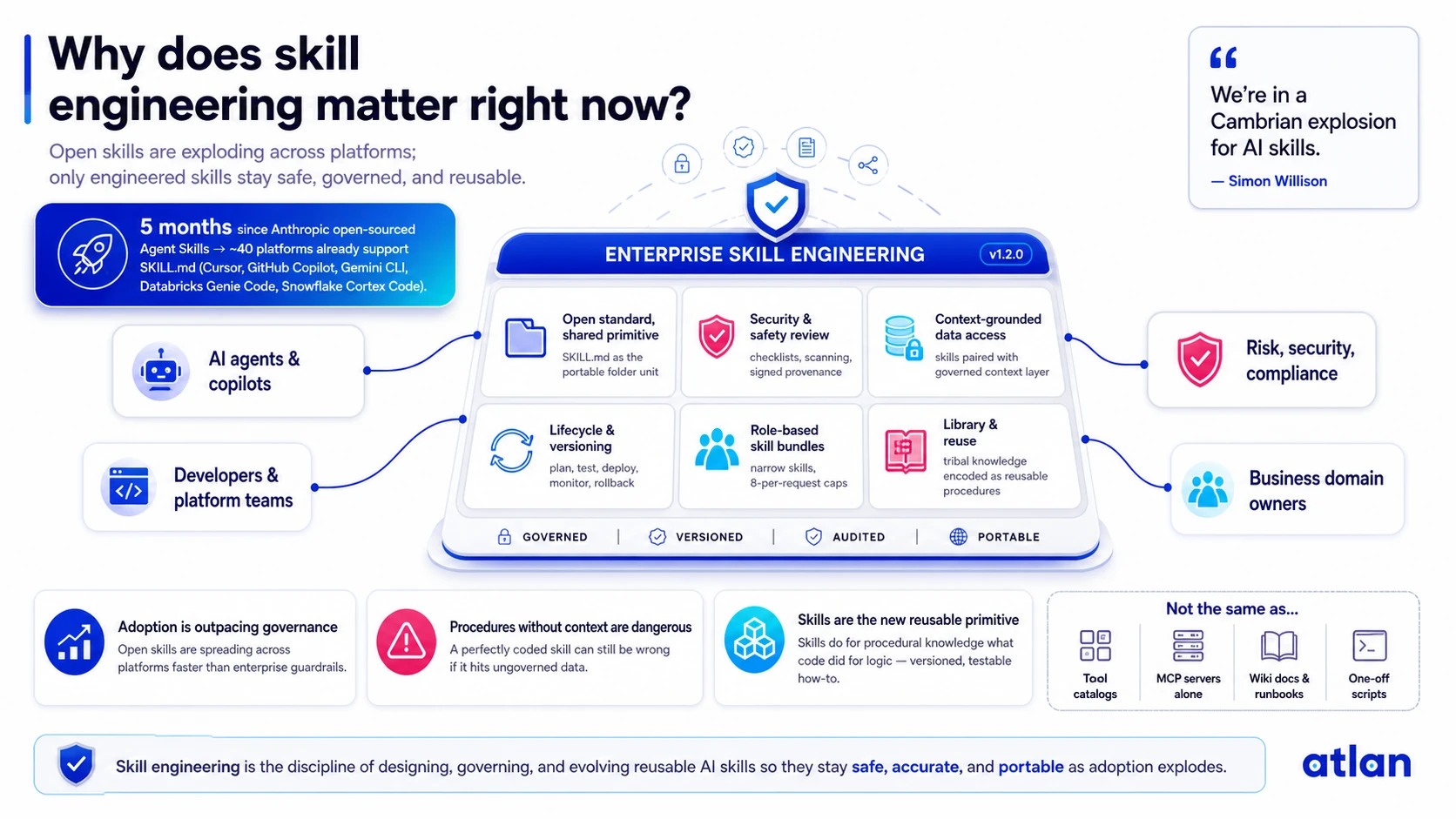
Skill engineering vs. prompt engineering: what actually changed?
Skill engineering and prompt engineering solve different problems at different points in an agent’s lifecycle. Prompt engineering shapes a single conversation turn. Skill engineering packages a procedure the agent can reuse across many turns and sessions without re-explaining the steps each time.
| Aspect | Prompt engineering | Skill engineering |
|---|---|---|
| Unit of work | A single instruction or turn | A packaged, multi-step procedure |
| Reusability | Rewritten or re-pasted per use | Loaded on demand, reused indefinitely |
| Where it lives | The context window | The file system |
| Update mechanism | Manual edit of the prompt | Version-controlled commit |
| Failure mode | Forgotten instructions | Stale procedure, or ungoverned data |
The full comparison belongs to this cohort’s dedicated skill-engineering-vs-prompt-engineering page; this section previews it. Two boundaries worth naming: skills are not MCP, and not discrete tool calls. A skill teaches how; MCP and function calling give the agent access to act; MCP matters for AI agents precisely because a skill without governed access is just documentation. The same split shows up one rung down between an agent harness and an agent framework.
How do you get started writing an agent skill?
Getting started with skill engineering means starting with a narrow, well-evaluated procedure, not encoding an entire workflow on day one. Three prerequisites matter: a scoped procedure, an evaluation set covering should-trigger and should-not-trigger cases, and a data source you can verify is current.
The condensed sequence: start with evaluation before instructions, Anthropic’s own best practice; write the procedure itself; validate the data sources the skill will reach for, the step every other guide treats as an afterthought; then test and iterate before you ship.
The full step-by-step lives on this cohort’s how-to-write-an-agent-skill page. If you are building the control system a skill runs inside rather than the skill itself, how to build an AI agent harness and how to test an AI agent harness cover that ground, and implementing an enterprise context layer covers the governed-data prerequisite in full.
How do you evaluate a skill engineering approach?
Evaluating a skill engineering approach means asking whether it governs the procedure, the data, or both. Most only do the first.
| Criterion | Why it matters | What to look for |
|---|---|---|
| Progressive disclosure | Keeps many skills in context without flooding the window | Three-tier loading: metadata, instructions, resources |
| Version control and testability | A new version can silently break an existing skill | Pinned versions, an evaluation suite before promotion |
| Cross-skill dependency management | Agents write near-duplicate skills when they can’t see what exists | Central registry with usage tracking |
| Data validation at runtime | A skill can pass every authoring check and still reach stale data | MCP-delivered access to a governed, certified source |
| Security posture | Public-registry skills carry real risk, per the Snyk audit above | Sandboxed execution, signed provenance |
The enterprise context layer and understanding why AI agents need one bear directly on that fourth row. For tooling comparisons, the best AI agent harness tools of 2026 is the closest ecosystem comparison until a skills-specific version ships.
How Atlan approaches skill engineering
Teams shipping their first Agent Skills report the skill “working”: it loads, follows the procedure, produces formatted output, while the answer underneath is wrong, because the skill has no way to know if the table it just queried is stale, deprecated, or uncertified. That is the same failure mode documented at the harness layer, applied to the newest primitive in the stack.
Atlan treats a skill the way it treats a metric or a policy: something needing version control, testing, and a lifecycle, not just well-written instructions. Skills are one of three parts of the context foundation, alongside the AI-ready data and knowledge graph and the semantic layer that defines what things mean. The Context Development Lifecycle, build, test, review, approve, deploy, learn, applies to a skill exactly as a certified metric. MCP is the delivery mechanism: a skill queries the context graph like any other system, except what comes back is certified.
The outcome mirrors a proof point one layer down: in an Atlan-Snowflake text-to-SQL study, agents grounded in live metadata answered with roughly 3x the accuracy of agents working from bare schemas. A skill that reaches for governed context produces an answer you can trust, not just one that’s formatted correctly. Getting AI agent governance right, and understanding how context engineering and governance relate, makes that outcome repeatable across every skill your teams ship.
Real stories from real customers: context that grounds agent workflows
"We're excited to build the future of AI governance with Atlan. All of the work that we did to get to a shared language at Workday can be leveraged by AI via Atlan's MCP server…as part of Atlan's AI Labs, we're co-building the semantic layer that AI needs with new constructs, like context products."
Joe DosSantos, VP of Enterprise Data & Analytics, Workday

"Atlan is much more than a catalog of catalogs. It's more of a context operating system…Atlan enabled us to easily activate metadata for everything from discovery in the marketplace to AI governance to data quality to an MCP server delivering context to AI models."
Sridher Arumugham, Chief Data & Analytics Officer, DigiKey

See the context layer live
Watch how governed context flows into an agent skill via MCP.
Watch the Live Demo SeriesWhy skill engineering without governed context stays incomplete
Packaging a procedure into something portable and testable is real progress over instructions buried in a wiki. It names prompt engineering, context engineering, and harness engineering as its predecessors, the first rung where the procedure itself becomes the reusable unit.
But a portable procedure and an ungoverned data source combine into a reliable-looking, wrong agent. What separates skill deployments that scale from ones that generate a slow-burning trust problem is not whether the SKILL.md is well-written, but whether the data behind every data-reaching skill is current, certified, and consistently defined, the question Atlan’s context layer exists to answer, and the argument Atlan’s enterprise skills governance guide develops in full.
Sources
- Equipping Agents for the Real World with Agent Skills, Anthropic Engineering
- Agent Skills Overview, Claude Platform Docs
- From Anatomy to Smells: An Empirical Study of SKILL.md in Agent Skills, arXiv
- Agent Skills Overview, agentskills.io
- The Agentic Age Needs a Cognitive Operating Model, Forrester
- Agent Skills: Disseminating Expertise, dbt Labs
- Claude Skills Are Awesome, Maybe a Bigger Deal Than MCP, Simon Willison
- Skills Are Quietly Becoming the Unit of Agent Knowledge, Hacker News
- Show HN: Agent Skill Harbor, Hacker News
- anthropics/skills, GitHub
- What Is Skill Engineering? The Complete 2026 Guide, Articsledge
- Skill Engineering in 2026, Towards AI
- ToxicSkills: Malicious AI Agent Skills Supply Chain Compromise, Snyk
FAQs about skill engineering
-
What is skill engineering in AI?
Skill engineering packages a repeatable AI agent procedure into a structured, version-controlled unit any agent can load on demand, the newest rung on a lineage running from prompt engineering through context and harness engineering. -
Who created the Agent Skills standard?
Anthropic published the SKILL.md format as an open standard on December 18, 2025. Agentskills.io lists more than 40 adopting clients, including Databricks Genie Code, Snowflake Cortex Code, Cursor and GitHub Copilot (checked September 2026). -
What is the difference between skill engineering and prompt engineering?
Prompt engineering shapes a single conversation turn inside the context window. Skill engineering packages a procedure into a file system artifact reusable across sessions. -
Do Agent Skills replace MCP?
No. A skill teaches an agent how to do a workflow; MCP gives it standardized access to the systems and data needed to carry it out. -
Are agent skills secure and safe to install?
Not by default. A Snyk audit of 3,984 public-registry skills found a third had at least one security flaw. Treat installation like production software: sandboxed execution, separation of duties, version pinning. -
Does Atlan’s context layer work with Agent Skills?
Yes. Atlan’s context layer delivers certified metric definitions, lineage, and policy through the same MCP connection a skill uses to reach enterprise systems, so both procedure and data are governed.
