

Once your Skill and MCP server are wired up, the real gap is governance maturity: MCP’s Enterprise-Managed Authorization extension went stable June 18, 2026; a static SKILL.md file has no equivalent. Atlan sits underneath both layers as the source of the governed context each one serves: the same Enterprise Data Graph that certifies a data asset’s lineage and definition is what Atlan’s MCP server hands to a Skill when it calls MCP for live data.
| Dimension | Agent Skills | MCP |
|---|---|---|
| What it is | Static markdown instructions | Live client-server protocol |
| What it does | Teaches a procedure or behavior | Delivers tool and data access |
| Who maintains it | The agent builder, edited directly | The server operator, deployed as a service |
| Key strength | Portable, human-readable, zero infrastructure | Live, authenticated, high-frequency data access |
| Best for | Stable knowledge that doesn’t change between runs | Data that changes between invocations |
| Question it answers | How should the agent do this? | What can the agent reach, and is it allowed to? |
| Cost model | Near-zero until triggered, no server to run | Ongoing hosting and auth; some servers use tens of thousands of tokens of context |
| Complexity | Low: a markdown file plus YAML frontmatter | Medium to high: JSON-RPC, transports, OAuth |
The CIO's Guide to Context Graphs
A primer for leaders deciding where governance sits in an agent stack that already runs Skills, MCP servers, or both.
Get the GuideAgent skills vs MCP: what’s the difference?
Anthropic’s own litmus test draws the line plainly: a Skill explains how to follow a procedure; MCP is what the agent reaches for when it needs a database or file it doesn’t already have. One axis does most of the sorting: does the thing change between invocations, which points to MCP, or stay stable for weeks, which points to a Skill? Anthropic created MCP in late 2024, donating it to the Agentic AI Foundation under the Linux Foundation in December 2025, then published Agent Skills as an open standard on December 18, 2025, why the two get conflated: same origin, adopted by other vendors since.
The “MCP is dead, Skills forever” framing keeps resurfacing, and it was never the interesting question. What is underserved is naming the two failure modes plainly: a Skill nobody reliably triggers, and an MCP server that blows the context budget, both covered below. This boundary sits inside skill engineering and the context engineering framework that context engineering operates under.
What is an agent skill?
An Agent Skill is a portable, version-able unit of procedural knowledge: a markdown file with a small YAML frontmatter block that teaches an agent a specific, repeatable task, independent of any live data connection. Simon Willison puts it plainly: “Skills are Markdown with a tiny bit of YAML metadata and some optional scripts.” It loads through progressive disclosure, metadata first, full body only when triggered, and runs wherever the host agent runs, no server required. Anthropic published the format as an open standard for cross-platform portability, and says it has been adopted by a growing number of agent products. Worth stating plainly for anyone assuming a Skill is a thinner MCP server: a Skill is instructions, not a tool-calling interface. The Enterprise Skills governance guide covers the file format further; Agent Skills vs Tools draws the adjacent boundary against a single tool call.
Core components of an agent skill
- Frontmatter (
name,description): always-loaded metadata the agent scans for relevance - SKILL.md body: the full procedural instructions, loaded only once triggered
- Bundled scripts and resources: optional helper files loaded on demand
- No built-in runtime or auth model: a Skill relies on whatever tools or MCP connections the host agent already has, a gap AI agent primitives covers more broadly. It maps to what Atlan calls procedural memory, distinct from the facts an agent’s memory stores
What is MCP (Model Context Protocol)?
MCP is a client-server protocol, built on JSON-RPC, giving an agent live, structured access to external tools, data, and prompts through a standardized set of primitives, Resources, Tools, and Prompts, over stdio, HTTP, or other transports. Unlike a Skill, it runs as a standing server other hosts connect to, though MCP’s July 2026 specification update retired the initialize/initialized handshake and Mcp-Session-Id header that made earlier versions stateful: the protocol core is now request/response and stateless, letting a server run behind a plain load balancer, a change Google’s developer blog confirmed independently. Atlan’s own MCP-vs-API guide covers this architecture in depth.
MCP’s governance is materially more mature than Skills’ today. Its Enterprise-Managed Authorization extension (Zero-Touch OAuth) reached stable status on June 18, 2026, with Okta as the first identity provider. The two roles are different and worth separating: Claude and Visual Studio Code shipped client support, while Asana, Atlassian, Canva, Figma, Granola, Linear, and Supabase implemented it on the server side, joined since by HubSpot, Ramp, and Webflow as named enterprise adopters, with Slack support in progress, a capability Skills structurally cannot replicate since they carry no built-in auth model. The protocol is stewarded by the Agentic AI Foundation, which also governs agent interoperability protocols like MCP vs A2A.
Core components of MCP
- Resources, Tools, and Prompts: the three primitive types a server exposes
- JSON-RPC transport: stdio, HTTP, and other transports carry protocol traffic
- OAuth-native authentication: including the Enterprise-Managed Authorization extension above
- Stateless protocol core: as of the July 2026 spec update, MCP retired its session handshake in favor of header-based routing and cacheable list results, so a server process can run behind a plain load balancer instead of holding session state, distinct from plain function calling or a direct API path, covered in why MCP matters for AI agents
- AAIF governance: co-founded by Anthropic, Block, and OpenAI
Context Gap Calculator
Estimate how much of the data your Skills and MCP servers touch is actually certified and current.
Check Your GapAgent skills vs MCP: head-to-head comparison
The sharpest differences show up in runtime model, authentication, and governance maturity. Skills are static and locally executed; MCP is live and centrally served.
| Dimension | Agent Skills | MCP |
|---|---|---|
| Protocol / format | Markdown plus YAML frontmatter | JSON-RPC over stdio or HTTP transports |
| Runtime model | Loaded into context locally, no running process | Server process runs, but the protocol core is stateless and request/response as of July 2026, with no session handshake |
| Execution | Agent reads and follows instructions | Schema-validated, typed tool and resource calls |
| Discovery | Progressive disclosure via description, agent decides relevance |
Explicit tool and resource listing at connection time |
| Authentication | No built-in auth model | OAuth-native, Enterprise-Managed Authorization since June 2026 |
| Governance body | Anthropic plus community skill registries | Agentic AI Foundation, Linux Foundation |
| Update mechanism | Edit the markdown file directly, no redeploy | Versioned server deployment and redeploy |
| Context cost | Lightweight until triggered | Can be heavy; every tool a server exposes carries its schema into context before any work happens, though July 2026’s cacheable list results make this addressable client-side |
| Failure mode | Rarely invoked or unreliable to maintain at scale | Works in dev, breaks under production auth and governance load |
| Maturity signal | Published as an open standard on December 18, 2025, and adopted by a growing number of agent products | Originated late 2024, mature AAIF governance, stable enterprise auth |
Jerry Liu, Co-founder and CEO of LlamaIndex, shared the lesson from building LlamaIndex’s own coding agent: “Skills are way easier to setup, but unreliable/hard to maintain.” Their docs MCP handled the job; Skills were rarely invoked, evidence the “right” choice is empirical, tied to the workload.
According to Agentman’s 2026 Agent Skills Ecosystem Report, SkillsBench analyzed 47,150 public skills and found an average quality score of just 6.2 out of 12, while curated skills lifted agent pass rates by 16.2 percentage points over uncurated ones: Liu’s experience is the pattern, not the exception. What an agent skills registry adds is exactly the curation and discovery layer that gap calls for. These failure modes connect to why MCP matters for AI agents and to how a governed AI control plane sits above both layers.
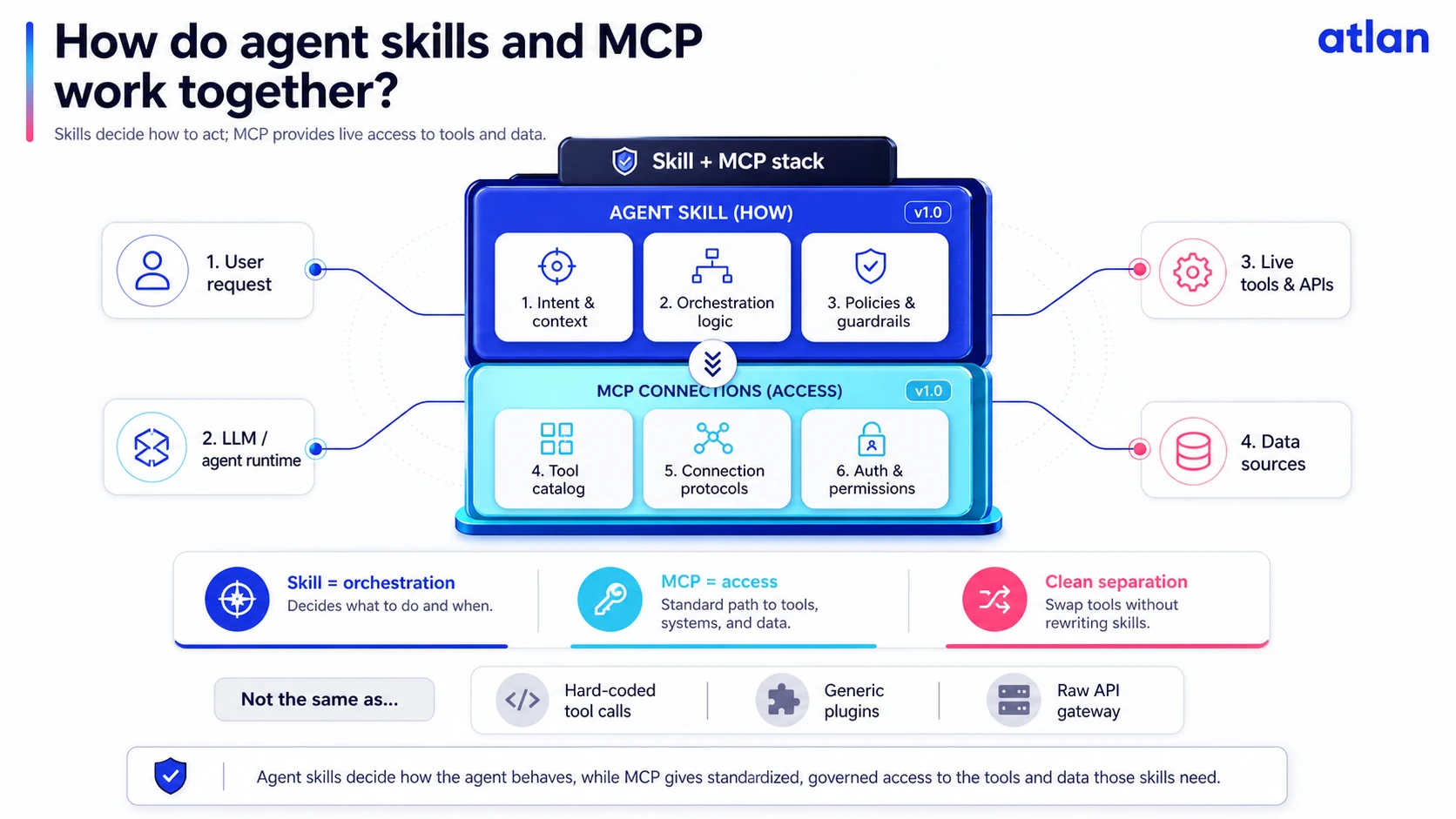
How do agent skills and MCP work together?
Skills and MCP solve different problems in the same stack, which is why “use both” is the emerging default, not a compromise. David Cramer, co-founder and Chief Product Officer at Sentry, frames it simply: “If skills teach you to cook, MCP provides the instruments that let you do it.” The common pattern: a Skill encodes the procedure, then reaches through an MCP server for the live data. The point most write-ups miss runs the opposite direction: MCP’s own docs now recommend using Skills to build MCP servers, via a reference mcp-server-dev plugin, Skills as tooling for MCP infrastructure, not just an alternative to it. Cramer’s own stack: two always-on MCP servers alongside roughly a dozen Skills, why cra.mr rejects any “X is all you need” framing here.
The “access alone is enough” assumption is already cracking in production. Reddit’s r/mcp increasingly reports servers that “work in dev but break in production” under real auth and governance load, and Snowflake’s announced intent to acquire Natoma, an enterprise MCP platform, was framed around agents needing “business context and the ability to take action securely,” not just a live connection. Neither resolves the question; both confirm the market is asking it: once a Skill correctly calls MCP for live data, is what comes back actually true?
When to prioritize one: start with a Skill for stable knowledge that doesn’t depend on runtime data: style guides, coding conventions, internal playbooks. Start with MCP when data changes between invocations or needs authentication. Invest in both for a production agent whose procedures reach live, governed systems, the same agent harness layer harness engineering and its comparison against prompt engineering address, and the distinction agent harness vs agent framework draws.
How Atlan approaches agent skills and MCP
Every source in this comparison, Anthropic included, treats “MCP delivers the data” as the end of the story, without asking whether what comes back is itself certified, current, or correctly defined.
Atlan doesn’t compete with Agent Skills or MCP. Per Atlan’s Context Activation and Retrieval capability, “One Context Layer. Many Protocols. Many Tools,” Atlan’s context layer treats MCP as one of several delivery protocols, alongside API, SQL, search, vector retrieval, and graph traversal, not a competitor and not the same layer as a Skill. Atlan’s own MCP server is hosted and enabled by default for every tenant, nothing to install or run, exposing search and discovery, lineage, glossary and definitions, SQL execution, metadata curation, and data quality to any MCP-compatible agent or Skill at runtime, all governed by permissions already in place. As Atlan’s enterprise Skills guide puts it: the Skill instructs how, the context layer guarantees what’s true, on the same context graph foundation behind Atlan’s harness engineering work and implementation path.
Real stories from real customers: context behind skills and MCP
"Atlan captures Workday's shared language to be leveraged by AI via its MCP server. As part of Atlan's AI labs, we're co-building the semantic layer that AI needs."
— Joe DosSantos, VP Enterprise Data & Analytics, Workday

"Atlan is much more than a catalog of catalogs. It's more of a context operating system…Atlan enabled us to easily activate metadata for everything from discovery in the marketplace to AI governance to data quality to an MCP server delivering context to AI models."
— Sridher Arumugham, Chief Data & Analytics Officer, DigiKey

Neither quote is about the Skills-vs-MCP boundary specifically; both point at the same shift this comparison sets up.
Check Your Agent's Context Readiness
See whether the data behind your Skills and MCP-connected agents is current and certified before you ship.
Check ReadinessWhere the real question sits after “how” and “access” are settled
Skills teach an agent how. MCP gives it access. Independent write-ups, Anthropic included, already treat that as settled, and “use both” is the practical result. What none fully answer is the question this page sets up rather than resolves: a Skill reaching through MCP for live data still depends on that data being governed, certified, and correctly defined. Governed Context for Agent Skills takes that question on directly; Atlan’s enterprise Skills guide is the closest existing treatment of the same boundary today.
Worth exploring next:
- Skill Engineering vs Prompt Engineering: how the discipline a Skill belongs to evolved from prompting
- How to Build an AI Agent Harness: the control layer many Skill-and-MCP stacks run inside
- Semantic Layer for AI Agents: the meaning layer adjacent to both sides of this comparison
- AI Readiness vs Knowledge Graphs: what has to be true about your data before either protocol is worth investing in
- Are Agent Skills Safe for Enterprise?: what closes the no-built-in-auth-model gap this page keeps surfacing on the Skills side
Where Does Your Context Maturity Stand?
Score how ready the data behind your Skills and MCP-connected agents actually is before you scale either one.
Take the AssessmentFAQs about agent skills vs MCP
1. What is the difference between agent skills and MCP?
Agent Skills are static markdown instructions teaching an agent a procedure. MCP is a live client-server protocol giving an agent access to tools and data it doesn’t already have. Skills answer “how”; MCP answers “access.”
2. Do agent skills replace MCP?
No. They solve different problems in the same stack. A Skill has no built-in way to authenticate against a live system; MCP has no built-in way to encode a repeatable procedure.
3. Can you use skills and MCP together?
Yes, and this is the default pattern now, not an edge case. A Skill commonly encodes the procedure while reaching through an MCP server for the live data it needs. The reverse also happens: Skills now scaffold MCP servers themselves.
4. What is MCP (Model Context Protocol)?
MCP is a client-server protocol, built on JSON-RPC, giving an AI agent structured, live access to external tools, data, and prompts through hosts, clients, and servers. In its July 2026 spec update, MCP also moved to a stateless protocol core, retiring the session handshake earlier versions required.
5. What are Claude agent skills?
Agent Skills are a portable file format, a markdown file plus a small YAML frontmatter block, teaching an AI agent to perform a specific, repeatable task. Anthropic published the standard on December 18, 2025, and says it has been adopted by a growing number of agent products beyond Claude.
6. Does a skill need an MCP server to work?
Not always. A Skill only needs MCP when its procedure depends on live, changing, or authenticated data. LlamaIndex found the opposite for some workloads: Skills went unused while an existing MCP handled the job.
7. How do skills and MCP handle authentication differently?
Skills have no built-in authentication model; they inherit whatever access the host agent already has. MCP is OAuth-native, and its Enterprise-Managed Authorization extension, stable since June 2026, adds zero-touch identity support starting with Okta.
8. Does the Atlan context layer work with both agent skills and MCP?
Yes. Atlan’s MCP server delivers governed metadata, lineage, glossary terms, quality scores, and access policies to any MCP-compatible agent or Skill at runtime, so the procedure a Skill encodes runs against certified data, not merely reachable data.
Sources
- Skills explained: How Skills compares to prompts, Projects, MCP, and subagents, Anthropic/Claude. https://claude.com/blog/skills-explained
- Skills vs MCP tools for agents: when to use what, LlamaIndex. https://www.llamaindex.ai/blog/skills-vs-mcp-tools-for-agents-when-to-use-what
- MCP, Skills, and Agents, cra.mr, David Cramer. https://cra.mr/mcp-skills-and-agents/
- Build with Agent Skills, official Model Context Protocol docs. https://modelcontextprotocol.io/docs/develop/build-with-agent-skills
- Enterprise-Managed Authorization: Zero-touch OAuth for MCP, Model Context Protocol blog. https://blog.modelcontextprotocol.io/posts/enterprise-managed-auth/
- Claude Skills are awesome, maybe a bigger deal than MCP, Simon Willison. https://simonw.substack.com/p/claude-skills-are-awesome-maybe-a
- Agent Skills overview, agentskills.io. https://agentskills.io/home
- MCP vs Tool Calling vs Skills: When to Use Each Layer, Mervin Praison. https://mer.vin/2026/04/mcp-vs-tool-calling-vs-skills-when-to-use-each-layer-in-llm-agent-architecture/
- Model Context Protocol donation announcement, Linux Foundation / Agentic AI Foundation. https://www.linuxfoundation.org/
- Snowflake to Acquire Natoma to Bring Governed Agentic Access to the Enterprise, Snowflake. https://www.snowflake.com/en/blog/snowflake-acquire-natoma-governed-agentic-access/
- The 2026-07-28 MCP specification update: stateless core, deprecations, extensions framework, Model Context Protocol Blog. https://blog.modelcontextprotocol.io/posts/2026-07-28/
- Scaling AI agent infrastructure with the MCP stateless updates, Google Developers Blog. https://developers.googleblog.com/scaling-ai-agent-infrastructure-with-the-mcp-stateless-updates/
- The Agent Skills Ecosystem in 2026, Agentman. https://agentman.ai/blog/agent-skills-ecosystem-report-2026
- Centrally manage authorization for MCP connectors, Claude by Anthropic. https://claude.com/blog/enterprise-managed-auth
- Agent Skills, Anthropic. https://www.anthropic.com/news/skills
