























Knowledge graphs vs. RAG for AI: Key differences at a glance
Permalink to “Knowledge graphs vs. RAG for AI: Key differences at a glance”| Dimension | Knowledge Graphs | RAG (Retrieval-Augmented Generation) |
|---|---|---|
| Data structure | Structured, with entities (nodes) connected by relationships (edges). | Unstructured text chunks with vector embeddings. |
| Retrieval method | Graph traversal following explicit relationships. | Semantic similarity search across vector space. |
| Query capability | Multi-hop reasoning, complex path finding. | Single-step similarity matching. |
| Explainability | Clear reasoning chains showing relationship paths. | Opaque similarity scores, difficult to explain. |
| Setup complexity | High - requires entity extraction, schema design. | Low - works with existing documents. |
| Maintenance | Schema governance, entity resolution. | Document refresh, embedding updates. |
| Best for | Connected data, compliance, impact analysis. | Broad document search, quick deployment. |
| Accuracy for complex queries | Better suited for complex, multi-part questions. | Variable, struggles with relationship-dependent answers. |
| Integration | Requires graph database (Neo4j, Amazon Neptune). | Works with vector stores (Pinecone, Weaviate). |
Choosing the right retrieval approach is a technical decision nested inside a larger infrastructure question. Atlan’s Context Hub covers 40+ guides on the context layer stack — the infrastructure that makes both knowledge graphs and RAG work reliably for AI.
What are the key differences between knowledge graphs vs. RAG?
Permalink to “What are the key differences between knowledge graphs vs. RAG?”1. Knowledge graph vs. Rag: Information structure
Permalink to “1. Knowledge graph vs. Rag: Information structure”Knowledge graphs organize information as interconnected entities. Every piece of data becomes a node, and relationships become edges connecting them. When you query “Which customers purchased Product A in Q4,” the graph traverses explicit relationships: Customer → purchased → Product → during → TimeFrame.
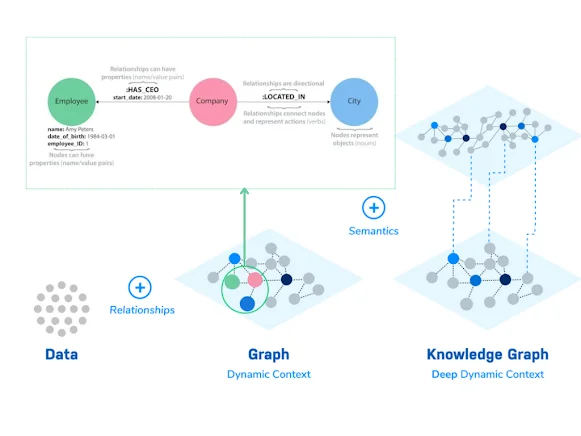
The structure of a knowledge graph. Source: Neo4j
Traditional RAG systems treat knowledge as isolated text fragments. Documents get split into chunks, converted to numerical embeddings, and stored in vector databases. Retrieval happens through similarity matching where the system finds chunks semantically close to your query.
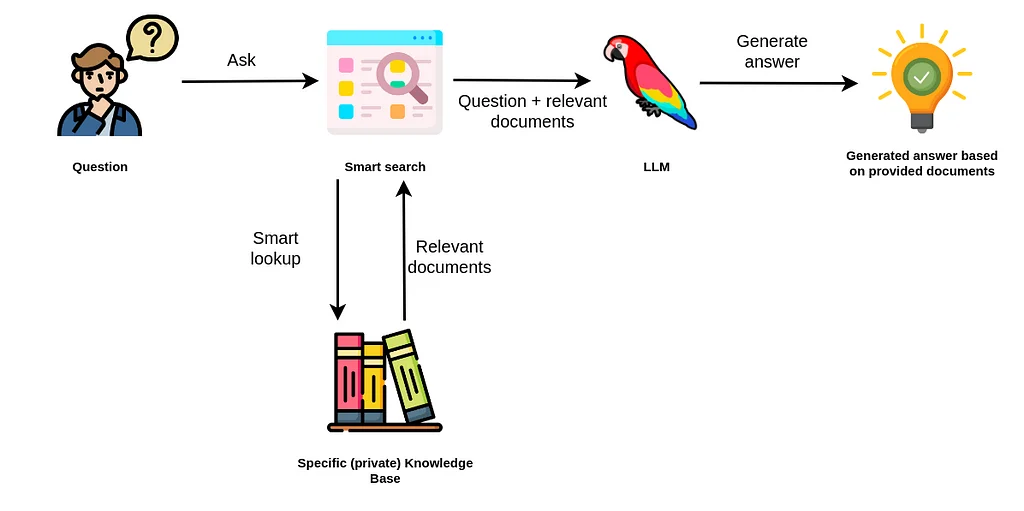
How RAG works. Source: Neo4j
This structural difference creates divergent capabilities. Knowledge graphs excel when answers require connecting facts across multiple relationships. Research demonstrates that context graphs incorporating relationships significantly improve performance on multi-hop reasoning tasks compared to flat retrieval.
2. Knowledge graphs vs. RAG: Retrieval approaches and their trade-offs
Permalink to “2. Knowledge graphs vs. RAG: Retrieval approaches and their trade-offs”Graph retrieval follows deterministic paths through relationships. Ask “What products did customers who bought X also purchase,” and the system traverses the exact path: Customer → bought → Product X → also_bought → Related Products. These paths are explainable and auditable.
Vector-based RAG uses semantic similarity without understanding connections. The system might retrieve text mentioning both Product X and other products, without knowing whether those products were purchased together, recommended together, or just appeared in the same document.
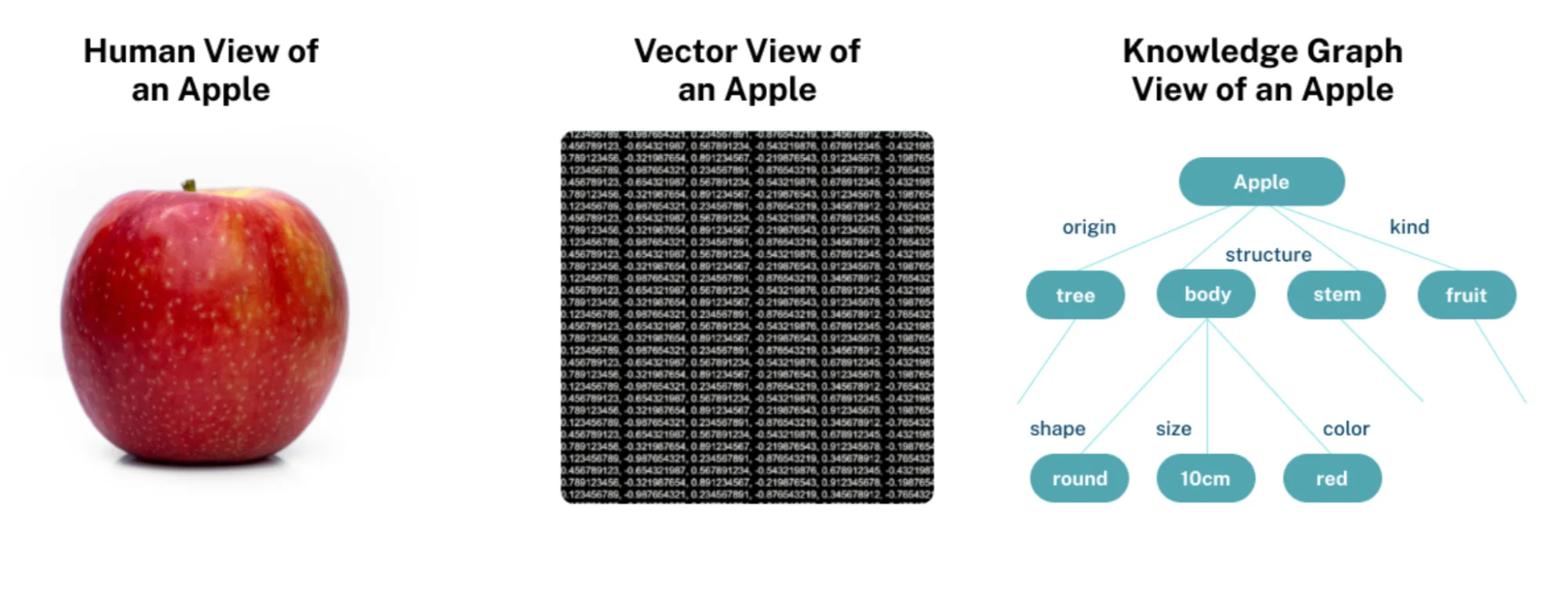
An analogy of how each retrieval method functions. Source: Neo4j
According to research, knowledge graphs improve LLM accuracy by 54.2% on average when used for retrieval augmentation. The structured format prevents models from fabricating connections between entities.
3. Knowledge graph vs. RAG: Maintenance and operational overhead
Permalink to “3. Knowledge graph vs. RAG: Maintenance and operational overhead”Knowledge graphs require ongoing schema management. As your domain evolves, you update entity types, add relationships, and maintain consistency. Financial services firms using knowledge graphs report spending 3-5x more on extraction compared to baseline RAG implementations.
RAG systems scale more easily with document-centric workflows. Add new documents, regenerate embeddings, and retrieval automatically incorporates fresh content. But this simplicity creates brittleness for relationship-dependent queries where connections between facts matter more than semantic similarity.
Modern platforms increasingly combine both approaches. The knowledge graph provides structure while RAG adds breadth through unstructured content retrieval.
What are the key benefits of knowledge graphs for AI?
Permalink to “What are the key benefits of knowledge graphs for AI?”1. Multi-hop reasoning for complex queries
Permalink to “1. Multi-hop reasoning for complex queries”Knowledge graphs enable AI to follow relationship chains. For example, healthcare systems using medical knowledge graphs connect symptoms → diseases → treatments → patient demographics through explicit relationships. So, physicians receive evidence-based suggestions that can be traced back to specific literature.
2. Explainable AI through traceable paths
Permalink to “2. Explainable AI through traceable paths”When knowledge graphs generate answers, they provide reasoning chains. Ask “Why is this customer at churn risk,” and the system shows: Customer → reduced_usage_by_40% → missed_invoices → support_escalations → similar_customers_churned. Every connection is explicit and auditable.
3. Consistency and disambiguation
Permalink to “3. Consistency and disambiguation”Knowledge graphs resolve ambiguity through relationships. If a query mentions “Jaguar,” the graph clarifies whether it refers to the car or animal through connected entities and context. Traditional text-based approaches struggle with this disambiguation.
Platforms like Atlan use active metadata to automatically map relationships across data assets, connecting business concepts to technical implementations. This semantic layer ensures consistent entity understanding across systems.
What are the key benefits of RAG for AI?
Permalink to “What are the key benefits of RAG for AI?”1. Rapid deployment with existing content
Permalink to “1. Rapid deployment with existing content”RAG works with documents you already have. Companies deploy RAG systems in weeks by pointing models at SharePoint, Confluence, or internal wikis. No entity extraction, no schema design, no relationship mapping required.
According to VentureBeat analysis, traditional RAG works well for static knowledge retrieval, where queries don’t require understanding connections between facts.
2. Breadth of coverage across unstructured content
Permalink to “2. Breadth of coverage across unstructured content”RAG excels at broad document search. When users ask “What’s our vacation policy,” RAG retrieves relevant passages from HR documents. The semantic search finds conceptually similar content even when exact terminology differs.
3. Lower barrier to entry
Permalink to “3. Lower barrier to entry”RAG requires minimal infrastructure. A vector database, embedding model, and retrieval pipeline get you operational quickly. Many teams start here before evolving to more sophisticated approaches.
When should you use knowledge graphs vs. RAG for AI?
Permalink to “When should you use knowledge graphs vs. RAG for AI?”Choose knowledge graphs when:
Permalink to “Choose knowledge graphs when:”1. Relationships matter more than content similarity
Fraud detection, supply chain analysis, and impact analysis all require understanding how entities connect. Knowledge graphs make these relationships explicit and queryable.
2. Explainability and auditability are required
Regulated industries need traceable reasoning. Healthcare and finance use knowledge graphs to ensure AI decisions can be explained to auditors with clear provenance chains.
3. Multi-hop reasoning drives value
Questions like “Which suppliers serve competitors who recently entered our market” require traversing multiple relationship hops. Graph databases excel at these complex path queries.
4. Data is already structured or semi-structured
CRM systems, ERP platforms, and enterprise applications already contain entities and relationships. Building knowledge graphs from structured data is more straightforward than extracting entities from unstructured text.
Choose RAG when:
Permalink to “Choose RAG when:”1. Documents contain the answers
Internal wikis, policy documents, and research papers work well with RAG. If your knowledge exists as text and queries are straightforward, RAG deploys faster.
2. Requirements are evolving rapidly
Early-stage AI initiatives benefit from RAG’s flexibility. Add documents, iterate on prompts, and refine retrieval without schema redesign.
3. Budget or timeline is constrained
RAG requires less upfront investment. It’s possible to get the initial systems operational in weeks rather than months.
4. Queries are primarily keyword-based or semantic-matching-based
Simple information retrieval like “Find the vacation policy” or “Summarize Q3 earnings” works well with vector search.
Use both knowledge graphs and RAG through GraphRAG when:
Permalink to “Use both knowledge graphs and RAG through GraphRAG when:”Most enterprises eventually need hybrid approaches. GraphRAG architectures combine graph traversal with vector search to get both structured reasoning and broad coverage.
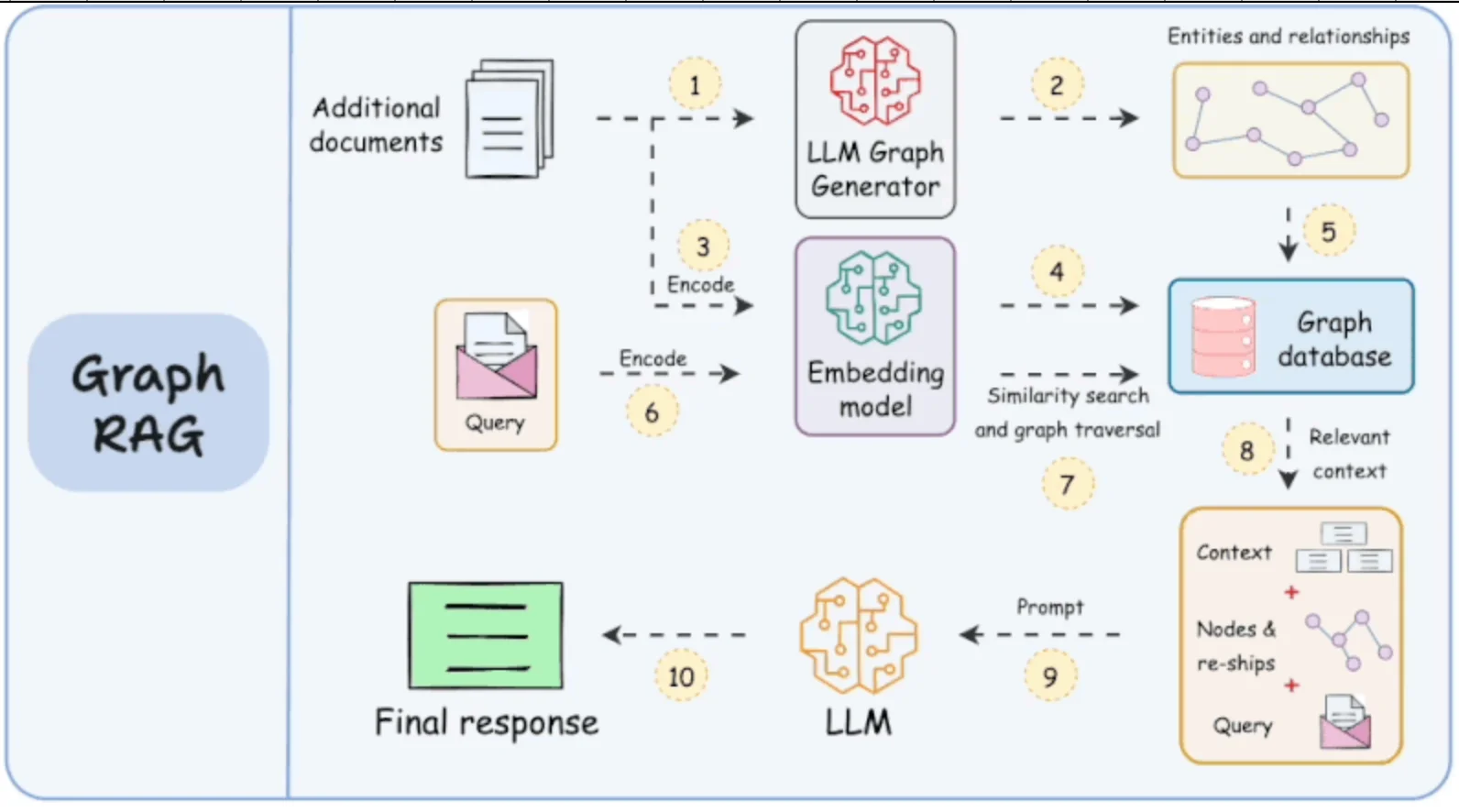
GraphRAG architecture overview. Source: Digital Ocean
GraphRAG consistently outperforms pure RAG in tasks requiring reasoning across multiple data sources, such as legal document analysis and scientific literature review.
What is the hybrid approach: GraphRAG?
Permalink to “What is the hybrid approach: GraphRAG?”Instead of knowledge graphs vs. RAGs, GraphRAGs combine the best of both worlds
Permalink to “Instead of knowledge graphs vs. RAGs, GraphRAGs combine the best of both worlds”GraphRAG layers knowledge graph structure over vector-based retrieval. The system first identifies relevant entities through semantic search, then traverses the graph to gather connected context.
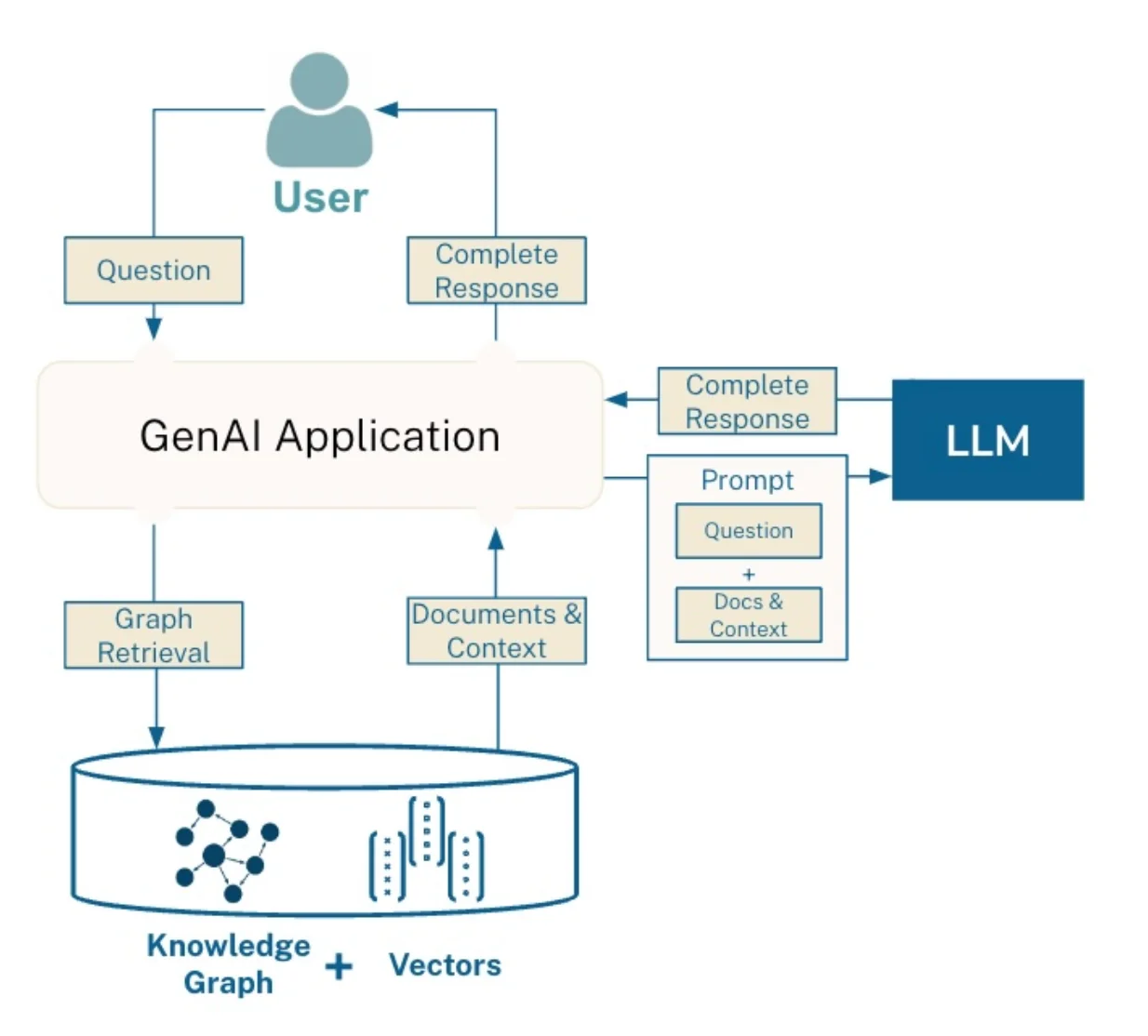
How GraphRAG works. Source: Neo4j
GraphRAG implementations can scour through document collections, creating hierarchical summaries that capture themes across entire datasets. This speeds up information retrieval and resolution times, when compared to conventional methods.
The three-stage GraphRAG workflow
Permalink to “The three-stage GraphRAG workflow”- Query understanding: Translate natural language into graph concepts and identify anchor entities.
- Hybrid retrieval: Combine vector similarity search with graph traversal to gather connected subgraphs.
- Context assembly: Merge retrieved graph data with semantic context for LLM processing.
Research published in arXiv demonstrates that KG²RAG (Knowledge Graph-Guided Retrieval Augmented Generation) frameworks utilizing knowledge graphs to provide fact-level relationships between chunks improve both response quality and retrieval quality compared to existing RAG approaches.
Why hybrid approaches deliver better results
Permalink to “Why hybrid approaches deliver better results”Pure vector search retrieves semantically similar text without understanding connections. Pure graph traversal misses relevant content not explicitly modeled as relationships.
GraphRAG gets both:
- Structured reasoning through relationship paths.
- Broad coverage through semantic similarity.
- Explainable answers with traceable provenance.
- Flexibility to handle both structured and unstructured knowledge.
How do modern platforms like Atlan address knowledge graphs and RAG?
Permalink to “How do modern platforms like Atlan address knowledge graphs and RAG?”Context graphs extend traditional knowledge graphs
Permalink to “Context graphs extend traditional knowledge graphs”Atlan defines context graphs as knowledge graphs enhanced with operational metadata, governance rules, and decision traces. Unlike traditional knowledge graphs that focus on “what things are,” context graphs capture the full operational reality of how data flows, who owns it, and why decisions were made.
Key differentiators of adopting a context graph like Atlan:
- Active metadata: Continuously captured from usage patterns, not manually curated.
- Temporal awareness: Time-travel queries showing how information evolved.
- Governance nodes: Policies as queryable graph elements, not external documentation.
- Lineage integration: Full traceability from business concepts to technical implementations.
Unified context layers for AI
Permalink to “Unified context layers for AI”Atlan’s approach combines semantic definitions with active metadata in a single graph-backed infrastructure. This removes silos between glossaries, lineage, quality metrics, and governance while supporting both human search and AI-ready retrieval.
The platform provides:
- GraphRAG systems: Graph traversal for multi-hop reasoning across connected entities.
- Automated knowledge graph construction: LLMs extract entities and relationships from unstructured text.
- Model Context Protocol (MCP) servers: AI agents programmatically access graph context without manual integration.
- Real-time freshness: Continuous metadata capture as the data landscape evolves.
Real stories from real customers: Proven results from customer implementations
Permalink to “Real stories from real customers: Proven results from customer implementations”Workday leverages Atlan’s unified context layer to build AI-ready semantic layers. Their VP of Enterprise Data & Analytics notes: “All of the work that we did to get to a shared language amongst people at Workday can be leveraged by AI via Atlan’s MCP server.”
Mastercard’s Chief Data Officer describes Atlan as “more of a context operating system” where “AI agents can access lineage context through the Model Context Protocol.” The metadata lakehouse is “configurable across all our tool sets and flexible enough to get us to a future state” of AI-driven operations.
Organizations using Atlan’s approach report 5x improvements in AI analyst response accuracy when systems have access to rich metadata including definitions, relationships, and operational context rather than just raw database schemas.
Key takeaways on knowledge graphs vs. RAGs for AI
Permalink to “Key takeaways on knowledge graphs vs. RAGs for AI”Knowledge graphs and RAG serve complementary purposes in AI systems.
Knowledge graphs excel at multi-hop reasoning, explainability, and relationship-dependent queries but require upfront investment in schema design and entity extraction. RAG deploys faster with existing documents and provides broad coverage but struggles with complex reasoning requiring connection awareness.
Most enterprises adopt hybrid GraphRAG approaches combining structured graph traversal with semantic search. Modern platforms unify knowledge graph infrastructure with active metadata capture, eliminating the historical trade-off between deployment speed and reasoning capability.
Start with your highest-value use case, validate the technical approach with real queries, then expand systematically rather than attempting comprehensive coverage immediately.
Explore how Atlan’s context graph infrastructure supports both knowledge graph and RAG capabilities through unified metadata management.
FAQs about knowledge graphs vs. RAG for AI
Permalink to “FAQs about knowledge graphs vs. RAG for AI”1. Can you use RAG and knowledge graphs together?
Permalink to “1. Can you use RAG and knowledge graphs together?”Yes. GraphRAG architectures combine both approaches. The system uses vector similarity for broad retrieval, then traverses knowledge graph relationships to gather connected context. This hybrid approach populates context windows with higher-relevance content through relationship connections.
2. Which approach is more cost-effective for enterprises?
Permalink to “2. Which approach is more cost-effective for enterprises?”RAG has lower initial costs but higher ongoing inference expenses for retrieval and vector operations. Knowledge graphs require 3-5x more upfront investment for extraction but enable efficient querying at scale. Most enterprises find hybrid approaches optimal, using graphs for relationship-heavy domains and RAG for broad document search.
3. How do knowledge graphs reduce AI hallucinations?
Permalink to “3. How do knowledge graphs reduce AI hallucinations?”Knowledge graphs ground responses in verified relationships rather than statistical patterns. Research demonstrates that knowledge graph-enhanced systems reduce hallucination rates by over 40% compared to traditional methods by retrieving only factually connected information.
4. What infrastructure do I need for GraphRAG?
Permalink to “4. What infrastructure do I need for GraphRAG?”GraphRAG requires graph databases (Neo4j, Amazon Neptune), vector stores (Pinecone, Weaviate), and integration layers connecting both. Modern platforms provide unified infrastructure supporting graph and vector capabilities through single metadata management systems.
5. How long does it take to implement knowledge graphs vs. RAG?
Permalink to “5. How long does it take to implement knowledge graphs vs. RAG?”RAG systems deploy in weeks with existing documents. Knowledge graphs require months for entity extraction, schema design, and relationship mapping. Organizations typically start with RAG for quick wins, then layer knowledge graphs for high-value domains requiring sophisticated reasoning.
6. Do I need different tools for knowledge graphs vs. RAG?
Permalink to “6. Do I need different tools for knowledge graphs vs. RAG?”Traditional approaches required separate graph databases and vector stores. Unified platforms now support both through integrated architectures, allowing teams to enhance existing infrastructure rather than replacing it entirely.
Share this article