

Atlan’s Enterprise Data Graph takes the same premise further: the graph has to be a runtime system, continuously re-mined from connected sources, not a one-time inventory that starts aging the moment it ships. That distinction shows up in five checkable mechanisms this page walks through, not a single label attached to a static export.
- Continuous ingestion replaces the single batch job most context graphs are still built from.
- Event-driven refresh means updates fire on a change signal, not a calendar.
- Lineage-triggered propagation carries tags, ownership, and policy downstream automatically.
- Drift detection catches a graph going stale before an agent acts on it.
Below: what makes a graph active, how that differs from a static build, the five mechanisms that keep it that way, why graphs go stale even when the category promises otherwise, when the distinction becomes non-optional, the mistakes that cause it, and how Atlan approaches it.
| What It Is | A context graph that updates continuously via event-driven propagation and lineage-triggered refresh, instead of being indexed once |
|---|---|
| Key Benefit | Aligned context layers can lift reasoning accuracy 40%+ and cut token consumption roughly 70%, per Gartner research cited by Kore.ai |
| Best For | AI agent teams whose context accuracy depends on upstream changes: schema edits, ownership changes, policy or certification updates |
| Core Components | Continuous ingestion, event-driven refresh, lineage-triggered propagation, policy and certification freshness, drift detection |
| Common Failure Mode | Built once via batch indexing, then treated as static reference documentation while the source systems keep changing |
What is an active context graph for AI agents?
An active context graph is a context graph that updates on a continuous, event-driven basis rather than sitting still after a single build. According to Kore.ai’s citation of Gartner research from February 2026, knowledge graphs are relatively static, updated periodically, while context graphs are continuously evolving, updated in real time. That is the category’s own definition, not a claim this page is inventing. “Active” names the operating discipline that has to exist for that definition to actually hold in production: event-driven signals, not a calendar, deciding when the graph changes.
“Context graph” itself gets used broadly across the AI infrastructure market, which is exactly why the compound word matters here. This page is not about the base architecture; that ground is covered by what an agent context graph is and its four key components. This page isolates one property of that architecture: whether it stays current after day one. If you are building a graph from scratch, the implementation guide for enterprise context graphs covers the construction steps this page assumes.
Atlan frames its own Enterprise Data Graph as a runtime system, continuously re-mined from connected sources rather than exported once and left alone. For a team evaluating any context graph, the honest question is not whether the vendor calls it active. It is whether the graph updates when the systems it describes change, and whether you can verify that it does.
How is an active context graph different from a static one?
The two builds differ across five dimensions: how they update, how fresh they stay, whether failures are visible, how policy context is handled, and what maintaining them actually requires. Understanding this contrast matters more than debating terminology, because the failure mode of a static graph is invisible until an agent acts on it.
A static context graph is built once via batch indexing and reflects the state of the world at that moment. According to Jim Allen Wallace, “batch indexing leaves graphs stale, the failures don’t surface in error logs, and agents reason over outdated facts.” An active build works differently: it updates on a source-system change signal, whenever that signal fires, rather than on a fixed re-indexing schedule. This is the same distinction that separates a knowledge graph built for AI agents from one that also tracks time and change.
This page is deliberately narrow on one point: it is not re-litigating the separate argument about context graphs versus knowledge graphs as architectures. That comparison, dimension by dimension, lives on Atlan’s Context Graph vs. Knowledge Graph guide. What matters here is freshness specifically, which cuts across both architectures.
| Dimension | Static context graph | Active context graph |
|---|---|---|
| Update mechanism | Built once via batch indexing | Updated continuously via event-driven propagation |
| Data freshness | Reflects state at build time | Reflects current source-system state |
| Failure visibility | Stale facts don’t surface as errors | Drift is flagged before reaching agents |
| Policy and certification | Frozen at build time | Propagates automatically on change |
| Maintenance model | Manual re-indexing and re-tagging | Lineage-driven, automatic propagation |
The gap in that table is not cosmetic. A graph that fails silently on the “failure visibility” row is a graph an agent trusts by default, which is precisely the condition that turns a stale fact into a confident, wrong answer downstream.
What keeps a context graph active instead of static?
Five mechanisms turn “active” from an adjective into something a team can check for, rather than take on a vendor’s word. Each one has a specific job, and skipping any single one reopens the gap this page is about.
Continuous ingestion reads from connected warehouses, pipelines, BI tools, and business systems as they change, rather than in a single batch job at build time. Without it, the graph reflects a moment, not the estate it claims to describe.
Event-driven refresh fires updates on a source-system change signal instead of waiting for the next scheduled crawl. Without it, data can sit stale for the entire interval between crawls, and that interval is invisible to whoever is relying on the graph.
Lineage-triggered propagation carries enrichment, tags, and policy context downstream automatically as data moves through a pipeline, instead of requiring someone to re-tag manually every time something upstream changes. Manual re-tagging cannot keep pace with real change volume at enterprise scale, and context freshness depends entirely on this mechanism holding.
Policy and certification freshness means stale or uncertified assets can be flagged or excluded from what gets served to an agent at inference time, so the policy context an agent receives reflects the current state, not the state when the graph was last built.
Drift detection runs simulation-based checks that catch staleness before it reaches a production agent, rather than after a wrong answer surfaces downstream. This is the observability layer underneath the other four; see AI agent observability for how that discipline extends across an agent’s full context, not just the graph.
At Atlan, Context Agents re-run against fresh signals to keep descriptions, SQL intelligence, and ontology context aligned with the estate as it actually changes, rather than as it looked when the graph was first populated. That is the mechanism this page is describing, applied to Atlan’s own product surface, and it is the same discipline behind active metadata compared to a broader context layer.
| Mechanism | What it does | What breaks without it |
|---|---|---|
| Continuous ingestion | Reads from warehouses, pipelines, BI tools, business systems as they change | Graph reflects a moment, not the estate |
| Event-driven refresh | Updates on a change signal, not a schedule | Data sits stale for the entire interval between crawls |
| Lineage-triggered propagation | Enrichment, tags, and policy flow downstream automatically | Manual re-tagging can’t keep pace with change volume |
| Policy and certification freshness | Stale or uncertified assets flagged or excluded from what’s served | Agent serves outdated context as if it were current |
| Drift detection | Simulation-based checks catch drift before production | Drift reaches production agents undetected |
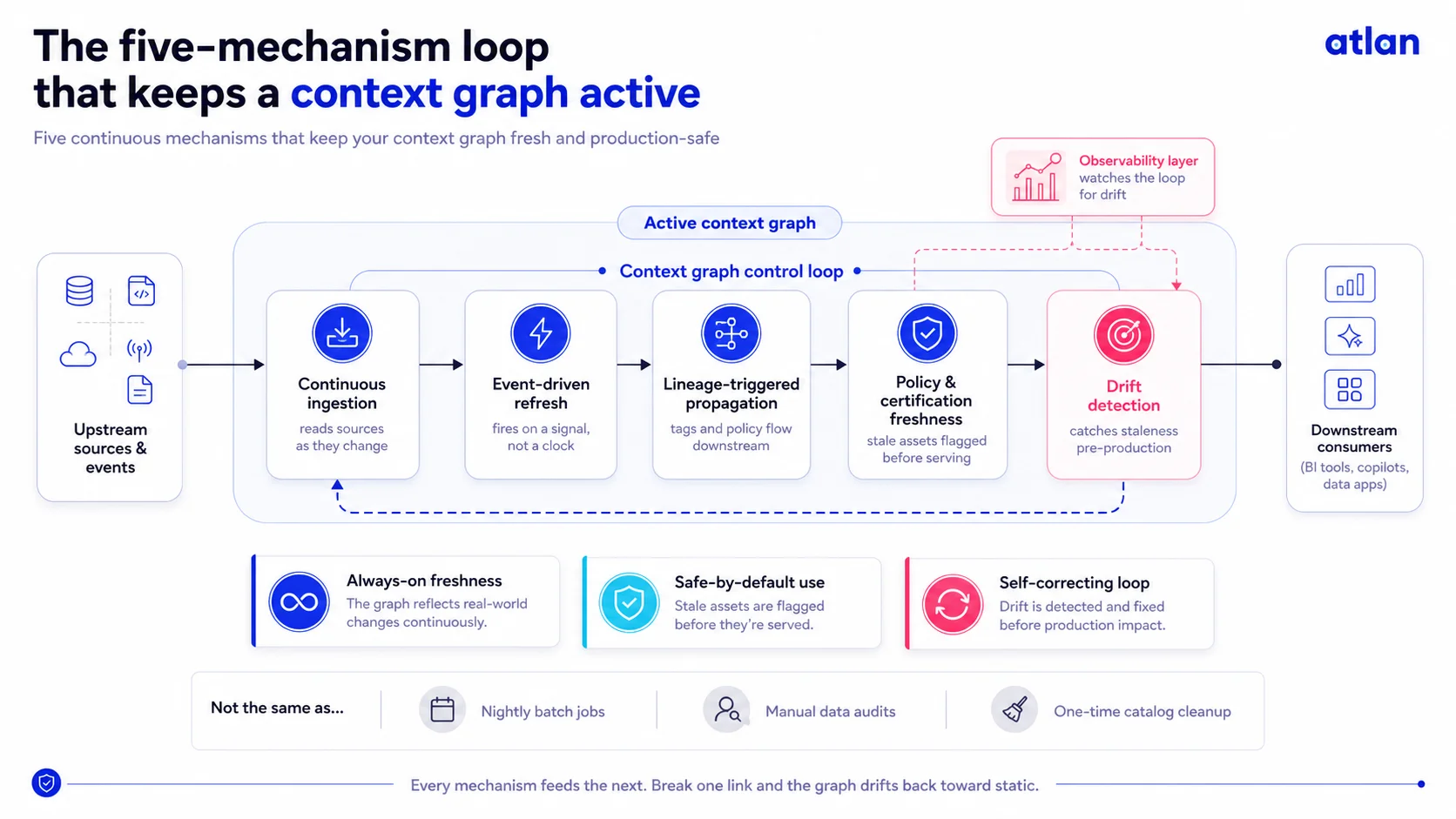
The five mechanisms that separate an active context graph from a one-time export. Source: Atlan.
Inside Atlan AI Labs & the 5x accuracy factor
See how context engineering drove measurable accuracy gains in real customer systems, with a repeatable playbook for closing the gap between AI demos and production.
Download the E-bookWhy do context graphs go stale in production?
Continuous ingestion, event-driven refresh, lineage-triggered propagation, policy and certification freshness, and drift detection are what the category’s own definition requires. Skip even one of them, most often drift detection or lineage-triggered propagation, and a graph quietly reverts to the static failure mode: built once, then treated as reference documentation while the systems it describes keep changing. The honest question is why that happens at all when the category’s own definition already promises continuous updates. The answer, documented by the same vendors who make that “continuously updated” claim, is that the definition and shipped practice have diverged for at least some real, cited share of production deployments.
One widely-read engineering post on this exact problem puts the admission directly. Shirshanka Das wrote: “A document is a snapshot. Reality is a movie.” That line names a pattern common across production AI context: static documentation describing a world that keeps moving underneath it.
The same failure shows up from the retrieval side. On version-sensitive questions, standard GraphRAG reaches only 64% accuracy, barely ahead of naive RAG, because it lacks explicit version-to-version connections, according to Jim Allen Wallace’s analysis of GraphRAG retrieval. A graph without a way to represent “this was true, then this changed” cannot answer questions where the change itself is the point.
This is worth stating plainly: “active” is not a redundant upgrade to an already-dynamic category. Gartner’s own definition already says context graphs are continuously updated. The gap this page is naming sits between that definition and what engineering teams building this kind of graph infrastructure independently observe shipping in practice. That gap is also an active academic research area, not a marketing invention; a 2024 survey on temporal knowledge graphs traces the shift from static to time-aware graph representation as a distinct, ongoing research problem, with real engineering approaches to keeping a graph’s facts time-bound rather than frozen.
Practitioners have coined their own vocabulary for this failure mode, sometimes faster than vendors have named the fix: context rot describes the same symptom from the angle of an agent getting less reliable the longer it runs on unrefreshed context, and dedicated tooling for catching context drift before it reaches production exists precisely because this gap is real and measurable, not theoretical. The organizations already treating context graphs as a moving opportunity rather than a shipped feature are the ones closing that gap first, and the same lesson applies to adjacent layers that failed for the same static-build reason.
When does an enterprise need an active context graph?
Not every team needs this distinction called out explicitly. Three conditions make it non-optional rather than a nice-to-have.
When source systems change faster than your review cycle
If schemas, ownership, or table definitions change weekly but your context graph refreshes quarterly, the graph is describing a version of your estate that no longer exists for most of that quarter. The review cycle is the wrong clock to build freshness around.
When an agent’s answer depends on current policy or certification state
A certification that expired last month but still shows as valid in the graph is not a minor staleness issue; it is an agent confidently citing authority it no longer has. This is where policy and certification freshness stops being an edge case and becomes the deciding factor in whether an answer is safe to act on.
When accuracy and token cost both matter at inference time
According to Kore.ai’s citation of Gartner research, aligned context layers can improve reasoning accuracy by over 40% and reduce token consumption by roughly 70%, and by 2029, 80% of AI agent platforms using reasoning models are projected to have an aligned context layer in place, up from under 10% today. Those numbers describe the payoff of getting freshness right, not just the cost of getting it wrong.
Atlan’s own guide on what a context graph is and where it’s used already covers the broader use-case landscape in depth, as does the context engineering discipline that sits above it, the semantic layer work for AI agents that sits alongside it, and Gartner’s own research agenda on context graphs. This section is intentionally short: the case for needing a context graph at all is made elsewhere. What decides whether that graph needs to be active is whether your source systems, policies, and inference stakes move faster than a manual rebuild can track. Teams building the harness an agent runs inside of face the same freshness question; the implementation sequence for an enterprise context layer and the architecture behind an AI agent harness both assume the graph underneath stays current.
What mistakes do teams make when building a context graph?
Most of the mistakes below trace back to one underlying error: treating a context graph as a project with an end date instead of a system with an owner.
- Treating the graph as a one-time export, not a running system. The fix is designing for event-driven refresh from day one, not retrofitting it after the graph has already gone stale in production.
- No drift detection until an agent visibly acts on wrong context. Waiting for an incident to reveal drift means the cost of discovery lands on whoever trusted the agent’s answer. Simulation-based checks before production catch it earlier and cheaper; see dedicated context drift detection for how that check works.
- Manual re-tagging as the freshness mechanism. Tags and policy that depend on someone remembering to update them will fall behind real change volume. Lineage-triggered propagation is the fix, not a bigger team.
- No named owner for keeping the graph current. This is the mistake underneath the other three, and it is also the one most enterprises haven’t resolved between their data team and their AI or platform team. A community-documented illustration of mistakes one and two compounding together, an agent getting measurably less reliable the longer it runs on unrefreshed context, shows what happens when nobody owns the fix.
None of these mistakes are exotic. They are what happens by default when a context graph gets built the way most software used to get shipped: once, then left alone. The graphs that stay useful are the ones somebody was assigned to keep that way, with decision traces recording what changed and why so the next reviewer isn’t starting from zero. Left unaddressed, this is also why agents forget or degrade over long sessions even when the underlying model hasn’t changed at all.
Assess your context graph's maturity
Run a quick assessment against the mechanisms in this guide to see where your current graph is genuinely active and where it's quietly reverting to static.
Take the AssessmentHow Atlan approaches keeping a context graph active
Atlan’s own product experience runs into the same gap at a smaller scale: a graph that captures an estate accurately on day one drifts from that accuracy every day after, unless something actively works to prevent it. Most teams that build a metadata layer solve for coverage first and freshness second, if at all, which is exactly backward once agents start acting on what the graph says.
Atlan’s Enterprise Data Graph is built as a runtime system: continuously re-mined from connected warehouses, pipelines, BI tools, and business systems, rather than exported once and left to age. Context Agents re-run against fresh signals to keep descriptions, SQL intelligence, and ontology context aligned with the estate as it changes. Lineage-driven propagation carries enrichment, tags, and policy downstream automatically, and policy or certification freshness is enforced at serving time rather than checked once at build time. The result is context that stays current rather than active metadata treated as a one-time label; governed, continuously refreshed context is the operating discipline, not a slogan attached to a static export.
That same discipline extends to how agent memory and retrieval interact with the graph: a context graph that stays current is what keeps memory, RAG, and knowledge graph layers from quietly diverging from each other as an agent runs longer sessions against a changing estate.
See Atlan's context layer live
Watch a live walkthrough of how Atlan's Enterprise Data Graph stays current as source systems change, from ingestion through policy freshness.
Watch the Live DemoFreshness without ownership is just a different kind of stale
The five mechanisms on this page keep a context graph’s data current. None of them answer who is accountable when one silently breaks, or who has to explain why an agent acted on a fact that had already drifted. Atlan’s own guide on context layer ownership takes that question on directly, because “active” without a named owner just relocates the failure mode from stale data to an unowned pipeline.
Gartner has already settled, by definition, that a context graph needs to stay current. What most enterprises haven’t settled is who is accountable when one doesn’t, and what happens the first time an agent acts on a fact the graph never bothered to update.
FAQs about active context graphs
1. What is a context graph in AI?
A context graph in AI is a structured, queryable network of an enterprise’s entities, relationships, policies, and lineage that AI agents use to ground their reasoning at inference time. It extends a knowledge graph with the operational and governance context, such as ownership, certification, and freshness, that production agents need to act on rather than just retrieve.
2. How does a context graph differ from a knowledge graph?
A knowledge graph models what entities exist and how they relate. A context graph adds an operational layer on top, including policy nodes, temporal validity, and freshness signals, so an agent knows not just what is true but whether it is still true. The full dimension-by-dimension breakdown lives on Atlan’s Context Graph vs. Knowledge Graph guide.
3. Does a context graph need to be rebuilt, or can it update incrementally?
It can update incrementally, and an active context graph is built specifically to do that. Event-driven propagation and lineage-triggered refresh update the graph as source systems change, rather than requiring a full re-index. A full rebuild is what a static, batch-indexed graph requires every time the underlying estate moves.
4. Who owns keeping a context graph up to date: the data team or the AI/platform team?
Ownership models vary by organization, and the question is genuinely unresolved at most enterprises today. Some assign it to the data team that already owns lineage and certification; others give it to the AI or platform team consuming the graph. Atlan’s guide on context layer ownership walks through both models in detail.
5. What happens when an AI agent acts on a stale context graph?
An agent acting on a stale context graph reasons over facts that were true when the graph was built but may no longer hold, such as a deprecated table, a changed owner, or an expired certification. Because the failure does not throw an error, it surfaces as a confidently wrong answer rather than a visible break.
6. What’s the most common mistake teams make when they treat a context graph as build-once?
The most common mistake is treating the initial build as a finished project rather than the start of a running system, which means event-driven refresh, drift detection, and a named owner never get designed in from day one. Each gap compounds, since the graph keeps aging while the systems it describes keep changing.
Sources
- What are Context Graphs and How Do They Make AI Agents Smarter, Kore.ai (citing Gartner, February 2026)
- Knowledge Graph RAG: Structured Retrieval for AI Agents, Redis (Jim Allen Wallace, 2026-06-24)
- Continuous Context: Why Your AI Documentation Is Already Lying to You, DataHub (Shirshanka Das, 2026-05-05)
- A Survey on Temporal Knowledge Graph: Representation Learning and Applications, Li Cai et al., arXiv:2403.04782 (2024)
- Context rot: why your AI agent gets dumber the longer it runs, dev.to
