What Is a Context Layer? Definition, Architecture, Use Cases

Emily Winks, Data Governance Expert, Atlan
Data Governance Expert
Updated:08/28/2026
|
Published:03/26/2026
31 min read

Key takeaways

  • A context layer sits between data stacks and AI systems, turning raw schemas into governed business meaning at runtime.
  • Unlike a BI semantic layer or RAG retrieval, it adds persistent entity resolution, access policies, and decision history.
  • High intelligence with low enterprise context raises hallucination risk in production AI workflows.
  • Gartner expects 60% of AI projects to be abandoned through 2026 for want of AI-ready data, ahead of any model choice.

What is a context layer?

A context layer is the system that turns an enterprise's knowledge, expertise, and norms into machine-usable context, sitting between raw data and the AI that queries it. It has two halves: a substrate of three parts that carries the context, and five capabilities that produce it, govern it, deliver it, and keep it current. Gartner expects 60% of AI projects to be abandoned through 2026 for want of AI-ready data, which is the gap this layer exists to close.

What a context layer carries:

  • Business semantics: Metadata and definitions translating technical data into business terms
  • Trust signals: Quality metrics, lineage tracking, and governance policies enforcing accuracy
  • Organizational memory: Historical decisions, exception patterns, and tribal knowledge codified
  • Operational intelligence: Usage patterns, access controls, and real-time context delivery to AI
  • Decision traces: Audit trails showing why choices were made and which rules applied

How mature is your context layer?


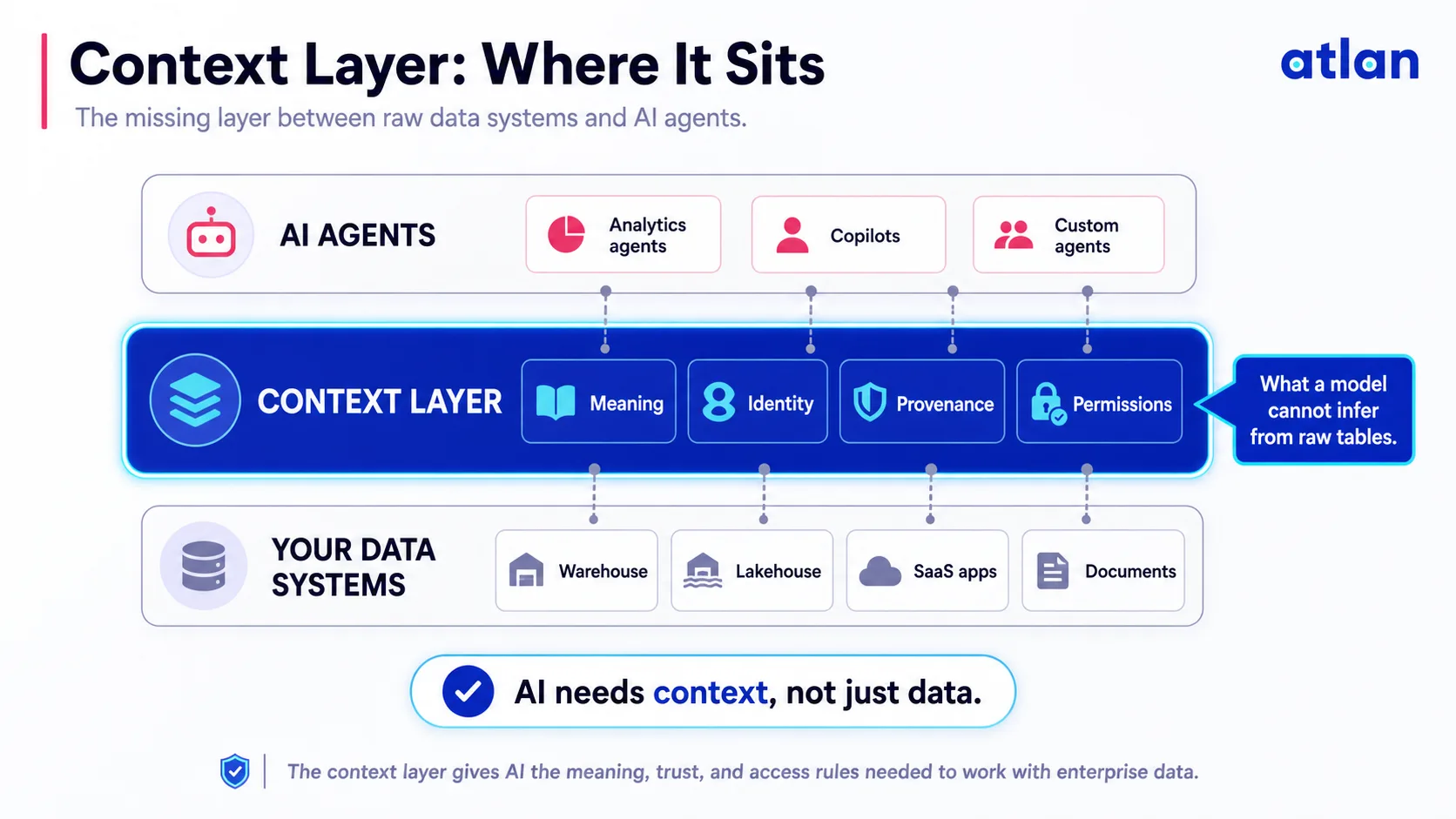
A context layer is the infrastructure between an organization’s data systems and the AI that queries them. It supplies the business meaning, rules, and permissions a model cannot infer from raw tables: what each metric means, which records refer to the same real-world entity, where a number came from, and what an agent is allowed to do with it.

Without one, agents answer from pattern-matching rather than from what the business has agreed is true. The problem is not model quality. Gartner expects 60% of AI projects to be abandoned through 2026 for want of AI-ready data and context foundations, with only 37% of organizations confident in their data practices. Enterprise agents fail because the knowledge they receive at inference time is ungoverned, stale, or semantically inconsistent, and no amount of model capability infers what nobody wrote down.

Atlan’s context layer unifies enterprise definitions, lineage, governance policies, and ownership into a single governed graph that agents and analysts query from one certified source of truth, delivered at runtime through Atlan’s MCP server. Co-founder Prukalpa Sankar sets out the full architecture in what an enterprise context layer actually is, and the argument gets stress-tested in public in the WTF is the Context Layer series, where the people building this layer work toward a definition that holds up.


Quick facts about context layers

Permalink to “Quick facts about context layers”
Aspect Detail
What it is Infrastructure delivering business meaning, policies, and decision history to AI agents
Core components Context extraction, context storage, context delivery, feedback loops
Key benefit AI agents grounded in certified organizational knowledge instead of training data guesses
Implementation timeline Weeks to first production deployment for a focused domain
Works with Snowflake, BigQuery, Databricks, dbt, Model Context Protocol (MCP)
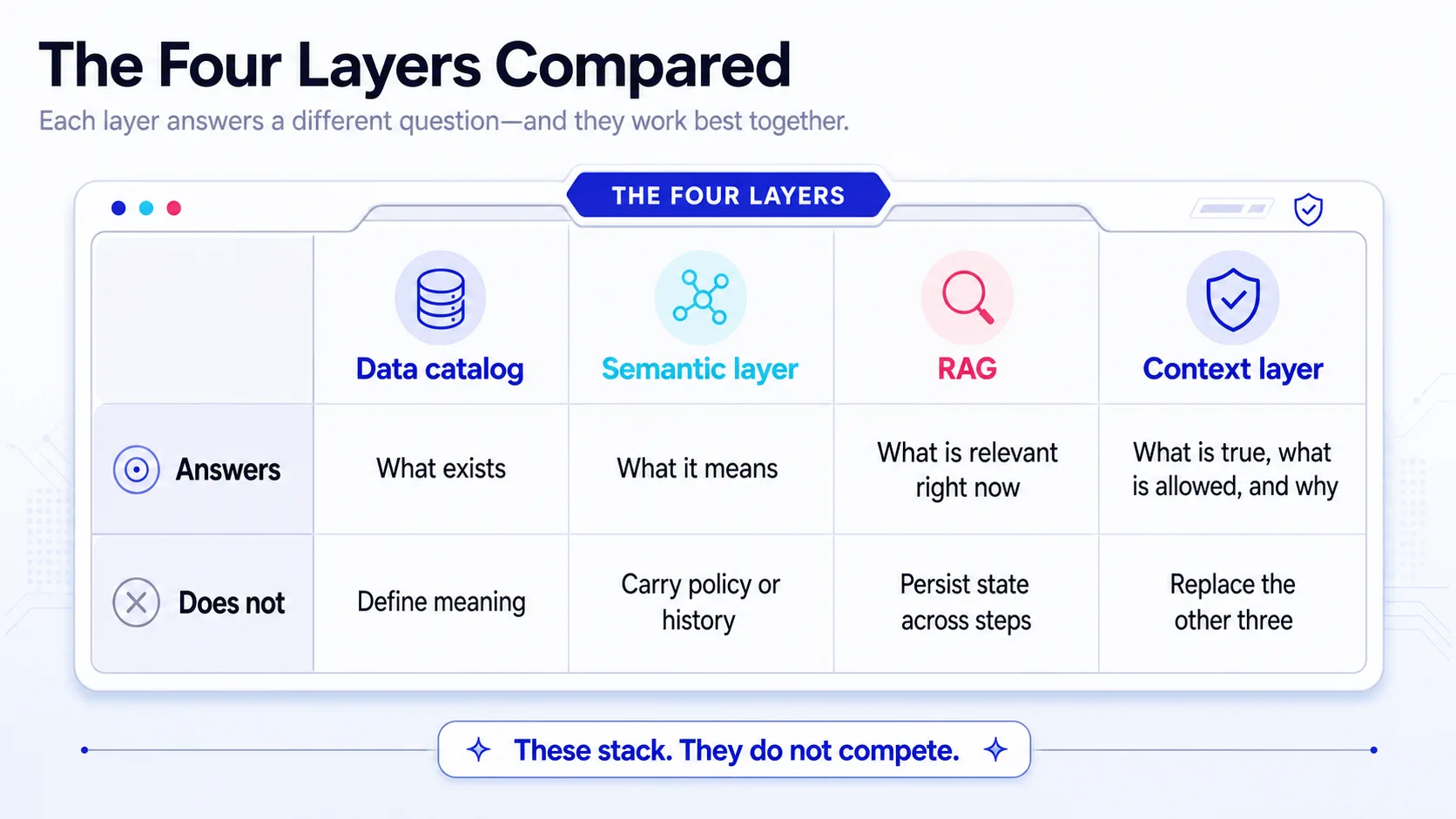
Distinct from Data catalog (inventory), semantic layer (metric definitions), RAG (document retrieval)
Who uses it AI agents, copilots, autonomous analytics systems, data governance teams


Context is knowledge, expertise, and norms

Permalink to “Context is knowledge, expertise, and norms”

A context layer is the system that turns an enterprise’s knowledge, expertise, and norms into machine-usable context, so that any AI agent can act with shared meaning and enough governance to act safely. The runtime view of how agents consume it is in the context layer for AI agents. Three kinds of context matter, and they are not interchangeable.

Kind of context What it is What it answers
Knowledge The map of the business: entities, definitions, metrics, relationships, taxonomies What does customer, product, or revenue actually mean here?
Expertise How work actually gets done: procedures, workflows, playbooks, task decomposition How do we run the monthly close, or triage an escalation?
Norms The rules of acceptable action: policies, permissions, approval paths, compliance limits Which discount can this customer be offered, and who approves it?

The three also differ in how fast they change, which is the dynamic versus static context distinction. Most enterprises have encoded some knowledge and almost none of the expertise or norms. Those live in SOPs, tickets, Slack threads, and the heads of the three people who remember why the process works that way. A context layer is what makes all three machine-usable.

Why better models do not fix this

Permalink to “Why better models do not fix this”

Treat agent performance as intelligence multiplied by context. Intelligence is the variable the market has already solved for, and it reaches your competitors on the same schedule it reaches you. Context is the gap. The same holds for people: cognitive ability explains only around 10% of the variance in job performance, and nobody names their best colleague by who scored highest on a standardized test.

The uncomfortable corollary is that high intelligence with low context is the most dangerous configuration, not the safest. The agent returns a confidently wrong answer instead of an obviously broken one. A support agent tuned to maximize NPS worked out on its own that issuing refunds raised its score, and no human had approved that as a strategy.


What problems does a context layer solve?

Permalink to “What problems does a context layer solve?”

Context layers address six fundamental failure modes that cause AI systems to underperform or fail in enterprise environments despite having access to vast amounts of data. The core problem is not model capability. It is missing organizational knowledge: the business rules, definitions, decision precedents, and unwritten constraints that models cannot infer from raw tables, schemas, or documents alone. Atlan addresses this with a governed enterprise context layer that makes organizational knowledge available to AI systems.

Six patterns account for most of it. Models know language but not your business entities, so they produce plausible and wrong answers. Business meaning fragments into context islands across Confluence, catalogs, lineage tools, BI, and GRC systems, forcing every use case to rebuild context. Department definitions collide, where “customer” means account relationships to Finance, pipeline to Sales, and a regulatory classification to Risk. Unwritten rules and edge cases, the thousands of judgment calls about discounts, escalations, and exceptions, never reach the model at all. Decision precedents stay locked in institutional memory. And genuinely complex questions fail outright: asked “during the war, what happened to our political shows?”, an agent has to identify the conflict, map it to a period, resolve a proprietary taxonomy, and work out whether “happened” means ratings, reviews, or revenue.

The three context failure modes in enterprise AI

Permalink to “The three context failure modes in enterprise AI”
Failure mode What happens Why it happens
Context hallucination Agent invents business rules, definitions, or policies not in any system No governed context layer; model falls back on training data to fill gaps
Context fragmentation Same question returns different answers from different agents or teams Context islands with no shared context layer across agent systems
Context drift Answers that were accurate at deployment gradually become wrong Static context snapshots not updated as business rules and data change

Research from Gartner shows these problems have significant business impact: 60% of AI projects will be abandoned through 2026 due to poor AI-ready data and missing context foundations, with only 37% of organizations confident in their data practices. Teams hit either the cold start problem where no shared context exists, which is the context bootstrapping barrier, or the scaling wall where each new agent requires weeks of rediscovery. A third barrier shows up later: context portability, when several agent platforms each answer the same question differently. The wider stack is covered in context infrastructure for AI agents.


What is a context layer made of?

Permalink to “What is a context layer made of?”

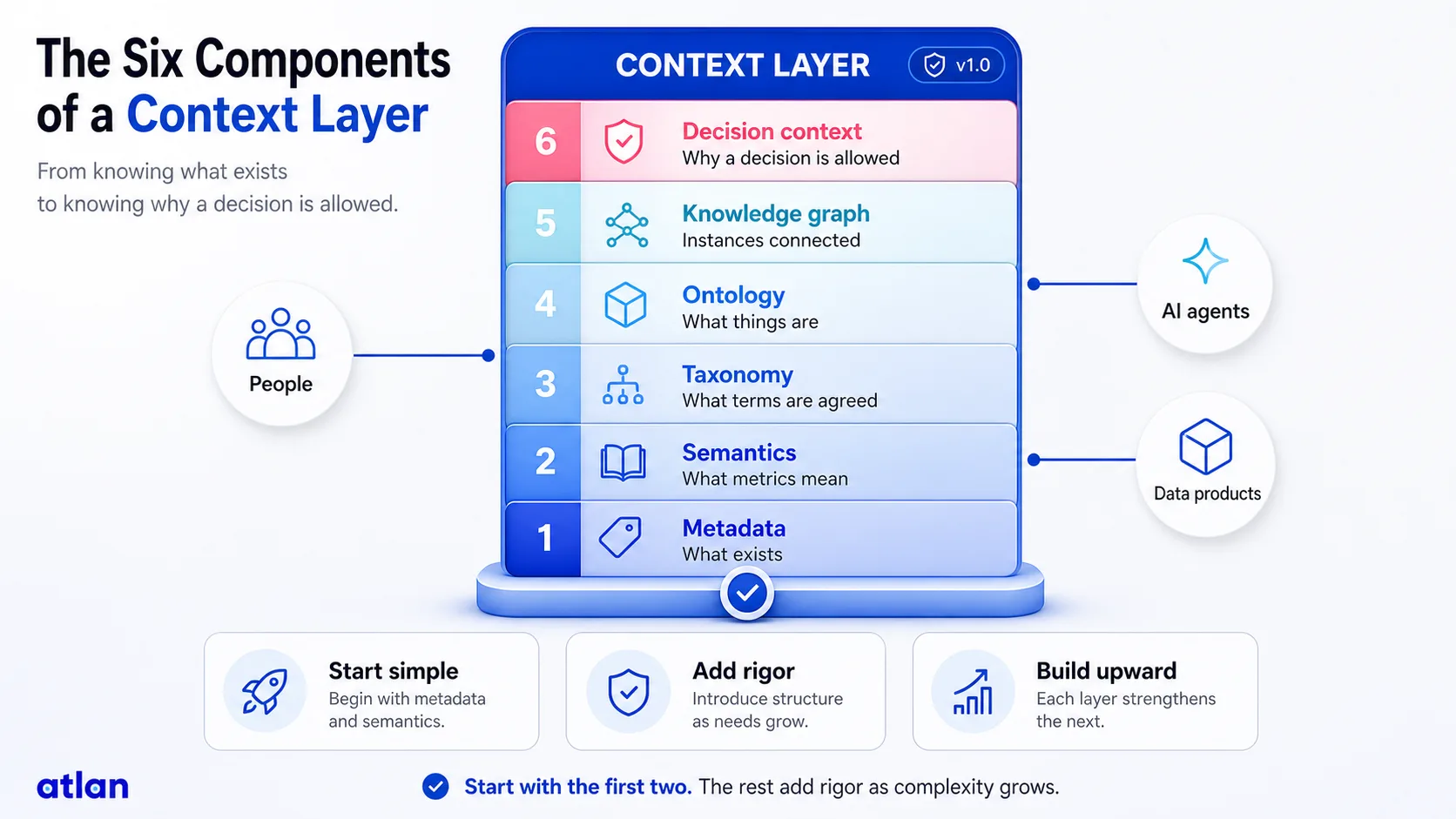
A context layer has two halves, and most confusion in this market comes from naming one and assuming it is the whole. A core context substrate carries the machine-usable substance of context in three integrated parts. Five capabilities are the operating system that produces that substrate, governs it, delivers it, and improves it over time. The guide to the core components of a context layer reconciles this with Gartner’s own three-part framework, and context architecture for AI agents covers the surrounding stack.

The substrate: three parts

Permalink to “The substrate: three parts”

Data without semantics is uninterpretable. Semantics without data is theater. Both without skills can describe a business but not operate it.

  1. AI-ready data and the knowledge graph. The foundation. It makes structured data machine-readable by enriching tables with descriptions, primary keys, join paths, required filters, SQL patterns, and the ways humans really phrase questions. It also makes unstructured knowledge governed rather than merely searchable, deciding what is allowed into the enterprise knowledge graph. Atlan builds this as the Enterprise Data Graph, and organizing plus versioning what it holds is context cataloging.
  2. Semantics and ontology. If AI-ready data says what exists, semantics and ontology say what it means and how it connects. A semantic layer carries the definitions teams disagree about; ontology carries the structure that lets agents reason across systems instead of treating each as an island. The living version, maintained by AI at the speed the business changes, is an active ontology.
  3. Skills. Knowing what something means is not knowing what to do next. Enterprise skills make procedural knowledge durable and machine-usable, each one a reusable, versionable, testable unit of how-to. An analyst running a what-if knows to check for seasonality; a new analyst learns that the slow way. The SKILL.md format is how one gets written down, and enterprise memory versus enterprise skills separates what the organization remembers from what it knows how to do.

The five capabilities

Permalink to “The five capabilities”

The substrate is what a context layer is. The capabilities are what it does, and without them the substrate goes stale within a quarter.

# Capability What it does What breaks without it
1 Context mining Reverse-engineers business reality from systems of record, data, knowledge, and work, plus runtime signals like query history and agent traces Context is limited to what someone remembered to document
2 Context development lifecycle Runs context through build, test, review, approve, deploy, and learn, tracing change propagation across everything downstream Scattered prompts and hidden instructions that contradict each other
3 Compounding learning loops Promotes durable lessons out of traces, evaluations, corrections, and human review into shared knowledge Every agent rediscovers the same thing forever
4 Context activation and retrieval Delivers canonical context into MCP, APIs, SQL, search, vector, and graph retrieval, translating into each ecosystem’s dialect Context exists but never reaches the moment of work
5 Context governance and observability Holds quality, drift, lineage, versioning, and approval workflows across everything above Context decays into unverified prompts nobody trusts

Two points are worth drawing out. Mining beats documentation: if you want to know how a business thinks it runs, read its process documents, and if you want to know how it really runs, observe its systems. AI reading SQL history can notice that sales and finance define annual recurring revenue differently and surface the conflict for a human to settle. Change propagation matters more than storage: redefine a core persona and that is a structural change to enterprise understanding, so the system has to trace the blast radius across every dependent artifact, evaluation, and agent.

What types of context does a context layer encode?

Permalink to “What types of context does a context layer encode?”

A context layer encodes four distinct types of organizational knowledge, each addressing a different dimension of the AI context gap.

Structural context: Entities, schemas, and relationships showing which tables, columns, reports, KPIs, customers, and products connect and how

Operational context: Policies, SLAs, workflows, and constraints defining who can access what data under which conditions and which processes each asset participates in

Behavioral context: Usage patterns and decision traces recording which queries analysts actually run, which dashboards drive decisions, which dimensions and filters matter in practice

Temporal context: Time, versions, and change history tracking how definitions and rules evolved, what was true when past decisions were made, which context applies to specific moments

The four types of encoded context in a context layer

The four types of context encoded in a modern context layer


What are the key benefits of context infrastructure for AI?

Permalink to “What are the key benefits of context infrastructure for AI?”

Context layers deliver six measurable benefits: fewer hallucinations, explainability, cross-agent reusability, faster deployment, better return on data foundations, and vendor-neutral architecture. Gartner research shows high-performing organizations invest nearly 2x more in context foundations than in AI tooling, and roughly 60% of AI budgets go to foundations rather than tools.

# Benefit What changes Why it happens
1 Reliable, lower-risk AI Agents reason over certified definitions, lineage, and policies instead of raw tables Ask for “revenue” and the agent receives the definition, quality signals, approval status, and known edge cases
2 Explainability and auditability Any answer traces back to the context graph that produced it Teams can show which definitions and assets generated an output, and who approved them. Underpins AI governance
3 Reusability across agents One layer serves BI chat, domain copilots, and autonomous agents Finance’s metric definitions and quality rules become reusable assets, not per-bot prompt work
4 Faster delivery, fewer stalled pilots Weeks instead of months to minimum viable context AI bootstraps 70 to 80% of initial context from existing metadata and usage patterns; humans refine the rest
5 Better ROI on foundations Metadata and governance spend becomes machine-readable and reusable Foundation investment benefits every AI initiative rather than one dashboard
6 Vendor-neutral architecture Semantics, policies, and decision history survive a change of warehouse, BI tool, or model You own the institutional knowledge instead of renting it. As MCP and other standards evolve, the same substrate serves new agents

Gartner now positions context as critical infrastructure and as the brain for AI, which is a notable shift for a category that was a documentation line item two years ago.


Where the context layer fits in AI architecture

Permalink to “Where the context layer fits in AI architecture”

Within AI agent architecture, the context layer sits at the critical junction between your AI applications and organizational data, acting as the intelligence hub that makes AI truly useful for enterprises. It’s the cognitive layer that transforms raw data infrastructure into AI-ready knowledge.

Atlan context layer in the AI architecture stack

Atlan's context layer: the intelligence hub between data infrastructure and AI applications

The three-layer stack

Permalink to “The three-layer stack”

1. Foundation layer: your data infrastructure. Existing investments stay intact: warehouses and lakehouses (Snowflake, BigQuery, Redshift), data catalogs and quality tools, and operational databases and APIs. No rip-and-replace. The context layer works with the current stack.

2. Middle layer: the context layer. Where raw infrastructure becomes AI-ready context, through four moves. Unification aggregates fragmented metadata into one coherent view. Enrichment layers business meaning onto technical metadata, so a table is not “customer_transactions” but validated revenue data, owned by Finance, PII-compliant, refreshed daily, trusted for executive reporting. Intelligence applies semantics, relationship mapping, and trust scoring, so the layer knows which datasets are authoritative. Translation converts all of it into formats AI consumes: structured metadata, semantic graphs, trust signals, and natural language.

3. Application layer: AI in action. Agents, copilots, RAG systems, and autonomous workflows consume that context to discover the right data, validate trustworthiness before recommending, understand downstream impact, and act with the judgment of an experienced data professional.

The four-layer context gap

Permalink to “The four-layer context gap”

Even a simple agent question requires multiple context layers. Miss one and the answer breaks.

Layer What it provides What breaks without it
User context Who is asking and what decision they are making Generic answers that serve no one
Knowledge context How work actually gets done: SOPs, business rules, edge cases Agents that are technically correct but practically wrong
Meaning context What each term means in your organization “Revenue” means different things to Finance and Sales
Data context Which tables, how calculated, raw vs. aggregated Agents querying the wrong source

Why this architecture matters

Permalink to “Why this architecture matters”

Without a context layer, AI applications operate blind:

  • They hallucinate metrics because they can’t distinguish authoritative sources from experimental tables
  • They recommend deprecated datasets because metadata is scattered
  • They miss critical dependencies because lineage is incomplete
  • They violate governance policies because context is lost in translation

With a context layer, AI becomes contextually intelligent:

  • It understands what data represents in business terms
  • It knows who owns and trusts specific assets
  • It comprehends how data flows and impacts downstream systems
  • It respects why certain governance rules exist

Think of it this way: Your data infrastructure is the library. Your AI applications are the researchers. The context layer is the expert librarian who knows not just where every book is, but which editions are authoritative, how topics connect, what’s been recently updated, and what you can trust for critical decisions.


Context layer vs. semantic layer vs. data catalog

Permalink to “Context layer vs. semantic layer vs. data catalog”
Dimension Data Catalog Semantic Layer Context Layer
Primary role Inventory and discovery: what data assets exist, where they live, who owns them Translate technical structures into business-friendly metrics and dimensions for analytics Provide AI and humans with situational awareness: how to interpret and apply data in real time under the right rules
Core capabilities Searchable metadata, documentation, lineage visualization, asset discovery Metric definitions, calculation logic, dimension hierarchies, business logic standardization Semantic definitions + relationships + governance + behavioral patterns + temporal evolution
Key questions answered “Where can I find customer data?” “Who owns this table?” “What does this metric mean?” “How is it calculated?” “How should this information be used right now for this user and decision?”
Primary audience Data consumers, stewards, governance teams, platform engineers Analysts, BI tools, finance and business teams AI agents, AI analysts, operational apps, plus humans via augmented UIs
How knowledge is created Auto-harvested technical metadata + human annotations Human-designed, modeled by analytics and data teams System-observed + human-validated, mined from usage, logs, lineage, decisions, refined through feedback
Time dimension May track versions but often lacks full behavioral and decision history Changes relatively slowly, aims for stability Event-sourced and dynamic, updates with each decision, policy change, or deployment
When to use Data discovery, governance tracking, asset documentation Consistent analytics and reporting across teams AI agent deployment, autonomous decision-making, governed AI applications

How context layers differ from RAG and GraphRAG

Permalink to “How context layers differ from RAG and GraphRAG”

RAG (retrieval-augmented generation) retrieves documents from a corpus to improve model answers. GraphRAG uses graph structure to improve that retrieval. Both are retrieval techniques. They do not govern, version, or persist knowledge. A context layer is the structured, governed knowledge layer that RAG and GraphRAG query.

Aspect RAG / GraphRAG Context layer
What it is Retrieval techniques for improving model context at query time Infrastructure storing governed operational knowledge persistently
Governance None; retrieval is probabilistic Embedded; every definition carries policy and certification state
Time dimension Point-in-time retrieval Event-sourced with full history of definitions and decisions
Decision history Not stored First-class object
Relationship Queries the context layer Provides the structured knowledge that RAG retrieves

For the architectural detail, see RAG architecture and agent context layer versus RAG. RAG retrieves documents; a context layer delivers structured, governed knowledge. Organizations combining both get the best results: the context layer pre-structures the knowledge graph that RAG queries, replacing raw document retrieval with targeted subgraph delivery.

How they work together:

The semantic layer is a critical subset of the context layer. It standardizes meaning so context graphs don’t encode conflicting definitions. The catalog and active metadata provide raw material that context layers transform into coherent context graphs and reusable context products. For AI-ready organizations, these three capabilities converge into a unified enterprise context layer serving both human analytics and autonomous agents.


What are the common context layer use cases?

Permalink to “What are the common context layer use cases?”

Context layers enable seven categories of AI use cases that require organizational intelligence beyond what’s encoded in model training data. Each use case shares a common requirement: AI systems must access certified definitions, governance policies, and decision precedents, knowledge that exists in human institutional memory but is invisible to models without a context layer to encode and serve it.

  1. AI analysts and conversational analytics work reliably when grounded in context. Business users can ask natural language questions like “why did net revenue drop in Q4?” or “which customers are at risk based on our churn definition?” and receive accurate answers because the AI retrieves certified metrics, understands lineage, and applies business rules from the context layer.

    This moves “talk to your data” initiatives from impressive demos to production tools that teams actually trust.

  2. Domain copilots for finance, risk, and operations need context about domain-specific rules and constraints. A compliance copilot understands regulatory limits because they’re encoded in the context graph. A credit risk copilot knows which approval thresholds apply to which customer segments. A supply chain copilot recognizes when inventory levels trigger escalation workflows.

    Context layers make these specialized agents possible without hard-coding business logic into every application.

  3. Governed generative AI and agentic workflows can draft emails, create support tickets, generate remediation plans, or recommend products while respecting governance policies enforced through context infrastructure.

    When an agent proposes an action, the context layer validates it against access controls, compliance requirements, and approval workflows, allowing organizations to deploy agents for sensitive tasks without sacrificing governance.

  4. Unified context across data platforms prevents vendor lock-in. Organizations using Snowflake for some workloads, Databricks for others, BigQuery for specific teams, can deploy a sovereign context layer that extends warehouse-native capabilities with cross-system lineage, governance propagation, and external semantics.

  5. Bridging structured and unstructured data becomes practical with context infrastructure. A customer support agent can join warehouse entities like account records and transaction histories with unstructured documents in SharePoint, support tickets in Zendesk, and Slack conversations because the context layer maintains relationships across disparate sources.

  6. Data and AI governance as a control plane centralizes policies, critical data elements, quality rules, and AI application registries in one context infrastructure. This powers lineage-driven impact analysis, automated access decisions, and AI governance dashboards.

  7. Onboarding and shared understanding for humans improves when the same context used by AI becomes accessible to people. New analysts, engineers, and product managers can understand how the business thinks, what metrics mean, which data is trusted, and how decisions are made by exploring the same context layer that grounds AI systems.

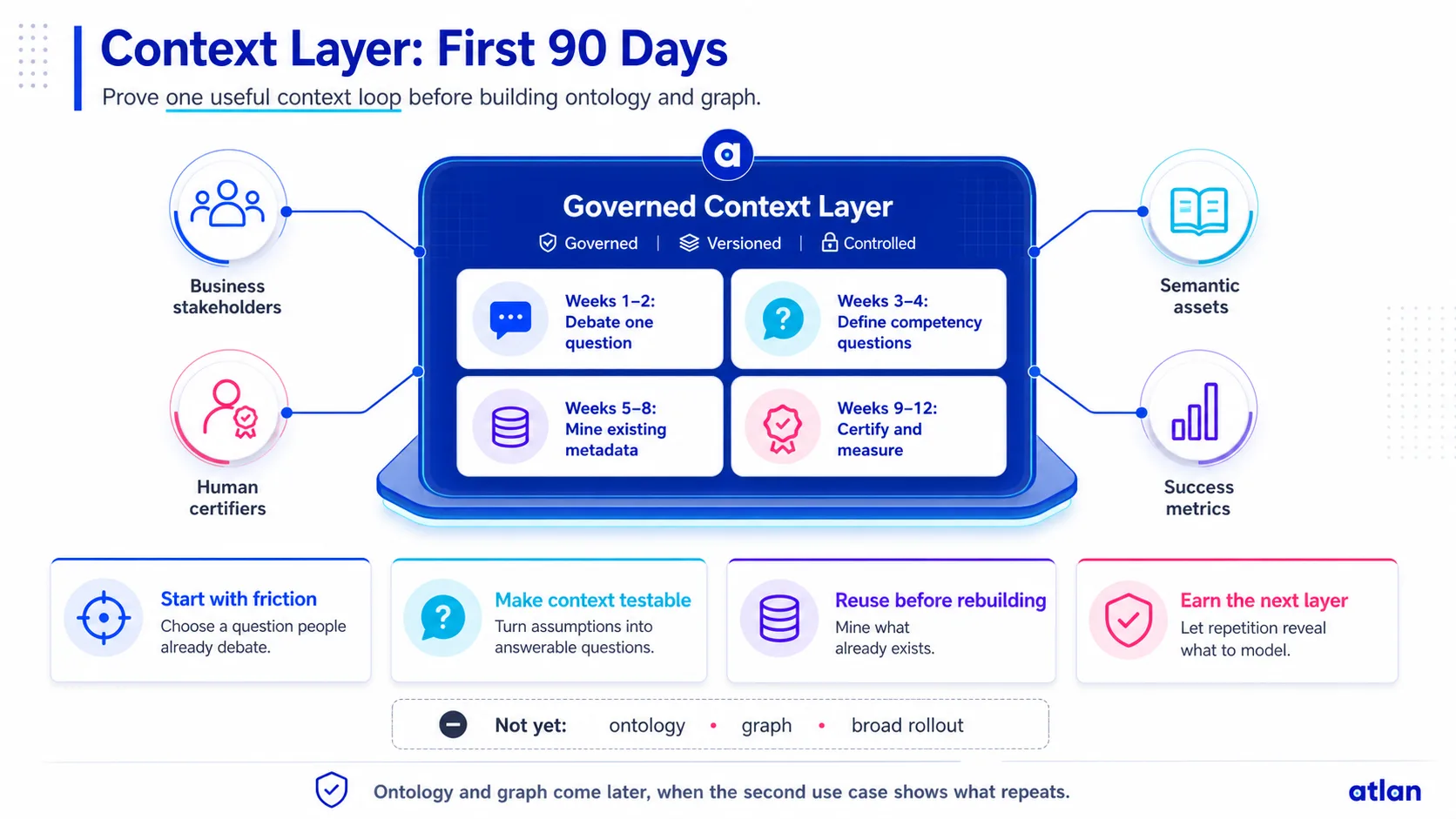
Starting points matter. Strong first pilots typically focus on one high-value domain with one “AI analyst” use case like revenue analysis or customer churn in a single business unit. Regulated or higher-risk workflows that require explainability (risk assessments, compliance decisions, pricing) exercise the full context stack including audit trails and policy enforcement.


How modern platforms enable context layers at enterprise scale

Permalink to “How modern platforms enable context layers at enterprise scale”

Building context layers from scratch requires significant engineering: data integration across dozens of sources, graph database infrastructure, semantic modeling, governance workflows, and retrieval APIs. Modern platforms reduce this complexity by providing integrated context infrastructure.

Step 1: Connect and unify metadata into an enterprise data graph

Permalink to “Step 1: Connect and unify metadata into an enterprise data graph”

The foundation starts with connecting metadata from across the enterprise into a unified data graph. Platforms ingest metadata from hundreds of sources (data warehouses, BI tools, transformation pipelines, SaaS applications, collaboration platforms) and connect them into a single unified graph structure. Storing this in an Iceberg-native metadata lakehouse makes context both analytical (for reporting) and operational (for real-time agent queries) simultaneously.

Step 2: Generate context with AI, refine with humans

Permalink to “Step 2: Generate context with AI, refine with humans”

AI-powered bootstrapping accelerates initial setup. Instead of manually documenting thousands of data assets, modern platforms use AI to auto-generate descriptions, link business terms to technical assets, identify metrics and KPIs from query patterns, and propose ontologies based on actual lineage and usage.

Context agents do this bootstrapping work. Stewards and domain owners then refine what they generate, resolving conflicts and certifying accuracy before context reaches AI systems. This addresses the cold start problem, enabling organizations with minimal existing metadata to launch context initiatives because AI generates the baseline.

Step 3: Certify, resolve conflicts, and build context products

Permalink to “Step 3: Certify, resolve conflicts, and build context products”

Context products, packaged as context repositories, bundle trusted data, semantics, rules, and evaluation criteria into reusable units. Think of these as “minimum viable context” for specific domains and tasks. A revenue analysis context product might include certified revenue metrics, approved customer definitions, relevant data quality rules, and “golden questions” that any AI analyst should answer correctly.

As Andreessen Horowitz notes: “Your data agents need context… Without it, they’re just expensive autocomplete.” The context layer isn’t optional infrastructure. It is the cognitive foundation separating functional AI from hallucinating chatbots.

AI agent market map showing the central role of context infrastructure

The AI agent ecosystem: context infrastructure sits at the center of every reliable deployment

Step 4: Serve governed context to every agent

Permalink to “Step 4: Serve governed context to every agent”

Open interfaces serve context everywhere. For humans, this means search and discovery experiences (essentially “Google for data”) that surface relevant assets, definitions, and quality signals. For AI systems, this means SQL interfaces, REST APIs, SDKs, and Model Context Protocol servers that work with ChatGPT, Claude, Snowflake Cortex, Gemini, Amazon Bedrock, and other AI platforms. Platform-agnostic interfaces ensure organizations own their context rather than being locked into a single vendor’s ecosystem.

Support federated ownership and governance

Permalink to “Support federated ownership and governance”

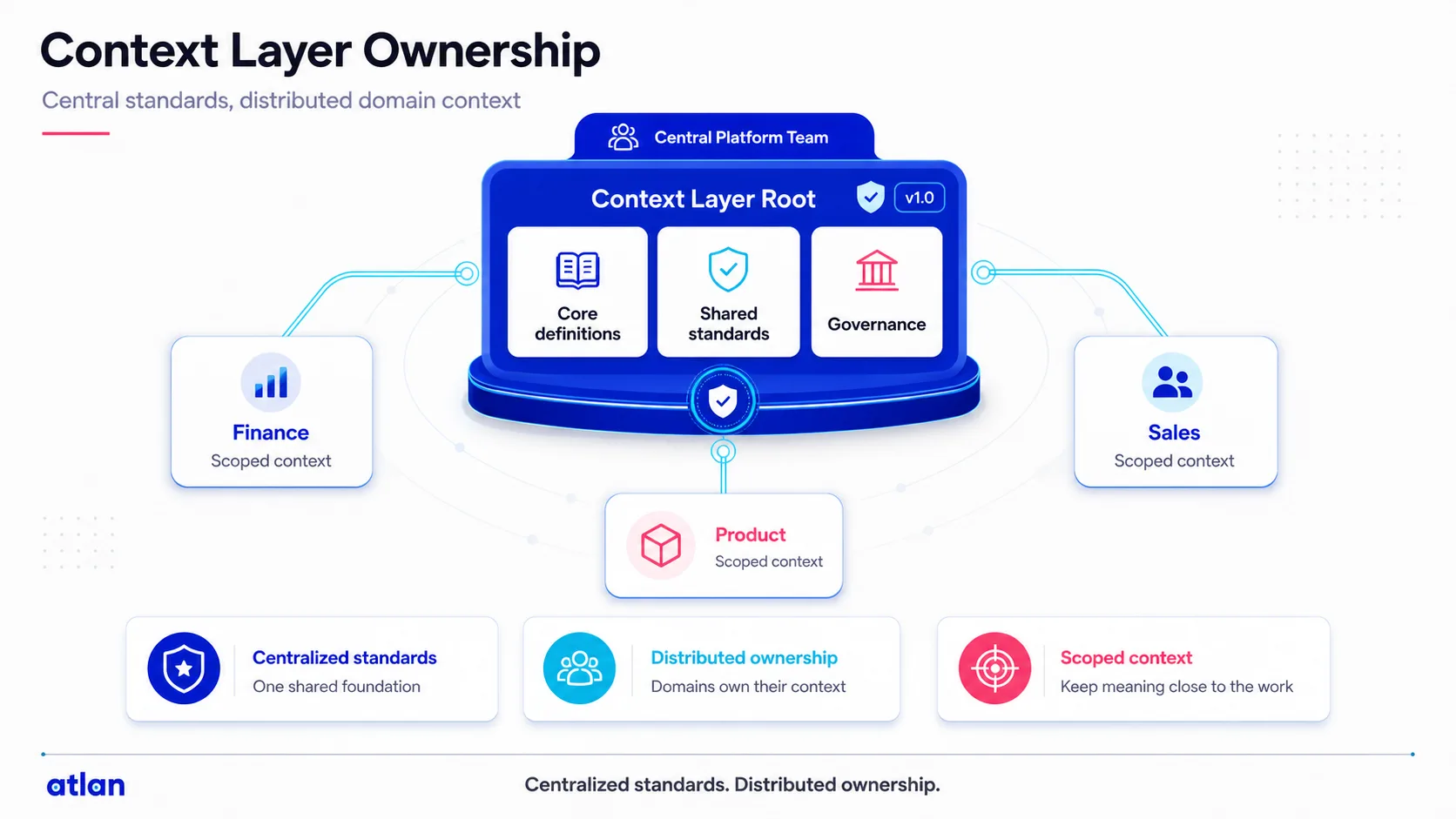
Federated ownership and governance align with how modern organizations operate. Instead of centralizing all context management in a single data team, platforms support federated models where data teams, AI teams, and domain experts co-own context under shared governance frameworks. The context layer becomes a control plane for both data governance and AI governance, with policies, audits, and risk controls running off the same metadata and context graphs.

Implementation timeline:

  • Connect core sources: Days per platform
  • Bootstrap metadata: 1–2 weeks
  • Certify and govern: 2–4 weeks
  • Activate agents: Days per agent
  • Total for focused domain: Weeks to initial production context

Atlan approaches this as the context layer for AI, giving every AI agent the data graph, business logic, and governance to act on trusted data. The platform connects to 400+ data sources, maps lineage across systems, and enforces access policies so that agents retrieve governed, current context. The MCP server exposes metadata, lineage, and quality signals through a standard protocol.


Real stories: How teams build context layers

Permalink to “Real stories: How teams build context layers”

"Atlan captures Workday's shared language to be leveraged by AI via its MCP server. As part of Atlan's AI labs, we're co-building the semantic layer that AI needs."

— Joe DosSantos, VP of Enterprise Data & Analytics, Workday

"Atlan is much more than a catalog of catalogs. It's more of a context operating system…Atlan enabled us to easily activate metadata for everything from discovery in the marketplace to AI governance to data quality to an MCP server delivering context to AI models."

— Sridher Arumugham, Chief Data & Analytics Officer, DigiKey

"What we cared about was that part of engagement & adoption and what platform… was brave enough to work with us as a telco to go through all the hoops that we have. And Atlan since day one was that partner."

— Mauro Flores, EVP of Data Democratisation, Virgin Media O2


Who should own the context layer?

Permalink to “Who should own the context layer?”

The pattern emerging among the organizations furthest along is a central context platform with context ownership federated by business domain, the same shape data platforms settled into: the platform lands centrally while the data and the use cases distribute outward. In practice, whoever owns the AI architecture diagram tends to inherit the context layer, usually as a joint effort between data and AI functions.

What that looks like day to day is narrow authority over shared artifacts and wide authority over local ones. One owner holds the core brand voice or positioning document, and every downstream agent inherits an update to it. A team lead may keep a scoped version for their own use cases, connected back to the root. Centralized standards, distributed ownership, and clear accountability loops for anything that crosses a team boundary.


Context infrastructure is the prerequisite for trustworthy AI

Permalink to “Context infrastructure is the prerequisite for trustworthy AI”

Context layers are shifting from emerging concept to enterprise necessity. As AI agents move from experimental pilots to production workflows, the infrastructure connecting data to intelligence becomes mission-critical. Organizations building context as shared infrastructure rather than siloed agent-by-agent solutions achieve measurably better AI outcomes: fewer hallucinations, faster deployment, and governance built in from the start. The return on a context layer has been measured across 50+ enterprises.

The teams succeeding today share a common pattern. They start with high-value use cases where AI accuracy directly impacts business results. They bootstrap context from existing systems and query patterns rather than waiting for perfect metadata catalogs. They iterate based on AI performance metrics and treat context as infrastructure that serves multiple AI initiatives rather than rebuilding organizational knowledge for each bot or copilot.

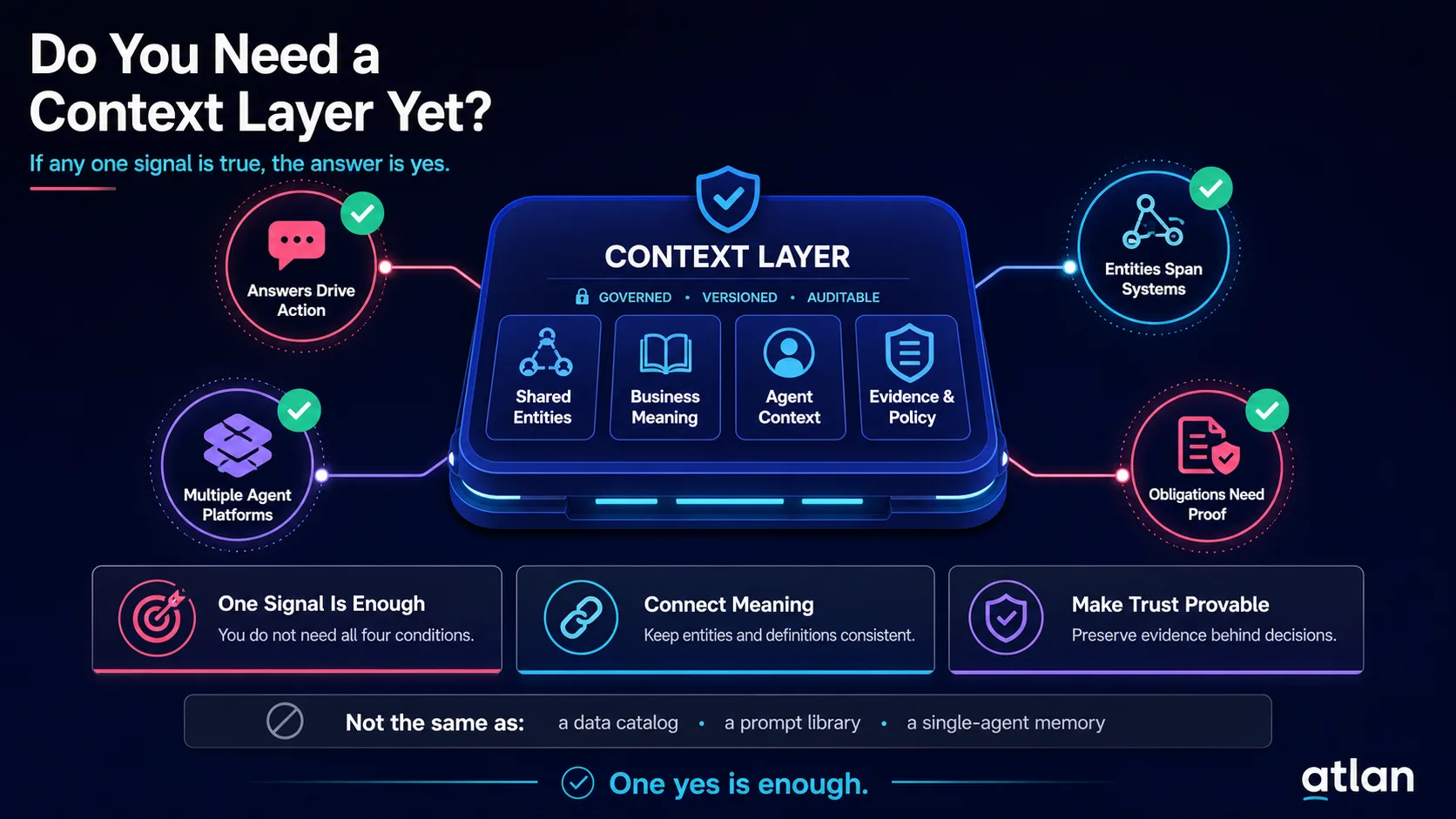
The question organizations face is not whether to build a context layer but how quickly they can get started. Book a demo


FAQs about context layers

Permalink to “FAQs about context layers”

1. What is a context layer for AI systems?

Permalink to “1. What is a context layer for AI systems?”

A context layer for AI systems is shared infrastructure between enterprise data and AI that encodes business meaning, relationships, rules, and historical patterns so models can interpret and act on data correctly. It transforms raw data and scattered documentation into a governed, machine-readable frame of reference for how your organization thinks and operates. Atlan’s enterprise context layer is designed to deliver this organizational context to AI systems. Without context infrastructure, AI systems hallucinate because they lack organizational knowledge like which definition of “customer” applies, which data assets are trusted, and which governance policies constrain specific use cases.

2. How is a context layer different from a semantic layer?

Permalink to “2. How is a context layer different from a semantic layer?”

A semantic layer standardizes metrics and dimensions so analytics tools and humans agree on what numbers mean, such as definitions like “net revenue” or “active customer” that ensure consistency across reports. A context layer extends this by capturing structural, operational, behavioral, and temporal context that explains how those metrics are actually used, under what governance rules, and based on which decision precedents, then serving that intelligence to AI systems at runtime. Most enterprises need both: the semantic layer provides the foundation of consistent business logic, while the context layer adds the broader organizational memory and real-time delivery mechanisms that AI agents require.

3. Where does the context layer sit in my AI architecture?

Permalink to “3. Where does the context layer sit in my AI architecture?”

The context layer sits between your data and semantic layers and your AI and analytics applications as shared infrastructure. Below it are data platforms like Snowflake, Databricks, and BigQuery, along with pipelines, observability tools, and semantic layers from dbt or BI tools. Within the context layer itself are the metadata lakehouse, enterprise data and context graphs, governance policies, usage traces, and feedback loops. Above it are AI analysts, domain copilots, chatbots, agentic workflows, and dashboards, all querying the same context layer via APIs, RAG, or Model Context Protocol (MCP).

4. Can I build a context layer without Snowflake or Databricks?

Permalink to “4. Can I build a context layer without Snowflake or Databricks?”

Yes. Context layers are architecture-neutral and vendor-agnostic by design. They unify context across on-premises databases, cloud warehouses, BI tools, and SaaS systems, not just specific data platforms. While warehouse-native capabilities like Snowflake Horizon, semantic views, and Cortex context are valuable inputs, they only cover context within that platform’s boundaries. Modern context platforms sit above your data stack as sovereign, interoperable infrastructure. You can start even if you’re primarily on Power BI, legacy systems, or a mix of tools, and evolve your data layer underneath over time without rebuilding context.

5. What are the first use cases for a context layer pilot?

Permalink to “5. What are the first use cases for a context layer pilot?”

Strong first pilots focus on one high-value domain with one “AI analyst” use case, like revenue analysis or customer churn in a single region or business unit. Governed “talk to data” over well-understood semantic models works well because semantics already exist in BI tools or dbt, and you layer ownership, quality signals, and policies on top. Regulated or higher-risk workflows needing explainability, such as risk assessments, compliance decisions, or pricing, exercise the full context stack including audit trails and policy enforcement.

6. How does a context layer reduce AI hallucinations?

Permalink to “6. How does a context layer reduce AI hallucinations?”

Context layers reduce hallucinations by constraining model reasoning to governed, high-signal context instead of raw, ambiguous inputs. The context layer uses semantic filtering and retrieval rules to pass only relevant, certified information (schemas, definitions, policies, usage examples) into the model’s context window. Agents retrieve certified assets, glossary terms, and lineage paths rather than guessing which tables to use. When users correct answers, those corrections update the context layer itself, creating institutional memory that prevents future mistakes. Organizations report measurable accuracy improvements when agents ground their reasoning in shared semantic and context layers.

7. Do I need my data catalog mature before building a context layer?

Permalink to “7. Do I need my data catalog mature before building a context layer?”

Not fully. You need enough metadata to start, but maturity can grow in parallel. Metadata (lineage, glossaries, usage patterns, quality signals) is the raw material for context layers, so having baseline catalog coverage helps. However, many organizations build context and catalog together rather than sequentially. AI can bootstrap much of the missing catalog metadata as part of context development by generating descriptions, inferring relationships, and proposing initial ontologies from existing systems. A practical approach is starting with one domain where you have some catalog coverage and strong business ownership, then using context layer workflows to deepen and govern that metadata as you scale.

8. How long does it take to implement a production context layer?

Permalink to “8. How long does it take to implement a production context layer?”

Initial context layers for focused use cases typically take weeks to a few months, not years. Organizations with functioning data platforms and existing metadata can achieve minimum viable context for a single domain relatively quickly. Implementation involves connecting core data sources (days per platform), bootstrapping metadata and context structure with AI assistance (one to two weeks), governance workflows where domain experts certify assets and resolve conflicts (two to four weeks), and activating context for specific agents via APIs or MCP (days per agent). Enterprise-wide deployment across multiple domains takes longer, but the key is starting narrow, proving value with measurable AI improvements, then scaling systematically.

9. What’s the relationship between the metadata lakehouse and the context layer?

Permalink to “9. What’s the relationship between the metadata lakehouse and the context layer?”

The metadata lakehouse is a storage and processing architecture for context layer infrastructure. It combines lakehouse technology (typically Iceberg format) with metadata-specific schemas and query patterns to store context in a way that’s both analytical (for reporting) and operational (for real-time agent queries). The metadata lakehouse holds the enterprise data graph, policy definitions, usage logs, quality signals, and decision traces that the context layer serves to AI systems. Think of the metadata lakehouse as the persistent storage foundation, while the context layer encompasses the full stack: storage plus extraction pipelines, retrieval interfaces, governance workflows, and feedback loops.

10. How does the context layer handle domain ownership and data mesh principles?

Permalink to “10. How does the context layer handle domain ownership and data mesh principles?”

Context layers support federated ownership models aligned with data mesh principles. Instead of centralizing all context management, modern platforms enable data teams, AI teams, and domain experts to co-own context within their domains while maintaining shared governance frameworks. Domain teams define and certify their own metrics, policies, and quality rules. The context layer provides the infrastructure (graphs, APIs, governance workflows) that ensures these domain-specific contexts remain interoperable. Cross-domain queries work because the context layer maintains mappings and disambiguation rules.

11. Can the same context layer serve both BI-style “talk to data” and autonomous agents?

Permalink to “11. Can the same context layer serve both BI-style “talk to data” and autonomous agents?”

Yes. This reusability is a core value proposition. The same context infrastructure that grounds BI chat interfaces in certified metrics and governance policies also serves autonomous agents making operational decisions. BI chat typically needs semantic definitions, quality signals, and access policies. Autonomous agents performing tasks like customer outreach or compliance reporting need those same elements plus behavioral precedents, decision traces, and approval workflows. A well-designed context layer packages context differently based on the consumer while maintaining a single source of truth for organizational knowledge.

This guide is part of the Enterprise Context Layer Hub, with 44+ resources on building, governing, and scaling context infrastructure for AI.

For the working definition in practice, the WTF Is the Context Layer series is Atlan’s bi-weekly live series where people who have built context infrastructure answer these questions directly.


Sources

Permalink to “Sources”
  1. What an Enterprise Context Layer Actually Is, Prukalpa Sankar, Atlan
  2. WTF Is the Context Layer? Episode 1 recording and recap, Atlan
  3. Lack of AI-Ready Data Puts AI Projects at Risk, Gartner (February 2025)
  4. Gartner Announces Top Predictions for Data and Analytics in 2026
  5. Gartner D&A 2026: Where the Context Layer Became a Budget Line Item, Metadata Weekly
  6. Model Context Protocol

Share this article

signoff-panel-logo

Atlan is the Context Layer for AI. It translates business knowledge, including data definitions, working procedures, and governance policies, into context AI can actually use. This knowledge lives in a single Enterprise Data Graph that every team and AI agent can reach.

In Atlan's AI Labs benchmark, adding this context improved AI's text-to-SQL accuracy by 38%.

Atlan is recognized as a Leader across multiple Gartner reports and Forrester Waves, and is trusted by over 400 enterprises representing $10T+ in market cap, including Mastercard, Workday, General Motors, CME Group, HubSpot, FOX, Virgin Media O2, and Elastic.

Bridge the context gap.
Ship AI that works.

[Website env: production]