

A person opens a dashboard. A reviewer eventually notices something looks off. Static role-based access control (RBAC) catches most of what’s left. That held for human query volumes. It stops holding once an AI agent issues hundreds of queries an hour with no one in the loop to notice a bad join or an invented metric, and Gartner already projects over 40% of agentic AI projects will be cancelled by 2027 over exactly this kind of unmanaged risk.
Every serious answer treats governance as non-negotiable, so the build vs buy question comes down to capability, not commitment: can your team build and continuously operate agent-aware governance in-house, agent identity as a first-class object, per-request policy enforcement, continuous audit trails, or does it need a platform that already operates at that granularity? Self-service governance was already fragile before agents arrived: shadow pipelines, spreadsheet metric reinvention, the self-service paradox of more access producing more chaos. Agents don’t invent this failure; they remove the last safety net, a human eventually noticing something looks wrong, at a speed where yesterday’s good-enough governance stops being survivable. The two paths below are rarely a clean either-or in production; most teams end up blending them, covered in the “work together” section.
| Dimension | Build in-house | Buy a platform |
|---|---|---|
| What it is | Engineering your own agent-identity, policy, and audit layer on existing infrastructure | Adopting a platform that already governs at agent-query granularity |
| What it does | Extends access-control and catalog stack to recognize agents as distinct actors | Delivers agent identity, per-request policy checks, and audit trails out of the box |
| Who owns it | Data platform and engineering team | Data governance team and vendor, jointly |
| Key strength | Full control over policy logic and proprietary integrations | Time-to-value; controls already built and maintained |
| Best for | Core-IP data-access logic no vendor models | Governance live before the next agent rollout |
| Questions it answers | Can we model this exact policy rule ourselves? | Can we govern this without a multi-quarter build? |
| Complexity level | High, ongoing engineering ownership | Low to medium, configuration not construction |
What’s the difference between building and buying agent-aware governance?
Building agent-aware governance means your engineering team owns identity modeling, policy enforcement, and audit logging for every querying agent. Buying means a platform already provides all three, and your team configures it instead of constructing it. Both paths assume AI agent governance is its own discipline, not an afterthought bolted onto an existing access-control stack.
Human-era self-service governance relied on RBAC, certified datasets, and a query cadence slow enough that manual review caught most problems, an implicit bet that a human would eventually notice if something was wrong. Once the querier is an AI agent reasoning at machine speed, that bet fails: the review cadence behind it no longer matches query volume.
Kevin Paige, Field CISO at C1 (ConductorOne) frames the shift directly: “The old question was who has access. The new question is what this agent can do, on whose behalf, and whether it is staying inside those lines.” That’s the build-vs-buy decision in two sentences, and it lines up with what zero-trust data governance already argues for humans: verify continuously, never once at provisioning.
Rita Sallam, Distinguished VP Analyst at Gartner has said D&A leaders should experiment with data governance agents in low-risk pipelines, a sign this is a live, analyst-endorsed decision. Immuta’s own competitive content states the failure mode plainly: treating agents like human users is a fast track to risk. None of this requires the AI governance framework you already have to be wrong; it requires extending it to an actor class RBAC was never designed to recognize, often a self-service analyst layer sitting on top of your BI stack.
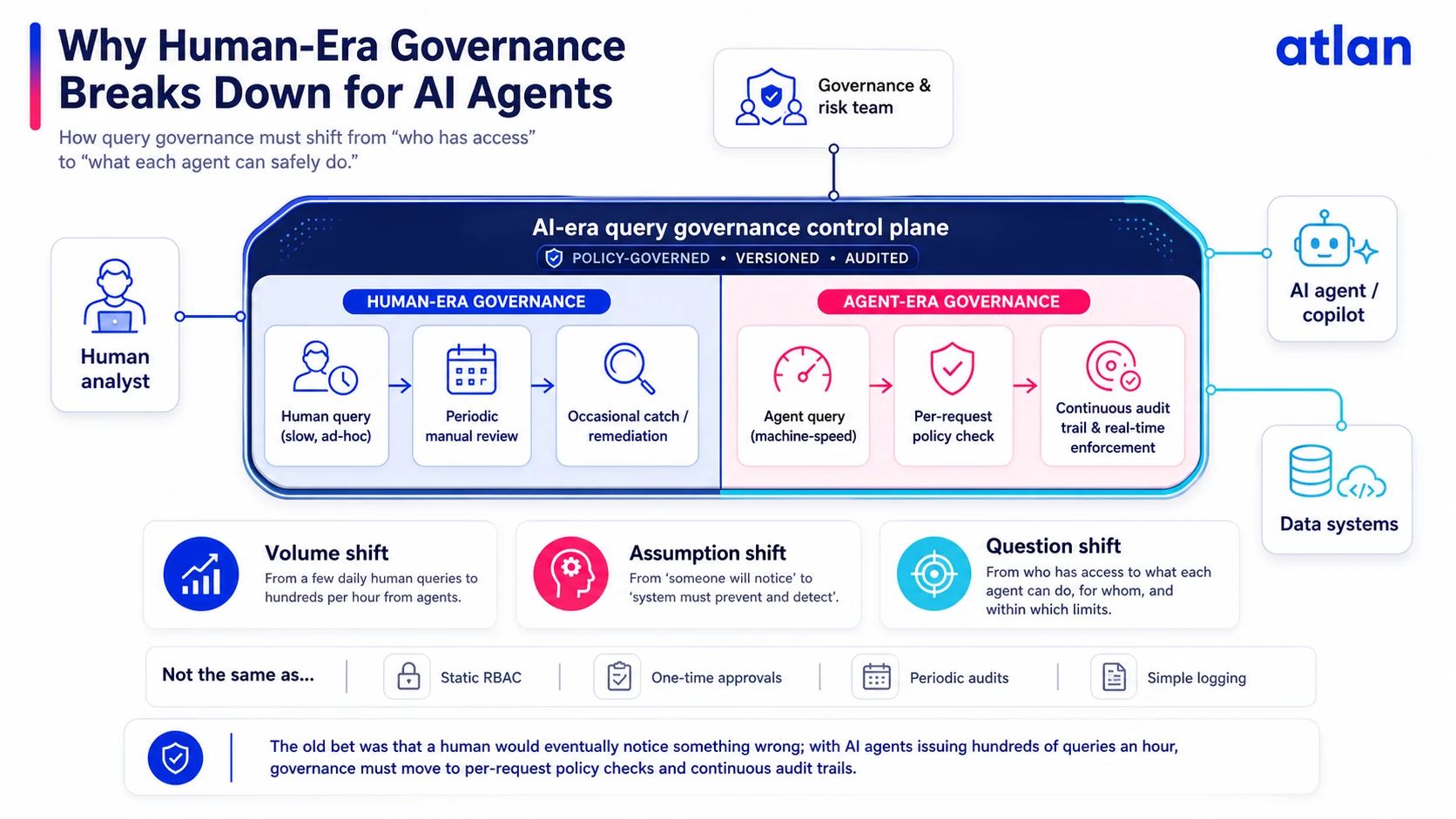
Human-era governance assumed a query cadence slow enough for manual review to catch problems. Agent-era governance moves to per-request policy checks and continuous audit trails instead. Source: Atlan
What does it take to build agent-aware governance for self-service AI analytics in-house?
Building in-house means standing up an agent identity registry distinct from human directories, enforcing policy-as-code at each query, and logging every agent action to an immutable, queryable trail, on top of whichever agent framework your team uses. None of these three is optional; skipping one leaves the other two enforcing rules against an actor that isn’t properly identified or audited.
Identity is hardest to retrofit. Krti Tallam’s arXiv paper on authorization propagation argues identity must be modeled as its own infrastructure layer, not inherited from nearby human credentials: an AI registry tracking each agent’s scope, owner, and permitted data surface. Skipping this is the most common build-side mistake, an agent silently inheriting a human’s dashboard permissions instead of its own, narrower identity.
Policy-as-code has to run at request time, not as a one-time grant checked at provisioning. Open Policy Agent (OPA) is the most commonly cited engine, evaluating rules against every incoming query rather than a static login check. CrowdStrike’s continuous-identity framing makes the same case from security: identity has to be re-verified continuously, the mechanism underneath AI agent access control once the requester is non-human and operating at volume.
Continuous audit logging turns governance from theoretical to defensible: every query and its reasoning lands in an immutable log, not a periodic snapshot. The maintenance loop is what teams underestimate, someone re-evaluating policy as the underlying framework changes beneath the build, which is why how to build an AI agent harness content treats the harness and its governance as one decision, and why securing multi-agent systems at scale means all three hold across every agent built.
Core components of the build path
- Agent identity registry: distinct from human SSO/IdP, tracking each agent’s scope, owner, data surface
- Policy-as-code engine: rules evaluated at request time, not a static grant checked once
- Continuous audit logging: immutable logs of every agent query and its reasoning context
- Ongoing maintenance loop: someone owns re-evaluating policy as agent frameworks change
Get the AI Context Stack
A four-layer blueprint for the infrastructure agent-aware governance sits on: metadata foundation, policy layer, delivery mechanism, and agent orchestration.
Get the AI Context StackWhat do you get when you buy agent-aware governance instead of building it?
A bought platform arrives with agent identity, per-request policy checks, and audit trails already built and maintained. Classification and certification propagate automatically along lineage, and policy reaches the agent at the moment it reasons rather than your team hard-coding rules dataset by dataset. The tradeoff: less control over bespoke logic, in exchange for not constructing the enforcement engine yourself.
Classification propagation does the most invisible work. When a source table is tagged as PII or certified for a use, a platform governing at the lineage level carries that classification to every downstream asset, so an agent querying a joined table inherits the same policy context a human analyst sees on the source. a recap of Gartner’s D&A Summit 2026 research found 44% of data leaders have implemented a semantic layer, with 48% more planning to by 2027, meaning roughly three-quarters of organizations are still catching up on the foundation this propagation depends on.
Delivery matters as much as propagation. Tallam’s arXiv research frames authorization as infrastructure continuously re-evaluated as agents delegate to each other, meaning policy reaches the agent through a runtime channel at the moment it reasons rather than a manual queue checked before deployment. That’s different from how PII handling in AI pipelines traditionally worked, a one-time tagging exercise rather than a continuously propagated property.
What buying removes is maintenance, not judgment. Your team still decides the policy rules; a vendor maintains the mechanism enforcing them, including parts of the stack, like connecting enterprise data sources to LLMs securely, that would otherwise need custom integration per source.
Core components of the buy path
- Pre-built agent identity model: agents recognized as distinct actors out of the box
- Runtime policy delivery: policy and business definitions delivered at query time via a protocol like MCP
- Automatic classification propagation: PII, sensitivity, certification status inherited along lineage
- Vendor-maintained audit trail: continuous, queryable logs maintained as part of the platform
Build vs buy for agent-aware governance: head-to-head comparison
The sharpest differences show up in time-to-value, maintenance burden, and how each handles an agent inheriting a human’s permissions by default. Both converge on the same goal: governance that operates at agent query speed, not human-review speed.
| Dimension | Build in-house | Buy a platform |
|---|---|---|
| Primary focus | Custom policy logic for proprietary systems | Pre-built controls, configured not constructed |
| Key stakeholder | Data engineering and platform team | Data governance lead or CDO, with vendor support |
| Agent identity handling | Modeled from scratch as a new registry | Native; agents are first-class objects on day one |
| Policy enforcement granularity | As granular as time allows building | Per-request, out of the box |
| Audit trail depth | Depends on what engineering chooses to log | Continuous, queryable by default |
| Time to value | Months to quarters | Weeks, configuration-bound |
| Maintenance burden | Ongoing; re-work as frameworks change | Vendor-maintained; configure, don’t rebuild |
| Failure mode | Agent inherits a human’s permissions instead of its own identity | Vendor model may not cover a proprietary access rule |
| Regulatory readiness | Only as strong as what’s explicitly built | Classification and audit built with HIPAA and GDPR in mind |
Both paths have to deliver the same three capabilities. The difference is who constructs and maintains them.
Example: a retail data team rolling out a self-service analytics agent. A retail team gives a new AI agent read access to a sales dashboard the same way it granted a human analyst, inheriting that analyst’s role. The agent joins tables the analyst never touched, at a volume no human generated, and surfaces a customer-segment metric it invented mid-prompt. With agent-aware governance, the agent would have its own identity, scoped narrower than any human role, every query checked at request time and logged for compliance to query directly. This exact failure, an agent inheriting a human’s permissions instead of its own identity, is a specific case few build-vs-buy pieces name directly; Immuta’s own content comes closest, warning that treating agents like human users is a fast track to risk. KPMG’s 2026 research puts a number on the imbalance: non-human identities already outnumber human users 80 to 1 inside the enterprise, and 61% of US companies have mandated a human-in-the-loop requirement for autonomous agents precisely because that gap is unmanaged. AI agent observability catches this before it becomes a compliance incident; prompt injection risk compounds the gap, since inherited access is a far larger attack surface. GDPR and AI risk management frameworks now treat agent identity as a named control, and agent harness failures research shows this pattern recurring in build-side postmortems.
How do build and buy approaches work together for agent-aware governance?
In practice, build and buy aren’t exclusive. Most teams buy or extend an existing policy, catalog, and lineage substrate and build only the agent-specific behavior on top, because underlying agent frameworks change too fast to justify owning the control-plane plumbing from scratch.
The most common pattern is a bought substrate with a built behavior layer: the control plane itself, catalog, policy engine, lineage, semantic layer, is bought, while the rules for how a given agent framework calls it are built in-house. Build contributes framework-specific integration; buy contributes the substrate, faster time-to-value than a full build with more control than a full buy, mapping onto how AI agent memory governance increasingly works: a governed substrate underneath, agent-specific rules on top.
A second pattern shows up in regulated workflows: bought classification propagation flags PII automatically, and built logic routes agent queries touching that data through an additional approval step, HIPAA-scoped datasets being the clearest example, compliance coverage without hand-maintaining a classification system from scratch.
A third pattern addresses the invented-metric failure directly: a bought semantic layer for AI agents defines certified metrics, and built guardrails constrain query generation to that layer instead of letting an agent invent definitions per prompt. LastPass’s own research on agent access control makes a parallel point: identity governance and continuous exposure monitoring have to work together.
When to prioritize one over the other: build when the access-control logic is genuinely proprietary and no vendor models it. Buy when governance needs to be live before the next agent rollout, or the team lacks spare capacity to own policy-as-code plumbing long-term. Invest in both on greenfield builds or M&A data integration, where neither a bought default nor an existing build covers the combined estate.
Assess Your Context Maturity
Score your organization's readiness to govern agents at query time across identity, policy, and audit.
Assess Your Context MaturityHow Atlan approaches agent-aware governance for self-service analytics
Organizations that treat human and agent governance as separate silos end up with a familiar failure: an agent inheriting a human’s access instead of its own scoped identity. MIT’s Project NANDA found a number that puts the wider cost in perspective: 95% of organizations deploying generative AI have seen zero measurable ROI, a gap governance built for humans, not agents, is one contributing factor in. Closing that specific gap is what Atlan’s Context Layer for AI is built for, the same question context engineering for AI governance frames underneath any agent deployment.
Atlan enforces the same policy rules against human and agent queries alike at the point of request, not a manual queue for one and an unmanaged path for the other. Classification and certification propagate automatically along lineage, so an agent querying a derived table inherits the same policy context a human analyst sees on the source. The MCP Server delivers policy context, business definitions, and lineage as the agent reasons; the Context Engineering Studio tests and certifies that context before production, what context engineering means in practice. How to build an AI center of excellence covers how ownership gets structured, AI model governance covers the models themselves, data privacy for AI agents depends on the same mechanic, and the EU AI Act increasingly expects request-time enforcement over a checklist.
Andrew Reiskind, CDO of Mastercard, on why agentic AI governance is still being defined, from Atlan’s Re:Govern 2025 session.
Atlan reports a Fortune 50 retailer running 35 to 40 production agents on one governed context foundation exposed through MCP, and says Workday co-built a semantic layer and MCP server on Atlan for the same reason: governed context, not separate rules for humans and agents. Mastercard calls this designing for context by design, so agents reason at transaction speed without governance gaps opening up, the same principle what is the enterprise context layer describes as the foundation underneath any agent-facing deployment.
Real stories from real customers: governance at scale
Two enterprise data leaders describe the same shift from different vantage points: governance that holds at scale has to be designed in, not bolted on after agents are already querying.
"AI initiatives require more context than ever. Atlan's metadata lakehouse is configurable, intuitive, and able to scale to hundreds of millions of assets. As we're doing this, we're making life easier for data scientists and speeding up innovation."
Andrew Reiskind, Chief Data Officer, Mastercard

"Context is the differentiator. Atlan gave our teams the shared vocabulary and lineage to move from reactive data management to proactive AI enablement."
Kiran Panja, Managing Director, Cloud and Data Engineering, CME Group

Check Your Agent Readiness
Run a 10-minute readiness check across agent identity, request-time policy, and audit coverage before your next agent ships.
Check Your Agent ReadinessThe governance question that actually decides build vs buy
Every path in this comparison assumes governance is non-negotiable. What separates them is capability: can your team build and continuously operate agent identity, per-request policy enforcement, and audit trails at agent query speed, or does it need a platform where that’s already true. Agents don’t invent the governance problem. They remove the last safety net, a human eventually noticing something looks wrong, and operate at a speed where yesterday’s good-enough static governance stops being survivable. Some organizations will make this call primarily on cost or core-IP grounds, with governance granularity a real but secondary factor, not the only lens that matters.
Most organizations land on a hybrid: buy the substrate, build the agent-specific layer on top. That’s not a hedge; it’s the pattern practitioner sentiment and enterprise deployments both point toward independently. Whichever path a team chooses, the deciding factor is the same three capabilities this comparison has been about, not the vendor logo attached to them.
FAQs about build vs buy for agent-aware governance
1. What is the difference between building and buying agent-aware governance?
Building means your team constructs agent identity, per-request policy enforcement, and audit logging as custom engineering. Buying means a platform already provides all three, configured rather than constructed.
2. Should you build or buy AI agent governance?
It depends on whether the access-control logic is genuinely proprietary. Build when no vendor models your specific rules. Buy when governance needs to be operational before the next agent rollout.
3. How does agent governance differ from human self-service governance?
Human self-service governance relied on a slow query cadence for manual review and static RBAC. An agent can issue hundreds of queries an hour with no human in the loop, so governance must be enforced continuously at each request.
4. What is the difference between user identity and agent identity?
User identity is tied to a person’s credentials and role. Agent identity is a distinct object scoped to what a specific agent is authorized to do, on whose behalf, and within what limits.
5. What percentage of in-house AI agent projects fail?
A widely repeated 80% failure-rate figure could not be traced to a primary source. Verified figures instead show Gartner projects over 40% of agentic AI projects will be cancelled by 2027, and MIT’s Project NANDA found 95% of organizations deploying generative AI have seen zero measurable ROI.
6. Who should own enterprise AI agent governance?
Ownership typically sits with the data governance lead or Chief Data Officer for policy, and data engineering for enforcement when built in-house. When bought, ownership shifts toward configuration and oversight.
7. What is the Model Context Protocol (MCP) in agent governance?
MCP is a runtime channel through which policy context, business definitions, and lineage reach an AI agent as it reasons, rather than the builder hard-coding access rules separately. Gartner projects that by 2028, 60% of agentic-analytics projects relying solely on MCP with no semantic layer will fail.
Sources
- Gartner, “Gartner Predicts Over 40% of Agentic AI Projects Will Be Canceled by End of 2027.” https://www.gartner.com/en/newsroom/press-releases/2025-06-25-gartner-predicts-over-40-percent-of-agentic-ai-projects-will-be-canceled-by-end-of-2027
- MSSP Alert, “Stop Asking Whether AI Works and Start Asking What It Can Reach.” https://www.msspalert.com/news/stop-asking-whether-ai-works-and-start-asking-what-it-can-reach-c1-ciso-on-ai-agent-security
- Gartner, “Top Predictions for Data and Analytics 2026.” https://www.gartner.com/en/newsroom/press-releases/2026-03-11-gartner-announces-top-predictions-for-data-and-analytics-in-2026
- Immuta, “How AI Agents Are Reshaping Data Governance.” https://www.immuta.com/guides/data-security-101/how-ai-agents-are-reshaping-data-governance/
- arXiv, “Authorization Propagation in Multi-Agent AI Systems.” https://arxiv.org/pdf/2605.05440
- CrowdStrike, “Continuous Identity for AI Agents.” https://www.crowdstrike.com/en-us/blog/crowdstrike-announces-continuous-identity-for-ai-agents/
- Context & Chaos, “Where the Context Layer Became a Budget Line Item” (recap of Gartner D&A Summit 2026 research). https://contextandchaos.substack.com/p/gartner-d-and-a-2026-where-the-context
- KPMG, “Non-Human Identity Security: CISO Priorities.” https://nhimg.org/nhi-news/kpmg-2026-non-human-identity-security-ciso-priorities
- LastPass, “AI Agent Access Control in 2026.” https://blog.lastpass.com/posts/ai-agent-access-control
- Fortune, “MIT Report: 95% of Generative AI Pilots at Companies Are Failing.” https://fortune.com/2025/08/18/mit-report-95-percent-generative-ai-pilots-at-companies-failing-cfo/
