

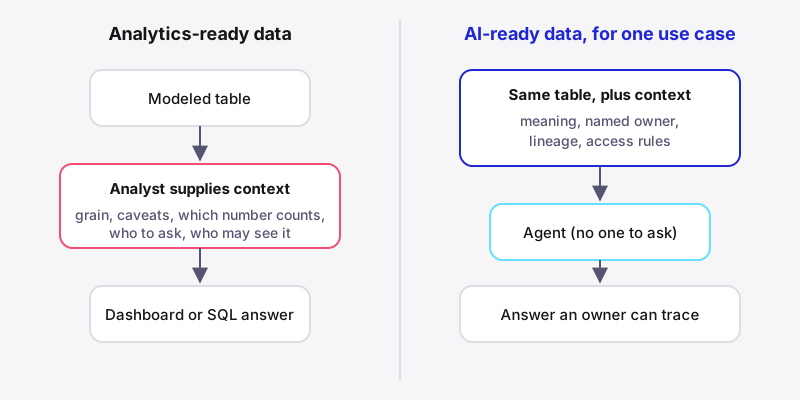
Analytics-ready data is modeled for an analyst who fills the gaps (what a row means and which revenue number counts); AI-ready data carries that context itself, for one named use case. In a LinkedIn study (2025), adding descriptions, example queries, and table clusters to bare schemas raised the share of text-to-SQL answers scored correct or close to correct from 9% to 48%. Atlan’s context layer records that meaning on each asset, with an owner, a certificate, and column-level lineage, and serves it to agents through Atlan MCP.
Data is AI-ready only for a named use case, when the agent receives the meaning, owner, lineage, and access rules with the rows. An analyst asks a colleague. An unattended agent uses the column as named. A context layer holds that knowledge once written down, so an AI-ready data program starts with one use case, not the whole estate.
| Dimension | Analytics-ready data | AI-ready data |
|---|---|---|
| Who supplies the missing context | The analyst, at query time | Metadata shipped with the data |
| Unit of readiness | A modeled domain or dataset | One named use case |
| Ownership | Recorded for some assets, rarely tied to a use case | Named owner who signs off for each use case |
| Lineage | Consulted when a number looks wrong | Used to trace an answer to source columns and avoid deprecated inputs |
| Access rules | Enforced for a named person at the tool or warehouse | Enforced for the user the agent answers for, not a shared service account |
| Key strength | Mature models; fast answers to known questions | Answers to new questions within a tested scope, with an owner accountable |
Why isn’t analytics-ready data automatically AI-ready?
The difference is who supplies the context the data does not carry: a person, for analytics, or the data itself, for AI. Forrester’s October 2026 report, AI Is Raising The Bar (Forrester, 2026), says it in one line: “Being analytics-ready does not mean being AI-ready.”
Atlan’s documentation defines AI-ready data (Atlan Documentation) as “data that an AI agent can use reliably without the contextual inference a human analyst supplies,” and calls BI-ready and AI-ready “parallel properties of the same underlying data, not a maturity progression.” The same docs add that closing the gap “doesn’t require rebuilding the data infrastructure that already works.”
According to a vendor-sponsored study by Precisely and Drexel LeBow (2026), in a 2025 survey of 505 data and analytics leaders, 88% report having the data readiness AI needs, yet 43% name data readiness as one of their biggest obstacles (2026 State of Data Integrity and AI Readiness).
Clean rows were never the hard part of what makes data AI-ready; the analyst’s business context for AI was. Gartner’s May 2026 release, Lack of Semantics Causes Inaccurate AI Agents (Gartner, 2026), advises leaders “to establish a context layer as a core component of their D&A infrastructure.”
What is analytics-ready data?
Analytics-ready data is cleaned, conformed, and modeled so people can answer known business questions through dashboards and SQL. It earns real trust through tested pipelines, certified dashboards, and a semantic layer that encodes metrics and approved joins. Mature teams with data contracts already record much of the meaning; what usually stays unwritten is fitness for a specific use case, owner sign-off, and rules for a non-human reader.
What the model leaves out, the analyst supplies. In Iceberg Sensemaking (IEEE TVCG), Charles Berret and Tamara Munzner describe an analyst who “absorbs the tacit schemas of both data and people.”
Core components of analytics-ready data
- Tested, conformed records
- A semantic model with approved joins and metrics
- Certified dashboards
- KPI definitions and a business glossary, where a team keeps them
- The analyst’s tribal knowledge: grain, caveats, who to ask
A person sat between the table and the decision, and that person is the part an agent does not get.
What is AI-ready data?
For one named use case, AI-ready data is data an agent can use because its meaning, owner, lineage, and access rules arrive with it. Gartner’s AI-Ready Data Essentials to Capture AI Value (Gartner), by Rita Sallam, Distinguished VP Analyst, is blunt: “There is no way to make data AI-ready in general or in advance. The readiness of data for AI depends on how the data will be used.”
McKinsey’s June 2026 analysis, AI data readiness: The key to scaling impact (McKinsey, 2026), describes the target as a “governed, traceable, and reusable foundation.” AI can draft much of what the analyst knew; treat each draft as unverified until its owner reads it against the use case it will serve.
Most of that work is reusable: a description or certified metric written for one agent serves the next. What repeats per use case is the table scope, the eval questions, the access mapping, and the owner’s sign-off.
Core components of AI-ready data
- Descriptions, glossary terms, stated grain
- A named, reachable owner
- Lineage for AI-ready data, from each answer back to source columns
- Access rules for the agent, often in data contracts for AI
- Fitness confirmed for a named use case, the core of trusted data for AI
For data that is already modeled, the rows barely change.
What context did the analyst carry that an agent cannot ask for?
The analyst carried knowledge that never made it into the schema, and an unattended agent has no way to ask for it.
On a typical orders_fact table, the analyst knows whether a row is an order or a line, which column finance means by net_revenue, and who to call when a number looks wrong.
Enterprise benchmarks show how hard the job gets once questions leave curated schemas. In the original Spider 2.0 paper (arXiv, 2024), a frontier code agent framework “successfully solves only 21.3% of the tasks, compared with 91.2% on Spider 1.0 and 73.0% on BIRD.” BEAVER (arXiv, 2026) puts agents on a frontier model at 10.8%. Missing meaning is one cause among several: Spider 2.0 databases often exceed 1,000 columns.
This knowledge lived in people, so institutional knowledge loss hurts, and it is a large part of why text-to-SQL breaks on enterprise data. A business context layer holds it instead.
AI-ready data vs analytics-ready data: head-to-head comparison
The two share clean, modeled data and differ in who fills the gaps. Scope can widen too, for example to unstructured data for AI.
| Dimension | Analytics-ready data | AI-ready data |
|---|---|---|
| Who fills gaps at query time | The analyst, from memory or a colleague | Nobody; context must already be on the asset |
| Primary consumer | People using dashboards and SQL | Agents and natural-language interfaces |
| Metric definitions | Encoded in BI or semantic models | Mapped to certified glossary terms the agent reads |
| How it is verified | The dashboard renders and KPIs match | The agent answers the use case’s test questions correctly |
| Failure mode | A wrong number many people see and question | A wrong answer one person sees, once |
An illustrative example: the analyst knows order_amount in orders_fact includes one-time services and test accounts. Asked for subscription revenue, an agent with only the schema writes the first query. With a certified “subscription revenue” definition on the asset, it retrieves that at question time and writes the second.
-- Schema only
SELECT SUM(order_amount) FROM orders_fact;

-- With the certified definition retrieved
SELECT SUM(order_amount)
FROM orders_fact
WHERE revenue_type = 'subscription'
  AND is_test_account = FALSE;
A definition the agent applies beats a caveat it might skip. The owner adds the question to the eval set, so a change that drops the filter fails the test. A semantic layer for AI agents and data quality for AI cover part of that. The step from a data catalog to a context layer is whether that recorded meaning reaches the agent when the question arrives.
What does adding context do to AI answer accuracy?
In three studies, adding what an analyst would know raised scores, by very different amounts.
| Study (year) | Baseline | With added information | What it measured |
|---|---|---|---|
| LinkedIn, internal warehouse (2025) | 9% (schemas only) | 48% (full knowledge-graph context) | Answers correct or close to correct |
| Atlan AI Labs, 174 queries (2026) | 16.1% | 22.2% (glossary, SQL usage patterns, domain hints) | Benchmark accuracy, not a customer result |
| BEAVER, agents on a frontier model (2026) | 10.8% | 30.1% (oracle subtask hints, not metadata) | Accuracy on enterprise warehouse queries |
LinkedIn’s Text-to-SQL for Enterprise Data Analytics (arXiv, 2025) traces most of the gain to example queries, table clustering, and table and column descriptions. In Atlan’s own benchmark of 174 queries, accuracy rose from 16.1% to 22.2% when governed metadata was added, a 38% relative lift. That is a 6.1-point absolute gain on a 13-table Formula One dataset, and accuracy still topped out at 22.2%.
Two cautions. The LinkedIn paper also reports that “adding domain knowledge decreases the percentage of answers scoring 4+,” so the target is the context a question needs. And according to UIUC researchers in Text-to-SQL Benchmarks are Broken (CIDR, 2026), annotation errors affect 52.8% of BIRD Mini-Dev problems and 66.1% of the Spider 2.0-Snow problems they inspected. Read every public number as a result under that study’s own conditions. Context closes part of the gap; scoping, testing, and review close more, so your own AI agent evaluation on one scoped use case will say more than any public score.
What goes wrong when teams treat analytics-ready data as AI-ready?
The usual failure is a well-modeled table handed to an agent without the knowledge the analyst used to read it. Gartner put a number on the risk in February 2025. In Lack of AI-Ready Data Puts AI Projects at Risk (Gartner, 2025), a Q&A with Roxane Edjlali, Senior Director Analyst at Gartner, the firm wrote: “Gartner predicts that through 2026, organizations will abandon 60% of AI projects unsupported by AI-ready data.” The same release reports that in a Gartner survey of 1,203 data management leaders in July 2024, 63% of organizations either do not have or are unsure if they have the right data management practices for AI.
Four mistakes recur: certifying the estate once instead of per use case, handing the agent every table and description (more is not always better, per LinkedIn), leaving deprecated tables discoverable, and shipping with no named owner to resolve a wrong answer. They show up in why AI projects stall on data rather than models, and they are why an AI readiness assessment and AI-ready data from day zero both begin with the use case.
How do you test whether data is AI-ready for one use case?
Name the use case first, check the data against what that one agent needs, and record who confirmed it. McKinsey’s advice in the same 2026 analysis is to “define what “good enough” means for each use case.”
| Check | Question to answer | Evidence it is met | Who signs off |
|---|---|---|---|
| Meaning | Are this agent’s columns described, grain stated? | Descriptions on columns in scope | Data steward |
| Definitions | Do metrics map to certified glossary terms? | Each metric links to one approved term | Data owner |
| Ownership | Is a named owner recorded and reachable? | Owner set and confirmed | Data owner |
| Lineage | Can each answer be traced to source? | Column-level lineage | Data engineer |
| Access | Do the agent’s permissions match the data’s rules? | Agent queries as the requesting user, or a scoped identity, under the same row and column policies | Governance lead |
| Evaluation | Does the agent answer real questions correctly? | Fixed eval set meets the owner’s pass bar; re-run on change | Owner and agent builder |
The AI-ready data checklist and the steps to prepare enterprise data for AI agents expand each check; sign-off follows who owns the context layer and your owners and stewards for AI-ready data. The AI-ready question score skill scores one business question and returns the gap blocking it.
Two rows need numbers before launch. Description coverage means every column the eval set touches. The eval set is real questions with owner-written answers, scored on result match against a pass bar set by the use case’s risk, and re-run when the schema, model, prompt, or a definition changes.
Readiness is a dated record of who checked what, for which use case, and which change reopens it.
How Atlan approaches AI-ready data
In Atlan, readiness is context attached to each asset and checked per use case. The meaning analysts carried gets recorded on the asset itself:
- Context Agents (Atlan Documentation) draft descriptions from column names, lineage, query history, glossary terms, and linked knowledge files, without overwriting values people have written.
- People set certificates (Atlan Documentation) such as Verified or Deprecated, and asset owners (Atlan Documentation) are the primary contact for questions about frequency, status, updates, and quality.
- Atlan captures column-level lineage (Atlan Documentation) automatically across warehouses, pipelines, and BI tools.
- Atlan MCP (Atlan Documentation) is “a hosted server, available on every Atlan tenant with nothing to install,” and “every action respects the permissions you’ve already set in Atlan.” Those permissions cover context in Atlan; warehouse policies still decide what a query returns, so run the agent as the requesting user, not a shared service account.
Analysts and agents share the same tables; context engineering shapes what an AI agent harness reads through Atlan MCP.
Real stories from real customers: Shared language for AI
"Atlan captures Workday's shared language to be leveraged by AI via its MCP server. As part of Atlan's AI labs, we're co-building the semantic layer that AI needs."
Joe DosSantos, VP, Enterprise Data and Analytics, Workday

The analyst was the context all along
Analytics-ready data worked because, for most questions, an analyst stood between the table and the answer. An unattended agent removes that person. AI readiness writes that knowledge down, one named use case at a time, and keeps every model already built. Each use case adds its own layer: talk-to-data, SAP and ERP data, extending a catalog, and delivery over MCP. The next decision is which use case to test first, and which of the best AI-ready data platforms records what that test needs.
FAQs about AI-ready data vs analytics-ready data
1. What is the difference between AI-ready and analytics-ready data?
Analytics-ready data relies on an analyst to supply missing context at query time. AI-ready data carries that context with it, as definitions, an owner, lineage, and access rules, for one named use case.
2. Is BI-ready data AI-ready?
BI-ready data is a strong starting point. A table becomes AI-ready for a use case once its meaning, owner, lineage, and access rules are recorded where the agent can read them.
3. Can the same dataset be AI-ready for one agent and not another?
Yes. Readiness depends on use: a table with clear revenue definitions may serve a finance agent while a compliance agent still needs lineage and access-policy context.
4. Does a semantic layer make data AI-ready?
A semantic layer covers much of it by encoding metrics and approved joins. Ownership, access policy, lineage, and a tested fit per use case still need recording.
5. Who decides whether data is AI-ready?
The data owner for the use case decides. Stewards maintain descriptions, engineers confirm lineage, and a governance lead checks the agent’s permissions.
6. How do you make data AI-ready?
Name one use case. Describe the columns that agent uses, map metrics to certified definitions, name an owner, confirm lineage and access, and test against real questions.
Sources
- AI Is Raising The Bar: Can Your Data Platform Keep Up?, Forrester
- AI-ready data, Atlan Documentation
- 2026 State of Data Integrity and AI Readiness, Precisely and Drexel LeBow
- Gartner Says Lack of Semantics Causes Inaccurate AI Agents and Wasted Spending, Gartner
- Iceberg Sensemaking: A Process Model for Critical Data Analysis, IEEE TVCG
- AI-Ready Data Essentials to Capture AI Value, Gartner
- AI data readiness: The key to scaling impact, McKinsey
- Spider 2.0: Evaluating Language Models on Real-World Enterprise Text-to-SQL Workflows, arXiv
- BEAVER: An Enterprise Benchmark for Text-to-SQL, arXiv
- Text-to-SQL for Enterprise Data Analytics, LinkedIn on arXiv
- Research Shows How Enhanced Metadata Delivers 38% Better AI Accuracy for Certain Queries, Atlan
- Text-to-SQL Benchmarks are Broken: An In-Depth Analysis of Annotation Errors, CIDR 2026
- Lack of AI-Ready Data Puts AI Projects at Risk, Gartner
- Understand context agents, Atlan Documentation
- Add certificates, Atlan Documentation
- Add owners, Atlan Documentation
- Column Level Lineage, Atlan Documentation
- Atlan MCP, Atlan Documentation

