


Atlan treats AI model governance as a governed-context problem: registering, versioning,
approving, monitoring, and retiring every model in one queryable system, not a document
trail. NIST’s AI RMF, MLflow-style registries, and Gartner’s 2026 Magic Quadrant for AI
Governance Platforms each name a piece of the same discipline. 40% of companies deploying AI models saw measurable performance degradation from drift within the first year, per McKinsey data cited via GAICC (2026), almost always in models nobody was still re-checking.

Most enterprise AI deployments run several models at once, governed the same way a single
pilot was governed two years ago: a spreadsheet, a Word doc, a launch-day checklist.
- Registration is manual and incomplete. Models get logged at launch, then drift out of anyone’s inventory as owners change teams.
- Model cards, if they exist, live in Word or SharePoint. The model card format was built to travel with the model, not sit unopened.
- Deprecation is rarely tracked. Retired models keep appearing in audits because no one closed the loop.
| Aspect | Details |
|---|---|
| What it is | Lifecycle discipline governing a model from registration through retirement |
| Key benefit | Cuts drift incidents (40% see degradation without it, McKinsey via GAICC, 2026) |
| Best for | Enterprises running 10+ production ML/LLM models |
| Implementation time | 4-8 weeks for registry rollout; monitoring is ongoing |
| Core components | Registration, versioning, approval, model cards, monitoring, deprecation |
| Regulatory anchors | NIST AI RMF, EU AI Act (Dec 2027), US SR 26-2 (Apr 2026) |
Why is AI model governance a lifecycle problem, not a one-time checkpoint?
Model governance fails when treated as a pre-launch gate instead of a continuous
discipline. A model approved once, with no re-check at each retrain, is not governed. It’s
approved. Without a lifecycle view, AI models shift from assets to liabilities across three
recurring failure modes.
Model bias and privacy risk
Errors creep into training data and outputs, driving unfair outcomes, which is why labeling and training-data practices matter as much as model architecture. Missing classification and ownership controls
compound the risk, since no one can trace which dataset produced which decision.
Opaque lineage and regulatory exposure
Per the May 2026 Digital Omnibus, the EU AI Act’s enforcement deadline moved to December 2, 2027. In the US, the Fed, FDIC,
and OCC replaced SR 11-7 on April 17, 2026 with a unified framework (SR 26-2), tiered by
materiality, the same shift reshaping AI risk management and AI agent risk and guardrails work.
Operational fragility at scale
Models embedded in critical operations introduce systemic risk the moment they’re flawed,
and that risk compounds as model count grows. Gartner’s first-ever Magic Quadrant for AI Governance Platforms values the category at $492 million in 2026, rising past $1 billion by 2030. That doesn’t
mean a fourth platform bolted onto the stack; the artifacts a governance platform tracks
need to live in the same governed context layer for AI every model already depends on.
These failure modes are symptoms of one root cause: governance artifacts that exist
somewhere, but nowhere the model’s runtime path can reach them.
What are the six stages of the AI model governance lifecycle?
Every AI model moves through six governance stages, registration, versioning, approval,
model cards, monitoring, and retirement, and treating any one as optional is where
governance programs break.
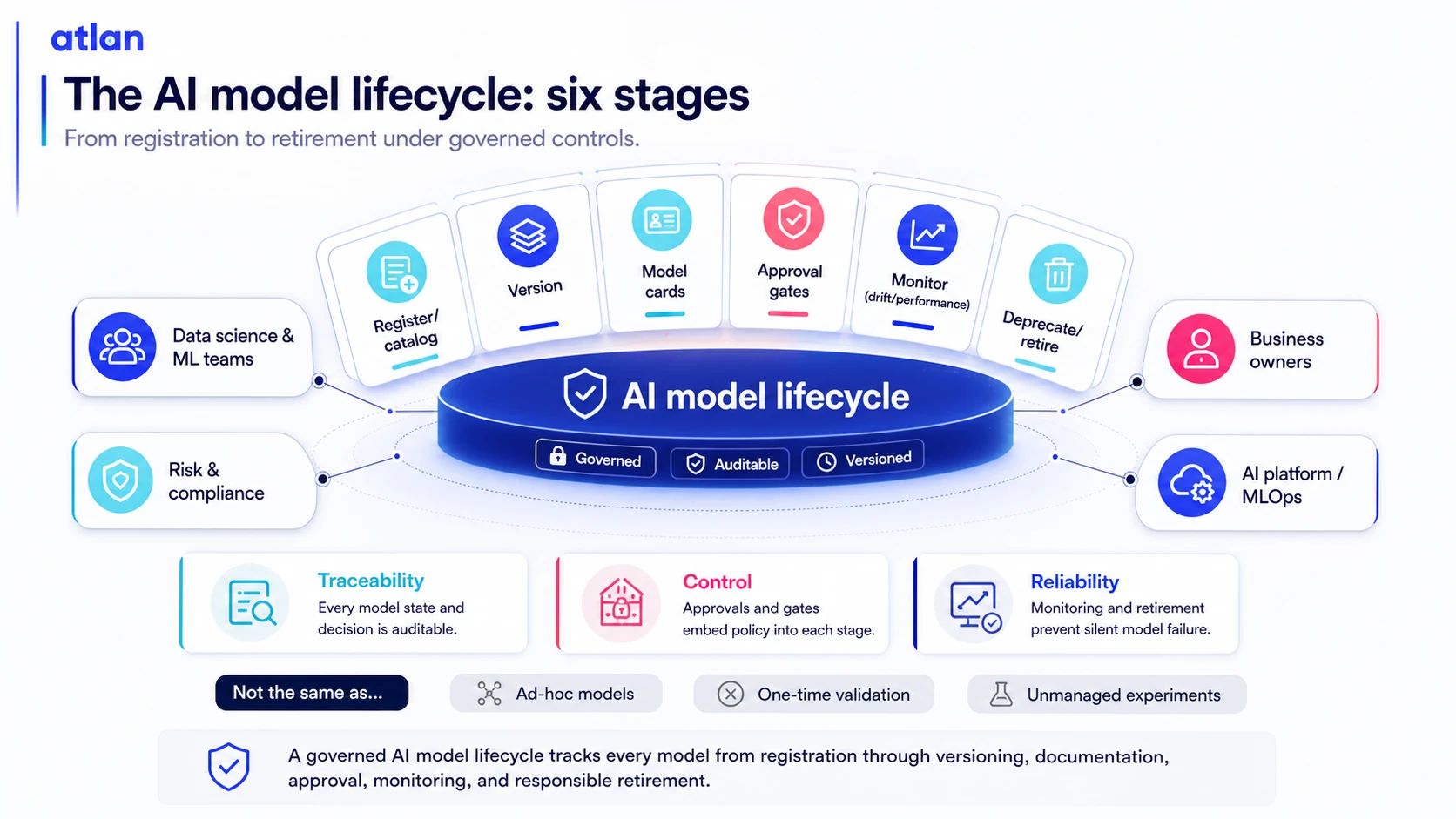
The AI model governance lifecycle: six stages from registration to retirement, under governed controls. Source: Atlan
1. Registration and cataloging
Every model needs one inventory entry: owner, purpose, risk tier, kept current as it
retrains, ideally auto-populated from the data infrastructure models run on into a data catalog built for AI, since manual logging is where inventories go stale.
2. Versioning
Versioning tracks which version, sometimes several concurrent A/B-tested ones, is live in
production, with metrics attached per version, not per model family. See AI Model Versioning Best Practices for the mechanics.
3. Pre-production approval gates
Before a model populates the catalog as production-ready, an intake package and risk
scores get reviewed by a governance council, enforcing the AI governance framework an organization has on paper.
4. Model cards
A model card defines a model’s intended use, training data, results, and limitations,
traced to Margaret Mitchell and colleagues’ “Model Cards for Model Reporting”. Cards are now the default artifact at the gate, yet frequently the biggest gap: teams have
the card but no system keeping it versioned alongside the model.
5. Continuous drift and performance monitoring
NIST’s AI RMF MEASURE function now calls for ongoing monitoring, not a single pre-launch benchmark, the same 40% drift
gap named above. The fix is wiring drift thresholds into the workflow so a breach opens a
review.
6. Deprecation and decommissioning
The thinnest-evidenced stage, and the one most programs skip: marking a model inactive and
closing its audit trail when retired, or “retired” models keep resurfacing in audits.
Model registry implementation gets its own depth elsewhere. These six stages are one arc, not six checklists: the moment
any stage’s artifact lives outside a queryable system, the chain of custody breaks.
Traditional vs. lifecycle-governed model management: what changes?
Traditional model governance treats documentation and monitoring as one-time, pre-launch
tasks. Lifecycle governance treats both as continuous, queryable state.
| Aspect | Traditional approach | Lifecycle-governed approach |
|---|---|---|
| Discovery | Manually logged at launch | Auto-discovered as models deploy |
| Documentation format | Word doc, written once | Model card, versioned alongside the model |
| Monitoring cadence | Pre-launch benchmark only | Continuous drift, bias, fairness checks |
| Approval trigger | One review before launch | Re-review at each version or retrain |
| Audit-trail completeness | Reconstructed from scattered files | Queryable in real time |
The traditional column isn’t a strawman; it’s the default state most enterprises are in,
the same one teams building AI Center of Excellence programs are trying to escape: not a tooling upgrade so much as a change in what “governed” means.
The CIO's Guide to Context Graphs
See how governed context graphs turn scattered model cards and approval records into one queryable system.
Get the CIO Context GuideHow does model governance differ from AI governance and agent governance?
Model governance, agent governance, and org-level AI governance are three distinct layers,
and conflating them is why programs stall on ownership questions. A fully governed model
can still power an agent that takes unauthorized actions, because agent governance covers a
different surface: what the agent can retrieve and do.
| Related page | What it covers | Read it for |
|---|---|---|
| AI Governance Operating Model | Org design, RACI, tiering | Who owns what |
| AI Agent Governance | Agent behavior, data layer | What an agent can retrieve and do |
| Model Registry Implementation Guide | Registry build-out mechanics | Building the registry |
| AI Model Versioning Best Practices | Versioning tooling | Deep versioning mechanics |
| AI Risk Management | Continuous risk practice | Risk scoring across your estate |
The same split shows up again once agents enter: decision traces and audit evidence, agent interoperability protocols, multi-agent orchestration, agent access control, and agent memory governance each govern a different layer. This page covers the model as a governed asset across its
full lifecycle.
What are the benefits of lifecycle-governed model management?
AI use cases need governance built into the lifecycle, not bolted onto the launch date.
Consider what’s already gone wrong without it:
- AI hiring tools are facing age-bias lawsuits, raising algorithmic fairness and HR compliance questions.
- A well-known magazine released fake, AI-generated content without human oversight.
- An AI-powered code editor deleted data from a production database, causing real operational disruption.
Lifecycle governance provides guardrails against exactly these pitfalls:
- Trust and transparency: Clear lineage and explainability make AI decisions defensible.
- Faster deployments: Governance built into the pipeline reduces failed launches and rework.
- Clear accountability: Every model has a named owner and a re-checkable approval history, the same ownership question that splits data and AI teams.
- Competitive edge: Scott Bridgen, General Manager of Risk and Audit at Diligent: “Rigorous AI governance is an absolute must for 2026,” citing data misuse, bias, and drift as non-hypothetical risks.
Each incident above traces to a lifecycle stage that broke down, not a one-time launch
mistake, which is why CDOs managing context at enterprise scale treat model governance as a standing operational practice.
How do you choose the right AI model governance approach?
The right approach depends on how many models you run, across how many platforms, and how
much regulatory exposure each carries. A five-person team running two internal models needs
a lighter process than a bank running 40 under SR 26-2, and both differ from teams building a centralized AI platform.
| Criterion | What to check |
|---|---|
| Model volume | Under 10: shared spreadsheet. 10+: auto-discovered registry |
| Platform diversity | Single-cloud needs less integration work than multi-cloud |
| Regulatory tier | Financial services, healthcare, HR models carry higher exposure |
| Existing tooling | Native MLflow or cloud registry changes what’s built vs. connected |
| Team maturity | No council yet? Build the approval gate first |
Before evaluating any tool, ask: Can models be auto-discovered rather than manually
logged? Does the system enforce approval gates, or just document them after the fact? Are
model cards versioned alongside the model? Analysts increasingly frame this as a context-graph problem, the same tension frontier labs face as model governance meets frontier-model-scale deployment: governance next to the artifact it governs beats a parallel system, the same pattern behind why enterprise teams are re-architecting around a context layer.
Where does your governance program actually stand?
See which of the six lifecycle stages above is your weakest link.
Assess Context MaturityReal stories from real customers: governing AI models at scale

Modernized data stack and launched new products faster while safeguarding sensitive data
"Austin Capital Bank has embraced Atlan as their Active Metadata Management solution to modernize their data stack and enhance data governance. Ian Bass, Head of Data & Analytics, highlighted, 'We needed a tool for data governance… an interface built on top of Snowflake to easily see who has access to what.' With Atlan, they launched new products with unprecedented speed while ensuring sensitive data is protected through advanced masking policies."

Ian Bass, Head of Data & Analytics
Austin Capital Bank
🎧 Listen to podcast: Austin Capital Bank From Data Chaos to Data Confidence

53% less engineering workload and 20% higher data-user satisfaction
"Kiwi.com has transformed its data governance by consolidating thousands of data assets into 58 discoverable data products using Atlan. 'Atlan reduced our central engineering workload by 53% and improved data user satisfaction by 20%,' Kiwi.com shared. Atlan's intuitive interface streamlines access to essential information like ownership, contracts, and data quality issues, driving efficient governance across teams."
Data Team
Kiwi.com
🎧 Listen to podcast: How Kiwi.com Unified Its Stack with Atlan
Austin Capital Bank and Kiwi.com prove the same pattern this page argues for: consolidating
scattered oversight into one system a team can actually run day to day. Other accounts are
living the six-stage version right now, model cards stuck in Word, registries that are “an
Excel version,” but aren’t yet cleared for named, public citation here.
Is your model estate governance-ready?
Self-assess against the same six lifecycle stages this page covers.
Check Governance ReadinessWhy the model lifecycle belongs in the context layer, not a spreadsheet
The gap in almost every model governance program isn’t a missing policy. It’s that the
model card, the version record, the drift alert, lives in a document or dashboard
disconnected from the runtime path where the model operates.
That disconnect shows up in how enterprise teams describe their own gaps: a model card
that sits in Word with no system tracking whether it’s current, a registry that’s
technically a spreadsheet, dataset-to-model traceability lost in SharePoint. The artifact
exists; the system of record behind it doesn’t, the same context-vacuum problem data teams describe beyond model governance.
Model lifecycle artifacts, the card, the version, the drift alert, are context objects.
They belong in the same governed Context Lakehouse every other AI asset lives in, alongside data lineage, so a drift alert triggers a review instead of sitting unwatched. Context Engineering Studio and MCP-based access make that record queryable by people,
and increasingly agents.
The outcome isn’t a fourth dashboard. When an auditor asks which version made a decision,
the answer is a query, not a reconstruction project, the same query an enterprise LLM knowledge base should answer for any AI asset, the starting point covered in how to implement an enterprise context layer for AI.
FAQs about AI model governance
1. What is AI model governance?
AI model governance is the lifecycle discipline of registering, versioning, approving,
monitoring, and retiring every AI model, treating each as a governed asset with a
continuous ownership record, not a one-time compliance checkpoint.
2. What is responsible and ethical AI?
Responsible and ethical AI ensures transparency, accountability, privacy, and reliability,
keeping bias out of training data and models, backed by guardrails that track performance.
3. What are some AI model governance frameworks?
Frameworks include the NIST AI Risk Management Framework, Microsoft’s Responsible AI
Framework, Meta’s Frontier AI Framework, and OpenAI’s agentic AI governance practices. In
banking, the Fed, FDIC, and OCC’s 2026 unified framework (SR 26-2) replaced SR 11-7.
4. What is a model card and do I need one?
A model card is a short document recording intended use, training data, results, and
limitations, originally defined by Margaret Mitchell and colleagues. Any production model
needs one, reviewed at each version.
5. How does model governance differ from agent governance?
Model governance manages the model as an asset: registration, versions, approvals. Agent
governance manages what an agent built on that model can do, which tools and data it can
access. A well-governed model can still power a poorly governed agent.
6. How does Atlan support the AI model lifecycle?
Atlan brings model cards, registry entries, versions, and drift alerts into the same
governed context graph every AI asset lives in, queryable instead of reconstructed at
audit time.
Sources
- GAICC, “AI Model Drift & Performance Risk: Detection & Governance Guide” (McKinsey survey data), 2026. https://gaicc.org/blog/ai-model-drift-performance-risk/
- Legalnodes, “EU AI Act 2026 Updates: Compliance Requirements and Business Risks,” 2026. https://www.legalnodes.com/article/eu-ai-act-2026-updates-compliance-requirements-and-business-risks
- Gartner, Magic Quadrant for AI Governance Platforms, 2026. https://www.gartner.com/en/documents/8006369
- ISPartners, “NIST AI RMF 2025-2026 Updates,” 2026. https://www.ispartnersllc.com/blog/nist-ai-rmf-2025-2026-updates-what-you-need-to-know-about-the-latest-framework-changes/
- Mitchell, M. et al., “Model Cards for Model Reporting,” arXiv:1810.03993. https://arxiv.org/abs/1810.03993
- Governance Intelligence, “How AI will redefine compliance, risk and governance in 2026,” 2026. https://www.governance-intelligence.com/regulatory-compliance/how-ai-will-redefine-compliance-risk-and-governance-2026
- Reuters, “Workday must face novel bias lawsuit over AI screening software,” 2024. https://www.reuters.com/legal/litigation/workday-must-face-novel-bias-lawsuit-over-ai-screening-software-2024-07-15
- Futurism, “Sports Illustrated Publisher Investigating Fake AI-Generated Writers,” 2025. https://futurism.com/sports-illustrated-ai-generated-writers
- Fortune, “AI coding tool wiped a company’s database, then lied about it,” 2025. https://fortune.com/2025/07/23/ai-coding-tool-replit-wiped-database-called-it-a-catastrophic-failure/
- MLQ.ai, State of AI in Business 2025 Report, 2025. https://mlq.ai/media/quarterly_decks/v0.1_State_of_AI_in_Business_2025_Report.pdf
