

Most teams treat knowledge graph construction for AI as a green-field modeling exercise: pick a graph database, hire an ontologist, start extracting triples from documents. That instinct produces months of work before anything is usable. Construction now takes 6 to 12 weeks for a single domain and 2 to 3 months enterprise-wide. Whatever the tooling, Neo4j, GraphRAG, or Atlan’s Context Lakehouse, the same wall shows up: extraction is cheap with today’s LLMs, but entity resolution and ontology alignment at scale are not. This guide walks through the five-stage sequence for reverse-constructing an Enterprise Data Graph from context an organization already has.
| Time to complete | 6 to 12 weeks (single domain) to 2 to 3 months (enterprise-wide) |
|---|---|
| Difficulty level | Advanced. Data engineering, semantic modeling |
| Prerequisites | Governed metadata access, schema ownership, entity resolution strategy, validation framework |
| Tools needed | A graph database (Neptune or equivalent), LLM-assisted extraction, SHACL validation |
| Step | What you’ll do | Time required |
|---|---|---|
| 1. Assess and scope | Inventory existing metadata sources and define the graph’s boundary | 1 to 2 weeks |
| 2. Design ontology and schema | Define entities, relationships, and domain vocabulary | 2 to 4 weeks |
| 3. Extract entities and relationships | Pull structured and unstructured sources into candidate nodes and edges | 1 to 3 weeks |
| 4. Resolve entities | De-duplicate, merge, and build a golden record | 2 to 4 weeks |
| 5. Validate and activate | Gate the graph with rules and human review before production use | 1 to 2 weeks |
Why build a knowledge graph for AI?
Terminology confusion between knowledge graph, ontology, semantic layer, and context layer stalls decisions before architecture starts; sorting out knowledge graph vs. graph database upfront removes that friction.
A graph supports multi-hop reasoning, tracing from a table through lineage to every dependent metric, because the answer lives in the structure of relationships. A widely cited 2023 survey found production-grade pipelines require provenance tracking and repair mechanisms as graphs scale, not just an extraction step (Construction of Knowledge Graphs: State and Challenges, arXiv, 2023). That governed-reuse case separates a project worth the investment from one duplicating work a semantic layer already does.
The ROI case isn’t universal, though: Jerry Liu, co-founder and CEO of LlamaIndex, has argued pure vector-based RAG is often good enough, weakening the case for heavy construction. Graphs earn their cost when a use case needs multi-hop reasoning or governed reuse across agents; readers evaluating knowledge graphs against RAG for AI should scope the investment to that narrower case. Projects that struggle treat construction as a parallel extraction exercise, disconnected from metadata the enterprise already governs, rather than reverse-constructing from that substrate.
What do you need before constructing a knowledge graph?
Construction here means reverse-reading an existing metadata estate, not modeling from a blank schema; prerequisites are about whether that substrate exists and is accessible, not new tooling.
| Prerequisite | Type | Why it matters |
|---|---|---|
| Governed metadata access | Technical | Reverse-construction needs a substrate |
| Executive sponsorship for schema ownership | Organizational | Needs cross-team authority |
| Entity resolution strategy defined upfront | Technical | One-time treatment is the top failure mode |
| Validation framework such as SHACL | Technical | Prevents ungoverned LLM output reaching production |
| Project lead at 20-40% FTE, domain experts on call | Team | Unowned effort is the pattern behind abandoned work |
Time breaks down as 1 to 2 weeks planning, 4 to 9 weeks implementation, 1 to 2 weeks validation. Compare your state against AI readiness for knowledge graphs first.
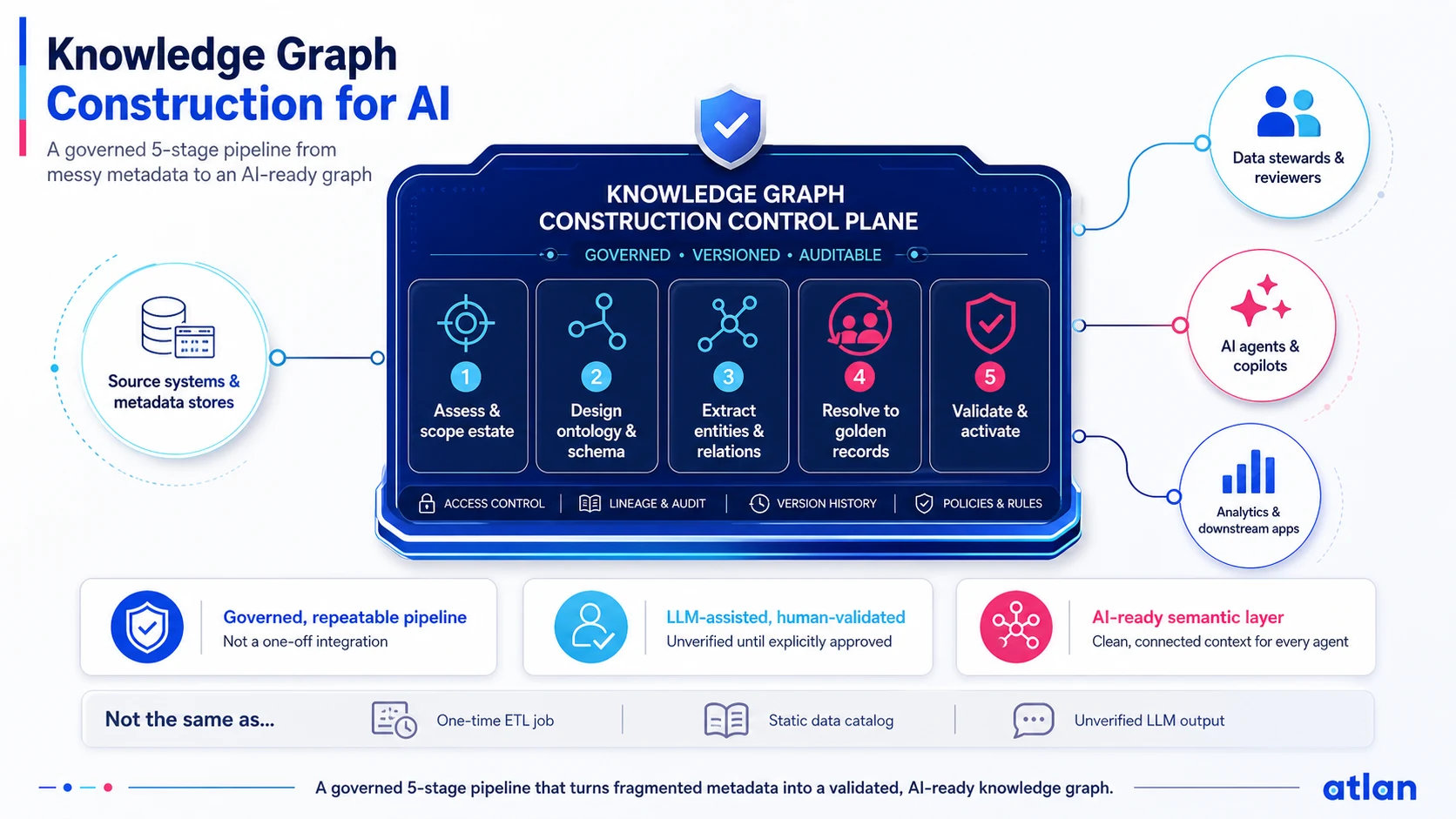
A governed 5-stage knowledge graph construction pipeline. Source: Atlan.
Step 1: Assess your metadata estate and scope the graph
What you’ll accomplish: Map structured sources (warehouses, BI, business systems) and unstructured sources (docs, wikis) against a bounded first domain.
Time required: 1 to 2 weeks
How to do it:
- Inventory metadata sources and access, the substrate described in metadata and the knowledge graph.
- Pick one bounded domain. Use-case-first modeling is the top fix for over-modeling.
- Identify who owns schema decisions before extraction starts.
Treat the domain boundary as a context graph scoping exercise, not an afterthought; modeling the entire enterprise before loading data almost always backfires (see Pitfall 1 below).
The AI Context Stack
A practical brief on the context infrastructure layer beneath agents, guardrails, and model councils, including the graph construction work this guide walks through.
Get the BriefStep 2: Design your ontology and schema
What you’ll accomplish: Define the vocabulary layer, the entity and relationship model, and the boundary between an entity and a property, a judgment call for any business term that could be modeled either way.
Time required: 2 to 4 weeks
How to do it:
- Draft a working ontology for the scoped domain, not an exhaustive one.
- Resolve entity-versus-property ambiguity with domain experts, not engineering alone; this is the ontology work that makes the graph mean something.
- Reference standards such as RDF and OWL selectively, not as a mandatory authoring project.
Common mistakes: authoring a full RDF/OWL ontology before touching real data rarely survives contact with production sources; model iteratively instead. Teams conflating this with a semantic layer or confusing ontology and knowledge graph construction end up re-litigating vocabulary mid-build.
Step 3: Extract entities and relationships from structured and unstructured sources
What you’ll accomplish: Turn warehouse tables, BI definitions, and unstructured docs into candidate nodes and edges using LLM-assisted extraction, treating all output as unverified until validation in Step 5.
Time required: 1 to 3 weeks
The tools below solve the same problem: turning unstructured text into candidate graph structure when no governed source exists. Where one already exists, reverse-construction skips a parallel pipeline entirely.
| Approach | Best for | Known limitation |
|---|---|---|
| Neo4j LLM Graph Builder | PDFs and web pages into property graphs | Needs prompt-tuning |
| LangChain LLMGraphTransformer | Document-to-graph, flexible schemas | Hallucination risk |
| LlamaIndex PropertyGraphIndex | Schema-guided, multi-modal construction | Needs upfront schema |
| Microsoft GraphRAG | Community detection at scale | Complex indexing |
| Reverse-construction from governed metadata | Existing catalog and lineage | Source must exist |
Every approach shares the same limitation: LLMs infer plausible-sounding but false relationships unconstrained, why combining knowledge graphs with LLMs still requires a downstream validation layer. Go deeper on knowledge graph tools or what GraphRAG actually does at query versus construction time. Treat all output as candidate only, gated by the validation step ahead.
Step 4: Resolve duplicate entities and build a golden record
What you’ll accomplish: De-duplicate candidate entities from Step 3 into a golden record per entity, the step practitioners call soul-crushing and most likely under-resourced.
Time required: 2 to 4 weeks
How to do it:
- Define merge rules per entity type, covering name, ID, and address variants.
- Build a golden-record strategy, not ad hoc de-duplication done once and forgotten.
- Treat resolution as an ongoing capability, not a one-time ETL step.
Rahul Pandey, an engineering leader with Meta experience, notes verification layers catching errors before they reach users are a core struggle teams face (The Current State of AI, LinkedIn Pulse). A resolved entity becomes the canonical node a knowledge graph built for agent runtime queries can rely on.
Context Gap Calculator
Score how much of your metadata estate is ready to serve as the substrate for a constructed knowledge graph, before committing a team to a multi-week build.
Run the CalculatorStep 5: Validate and activate the graph before production use
What you’ll accomplish: Apply a validation layer such as SHACL and route high-impact edges through human review before the graph goes live, the gate every extraction pipeline needs and the one most under-adopted.
Time required: 1 to 2 weeks
How to do it:
- Apply schema-conformance validation, SHACL or an equivalent, to catch errors before they compound.
- Route high-impact or low-confidence edges to human reviewers, not just spot-checks.
- Log provenance per relationship so errors trace back to source.
DeepLearning.AI’s course on agentic knowledge graph construction treats extraction as requiring structured validation by design, not blind trust in the model’s output (Agentic Knowledge Graph Construction, DeepLearning.AI). Once a graph clears this gate, a downstream system can query it with confidence, the boundary between construction and consumption through protocols like Model Context Protocol; how MCP delivers business context is a separate concern from construction (skipping this gate is Pitfall 3 below).
What goes wrong in knowledge graph construction?
Pitfall 1: Over-modeling the entire enterprise before loading any data
Why it happens: Teams design a complete ontology upfront, then find it doesn’t survive contact with real sources.
How to avoid it: Scope to one domain, model iteratively, and expand only after validation.
Pitfall 2: Treating entity resolution as a one-time ETL step
Why it happens: Resolution gets budgeted as a load-time task instead of an ongoing capability.
How to avoid it: Build resolution as a recurring, scheduled process with owned merge rules.
Pitfall 3: Skipping the validation gate
Why it happens: LLM extraction output looks plausible, so teams skip structural validation.
How to avoid it: Apply SHACL-equivalent validation and human review to every batch, not a sample.
Pitfall 4: Letting one-off extraction jobs go stale
Why it happens: Construction gets treated as a project with an end date, so schema drift accumulates.
How to avoid it: Schedule continuous population and monitor for drift, not a single load.
A 19-practitioner interview study names poor data quality, schema inconsistencies, and a lack of standardization as the same recurring failure modes (Knowledge Graphs in Practice, arXiv). Context graph vs. knowledge graph and context graph vs. ontology cover the terminology confusion that precedes this pattern.
Best practices for knowledge graph construction
- Model use-case-first, not enterprise-first. The single most repeated fix for avoiding the ontology-abandonment pattern.
- Adopt SHACL-equivalent validation from day one. Practitioners who do report materially lower data-quality issues.
- Treat entity resolution as a platform capability, not a project phase. A one-time effort decays the moment a new source system gets added.
- Log provenance on every extracted relationship, the discipline that separates production-grade pipelines from prototypes.
- Invest in the schema and ontology layer specifically. Well-modeled semantic layers reach 98.2% accuracy with Claude Sonnet 4.6 versus 90% for raw Text-to-SQL, per dbt Labs’ own 2026 benchmark of its own Semantic Layer (Semantic Layer vs. Text-to-SQL, dbt Labs, April 2026), evidence that modeling quality, not extraction volume, is what construction buys a team.
Teams that treat these as sequential checkpoints, not a checklist to revisit later, are the ones whose graphs are still queried a year on instead of quietly abandoned.
How does Atlan approach knowledge graph construction?
Heterogeneous-source curation, pulling meaning from CRM records, spreadsheets, and usage metrics, stays manual without lineage and catalog understanding underneath it; some enterprises abandon the effort outright.
Atlan continuously reads across existing systems, warehouses, pipelines, BI tools, business apps, and docs, and reverse-constructs a unified graph from context that already exists, stored in the Context Lakehouse (a knowledge graph combined with Iceberg-native storage and vector-native search). Context Agents mine that material: Orion, the Ontologist, maps what terms mean in context and models domain relationships, while other Context Agents resolve competing definitions and classify assets automatically.
The Context Engineering Studio’s build, test, review, approve, deploy, and learn lifecycle wraps human review around what the agents mine, the same governance shape a model council applies to models.
Real stories from real customers: knowledge graphs powering enterprise AI
"We're excited to build the future of AI governance with Atlan. All of the work that we did to get to a shared language at Workday can be leveraged by AI via Atlan's MCP server...we're co-building the semantic layer that AI needs with new constructs, like context products."
— Joe DosSantos, VP of Enterprise Data & Analytics, Workday

"Atlan is much more than a catalog of catalogs. It's more of a context operating system…Atlan enabled us to easily activate metadata for everything from discovery in the marketplace to AI governance to data quality to an MCP server delivering context to AI models."
— Sridher Arumugham, Chief Data & Analytics Officer, DigiKey

AI Agent Context Readiness Checklist
A practical checklist for confirming a knowledge graph, and the metadata feeding it, is actually ready for an agent to query in production.
Get the ChecklistThe construction sequence is what the rest of your AI stack stands on
A knowledge graph is only as trustworthy as the sequence used to build it: bounded scope before extraction, entity resolution before it’s an afterthought, a validation gate before anything depends on it, continuous population after launch. Skip any of those and every agent or guardrail querying the graph inherits its unresolved duplicates silently.
Success is measured by continuous population and resolution accuracy, not a one-time completeness score; expect refinement to continue for months. What an agent does with a certified graph at query time is covered in how to build a knowledge graph for AI agents. Gartner connects context graphs to broader enterprise context layer adoption, at the implementation and readiness level.
FAQs about knowledge graph construction for AI
1. How long does knowledge graph construction take for an enterprise AI project?
A single, bounded domain typically takes 6 to 12 weeks from metadata inventory to a validated graph. Enterprise-wide ontology work takes 2 to 3 months. Teams that skip prerequisites tend to run longer, not shorter.
2. Do I need a data engineering team to build a knowledge graph for AI?
Yes, at minimum a data or ML engineer for extraction and a domain expert for entity-versus-property decisions. Ontology design needs business knowledge, not just engineering.
3. Can large language models build a knowledge graph on their own?
LLMs can extract candidate entities and relationships cheaply, but infer plausible-sounding, false relationships when left unconstrained. Treat output as candidate only, gated by SHACL validation and human review.
4. What is entity resolution, and why is it hard?
Entity resolution merges duplicate nodes representing the same entity under different names, IDs, or address variants into one golden record. Practitioners call it the soul-crushing part because it needs business-specific merge rules.
5. What happens if I skip the validation step?
Ungoverned LLM-extracted relationships reach production, and any agent or control-plane tool querying the graph inherits those errors silently. Teams adopting SHACL-equivalent validation report lower downstream data-quality issues.
6. Is a knowledge graph different from a knowledge base?
Yes. A knowledge graph models entities and relationships as a graph of nodes and edges, enabling multi-hop reasoning, while a knowledge base is a flatter document or fact store without relationship modeling.
Sources
- Construction of Knowledge Graphs: State and Challenges, arXiv: https://arxiv.org/pdf/2302.11509.pdf
- Knowledge Graphs in Practice: Characterizing their Users, Challenges, and Visualization Opportunities, arXiv: https://arxiv.org/html/2304.01311v4
- Microsoft GraphRAG, official project documentation: https://microsoft.github.io/graphrag/
- Neo4j LLM Knowledge Graph Builder, official labs page: https://neo4j.com/labs/genai-ecosystem/llm-graph-builder/
- Building a Knowledge Graph in Amazon Neptune Using Amazon Comprehend Events, AWS: https://aws.amazon.com/blogs/database/building-a-knowledge-graph-in-amazon-neptune-using-amazon-comprehend-events/
- Agentic Knowledge Graph Construction, DeepLearning.AI: https://www.deeplearning.ai/courses/agentic-knowledge-graph-construction
- GitHub: run-llama/llama_index: https://github.com/run-llama/llama_index
- GitHub: langchain-ai/langchain: https://github.com/langchain-ai/langchain
- GitHub: getzep/graphiti: https://github.com/getzep/graphiti
- The Current State of AI: Real Pain Points Teams Are Facing, Rahul Pandey, LinkedIn Pulse: https://www.linkedin.com/pulse/current-state-ai-real-pain-points-teams-facing-rahul-pandey-4snwe
- Semantic Layer vs. Text-to-SQL 2026 Benchmark, dbt Labs (a vendor’s own test of its own Semantic Layer): https://docs.getdbt.com/blog/semantic-layer-vs-text-to-sql-2026
- W3C RDF: https://www.w3.org/RDF/
