

Microsoft Fabric governance is how a Fabric tenant organizes, discovers, protects, and monitors its data, with the OneLake catalog as the foundation. On November 12, 2026, Microsoft announced that Fabric is now its data governance solution and that Purview Data Governance will be retired. Support ends November 12, 2027. Microsoft Purview stays focused on security and compliance. In its November 17, 2026 post, Microsoft announced a strategic partnership with Atlan and calls Atlan its preferred data governance partner. The retirement guide covers the dates and decisions in more depth.
Fabric now carries more of the governance load. The OneLake catalog gives every Fabric user a searchable view of the workspaces, lakehouses, and reports they can access, and is where domains, endorsement, and policies are managed.
Purview supplies the protection layer on top: sensitivity labels and Data Loss Prevention (DLP), which detect sensitive data and act on it. Microsoft says governance is included in Fabric capacity. Some Purview capabilities need separate Purview licensing, per Microsoft Learn.
Microsoft says “some organizations have needs that reach beyond what’s in Fabric today.” Three needs come up:
- Lineage that continues past Fabric into a non-Microsoft warehouse or BI tool
- One catalog and glossary for Databricks, Snowflake, BigQuery, and object storage, next to Fabric
- Governance workflows that people outside the data team keep using after launch
| What it is | Key benefit | Best for | Works alongside | Core components |
|---|---|---|---|---|
| Fabric governance (OneLake catalog) | Included in Fabric capacity; Microsoft’s governance solution | Estates standardized on Fabric | Purview security and compliance | Explore, Govern, Secure tabs; domains; endorsement; Purview security and compliance |
| AI Context Platform (Atlan) | Lineage and ownership carry across platform handoffs | Estates running Fabric plus Databricks, Snowflake, or other systems | Fabric, OneLake, Purview security | Catalog, column-level lineage, glossary, context for AI agents |
What is Microsoft Fabric governance?
Microsoft Fabric governance covers ownership, discovery, protection, and monitoring for a Fabric tenant. Since the November 12, 2026 announcement, the OneLake catalog is “the single foundation for governing data across your entire estate.”
What Fabric governance covers
Microsoft Learn groups the capabilities into five outcomes.
- Manage: the tenant, domain, and workspace hierarchy that decides who administers what.
- Encourage trusted discovery: the OneLake catalog, endorsement, tags, and lineage.
- Protect and comply: sensitivity labels and DLP from Purview, plus workspace roles and item-level security.
- Understand governance health: the Govern tab’s insights and recommended actions.
- Monitor: the monitoring hub and capacity metrics.
OneLake catalog and Purview at a glance
The OneLake catalog is the day-to-day experience: search, filters, governance health, and security roles for items the viewer can access. The OneLake catalog guide goes deeper. Microsoft describes the split as “drawing a clearer line between protecting data and governing it.”
How Microsoft Fabric governance works, from tenant to workspace
Fabric’s governance hierarchy runs from tenant settings down through domains to workspaces. Microsoft documents the setup well.
Administration in the Govern tab
Administration is moving into the OneLake catalog’s Govern tab: tenant configuration, workspace and capacity management, domains, and policies.
Domains group related workspaces under one owner. A business unit or region can then configure its delegated settings itself. Workspace roles control who can view, edit, or administer a workspace.
Where setup documentation lives
Microsoft’s governance and compliance overview covers domains, tenant settings, and workspace roles step by step. The Power BI data catalog setup guide walks through the semantic-model side. Power BI governance at enterprise scale covers what changes with many workspaces.
OneLake catalog vs Purview after the retirement
Before November 2026, the usual comparison was the OneLake catalog against Purview’s Unified Catalog. That comparison now has an end date.
What Microsoft announced
Per Microsoft’s November 12, 2026 announcement, the OneLake catalog is now Microsoft’s data governance solution. Purview Data Governance will be retired, and support ends November 12, 2027. In its November 17, 2026 post, Microsoft calls the OneLake catalog “a new model, not a feature-for-feature replacement for Purview Data Governance.”
Microsoft Learn adds detail. Unified Catalog and classic Purview data governance capabilities are being retired. New accounts can no longer be created. Existing capabilities stay in maintenance mode through that date.
What stays in Purview
Purview stays focused on security and compliance. Per Microsoft’s November 17 post, Purview Data Security and Compliance, including Information Protection, Data Loss Prevention, Insider Risk Management, and Data Security Posture Management, is “not affected and continue to protect your data in Fabric.”
Microsoft says the OneLake catalog governs data in or connected to OneLake through native items, federated catalogs, IQ Shares, Shortcuts, and Mirrored databases.
The comparison
| Dimension | OneLake catalog (governance) | Microsoft Purview (security and compliance) | AI Context Platform (Atlan) |
|---|---|---|---|
| Role after the retirement | Microsoft’s data governance solution | Security and compliance, not affected by the retirement | Context and lineage across Fabric and non-Microsoft systems |
| Scope | Data in or connected to OneLake: native items, federated catalogs, IQ Shares, Shortcuts, Mirrored databases | Information Protection, DLP, Insider Risk Management, DSPM | Fabric plus more than 100 sources in one graph |
| Where it shows up | Fabric, Teams, Excel, Copilot Studio | Sensitivity labels on Fabric items; DLP detections and alerts | Fabric, Teams, and Copilot Studio, via Atlan context |
| Access model | Workspace roles and OneLake security roles | Label and policy based | Metadata-only, read-only connector |
| Cost model | Included in Fabric capacity, per Microsoft | Purview licensing for labels and DLP | Atlan subscription |
When a third column helps
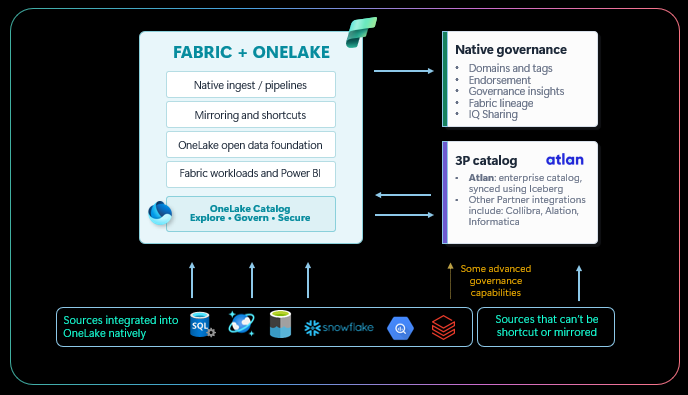
OneLake catalog governance, extended by a third-party catalog like Atlan. Source: Microsoft
For a Microsoft-standardized estate, the OneLake catalog plus Purview security is a complete Microsoft answer. Estates that also run Databricks, Snowflake, or file shares add a third column. So do teams that want agents to query context across all of it.
The coexist, extend or replace guide walks through the choice. Data catalog vs context layer explains why cataloging and carrying context are different jobs.
What the shift means for Purview Data Governance users
Microsoft says customers with contractual obligations or in highly regulated industries should engage their Microsoft account team early.
The migration plan covers sequencing. Purview alternatives compares the options. Microsoft data governance tools puts the Microsoft pieces side by side.
Where teams add a layer beyond Fabric governance
The four needs below are where estates typically add something.
Lineage across the Fabric and non-Microsoft boundary
Fabric lineage shows how items in a workspace relate. It also shows what an edit would affect downstream. For example, an estate that lands data in Snowflake or Databricks needs the trace to continue past Fabric’s edge.
Atlan’s Fabric connector catalogs workspaces, lakehouses, warehouses, semantic models, reports, dashboards, dataflows, and data pipelines down to column level, with lineage from source systems to reports. See AI-ready data lineage for the broader pattern. Power BI’s semantic model covers the report side.
One catalog beside Fabric
Microsoft’s OneLake catalog reaches connected sources through federated catalogs, Shortcuts, and Mirrored databases. Some teams want one catalog that sits across every platform. They run context layer for Databricks or context layer for Snowflake workloads and want the same glossary and owners everywhere.
Adoption and stewardship
Configuring a catalog and keeping glossary terms current are separate projects. Teams create Fabric workspaces faster than anyone assigns ownership. A steward workflow that ties owners and terms to assets across systems helps. Context layer ownership between data and AI teams covers who runs it.
AI agents that need context across sources
An agent answering a business question follows the data wherever it lives. Atlan’s context reaches people in Microsoft Teams and agents in Copilot Studio. See why AI agents need an enterprise context layer. Purview controls for AI agents covers the security side that stays with Purview.
When do you need more than the OneLake catalog?
Three signals usually mean an estate has outgrown Fabric governance on its own.
Your estate includes Databricks, Snowflake, BigQuery, Redshift, or object storage such as Amazon S3 that need the same catalog, glossary, and lineage as Fabric. This is the clearest trigger.
AI agents or Copilot need context across Fabric and non-Fabric sources. AI agent governance depends on that context reaching every source an agent touches.
You are migrating off Purview Data Governance and want to keep glossary terms, owners, and lineage. Microsoft’s Learn and REST APIs let you export glossaries, domains, data products, and classifications. Choose a landing spot for each, check that owners and lineage survive the move, and rerun the export until the counts match, then cut over. In its November 17, 2026 post, Microsoft says Atlan supports customers transitioning from Purview Data Governance to Fabric with tooling to carry their existing metadata forward.
Once any signal is present, weigh the context layer ROI against the cost of the gaps. An estate that is Fabric end to end may reasonably stop at the OneLake catalog.
What an AI Context Platform adds to a Fabric estate
An AI Context Platform catalogs metadata across Fabric and everything outside it. It carries lineage across handoffs and keeps owners and glossary terms attached as an asset moves.
Example: Fabric plus Snowflake
Take a table that sits in a Fabric lakehouse and a Snowflake warehouse. You get one catalog entry for it. Lineage continues from an external source through Fabric into a semantic model and a report. Glossary terms stay attached across systems.
How it fits beside Fabric
It sits alongside Fabric. The OneLake catalog stays Microsoft’s governance experience inside Fabric, and Purview keeps security and compliance. Atlan’s connector is read-only and metadata-only. See context graphs for AI agents and metadata layer for AI for the mechanics. Regulated teams can start with context layer for financial services.
How do you evaluate a governance layer for a Fabric-first estate?
Focus on what a layer does outside Fabric, and how deep its Fabric lineage goes under which configuration. Atlan’s documentation spells out the main setting.
Scanner API settings
| Scanner API setting | Lineage depth | Notes |
|---|---|---|
| Enabled | External sources to semantic models, with column-level and upstream SQL lineage | Uses the Power BI Admin Scanner APIs |
| Disabled | Adds report pages, visuals, and table-level lineage for pipeline Copy Activities | Uses both admin and non-admin APIs |
Per Atlan’s lineage reference, Dataflow Gen2 (CI/CD) items need the Contributor role on their workspace in both modes. With that role, Atlan reads their columns and lineage. Ask every vendor for the same written detail.
Criteria to check
| Criterion | Why it matters | What to ask or check |
|---|---|---|
| Lineage beyond Fabric | Most gaps show up at platform handoffs | Does lineage trace into Databricks, Snowflake, or your warehouse of record? |
| Coverage of non-Microsoft systems | Governance has to follow the estate | Which non-Microsoft platforms does the tool catalog natively today? |
| Security and access model | Metadata-only access limits blast radius | Does it use an Entra ID service principal, or a self-deployed runtime that keeps credentials in your network? |
| Read-only or write-back | A tool should say exactly what it changes | What does the connector change in Fabric permissions? |
| Purview transition path | Purview Data Governance support ends Nov 12, 2027 | How does the vendor carry glossary terms, owners, and lineage, and show what landed? |
| Cost overlap | Governance is included in Fabric capacity | Which capabilities does the layer add beyond what Fabric includes? |
The Fabric governance evaluation questions page turns these into a 20-question checklist with a scorecard.
How Atlan approaches Microsoft Fabric governance
Atlan connects to more than 100 sources. Fabric sits in the same graph as the rest of the estate.
Fabric connector
The Fabric connector is generally available. It catalogs workspaces, lakehouses, warehouses, semantic models, reports, dashboards, dataflows, and data pipelines down to column level, with lineage from source systems to reports. The September 29, 2026 press release has the announcement.
Context Lakehouse and Microsoft surfaces
Atlan’s Context Lakehouse stores context as open Apache Iceberg tables in OneLake that Fabric can query directly. That context reaches people in Microsoft Teams and agents in Copilot Studio. Atlan is available in Microsoft Marketplace. Microsoft’s November 17 post describes Atlan as providing cross-estate lineage and usage and popularity stats across non-Microsoft sources. See the Microsoft and Atlan OneLake page.
Access model and the move off Purview
Authentication runs through an Entra ID service principal. A self-deployed runtime keeps credentials in the customer’s secret store. The connector reads structural and governance metadata through Fabric’s APIs, and business data stays in Fabric.
For teams moving off Purview Data Governance, the Atlan and Purview page covers the path.
What to do now
Pick the path that matches your estate.
- Fabric-first: start in the OneLake catalog’s Govern tab and keep Purview for labels and DLP.
- Spans platforms: map which sources and teams sit outside Fabric. Test lineage depth on your own data before you choose a layer.
- Running Purview Data Governance: plan the move before November 12, 2027. Talk to your Microsoft account team early if you have contractual or regulatory obligations.
Next, read the retirement guide and the evaluation questions.
FAQs about Microsoft Fabric governance
1. What is Microsoft Fabric governance?
Microsoft Fabric governance is the set of capabilities that organize ownership, help people discover and trust data, protect it, and monitor it inside a Fabric tenant. Since Microsoft’s November 12, 2026 announcement, the OneLake catalog is the governance foundation, with Purview handling security and compliance.
2. Do you need Microsoft Purview to govern a Microsoft Fabric environment?
No. Governance runs through the OneLake catalog, domains, and workspace roles, and is included in Fabric capacity. Purview supplies sensitivity labels and Data Loss Prevention, which can require separate Purview licensing.
3. What is the difference between the OneLake catalog and Purview after the retirement?
The OneLake catalog is now Microsoft’s data governance solution, covering discovery, ownership, and governance health. Purview Data Governance, including Unified Catalog, is being retired with support ending November 12, 2027. Purview Data Security and Compliance, including Information Protection, Data Loss Prevention, Insider Risk Management, and Data Security Posture Management, is not affected.
4. How do you use sensitivity labels and DLP in Microsoft Fabric?
Sensitivity labels classify Fabric items by confidentiality. Purview Data Loss Prevention policies detect sensitive data uploaded into supported items, then generate alerts or custom messages. Both are configured centrally in Purview and applied across Fabric workspaces.
5. How do you organize Microsoft Fabric workspaces across multiple domains?
Fabric groups workspaces under domains. Fabric admins can delegate some settings to domain admins, so central IT does not manage every workspace. Workspace roles then control who can view, edit, or administer each workspace.
6. Does Fabric governance cover Databricks, Snowflake, or file shares?
Microsoft says the OneLake catalog governs data in or connected to OneLake. Teams that want one catalog, glossary, and lineage graph across every platform often add a third-party layer. In its November 17, 2026 post, Microsoft announced a strategic partnership with Atlan and calls Atlan its preferred data governance partner.
7. Is Atlan’s Microsoft Fabric connector read-only, or can it change access permissions?
Read-only. Atlan’s Fabric connector reads metadata through Fabric’s APIs. Per Atlan’s documentation, it does not extract or store your business data.
8. What should teams running Purview Data Governance do before the retirement?
Support for Purview Data Governance ends November 12, 2027. Inventory your glossary terms, owners, and lineage. Decide where governance will live. Engage your Microsoft account team early if you have contractual or regulatory obligations.
9. Which data governance partner does Microsoft prefer for Fabric?
In its November 17, 2026 post, Microsoft announced a strategic partnership with Atlan and calls Atlan its preferred data governance partner.
Sources
- A next step in the evolution of the Microsoft data governance strategy, Microsoft Security Blog, 2026-11-12
- OneLake: the unified foundation for data, context, governance, and AI, Microsoft Fabric Community Blog, 2026-11-17
- Governance and compliance in Microsoft Fabric, Microsoft Learn
- OneLake catalog overview, Microsoft Learn
- Learn about data governance with Microsoft Purview, Microsoft Learn
- How Atlan connects to Microsoft Fabric, docs.atlan.com
- What lineage does Atlan extract from Microsoft Fabric, docs.atlan.com
- “Atlan Brings Governed Context to Microsoft Fabric and OneLake,” BusinessWire via FinancialContent, 2026-09-29
