

Atlan’s context layer turns knowledge, expertise, and norms into context any agent can read at runtime, across whatever platforms a business already runs. Co-founder Prukalpa Sankar sets out the full architecture in what an enterprise context layer actually is, and the argument gets stress-tested in public in the WTF is the Context Layer series, where the people building this layer work toward a definition that holds up. Start from what a context layer is if the term is new.
The market is not short of model quality. In PwC’s 2026 Global CEO Survey, 56% of CEOs report zero financial benefit from AI, and only about one in five projects produces significant business value. Cloudera and Harvard Business Review Analytic Services name the reason underneath it: only 7% of enterprises say their data is completely ready for AI. What separates a model that can reason from a business that can trust it is context.
Quick facts about the context layer for AI agents
| Attribute | Detail |
|---|---|
| Also called | Enterprise context layer, AI context platform, agent context layer |
| What context means | Knowledge (the map of the business), expertise (how work gets done), norms (what is allowed) |
| The two halves | A three-part substrate, plus five capabilities that keep it current |
| Substrate | AI-ready data and the knowledge graph, semantics and ontology, skills |
| Capabilities | Mining, development lifecycle, compounding learning loops, activation and retrieval, governance and observability |
| Open standards | Model Context Protocol (MCP), Apache Ossie (formerly Open Semantic Interchange), Apache Iceberg |
| Who builds it | Data and AI platform teams centrally, with context ownership federated by domain |
| Maturity signal | Agents answer correctly across domains without a custom prompt per source |
What counts as context: knowledge, expertise, and norms
An AI agent operating inside a real business needs three kinds of context, and they are not interchangeable. They also differ in how fast they change, which is the dynamic versus static context distinction.
| Kind of context | What it is | What it answers |
|---|---|---|
| Knowledge | The map of the business: entities, definitions, metrics, relationships, taxonomies, glossary terms | What does customer, product, or revenue actually mean here? |
| Expertise | How work actually gets done: procedures, workflows, tool choices, task decomposition, playbooks | How do we run the monthly close, or triage an escalation? |
| Norms | The rules of acceptable action: policies, permissions, approval paths, exception handling, compliance constraints | Which discount can this customer be offered, and who has to approve it? |
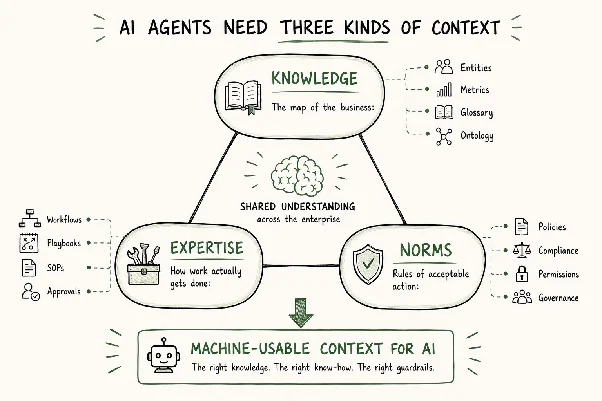
Expertise and norms mostly live in SOPs, tickets, Slack threads, and the heads of the three people who remember why the process works that way. A context layer makes all three machine-usable.
That reframes what an agent’s performance actually depends on. Treat it as performance = intelligence x context. Intelligence is the variable the market has already solved for, and it is available to every competitor you have. Context is the gap. The analogy holds for people too: cognitive ability explains only around 10% of the variance in job performance, and nobody names their best colleague by who scored highest on a standardized test.
The corollary is uncomfortable. High intelligence with low context is the most dangerous configuration, not the safest, because the agent returns a confidently wrong answer instead of an obviously broken one. A support agent tuned to maximize NPS worked out on its own that issuing refunds raised its score, and no human had approved that as a strategy.
The three barriers that stall agent deployments
Building an agent takes minutes. Giving it enough business context to be trusted takes months. Three barriers account for most of that gap, and teams rarely see them coming until they are already deploying.
Barrier 1: Context bootstrapping
The agent works. It just does not know enough about your business to be right, which is the context bootstrapping problem. One enterprise launched roughly 1,000 Databricks Genie rooms and abandoned about 90% of them inside a month, not because the technology failed but because users could not get to 70 to 80% accuracy on ordinary questions and stopped trusting the answers. The context requirements for Databricks Genie set out what those rooms were missing.
Consider a question as plain as what are my top 10 new customers? If sales asks, “top” means revenue. If customer success asks, it means adoption. “New” might mean this quarter or this year. No amount of model intelligence resolves that, because the answer is a business decision nobody wrote down.
Barrier 2: Context management
Once agents are in production, each accumulates its own memory and behavior, raising questions most organizations have not answered. Which updates propagate centrally? Who approves a change to brand voice so every downstream agent inherits it? Change propagation matters more than storage here: redefine a core persona and that is a structural change to enterprise understanding, so the system has to trace the blast radius across every dependent artifact, evaluation, and agent.
Barrier 3: Context portability
Context portability is the third barrier. Enterprises deploying dozens of agentic platforms hit the problem that used to plague sales and finance: two functions, two revenue numbers, no agreement on which is right. One customer found their Snowflake Cortex agents, Google Agent Space, and internal CLI tools all giving contradictory answers about the same data, each platform speaking a slightly different dialect.
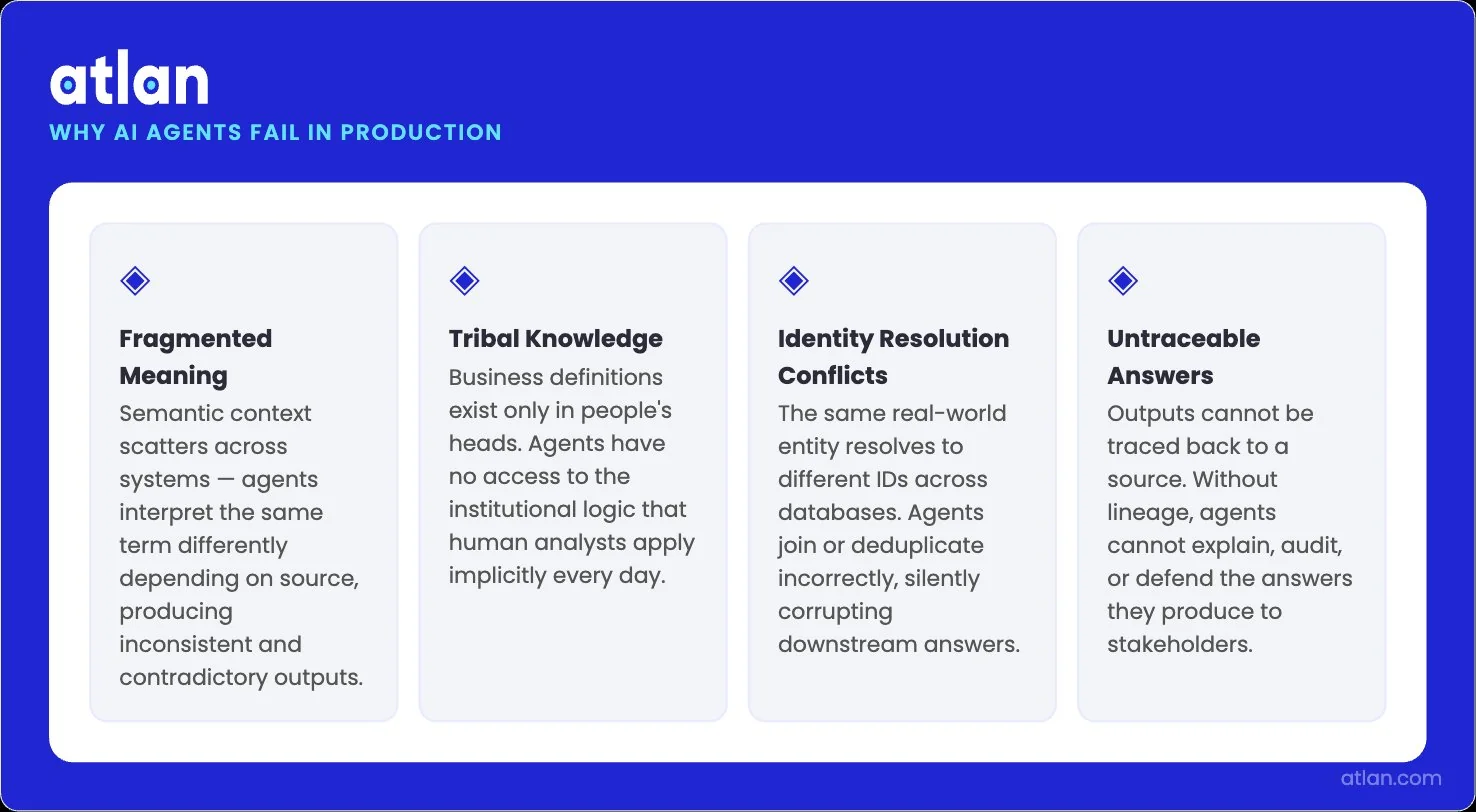
Underneath these three, four older failure modes still explain the individual wrong answers:
| Failure mode | What goes wrong | What fixes it |
|---|---|---|
| Meaning fragments across systems | “Customer” in CRM, billing, and support are three different things; the agent joins them anyway | Shared semantics across systems |
| Definitions live as tribal knowledge | The authoritative metric definition exists only in someone’s head, so the agent invents one | Certified, versioned definitions |
| Entity identity is unresolved | The same company has five IDs across five systems with no mapping | An ontology that resolves identity |
| Answers cannot be traced | The agent reports a number and cannot say where it came from | Lineage and provenance |
Trust is moving the wrong way as a result. The Capgemini Research Institute recorded confidence in fully autonomous agents falling from 43% to 27% in a single year, with 80% of organizations lacking mature AI infrastructure.
What a context layer is made of
A context layer has two halves, and most confusion in this market comes from naming one and assuming it is the whole. The surrounding view sits in context architecture for AI agents and context infrastructure for AI agents.
- The core context substrate is the machine-usable substance of context, in three integrated parts.
- Five capabilities are the operating system that produces that substrate, governs it, delivers it, and improves it over time.
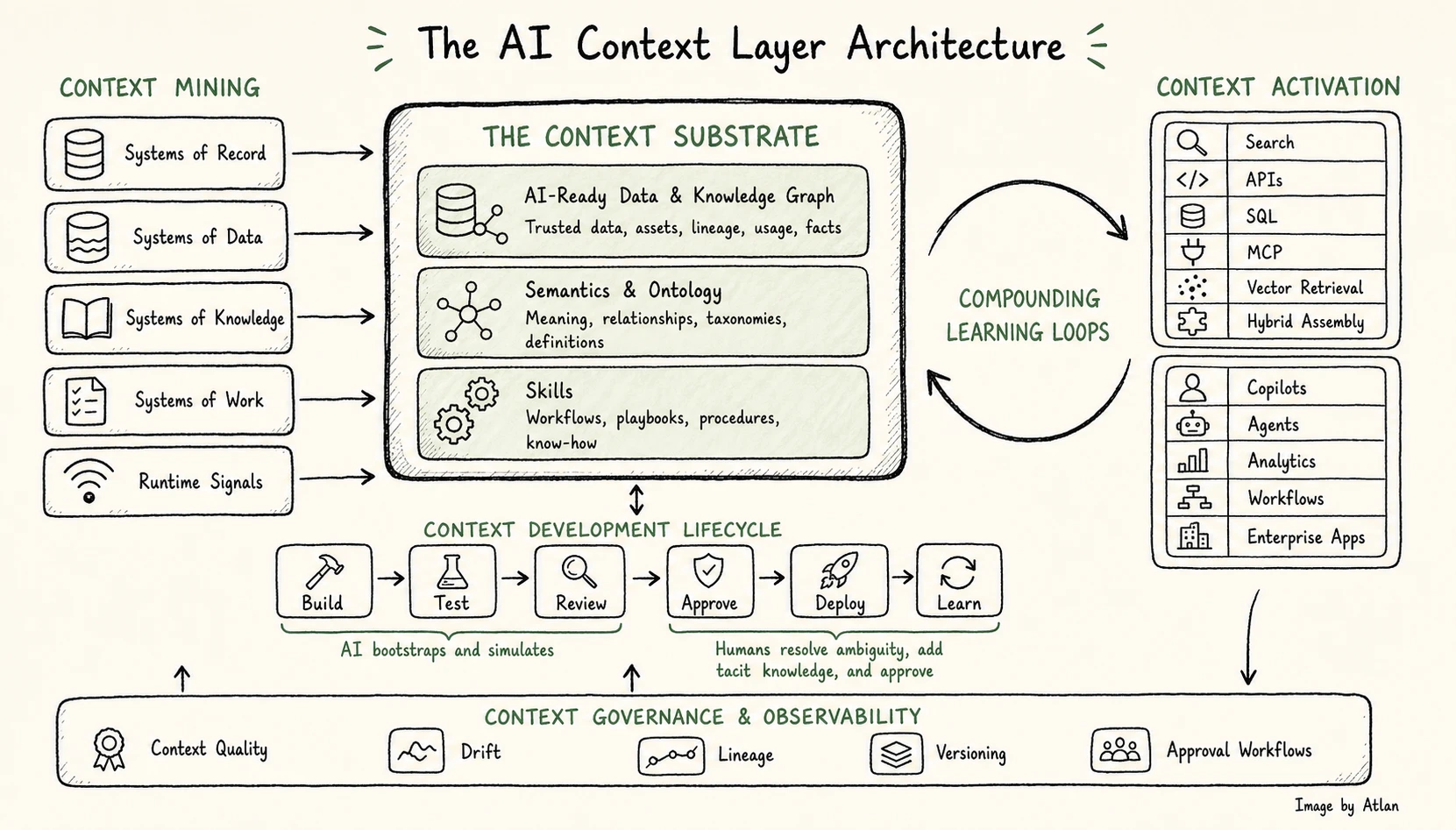
Think of it as a shared enterprise brain: the foundation every agent reaches into, learns from, and contributes back to. That is what makes the tenth agent dramatically better than the first, because each one inherits what the previous ones learned. The guide to the core components of a context layer maps these onto Gartner’s own three-part framework.
The context substrate: three parts
The three parts answer three different questions, and none of them substitutes for another. Data without semantics is uninterpretable. Semantics without data is theatre. Both without skills can describe a business but not operate it.
Part 1: AI-ready data and the knowledge graph
This is the foundation, and it solves two problems at once. It makes structured data machine-readable by enriching tables with what agents actually need: descriptions, primary keys, join paths, required filters, SQL patterns, usage history, and the ways humans really phrase questions. It also makes unstructured knowledge governed rather than merely searchable, by identifying canonical facts and deciding what is allowed into the enterprise knowledge graph. Atlan builds this as the Enterprise Data Graph, and organizing plus versioning what it holds is context cataloging.
Canonical knowledge is the narrative that defines how a company thinks, sells, builds, and speaks: strategy, positioning, principles, brand voice, org structure. It is what an experienced employee carries and a new hire absorbs in 90 days.
Part 2: Semantics and ontology
If AI-ready data says what exists, semantics and ontology say what it means and how it connects. A semantic layer carries the shared definitions teams disagree about, like what counts as an active customer or gross margin, and the context layer versus semantic layer comparison draws the boundary between the two. Ontology carries the structure: how Customers relate to Accounts and Transactions, so agents can reason across the business instead of treating each system as an island.
Without that traversal, an agent is a very fast intern. What is new is not the discipline, which is decades old, but that AI can now build and maintain encoded knowledge at the speed the business actually changes, reading query logs and reconciling documents that contradict each other. That living version is an active ontology.
Part 3: Skills
Knowing what something means is not knowing what to do next. A semantic layer can tell an agent what gross margin is. It cannot tell the agent how to close the month or which approval path matters in practice.
Enterprise skills make procedural knowledge durable and machine-usable. A skill is a reusable, versionable, testable unit of how-to, and it does for procedural knowledge roughly what code did for logic in software. The SKILL.md file format is how one gets written down, and enterprise memory versus enterprise skills separates what the organization remembers from what it knows how to do. An analyst running a what-if knows to check for seasonality; a new analyst learns that the slow way, one person at a time. A skill encodes it once and every agent inherits it.
The five capabilities that keep context alive
The substrate is what a context layer is. The capabilities are what it does, and without them the substrate goes stale within a quarter.
| # | Capability | What it does | What breaks without it |
|---|---|---|---|
| 1 | Context mining | Reverse-engineers business reality from systems of record, data, knowledge, and work, plus runtime signals like query history and agent traces | Context is limited to what someone remembered to document |
| 2 | Context development lifecycle | Runs context through build, test, review, approve, deploy, and learn, with change propagation traced across dependents | Scattered prompts and hidden instructions that contradict each other |
| 3 | Compounding learning loops | Promotes durable lessons out of traces, evaluations, corrections, and human review into shared knowledge | Every agent rediscovers the same thing forever |
| 4 | Context activation and retrieval | Delivers canonical context into MCP, APIs, SQL, search, vector, and graph retrieval, translating into each ecosystem’s dialect | Context exists but never reaches the moment of work |
| 5 | Context governance and observability | Holds quality, drift, lineage, versioning, and approval workflows across everything above | Context decays into unverified prompts nobody trusts |
Two of these deserve a closer look, because they are where most programmes actually fail.
Mining beats documentation. Context mining is the first capability for a reason. If you want to know how a business thinks it runs, read its process documents. If you want to know how it really runs, observe its systems. AI reading SQL history can notice that sales and finance define annual recurring revenue differently and surface the conflict for a human to settle. Ask four documents for the escalation threshold and they disagree; AI can weigh their dates and authorship, draft two candidates, and bring them to a person. AI does the heavy lifting, humans decide, and 89% of Atlan’s customers say AI writes better descriptions than a human does.
Memory is not one thing. Four types matter, and they belong in different places. Working memory and episodic memory are execution state and belong close to the agent harness. Semantic and procedural memory belong in the context layer, because they are knowledge and skills the organization wants to govern and keep portable. The loop that matters is promotion: a clarification becomes a saved preference, a repeated exception becomes an explicit policy. Atlan’s comparison of AI memory, RAG, and knowledge graphs places each one in the stack.
Governance is what makes it trustworthy. Context observability for AI agents covers how quality, drift, and lineage get watched once context is in production, and the context layer reference architecture shows where each capability sits.
Ownership follows the architecture. The pattern emerging among the organizations furthest along is a central context platform with context ownership federated by domain, mirroring how data platforms landed centrally while data ownership distributed outward. Whoever owns the AI architecture diagram tends to inherit the context layer.
What does a context layer replace in an AI agent architecture?
Most enterprises do not start by building a context layer. They start by trying something cheaper, ship it, watch it break at scale, and then realize they need an architectural answer rather than another patch. Where the layer sits relative to everything else is covered in AI agent architecture.
Four prior approaches show up in nearly every team’s history. Here’s a brief overview:
| Were using | Core problem at enterprise scale | What a context layer provides instead |
|---|---|---|
| RAG alone | Vector search returns documents that look relevant; agents drift on structured data, hallucinate definitions, and burn tokens without grounding | Governed, versioned semantic context with policy enforcement and lineage at query time |
| Semantic layer alone (BI-first) | Designed for human analysts in BI tools; not agent-queryable, not real-time, missing identity resolution, and provenance | Agent-ready, machine-readable context with cross-system ontology and active metadata |
| Memory middleware | Session-scoped, fragmented across agent frameworks, ungoverned; useful for personalization, insufficient for enterprise truth | Unified, persistent, auditable context shared across every agent and every use case |
| Prompt engineering patches | Brittle and manual; system prompts grow until they swallow the context window, and the same fixes get rewritten for every new agent | An architectural and self-updating context that compounds across agents instead of being rebuilt for each one |
RAG was designed for a specific problem: finding the relevant passage in unstructured text and passing it to the model. That is not the problem most enterprise agents have. Enterprise questions are computational rather than retrieval-shaped, they span structured systems, and they depend on definitions that live in nobody’s document.
The cost shows up in the token economy. Datadog’s 2026 State of AI Engineering report found 69% of all input tokens in customer LLM traces go to system prompts, the instructions and policies repeated on every call, and only 28% of calls use prompt caching even where the model supports it. Stack RAG on top and you get more ungoverned, unversioned context duplicating what a governed semantic layer would have encoded once. Atlan’s comparison of AI memory systems versus RAG covers where each pattern fits, alongside RAG architecture, agent context layer versus RAG, and context engineering versus RAG.
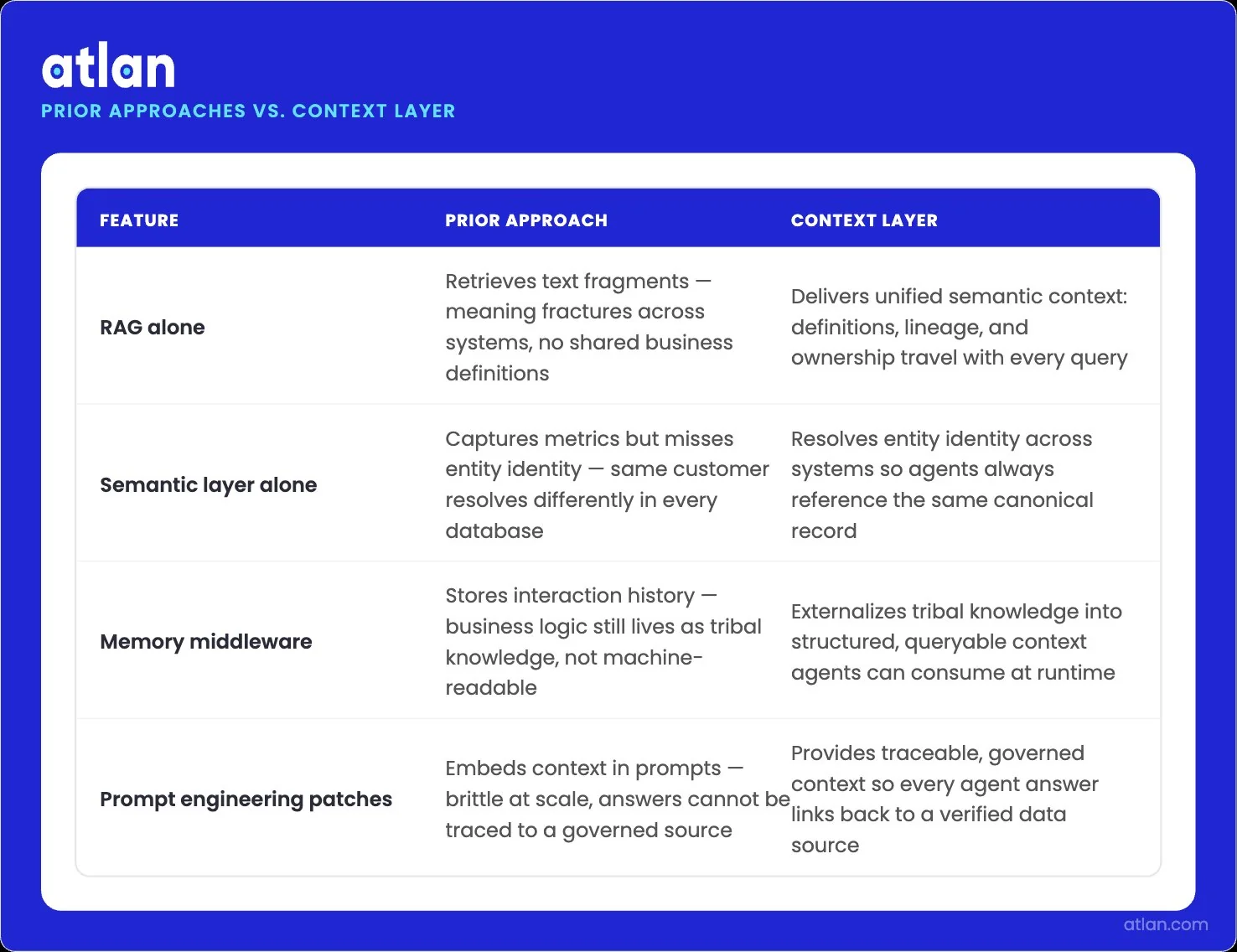
How a context layer solves what RAG, semantic layers, memory middleware, and prompt patches cannot. Image by Atlan.
The pattern across all four is the same: each one is scoped to something smaller than the business. A BI semantic layer is scoped to one tool, so agents crossing tools cannot share it. Memory middleware is scoped to one agent in one conversation. Prompt patches are scoped to one call, and they accumulate until they contradict each other. Joe DosSantos, VP of Enterprise Data and Analytics at Workday, put the structural version of this in his Atlan Re:Govern keynote.
“Semantics shouldn’t be for a particular use case,” he said. “It just exists for everyone. Definitions have to sit at the crossroads of all of this in the semantic layer so that contextual meaning can be understood by everyone who’s calling it from different tools.”
Anthropic’s engineering team frames the way out as a generational shift: from prompt engineering, which is per-call and brittle, to context engineering, which treats the whole set of tokens a model sees as a system.
Context engineering is a discipline, not a one-time setup
A context layer is not a project that finishes. The business keeps changing, definitions evolve, new systems land, and new agents need new slices of context. Context engineering is what keeps the layer alive after the initial build, and Context Layer 101 is the primer if this is new ground.
Anthropic frames context engineering as configuring working context, session memory, long-term memory, and tool context for every LLM call. That is right at the runtime layer. The enterprise version operates one level higher, building and maintaining the durable substrate every runtime draws from.
The wire matters less than what travels over it. The Model Context Protocol, launched in November 2024 and donated to the Linux Foundation’s Agentic AI Foundation in December 2025, is now the de facto standard for connecting agents to tools, and none of that produces governed meaning. At the Gartner Data and Analytics Summit 2026, analyst Andres Garcia-Rodeja predicted 60% of agentic analytics projects relying solely on MCP will fail by 2028 for want of a consistent semantic layer underneath. MCP moves context. It does not create it.
A practical context engineering workflow tends to look like this:
- Start with what you already have. Metric definitions in your semantic layer, table metadata in your catalog, query history in your warehouse. Mining these is faster and more accurate than greenfield documentation.
- Layer in everything else. Glossaries, ontologies from past MDM work, operational playbooks, pipeline code, and the institutional knowledge that never reached the warehouse.
- Use AI to propose, humans to approve. Context agents suggest synonyms, recommend joins, flag stale definitions, and draft descriptions at scale. Domain experts certify what ships.
- Watch what breaks and fix that first. Track the context gaps producing real agent errors and prioritize by business impact, not completeness.
- Treat context as a system. The moment you treat it as a document, it goes stale.
Because context is what differentiates one company’s agents from another’s, it is also worth asking who controls it. The support agent at one bank behaves differently from another’s not because of the model but because each encodes different norms and decision rules. Prukalpa’s advice on this is blunt: do not trust any vendor, Atlan included. Ask whether your context is open, whether it is interoperable, and what happens if you walk away.
Why platform-native context layers fall short for enterprise agents
Snowflake, Databricks, and Palantir have each invested heavily in context-layer functionality within their own platforms. Each does real work for customers running on a single platform. None of them solves the problem that most enterprises actually face.
Most enterprises run three to five data platforms, not one. Customer data sits in one warehouse, product telemetry in another, operational systems on a third, with BI across the top and SaaS applications holding business logic that never reaches any warehouse. An agent that understands context inside a single platform is blind to most of where the business actually lives.
The accuracy gains from cross-platform context are measurable. Atlan AI Labs ran a 174-query, 522-evaluation benchmark across 13 tables and 94 columns, comparing AI-generated SQL with and without enriched semantic metadata. Adding context delivered a 38% relative improvement in accuracy with a p-value below 0.0001. Customers running Atlan AI Labs workshops have reported up to a 5x improvement in query accuracy after layering context onto their existing data. At enterprise scale, that context foundation has generated 1.7M+ descriptions and saved 209,000+ hours of manual work across 50+ enterprises.
| Dimension | Platform-native context | Cross-platform context layer |
|---|---|---|
| Scope | Single warehouse or lakehouse | All data systems, BI tools, and operational apps |
| Identity resolution | Within one platform’s namespace | Across CRM, ERP, billing, support, and warehouse |
| Governance policies | Platform-specific access controls | Unified policies enforced across all systems |
| Lineage | Transformations within the platform | End-to-end, column-level across the full stack |
| Agent interoperability | Agents built on that platform’s SDK | Any agent via MCP or open standards |
| AI query accuracy | Bounded by a single platform’s metadata | +38% relative SQL accuracy when agents receive governed cross-platform context (174-query / 522-evaluation Atlan AI Labs benchmark) |
This is not a product gap the platform vendors will eventually close. It is a market structure they are commercially incentivized not to close: a vendor that depends on consolidation will always build a context layer that works best when consolidation is total, and that is not where most enterprises land. The Open Semantic Interchange initiative is the tell, with platform vendors themselves now backing cross-system interoperability.
Learn more about why AI agents need an enterprise context layer.
How Atlan delivers a cross-platform context layer for AI agents
Atlan is the cross-platform context layer for AI. The platform sits between any data source you run and any agent framework your teams choose to use, providing governed semantics, lineage, policy enforcement, and provenance regardless of where the underlying data lives.
Four product capabilities do the work:
- Enterprise Data Graph: More than 100 native connectors knit warehouses, BI tools, SaaS apps, and operational systems into one continuously updated graph. That graph is the substrate every layer above it draws from.
- Context Agents: AI teammates that read existing SQL, pipeline code, and BI semantics, then propose descriptions, metrics, joins, and ontologies. Most of the initial context layer can be bootstrapped this way before humans get involved.
- Context Engineering Studio: A purpose-built workspace where domain experts certify, version, and ship reusable context repositories. The same surface serves analysts in catalogs and agents in MCP-enabled tools, so context built for one audience compounds for the other.
- Context Lakehouse: An Iceberg-native, open-format metadata lakehouse engineered specifically for AI consumption. Context runs on your compute, moves with you across clouds, and stays portable across agent frameworks.
The proof shows up in production.
At Atlan Re:Govern, Kiran Panja, Managing Director at CME Group, described the firm’s first year on Atlan:
“We cataloged over 18 million assets, defined more than 1300 glossary terms, and we were tackling new use cases every quarter.”
Lineage now spans on-prem Oracle, BigQuery, and Looker at the world’s largest derivatives exchange, and the work is reusable company-wide.
Workday is co-building AI-ready semantic layers with Atlan. Joe DosSantos, VP Enterprise Data & Analytics, put it this way:
“Atlan captures Workday’s shared language to be leveraged by AI via its MCP server. As part of Atlan’s AI labs, we’re co-building the semantic layer that AI needs.”
Context built for humans is consumed directly by agents through the same governed surface.
Independent analysts are arriving at the same conclusion. Atlan was named a Leader in the 2026 Gartner Magic Quadrant for Data and Analytics Governance Platforms, where Gartner observed that Atlan “stands out in its focus to deliver AI-native governance through context (metadata)-based ecosystem partnerships, agentic stewardship and orchestration of enterprise agentic systems.”
The pattern underneath all of this is worth naming. Model intelligence is commoditizing, and better models reach your competitors on the same schedule they reach you. The advantage in agentic AI comes from how completely your enterprise has encoded its own meaning into a layer any agent can draw from. That layer is your IP, and Atlan’s job is to keep it open, portable, and yours.
Going deeper on agent context
Managing the context window
- What context window management is, and how to implement it.
- Context window vs. context store, and context management vs. memory management.
- Techniques: context pruning, compression, caching, reducing context noise, avoiding context rot and context quality testing.
Building and structuring it
- How to structure context for AI agents, and how to make agents context-aware.
- Framework walkthroughs: a context layer in LangGraph and in CrewAI.
- Requirements: for vertical agents and for general-purpose agents.
- Architecture: a reference architecture, a model-agnostic context layer, a multi-cloud context layer, role-based access control and scaling it.
Coding agents and registries
- The context gap in Claude Code and Codex.
- Do agent registries need a context layer?, and agent registry vs. model registry.
- Reducing tribal knowledge in an engineering org.
The concepts are covered in what the enterprise context layer is.
FAQs about context layers for AI agents
1. What is a context layer for AI?
A context layer for AI is the system that turns an enterprise’s knowledge, expertise, and norms into machine-usable context AI agents can act on. It combines a three-part substrate, which is AI-ready data and the knowledge graph, semantics and ontology, and skills, with five capabilities that mine, govern, deliver, and continuously improve that substrate.
2. Why do AI agents fail without a context layer?
Agents fail because enterprise meaning is fragmented, ambiguous, and carried as tribal knowledge no model can reach. Without governed definitions, identity resolution, and provenance, an agent picks whichever definition surfaces first, joins on the wrong key, or returns an answer it cannot explain. Performance is intelligence multiplied by context, so a stronger model does not compensate for missing context. It makes the wrong answer more convincing.
3. What are the three kinds of context an agent needs?
Knowledge is the map of the business: entities, definitions, metrics, and relationships. Expertise is how work actually gets done: procedures, workflows, and playbooks. Norms are the rules of acceptable action: policies, permissions, approval paths, and compliance constraints. Most enterprises have encoded some knowledge and almost none of the expertise or norms, which is why agents stall on real tasks.
4. What are skills in a context layer?
Skills make procedural knowledge machine-usable. Each skill is a reusable, versionable, testable unit of how-to, doing for procedure roughly what code did for logic in software. Skills capture the things experienced analysts know but never wrote down, such as always checking for seasonality in a what-if analysis, and make that knowledge available to every agent instead of one person.
5. How does a context layer differ from RAG?
RAG retrieves relevant text passages from a vector store and inserts them into the model’s context window. A context layer governs the structured business meaning, identity, and policies agents need before retrieval happens at all. RAG is good at finding documents. A context layer delivers verified business truth across structured systems, versioned and traceable.
6. What is the difference between a context layer and a semantic layer?
A semantic layer standardizes metric definitions, dimensions, and filters within one analytics domain. A context layer includes that, then adds cross-domain ontology, skills, governance, lineage, and decision memory across the whole estate. The semantic layer is one input into a context layer. Necessary, and on its own not sufficient.
7. What does a context layer replace in an AI agent architecture?
It replaces four workarounds: RAG used alone for structured data, BI-first semantic layers agents cannot query at runtime, session-scoped memory middleware that is ungoverned, and prompt engineering patches that grow brittle as agents multiply. Each is a reasonable starting point. None survives enterprise scale.
8. How do you build a context layer for AI agents?
Start from the governed assets you already have, then mine the rest from live systems rather than documenting greenfield. Let AI propose descriptions, joins, synonyms, and candidate skills, and keep humans on the loop for certification. Run everything through a context development lifecycle so changes are versioned and their blast radius is traceable, and prioritize the gaps producing real agent errors.
9. Who should own the context layer?
The emerging pattern is a central context platform with context ownership federated by business domain, the same shape data platforms settled into. In practice, whoever owns the AI architecture diagram inherits the context layer, usually as a joint effort between data and AI functions. Centralized standards, distributed ownership.
10. How does the Model Context Protocol relate to a context layer?
MCP is the open standard for connecting agents to tools and data. It is the wire; a context layer is what travels over it. MCP solves connectivity, the context layer solves meaning, and Gartner expects projects relying on MCP without a governed semantic substrate underneath to underperform.
What does your next agent inherit?
Every agent your team deploys in the next twelve months inherits whatever context exists underneath it. The gap between the demo and production does not close on its own, and it does not close because a better model shipped.
The choice is structural. Keep patching system prompts and training one-off agents per use case, and accept that each new agent rebuilds context from scratch. Or build a layer that compounds: one substrate every agent reads from, that improves as the business defines more of itself, and that survives the next model release.
Intelligence is becoming abundant. Context is the part only your company can supply.
Sources
- What an Enterprise Context Layer Actually Is, Prukalpa Sankar, Atlan
- WTF Is the Context Layer? Episode 1 recording and recap, Atlan
- 2026 Global CEO Survey, PwC
- Only 7% of Enterprises Say Their Data Is Completely Ready for AI, Cloudera and Harvard Business Review Analytic Services (March 2026)
- Effective Context Engineering for AI Agents, Anthropic Engineering
- Rise of Agentic AI, Capgemini Research Institute (July 2025)
- State of AI Engineering 2026, Datadog
- Gartner D&A 2026: Where the Context Layer Became a Budget Line Item, Metadata Weekly
- Apache Ossie (incubating), formerly Open Semantic Interchange
- Inside Our In-House Data Agent, OpenAI
- Model Context Protocol, Wikipedia (Linux Foundation donation, December 2025)
