

Atlan’s Context Layer for AI is one of the platforms enterprises use to build, govern, and deliver the business context AI agents need to work with enterprise data. Here’s what an AI context platform is, why you need one, and what to look for in one.
AI context platform: core components and quick facts
An AI context platform (also known as an enterprise context platform) is the system used to build, govern, and deliver the business context that AI agents need to reason and act accurately. It includes taxonomies, ontologies, and knowledge graphs that provide business meaning, relationships, rules, policies, and constraints. This context can be delivered to any agent through open protocols so that outputs are grounded.
The platform sits between your raw data estate and the agents built on top of it, typically including:
-
A context graph: The connected map of assets, meaning, relationships, and policies agents can trust.
-
Context engineering workflows: The versioned build, test, and approval lifecycle for context, treated like code.
-
A context store: The open delivery layer that serves context over the protocols agents already speak.
-
Context agents: The specialist AI that bootstraps context from your existing systems instead of requiring humans to write it by hand.
-
Continuous feedback loops: The mechanism that lets context improve with every agent interaction.
AI context platforms: At a glance
| Aspect | Quick facts about AI context platforms |
|---|---|
| Also known as | Enterprise Context Platform (ECP) |
| Core components | Context graph, context engineering workflows, context store, context agents, feedback loops |
| Model relationship | Model-agnostic — served to Claude, GPT, Gemini, and custom agents via open protocols (MCP, A2A, SQL, APIs) |
| Enterprise driver | Gartner: organizations with successful AI initiatives invest up to 4x more in data and analytics foundations (April 2026) |
| Vs. a data catalog | A catalog stores metadata for humans to browse; a context platform captures meaning and relationships, then serves them to any agent |
| Vs. a vector database / RAG pipeline | Those retrieve passages for a single prompt; a context platform governs and versions context across every agent and interaction |
Atlan’s context layer for AI is the infrastructure enterprises need to establish a governed, portable context foundation that works across whichever data and AI tools you run today, and whichever you adopt next.
Rather than locking context inside a single agent framework and creating enterprise context silos, Atlan stores it in an open, vendor-agnostic, Iceberg-native store that you own. Context is versioned and treated like testable code.
Atlan’s Context Agents reverse-engineer context from your existing systems (with 100+ connectors). You can refine it together with AI agents, and serve this context to any agent through open standards (like the Model Context Protocol, A2A, SQL, and APIs).
Why do you need an AI context platform?
AI agents will continue to arrive fast, progressing from task and application specific agents to agentic ecosystems, according to Gartner. Gartner also predicts that 40% of enterprise applications will be integrated with task-specific AI agents in 2026, as compared to 5% in 2025.
Gartner also found that the pressure to implement high-quality AI agents for mission-critical applications, with low tolerance for hallucinations, is increasing for enterprises. AI context platforms can speed up the successful adoption of agentic AI as they enable agents to dynamically interpret, retain, and use relevant information across interactions. This improves the agents’ ability to perform complex tasks autonomously and reduces project implementation timelines from months to mere weeks.
Performance is a function of intelligence and context, P = f(I, C).
With intelligence being commoditized, every company will have roughly the same models at roughly the same price. What remains different is your context: your definitions, your rules, and your institutional memory.
An AI context platform helps you build and own that context, making it a compounding investment that decides whether enterprise AI is performant or just a confident hallucination at scale.
AI agents need a dedicated “talk to context” architecture to deliver responses grounded in trustworthy business context. Instead of reading raw tables and guessing, the agent queries a governed layer of consolidated semantic models and indexed reference data, so a plain-language question returns an accurate BI insight or executive dashboard.
According to Gartner (April 2026), organizations with successful AI initiatives invest up to four times more in data and analytics foundations than those with poor outcomes. Separate research points to the same pattern: model performance is “fundamentally determined by the contextual information provided during inference.”
That investment gap is why data teams are redesigning their data architecture around a context layer as the reference point for AI agents. Without this foundation, agents reconstruct meaning from raw data on every request, compounding errors and delivering unreliable outcomes.
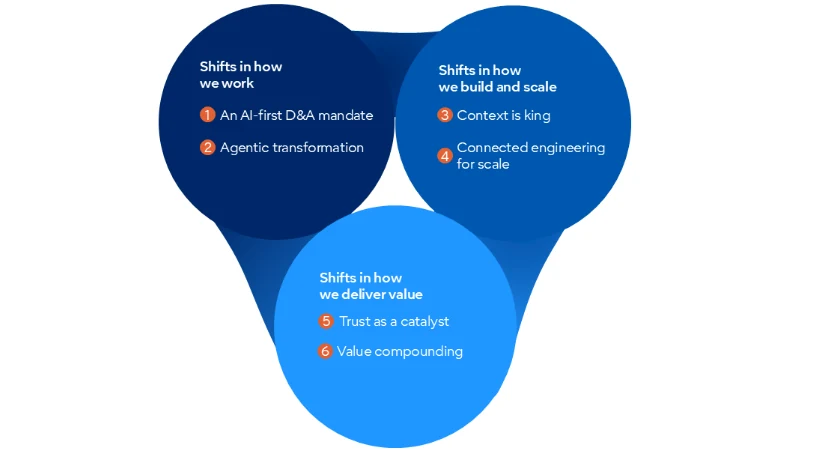
Caption: Shifts that D&A leaders must make in the agentic era. Source: Gartner
Since that context is your company’s IP, it can’t be locked inside any one agent platform. Atlan lets you build your AI context platform, govern it, and keep it portable, regardless of your data and AI ecosystems.
What does an AI context platform do?
Before covering the mechanics, it helps to define what “context” actually is. Context is a combination of knowledge, expertise, and norms:
-
Knowledge: What data exists, what it means, how it connects (explained with ontologies, semantic layers, and knowledge graphs), and which policies apply to it.
-
Expertise: The enterprise skills and business logic that turn raw definitions into correct decisions, including edge cases and exceptions.
-
Norms: The policy rules, provenance, and governance boundaries that determine what an agent is allowed to do and trust, while providing a detailed audit trail.
Since these elements aren’t static, a one-time documentation project will merely capture all three once and then go stale within weeks. For instance, business rules change frequently and as such, must be continuously verified, reviewed, and approved before AI agents consume them.
An AI context platform is a shared, living infrastructure built to continuously mine governed context, expertise, and norms. This creates a shared understanding of your business (unifying ontologies, knowledge graphs, semantic layers, etc.) that’s adaptable and continuously updated at the speed of business.
Mine context from your data and AI estate
An AI context platform mines context from where it already lives. The knowledge agents need is scattered across SQL query history, BI dashboards, pipelines, and tribal knowledge.
The platform reads those sources to draft context automatically.
Build and govern foundational context infrastructure
The second function is to build and govern that context deliberately. Domain experts refine the drafts, resolve conflicting definitions, and certify ownership, so the same term means the same thing wherever it is used. This is closely related to the discipline of context engineering, which IBM describes as the practice of assembling the right information for a model at the right time.
Deliver context to AI agents at inference time
Anthropic highlights that curating the right context, not just more of it, is what drives reliable agent behavior. That’s why a crucial function of the AI context platform is to deliver governed context to agents at machine speed.
The platform serves governed context through the protocols agents already speak, so any agent can check what an asset means and whether it can be trusted before acting.
Traditional documentation vs. a modern AI context platform
| Aspect | Traditional Approach | Modern Approach |
|---|---|---|
| Context creation | One-time documentation project, written by hand | AI-bootstrapped from existing systems (query history, BI logic, lineage) |
| Currency | Goes stale within weeks | Continuously updated through feedback loops |
| Scope | Single team, single tool | Enterprise-wide, model-agnostic |
| Delivery | Static docs or wiki pages | Served live to any agent via MCP, A2A, SQL, or APIs |
| Governance | Ad hoc, unversioned | Versioned, tested, and approved through a managed lifecycle |
| Model dependency | Locked to whichever tool authored it | Portable across Claude, GPT, Gemini, and future models |
Where does an AI context platform get used?
An AI context platform earns its place wherever an agent needs business judgment, not just a table scan. The pattern repeats across functions and industries:
-
Data and analytics: Agents answer plain-language business questions using certified metric definitions instead of guessing from raw tables.
-
Software development: Code assistants hold project conventions, architectural decisions, and naming standards, so suggestions fit the existing codebase.
-
Customer service: Support agents draw on account history, entitlements, and prior interactions without a human retyping the background first.
-
Cybersecurity: Security teams correlate alerts against organizational risk posture and attack history, so the response reflects what actually matters to that business.
-
Financial services: Analysts get recommendations grounded in internal risk models, client mandates, and the current regulatory state, not a generic playbook.
-
Legal and compliance: Document review improves once the agent knows which clause standards, precedents, and policy exceptions apply.
-
Supply chain: Inventory and logistics decisions improve when procurement, warehousing, and demand signals resolve into one connected view instead of five disconnected spreadsheets.
-
Manufacturing: Predictive maintenance and adaptive production scheduling depend on equipment history and operating norms that live outside any single system.
Each of these draws on the same context graph and feedback loop described above. What changes is which slice of the graph the agent needs, and how fast it needs it.
What should you look for in an AI context platform? 7 must-have criteria in your evaluation framework
The context platform market is crowded, with several rebranded catalogs and single-model memory stores claiming the label. Seven capabilities separate a real platform from a metadata catalog rebranding itself as a context management system, and they map directly to the mine, build, and deliver cycle described earlier.
1. Model-agnostic context
The leading criterion for AI context platforms is model-agnostic context. Context can be served over multiple open protocols (MCP, A2A, SQL, REST/Graph APIs) any model can read, and swapping models doesn’t touch context.
2. Context ownership and portability
Another top criterion is context ownership. Context must be stored in open formats that you own, like Atlan’s Context Lakehouse, and not a proprietary store.
A platform that welds context to one model or one cloud has already failed the test, however good the demo looks, because the day you switch models or add a platform, you start over and your truth forks.
This context should be portable across environments and AI models.
3. AI agents that bootstrap context
A must-have capability is AI agents that mine context from systems rather than requiring humans to write it from scratch. Specialist agents read lineage, SQL, usage, and BI logic to generate an initial semantic layer, which directly addresses the AI agent cold-start problem.
Domain experts then refine that draft instead of authoring everything by hand.
4. Enterprise-wide context graph
The context graph is the foundation a context platform stands on, and answers the question, “what can the agent trust?”. It connects assets, meaning, relationships, and policies.
A true AI context platform offers heterogeneous coverage, connecting across systems of record, data, knowledge, and work. It connects assets, meaning, lineage, and policies, so an agent can traverse them in a single call and resolve what it can trust before it acts.
5. Context engineering workflows
Context engineering treats context as code. Instead of scattered prompts, you get versioned, testable context repositories with branching, staged rollouts, and rollbacks.
The AI context platform runs context through a managed lifecycle, from build and test to review, approval, and deployment. Validating context against real questions (using automated evals) before production ensures provable correctness.
Ownership and access controls determine who can change a definition and who signs off before it reaches production.
This is where context versioning for AI agents turns context management from a documentation project into a managed lifecycle. Versioning ensures that context has full history, branching, and rollback, so you can reconstruct exactly what an agent saw and when.
6. Context store as the activation layer
The context store acts as the activation or the delivery layer, one open store that every agent can connect to and understand via MCP-compatible servers. This makes context portable and not locked to one vendor.
7. Continuous feedback loops
Continuous feedback is the differentiating factor for an AI context platform, in comparison to a static knowledge base. Every question and correction feeds back into the shared layer, so the platform improves with every interaction rather than degrading as agents multiply, which is critical for context management across multi-agent systems.
Treat these seven evaluation criteria as a checklist, not a wish list: a platform that’s missing even one tends to reduce to a catalog with a chat interface bolted on.
Two practical tests, beyond the checklist
Run these alongside the seven criteria above:
-
The model-swap test: Ask what happens to your context when you move from one model provider to another. If the answer involves migration or rework, the context is welded to the tool, not owned by you.
-
The audit test: Ask whether you can reconstruct exactly what context an agent saw at a specific point in time. Without versioning and time travel, an agent’s mistake stays unexplainable.
What best practices does Gartner recommend?
Gartner recommends four practices for building or evaluating an AI context platform:
- Develop comprehensive context management tooling: Adopt capabilities like automated tagging, ontology, and knowledge graphs to organize, enrich, and maintain high-quality context for AI.
- Prioritize seamless integration and interoperability: Ensure MCP, API, and A2A support across diverse enterprise systems, data sources, and workflows.
- Embed advanced privacy, security, and governance controls: Adopt granular access management, data anonymization, and compliance features to ensure trust and reliability in your data and AI estate.
- Enable dynamic, user-friendly context orchestration: Support intuitive UIs, automation, and real-time observability for effective context management.
It is also worth being clear about what a context platform is not, since much of the market conflates it with adjacent tools. You can use this breakdown of agent context layer tools to familiarize yourself with the market, or this side-by-side comparison of leading agent context layer tools.
On these seven criteria, Atlan stands out as a leading AI context platform, and to date few others have shipped an advanced real-world build like Atlan’s context layer for AI.
For example, a large customer-experience firm described pulling business context into its custom AI agent through MCP as a “game changer” for their architecture. Context gets delivered to the agent at runtime, not hard-coded.
Let’s look at how Atlan acts as an enterprise context layer for AI.
How does Atlan help enterprises build context platforms for AI?
Atlan is an AI context platform that sits between your data and AI agents, supplying the business knowledge your agents need to act correctly: what terms mean, how work gets done, and what’s allowed. This layer is where context is mined from existing systems, built and governed with humans, and delivered to any agent through any interface, forming a connected AI context ecosystem rather than a single point tool.
Atlan’s AI context platform offers heterogeneous coverage, with 100+ connectors across all source-system types. Key capabilities include:
-
Enterprise Data Graph: Unified graph of what data exists, what it means, and how it connects, forming the enterprise memory every agent draws from. It includes column-level lineage reverse-engineered from SQL, pipelines, and BI logic, which turns a fragmented estate into a single, traversable source of truth for context.
-
Context Lakehouse: An open store where that context lives and is served. It combines Iceberg-native storage, a knowledge graph, and vector search, and it delivers context to agents over MCP, agent-to-agent, SQL, and APIs.
-
Context Agents: Nine specialist agents mine (i.e., bootstrap) context so humans do not start from a blank page. They read lineage, SQL, usage, annotations, and BI logic to produce descriptions, glossary, metrics, ontology. According to Atlan’s own customer data, 87% of customers rate the output on par with or better than human-generated context.
-
Context Engineering Studio: The workspace where AI and humans build business context through a clear lifecycle of build, test, review, approve, deploy, and learn. Context is versioned and governed across its lifecycle.
-
Compounding learning loops: Evals, traces, and memory from every agent interaction feed back into the shared context layer, so accuracy improves with use rather than drifting as you add agents.
Together, these components let enterprises build the agent context layer once and serve it everywhere, without locking their most valuable intellectual property to a single vendor.
By May 2026, a global hospitality company (50,000+ employees) started using Atlan as the foundational reference for everything the company does with data and AI. Atlan’s AI context platform is the single place that defines what every asset means as the company becomes data- and AI-driven.
Real stories from real customers: AI context platforms in production
How Workday is building an AI-ready semantic layer
"Atlan captures Workday's shared language to be leveraged by AI via its MCP server. As part of Atlan's AI labs, we're co-building the semantic layer that AI needs."
— Joe DosSantos, VP of Enterprise Data & Analytics, Workday

How DigiKey built a unified, sovereign context layer for its data and AI estate
"Atlan is our context operating system to cover every type of context in every system including our operational systems. For the first time we have a single source of truth for context."
— Sridher Arumugham, Chief Data & Analytics Officer, DigiKey

More on choosing a context platform
- AI context platform vs. agentic operating system, and time to value.
- Context layer evaluation criteria, agent context layer tools and how they compare.
- Gartner Impact Radar on AI context platforms.
- Build or buy: the DIY context layer, TCO of build vs. buy vs. bundle, full-stack platform vs. best-of-breed, metadata tooling criteria and the healthcare case.
- Lock-in: single-stack lock-in vs. a neutral context layer, and why platform-native context layers fail.
- IBM Knowledge Catalog and where a context layer sits next to it.
Moving forward with AI context platforms
The bottleneck in enterprise AI is context, and it’s crucial to invest in a platform to build and own your context. Gartner’s own research on data and analytics foundations backs this up directly: organizations with successful AI initiatives invest up to four times more in the foundational work than those without.
Treat context as the durable, owned foundation it is to scale enterprise AI from demo to production. Start by reverse-engineering context from the systems where it already lives instead of authoring it by hand, following a clear enterprise rollout path.
Next, build, test, and version context through a managed lifecycle so definitions stay trustworthy.
Make sure that this context is accessible, portable, and vendor-neutral, allowing every agent to connect with it via open protocols. Lastly, feed every interaction back into the shared layer so context compounds rather than decays.
This is the pattern Atlan is built around: the graph, the engineering workflows, and the open store to run all four steps on context you own rather than rent.
FAQs about the AI context platform
1. What is an AI context platform?
An AI context platform is the system enterprises use to build, govern, and deliver the business context that AI agents need to reason and act accurately.
2. How is it different from a data catalog, a vector database, and a RAG pipeline?
A data catalog stores metadata for humans to browse, a vector database stores embeddings for similarity search, and a RAG pipeline retrieves passages to ground a single prompt. A context platform is broader and active: it captures meaning, relationships, rules, and ownership in a governed, versioned form and serves that understanding to any agent, so retrieval is trustworthy rather than just relevant.
3. Why do AI pilots stall without one?
Without a shared context foundation, each agent reconstructs meaning from raw data on every request, and definitions conflict as more agents are added. A controlled demo built on hand-curated context breaks in production where data is messy and systems change, which is the pattern of cold start, testing difficulty, and scaling that stalls most pilots.
4. What capabilities must a real AI context platform have?
An AI context platform must bootstrap context from existing systems, stand on a context graph, manage context through versioned engineering workflows, deliver context over multiple protocols, and improve continuously from feedback. Missing any one of these tends to produce a catalog or index rather than a genuine platform.
5. Who owns and governs context once you have more than a few agents?
Ownership typically sits with data and AI platform leadership, with domain experts certifying the definitions for their own areas. Policy ownership should live in the context layer itself, not inside each agent, so ownership, access, and definitions are managed centrally and consistently. This is essential for context management across multi-agent systems, where isolated agent memories otherwise drift and produce conflicting answers.
6. How does context stay portable across multiple agent platforms?
Portability comes from storing context in open formats you own and serving it over open standards like MCP, so any compatible agent can consume it. This decouples context from any single framework and prevents the vendor lock-in that turns your intellectual property into someone else’s dependency.
7. How do you bootstrap context without writing it all by hand?
Specialist agents read your lineage, SQL history, usage, and BI logic to draft descriptions, glossary terms, metrics, and ontology automatically. Domain experts then review and refine that draft, which addresses the AI agent cold-start problem by turning weeks of manual documentation into hours of verification.
8. How do you know the context is right before agents use it in production?
You test it the way you test code, by generating an evaluation suite from existing dashboards and queries and running agents against the questions users actually ask. Failing evals surface exactly what context is missing, so you fix gaps before users encounter them, and each improvement is retested against the same benchmark using context versioning for AI agents.
9. How do you keep context current as the business changes?
Continuous feedback loops treat every agent interaction as a signal: corrections generate suggested updates, confirmations become regression tests, and drift detection flags definitions that no longer match reality before an agent acts on them.
Sources
-
Anthropic, “Effective Context Engineering for AI Agents,” 2025. https://www.anthropic.com/engineering/effective-context-engineering-for-ai-agents
-
Mei et al., “A Survey of Context Engineering for Large Language Models,” arXiv, 2025. https://arxiv.org/abs/2507.13334
-
Gartner, “Gartner Predicts 40% of Enterprise Apps Will Feature Task-Specific AI Agents by 2026, Up from Less Than 5% in 2025,” August 2025. https://www.gartner.com/en/newsroom/press-releases/2025-08-26-gartner-predicts-40-percent-of-enterprise-apps-will-feature-task-specific-ai-agents-by-2026-up-from-less-than-5-percent-in-2025
-
Gartner, “Gartner Says Organizations with Successful AI Initiatives Invest Up to Four Times More in Data and Analytics Foundations,” April 2026. https://www.gartner.com/en/newsroom/press-releases/2026-04-16-gartner-says-organizations-with-successful-ai-initiatives-invest-up-to-four-times-more-in-data-and-analytics-foundations
-
IBM Think, “Context Engineering.” https://www.ibm.com/think/topics/context-engineering
-
Stanford HAI, “2025 AI Index Report.” https://hai.stanford.edu/ai-index/2025-ai-index-report
-
Model Context Protocol, modelcontextprotocol.io. https://modelcontextprotocol.io/
-
Gartner, “Emerging Tech Impact Radar: Generative AI,” ID G00842957, 7 August 2026.
