

Build Your AI Context Stack
Get the blueprint for implementing context graphs across your enterprise. This guide walks through the four-layer architecture from metadata foundation to agent orchestration, with practical implementation steps for 2026.
Get the Stack Guide
Why do multi-agent coordination patterns matter?
Gartner predicts that 40% of enterprise applications will integrate task-specific AI agents by the end of 2026. This projection describes multi-agent deployments where agents across finance, compliance, customer success, and operations must coordinate in real time.
The coordination pattern determines what class of failures your system is exposed to — a supervisor bottleneck is a different failure mode from a peer-to-peer tracing gap.
Choosing a pattern without designing the context architecture for that pattern is the most common reason multi-agent systems that work in demos break at scale. According to Deloitte (2026), only 21% of enterprises have mature governance for multi-agent AI, and the gap is rarely the orchestration framework.
What do multi-agent coordination patterns involve?
Each coordination pattern defines a distinct set of engineering decisions: which agents exist, how they discover one another, how tasks are assigned, how state is maintained across steps, and how failures are handled.
1. Supervisor/worker pattern
In the supervisor/worker pattern, a single orchestrator agent receives a task, determines which specialist agents are best positioned to handle components of that task, routes sub-tasks accordingly, and aggregates the returned outputs into a final result.
Key characteristics
-
Routing logic: Clear and deterministic. The supervisor decides which agent handles which task based on capability declarations.
-
Debuggability: Easier than peer-to-peer because the supervisor creates an observable decision record at every routing step.
-
Bottleneck risk: The supervisor is a single point of failure. If it is unavailable or makes a wrong routing decision, every downstream task is affected.
-
Framework support: LangGraph and CrewAI both have strong supervisor pattern implementations.
2. Peer-to-peer pattern
In the peer-to-peer pattern, agents communicate directly with one another without a central dispatcher. A task may originate with one agent, which identifies another agent capable of contributing and initiates a direct exchange.
Key characteristics
-
Flexibility: No single bottleneck. Agents can dynamically discover collaborators based on capability rather than pre-assigned routing.
-
Protocol dependency: Direct agent-to-agent communication requires a shared messaging standard. The Agent2Agent (A2A) protocol, launched by Google in April 2025 and now maintained by the Linux Foundation, provides this standardized layer.
-
Traceability difficulty: Without a central orchestrator producing a routing log, reconstructing what happened across a peer-to-peer exchange requires careful distributed tracing.
-
Best fit: Collaborative tasks where agents need to negotiate, share partial results, or iteratively refine outputs.
3. Hierarchical pattern
In the hierarchical pattern, a top-level supervisor delegates to mid-level supervisors, which in turn delegate to specialist agents. This nesting can extend across multiple levels.
Key characteristics
-
Scale: Handles the most complex tasks because decomposition can be recursive. A top-level agent breaks a goal into domains; domain-level supervisors break those into sub-tasks; specialist agents execute.
-
Context propagation risk: Any error, stale definition, or incorrect assumption at the top level is passed as an instruction to every level below. Mistakes do not stay local.
-
Governance complexity: More levels mean more context handoffs, each of which is an opportunity for the shared understanding to degrade.
-
Best fit: Large-scale enterprise workflows where task complexity genuinely requires recursive decomposition.
CIO Guide to Context Graphs
For data leaders evaluating where to start, Atlan's CIO guide to context graphs walks through a practical four-layer architecture from metadata foundation to agent orchestration.
Get the CIO GuideHow does each coordination pattern work, and what context architecture does it require?
Coordination patterns are not just routing diagrams. Each one creates a specific context architecture requirement. This is the dimension that most pattern selection guides omit, and it is the dimension most likely to cause production failures.
How does the supervisor pattern work and what are its context requirements?
The supervisor pattern operates in three steps:
-
Receives an inbound task and evaluates which agents have the relevant capability and data access.
-
Routes sub-tasks to those agents and waits for results.
-
Aggregates the results, resolves any conflicts, and returns a final output.
The context architecture requirement for this pattern is that the supervisor must have a complete and accurate picture of what each specialist agent knows, including the definitions.
Consider a concrete failure: a supervisor routes a revenue-related query simultaneously to a Finance agent and a Sales agent. If the Finance agent calculates revenue using GAAP recognition rules and the Sales agent calculates it using booking dates, the supervisor will receive two different numbers.
Neither agent has made an error on its own terms. But the supervisor has no mechanism to reconcile them unless it knows, in advance, that these two agents operate on different definitions of the same term.
The fix is a shared context layer where both agents pull from the same governed definition of “revenue,” including which version applies to which use case. Atlan’s Context Engineering Studio is designed for exactly this: resolving definition conflicts across domains before they reach the orchestration layer, so the supervisor routes tasks that will produce reconcilable outputs.
How does the peer-to-peer pattern work and what are its context requirements?
The peer-to-peer pattern operates by having each agent expose a capability declaration (in A2A, this is called an “Agent Card”). When an agent needs help with a sub-task, it queries available agents, identifies a collaborator by capability, and initiates a direct exchange using the A2A protocol.
A2A enables four key capabilities:
-
Capability discovery through Agent Cards in JSON format.
-
Task management with defined lifecycle states.
-
Agent-to-agent collaboration via context and instruction sharing.
-
User experience negotiation that adapts to different interface requirements.
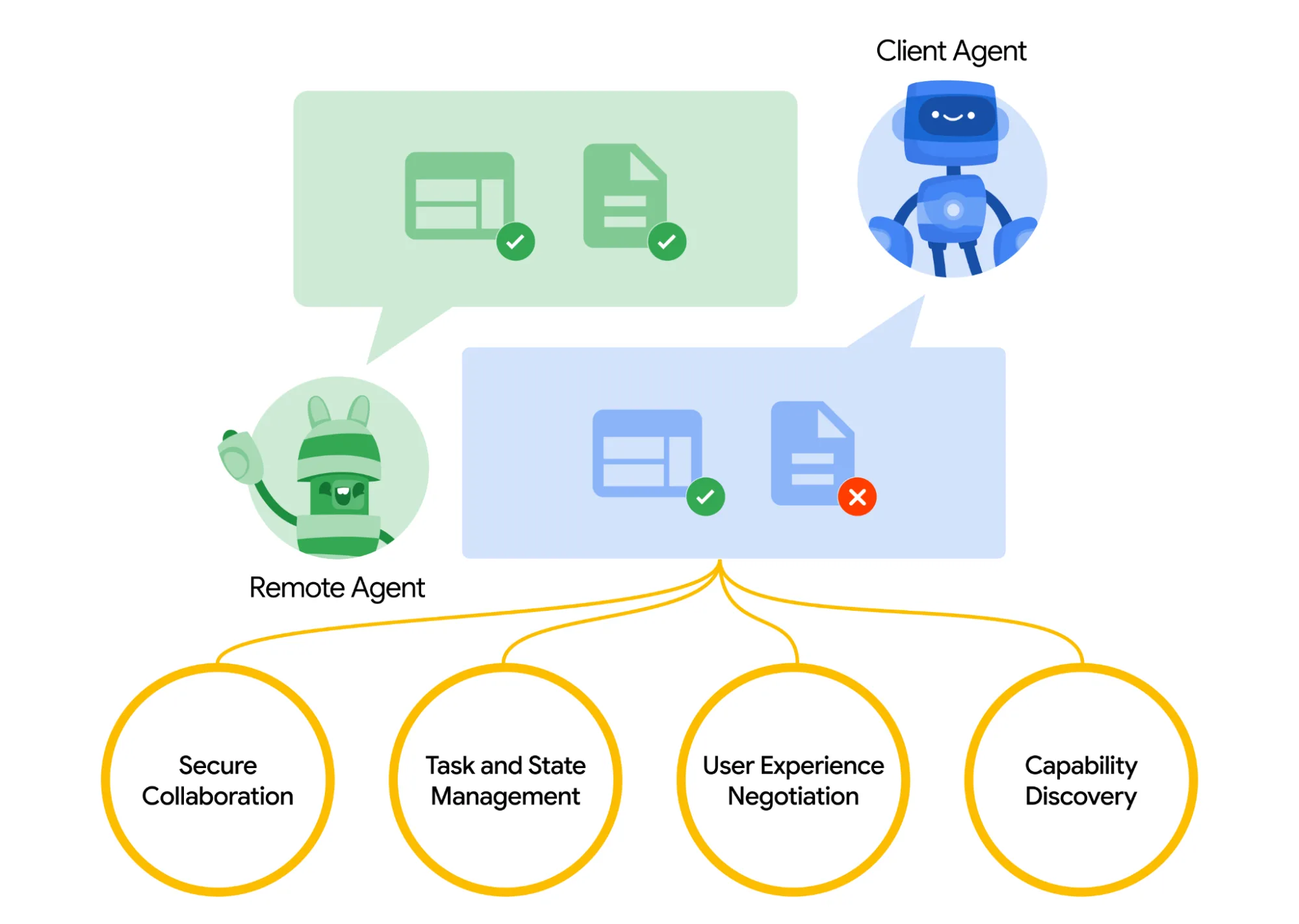
Key capabilities of A2A protocol. Source: Google for Developers
The context architecture requirement for this pattern is a shared business vocabulary. Suppose a Marketing agent and a Finance agent are collaborating on a customer retention analysis. The Marketing agent defines “active customer” as anyone who logged in within the last 90 days. The Finance agent defines “active customer” as anyone with a non-zero balance in the current billing cycle. When the Finance agent sends a message referencing “active customers,” the Marketing agent receives it, processes it, and responds. The exchange is syntactically valid. The downstream result is wrong, because the two agents were operating on different populations without either agent knowing it.
A shared business glossary, governed and versioned, is the prerequisite for reliable peer-to-peer coordination. The A2A protocol focuses on agent collaboration and facilitating communication between AI agents, but it does not handle the semantic layer. That is an organizational governance responsibility.
How does the hierarchical pattern work and what are its context requirements?
The hierarchical pattern works through recursive delegation. A top-level agent receives a goal and creates a plan. That plan is divided into domain-specific sub-goals, each assigned to a mid-level supervisor. Each mid-level supervisor further decomposes its sub-goal into tasks for specialist agents. Results flow back up the hierarchy, aggregated at each level.
The context architecture requirement for this pattern is that the context layer must be the authoritative source of truth at every level, not each agent’s individual memory.
This matters because context problems propagate downward. If the top-level agent operates on a stale definition of a business context, for example, last quarter’s customer segmentation model rather than the updated version, it will instruct every mid-level supervisor to work from that stale model. Each mid-level supervisor will pass it further down. Specialist agents at the bottom will execute correctly against the stale definition, producing outputs that look internally consistent but are wrong relative to current reality.
The fix is not patching individual agent memories as individual agent memory is transient and agent-scoped. The fix is a persistent, governed context layer that all agents at all levels query at inference time, so that every level of the hierarchy draws from the same current state.
Inside Atlan AI Labs & The 5x Accuracy Factor
Learn how context engineering drove 5x AI accuracy in real customer systems. Explore real experiments, quantifiable results, and a repeatable playbook for closing the gap between AI demos and production-ready systems.
Download EbookHow do you choose the right multi-agent coordination pattern?
The most common mistake in pattern selection is choosing based on which has the best framework support rather than which matches the actual requirements of the task and the failure tolerance of the system.
The pattern selection rule is: match the pattern to the task structure and failure consequences first, then design the context architecture for that pattern, then write orchestration code.
Use the following as a decision guide:
-
Task has a clear central orchestrator: Use supervisor/worker when tasks can be cleanly routed to non-overlapping specialists and the system requires a single, auditable routing log.
-
Task requires iterative negotiation: Use peer-to-peer when agents need to share partial results, refine outputs collaboratively, or operate in environments where a central bottleneck is not acceptable.
-
Task involves genuinely recursive complexity: Use hierarchical when task decomposition must span multiple levels of abstraction and no single supervisor can hold the full routing logic.
How does a context layer support multi-agent coordination?
The coordination pattern determines the routing structure. The context layer determines whether the routing produces reliable results. These are two separate engineering concerns, and conflating them is the reason most multi-agent systems that work in demos break under production load.
A governed context layer does three specific things across all three patterns:
-
Resolves definition conflicts before routing: In supervisor systems, the shared business glossary ensures that specialist agents operate on the same definitions before the supervisor routes a query to them.
-
Provides the semantic ground for peer-to-peer exchanges: A2A handles the transport. The context layer handles the meaning.
-
Acts as the authoritative source at every hierarchical level: Instead of child agents inheriting definitions from the agent that dispatched their task, they query the shared context layer at inference time. A stale definition at the top of the hierarchy does not propagate downward because no agent in the chain carries definitions in its own memory.
The practical implication is sequencing. Before selecting a framework, before writing routing logic, before defining agent capabilities, the context architecture for the chosen pattern needs to be in place.
Atlan’s Context Engineering Studio is designed for this pre-orchestration work: resolving definition conflicts across domains, versioning business terms, and certifying context for production use. Atlan’s MCP server then exposes that governed context to any MCP-compatible agent at inference time, covering assets, lineage, glossary definitions, and governance policies. As a result, every agent in the coordination pattern draws from the same authoritative source regardless of the framework being used.
Real stories from real customers building enterprise context layers for scaling AI
"Atlan captures Workday's shared language to be leveraged by AI via its MCP server. As part of Atlan's AI labs, we're co-building the semantic layer that AI needs."
— Joe DosSantos, VP Enterprise Data & Analytics, Workday

"Atlan is our context operating system to cover every type of context in every system including our operational systems. For the first time we have a single source of truth for context."
— Sridher Arumugham, Chief Data Analytics Officer, DigiKey

Moving forward with multi-agent coordination patterns
Multi-agent coordination is an architectural decision first. The pattern you choose creates a specific context dependency: supervisors need shared metric definitions, peer-to-peer agents need governed vocabulary, hierarchical systems need a context layer that is authoritative at every level.
Getting the orchestration framework right while leaving the context architecture undesigned produces systems that are coherent in structure but unreliable in output. Atlan’s sovereign, vendor-agnostic enterprise business context layer gives every coordination pattern the shared, versioned, governed foundation it needs to produce results that hold up in production.
FAQs about multi-agent coordination patterns
1. What is the difference between agent orchestration and agent coordination?
Orchestration refers to the mechanics of managing agent execution: task assignment, sequencing, error handling, and retry logic. Coordination refers to the broader structural question of how agents relate to one another: whether through a central dispatcher, direct peer communication, or a hierarchical chain of delegation. Orchestration is a subset of coordination. You can have an orchestrated supervisor/worker system, an orchestrated peer-to-peer system, or an orchestrated hierarchical system. The coordination pattern determines the architecture; orchestration handles the runtime execution within that architecture.
2. Can an enterprise use more than one coordination pattern at the same time?
Yes, and most production multi-agent systems at scale do. A large enterprise deployment might use a hierarchical pattern for strategic planning workflows, a supervisor/worker pattern for customer support routing, and a peer-to-peer pattern for cross-functional analysis tasks. The important constraint is that each pattern requires its own context architecture design. Patterns that share agents but not context foundations are likely to produce definition conflicts at the boundaries.
3. Why does the supervisor pattern create a bottleneck, and how can it be reduced?
The supervisor pattern creates a bottleneck because every task must flow through a single orchestrator, which both routes tasks and waits for results before aggregating. If the supervisor is slow, unavailable, or makes a wrong routing decision, all downstream work is affected. The bottleneck can be reduced by implementing supervisor redundancy, caching routing decisions for recurring task types, and designing specialist agents to handle pre-validated sub-tasks autonomously so that the supervisor’s active involvement is limited to initial routing and final aggregation rather than mid-task coordination.
4. What is context propagation in hierarchical agent systems?
Context propagation refers to how definitions, instructions, and assumptions move from a parent agent to its child agents in a hierarchical system. If a parent agent sends a task to a child agent with an embedded assumption about what a business term means, the child agent will operate on that assumption without independent validation. When the assumption is correct, this is efficient. When the assumption is stale, the child agent executes correctly against wrong instructions, and the error is difficult to detect because the child agent’s output is internally consistent.
5. How do you test context consistency across a multi-agent system?
Testing context consistency requires verifying that all agents in the system resolve key business terms to the same definitions at inference time, not just at build time. This means testing with queries that exercise the boundary terms most likely to vary across domains, such as shared metrics, customer definitions, and time-period conventions. Running the same business question through multiple coordination paths and comparing outputs is a practical consistency test. Divergent outputs from the same question indicate a definition conflict that needs to be resolved in the shared context layer, not in the routing logic.
Sources
-
Gartner, “Gartner Predicts 40% of Enterprise Apps Will Feature Task-Specific AI Agents by 2026, Up From Less Than 5% in 2025,” August 2025. https://www.gartner.com/en/newsroom/press-releases/2025-08-26-gartner-predicts-40-percent-of-enterprise-apps-will-feature-task-specific-ai-agents-by-2026-up-from-less-than-5-percent-in-2025
-
Deloitte, “The State of AI in the Enterprise,” 2026. https://www.deloitte.com/cz-sk/en/services/consulting/research/the-state-of-ai-in-the-enterprise.html
