

If you’re comparing Purview and Unity Catalog as an either/or decision, you’re likely asking the wrong question. Purview governs your entire data estate, including on-premises, Azure, and SaaS sources. Unity Catalog governs your Databricks lakehouse. Most enterprises running Databricks in an Azure or multi-cloud environment use both. This guide breaks down where each tool excels, where they overlap, and how to decide what your stack actually needs.
| Factor | Microsoft Purview | Databricks Unity Catalog |
|---|---|---|
| Primary scope | Enterprise-wide (Azure, M365, multi-cloud, on-prem) | Databricks Lakehouse + federated sources |
| Target users | Compliance officers, business users, data stewards | Data engineers, data scientists, ML engineers |
| Governance model | Scan-based catalog with sensitivity labels and DLP | Real-time enforcement with row/column-level controls |
| Data discovery | Broad scanning across 200+ sources; AI-powered Copilot | Deep lakehouse-native discovery; Discover marketplace (2025) |
| Lineage depth | Entity + column-level, scan-based | Automatic real-time column-level across all code |
| Cost basis | Pay-per-governed-asset (from January 2025) | Included with Databricks Premium/Enterprise; OSS free |
| AI/ML governance | DSPM for AI, Copilot governance, Azure AI Foundry | Model lineage, MLflow 3.0, AI agent governance |
| Best for | Enterprise compliance, Microsoft-ecosystem governance | Databricks operational governance, ML/AI, lakehouse security |
Why does the comparison between Purview and Databricks matter in 2026?
The Purview vs. Unity Catalog comparison matters because poor data quality costs enterprises $12.9 million annually, and 40% of breaches stem from multi-cloud data sprawl. Purview governs your full estate; Unity Catalog governs your lakehouse. Choosing wrong, or ignoring either, creates compliance blind spots and stale metadata that compound over time.
The data governance market is projected to reach $18.07 billion by 2032, up from $5.38 billion in 2025, at a CAGR of 18.9%. Cloud-based governance tools now hold 63.68% of that market.
They serve different audiences, operate at different layers of the governance stack, and are increasingly used together rather than as alternatives.
Gartner reinforced how critical this category has become by reintroducing its Magic Quadrant for Metadata Management in November 2025 after a five-year pause. The market, Gartner noted, is shifting from augmented data catalogs to metadata “anywhere” orchestration platforms.
Both tools have changed significantly since 2024. Purview launched its Unified Catalog and a new pricing model. Unity Catalog went open-source and added attribute-based access control.
What are Microsoft Purview and Databricks Unity Catalog?
Purview (generally available since 2021) is Microsoft’s enterprise data governance platform for Azure and hybrid estates. Unity Catalog is Databricks’ native governance layer for lakehouse data and AI assets. Both launched the same year, but they address fundamentally different governance scopes. This is why most enterprise stacks end up running them together.
Microsoft Purview
Microsoft Purview is an enterprise-wide data governance, security, and compliance platform built for the Microsoft ecosystem and beyond. It originally launched as Azure Purview in September 2021. Microsoft rebranded it to Microsoft Purview in 2022 after unifying its Azure data governance and Microsoft 365 compliance offerings under one name.
In September 2024, Microsoft shipped a major transformation: the Unified Catalog. This completely redesigned governance experience consolidates data discovery, data products, business glossaries, and data quality into a single, business-friendly interface. A new pricing model took effect in January 2025, shifting from scan-based billing to a governed-assets-based model. Scanning is now free. Charges are based on unique governed assets per day.
Since the launch of its new data governance experience in April 2024, Purview usage grew by more than 400%, with more than 1,500 commercial entities actively participating, according to the Microsoft Security Blog.
Purview’s core strengths include:
- Enterprise-wide data cataloging across Azure, Microsoft Fabric, Microsoft 365, on-premises, and multi-cloud sources (including AWS and Google Cloud).
- Data products in the Unified Catalog let business users discover, understand, and request access to groupings of related data assets, complete with access policies and ownership.
- Critical Data Elements (CDEs) for unifying important data fields that exist under different names across your estate.
- Objectives and Key Results (OKRs) that link data products directly to business objectives, turning governance into a bridge between your data estate and business strategy.
- Sensitivity labeling and data classification that extends across the Microsoft ecosystem.
- AI governance features for Microsoft 365 Copilot, AI agents, and Azure AI Foundry integration.
- Data Security Posture Management (DSPM) that identifies which data assets Copilot and other AI agents can access, flags overexposed sensitive data, and offers remediation workflows.
- Deep integration with Microsoft Fabric’s OneLake, where Purview serves as the default governance layer for Fabric’s unified lakehouse.
- Metadata Self-Service Analytics that enables governance teams to analyze their own metadata estate directly within Purview.
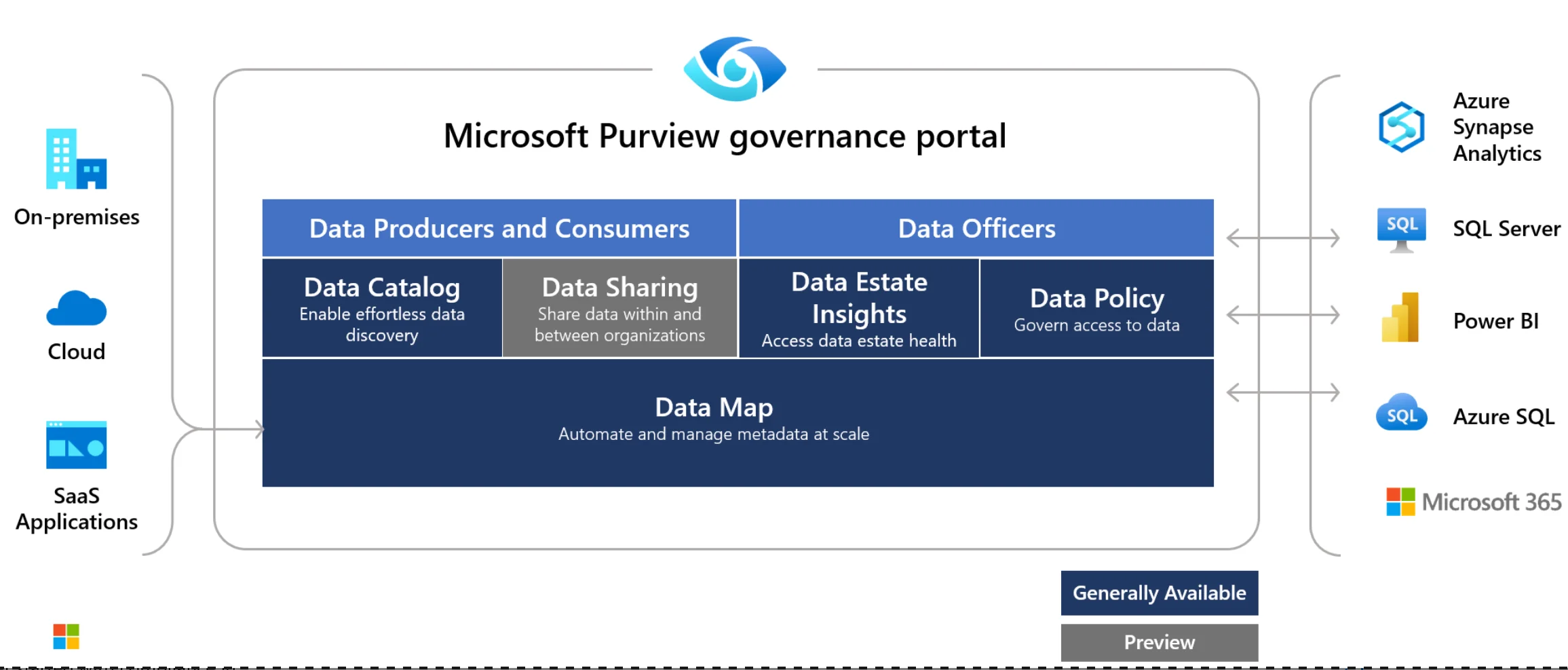
Microsoft Purview governance portal. Image by Microsoft.
Databricks Unity Catalog
Databricks Unity Catalog is a centralized governance and metastore layer for the Databricks Lakehouse Platform. Introduced in 2021, it provides real-time access control, automated lineage, data discovery, and AI asset governance within Databricks workspaces.
As of December 2025, over 60% of the Fortune 500 rely on Databricks.
Unity Catalog’s core strengths include:
- Real-time, automatic column-level lineage across all Databricks assets, including tables, views, notebooks, dashboards, and ML models.
- Fine-grained access control at the table, row, and column level using ANSI SQL, plus attribute-based access control (ABAC).
- Open-source APIs (Apache 2.0) with compatibility for the Iceberg REST Catalog API and Hive Metastore API.
- Multi-format support for Delta Lake, Apache Iceberg (via UniForm), Hudi, Parquet, CSV, and JSON.
- AI/ML governance, including model lineage, experiment tracking via MLflow, and AI agent governance.
- Lakehouse Federation for querying data in external sources like PostgreSQL, MySQL, Snowflake, and AWS Glue without data movement.
- Unity Catalog Metrics for defining business KPIs as first-class data assets, plus a new Discover experience for business user data discovery.
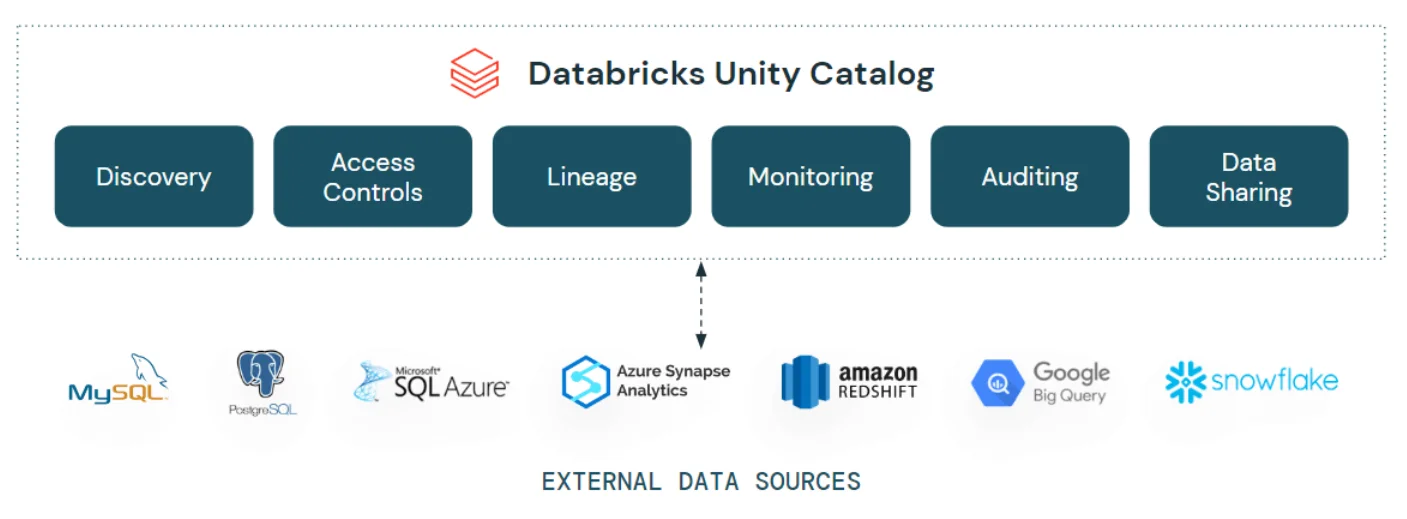
Databricks Unity Catalog. Image by Databricks.
What changed when Databricks open-sourced Unity Catalog?
Databricks open-sourced Unity Catalog under an Apache 2.0 license in June 2024, eliminating vendor lock-in as a barrier to adoption. You can now run Unity Catalog independently of a Databricks subscription, integrate it with engines like Spark, Trino, DuckDB, and Snowflake via the Iceberg REST Catalog API, and govern Delta Lake, Iceberg, and Hudi assets through a single standards-based catalog.
The open-sourcing fundamentally alters the vendor lock-in calculus. UC OSS provides a catalog and access control foundation. It does not include the enterprise features of Databricks’ managed service, such as automated lineage, Lakehouse Monitoring, Delta Sharing, and Predictive Optimization. It also lacks business glossary management, governance workflows for non-technical users, and embedded collaboration between data producers and consumers.
Purview and Unity Catalog: competitors or complements
Purview and Unity Catalog are complements, not competitors. Unity Catalog enforces real-time governance inside Databricks. Purview provides enterprise-wide cataloging and compliance across Azure, Fabric, Microsoft 365, and other sources. Most enterprises running Databricks on Azure deploy both tools together.
Data governance operates across three layers:
- Technical enforcement (Unity Catalog). Governs data and AI assets inside the Databricks Lakehouse. Manages real-time access controls, automated lineage, data classification, and ML model governance. Primary users are data engineers, data scientists, and analysts working directly in Databricks.
- Enterprise visibility and compliance (Microsoft Purview). Governs data across the entire organizational estate, spanning Azure storage, Microsoft Fabric, Power BI, Microsoft 365, Databricks, Salesforce, on-premises databases, and more. Primary users are compliance officers, data stewards, IT administrators, and business users who need a single view across all data assets.
- Business stewardship and cross-platform orchestration (Atlan). Unifies governance across all tools and ecosystems, including those outside Microsoft and Databricks, with business glossaries, embedded collaboration, workflow automation, and metadata orchestration. Primary users are cross-functional teams: data product owners, business analysts, governance leads, and domain stewards.
When all three layers connect, technical metadata flows from Unity Catalog into Purview’s enterprise catalog. A platform like Atlan provides the connective tissue that makes governance actionable across the full stack.
How do Purview and Unity Catalog compare across eight key dimensions?
Purview delivers broader cross-platform discovery, classification, and compliance across 200+ sources. Unity Catalog delivers deeper real-time lineage, row-level security, and native AI/ML governance inside Databricks. The key difference: Purview governs width across your estate; Unity Catalog governs depth within the lakehouse.
1. Data discovery
Purview’s search spans Azure, on-premises, and SaaS sources, including natural language queries and AI-powered Copilot recommendations. Unity Catalog’s search is optimized for lakehouse assets: tables, models, and dashboards within Databricks.
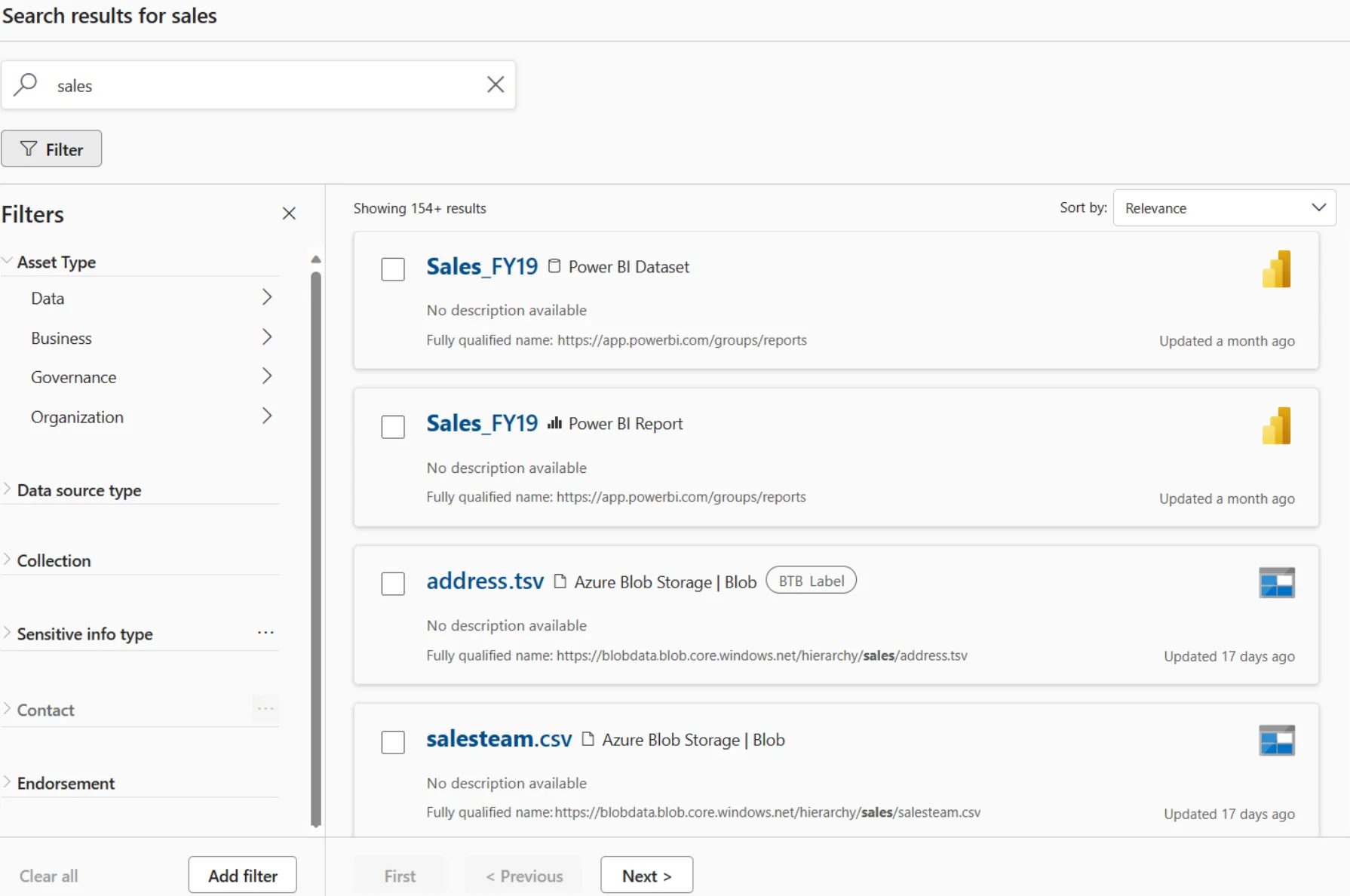
Microsoft Purview Data Catalog search interface. Image by Microsoft.
If you need to find data across your entire estate, Purview is the broader tool. For lakehouse-specific discovery, Unity Catalog is faster and more precise.
| Aspect | Microsoft Purview (Unified Catalog) | Databricks Unity Catalog |
|---|---|---|
| Discovery scope | Broad: entire enterprise data estate across platforms | Deep but narrow: optimized for the Databricks ecosystem |
| Data products | Groupings of related data assets discoverable by business users without technical expertise | Curated internal marketplace of certified data products organized by business domains |
| AI capabilities | Copilot-powered recommendations; search by governance domain | AI-powered recommendations within the Discover experience |
| Source coverage | On-premises, multi-cloud, and SaaS data sources | Databricks-native sources + federated external sources via Lakehouse Federation |
| Discovery signals | Governance-oriented: CDE coverage, OKR linkages, data product adoption | Usage-oriented: data popularity, ownership, tags, freshness, usage patterns |
| Target users | Business users and governance teams across the enterprise | Data teams and analysts primarily within the Databricks ecosystem |
| Key strength | Width: platform-agnostic, enterprise-wide discovery | Depth: rich operational metadata and usage insights within its ecosystem |
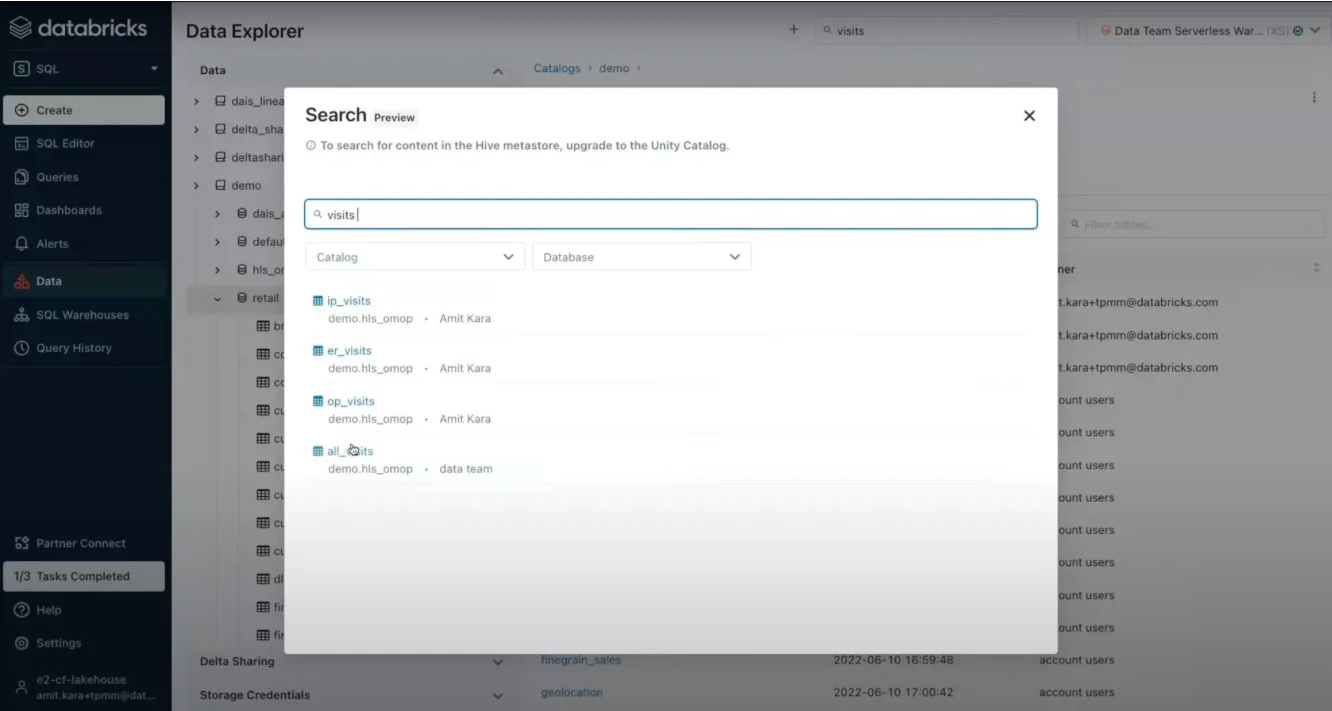
Unity Catalog Search and Discovery. Image by Databricks.
2. Data lineage
Both tools offer column-level lineage, but Unity Catalog captures it automatically across any code you write in your Databricks workspace, not just SQL. Purview tracks lineage at the entity and column levels for Azure assets and captures job execution status for root-cause analysis.
| Aspect | Microsoft Purview | Databricks Unity Catalog |
|---|---|---|
| Lineage granularity | Entity-level and column-level across Azure data assets | Automatic column-level lineage for all Databricks workloads |
| Capture method | Scan-based (periodic extraction); not real-time | Real-time, automatic capture as code executes |
| Language support | Primarily captures lineage from pipeline definitions and notebook runs | Full support for Python, Scala, R notebooks, and SQL |
| Cross-platform reach | Broad — spans the Microsoft ecosystem and connected data sources | External lineage support introduced in June 2025 |
| Key strength | Width: lineage visibility across many platforms and services | Depth: granular, real-time, automatic lineage within Databricks |
3. Security and access control
Purview provides role-based access control, sensitivity labels, and a single pane of glass to manage access to Azure data sources. Unity Catalog goes more granular, with row- and column-level security defined through an SQL interface.
| Aspect | Microsoft Purview | Databricks Unity Catalog |
|---|---|---|
| Core role | Classification, labeling, and policy definition | Direct access enforcement at the compute layer |
| Access control model | RBAC, sensitivity labels, and access policies for data products | Fine-grained row-level filters, column masking, and table-level permissions using ANSI SQL; ABAC added June 2025 |
| Enforcement scope | Does not directly enforce inside Databricks; passes classification context to enforcement systems | Enforces consistently across all Databricks workloads: notebooks, SQL warehouses, and jobs |
| Key strength | Visibility: identifies what should be protected across the entire estate | Enforcement: controls who can access what directly, where queries execute |
4. AI and ML governance
Microsoft Purview approaches AI governance from a security and compliance perspective. Its Data Security Posture Management (DSPM) for AI identifies which data assets Microsoft 365 Copilot and other AI agents can access, flags overexposed sensitive data, and provides remediation workflows. Purview also enforces DLP policies on AI prompts, generates audit trails for AI-assisted decisions, and integrates with Azure AI Foundry.
Unity Catalog approaches AI governance from an operational and model lifecycle perspective. It tracks model lineage end-to-end — from training data through feature engineering to deployed endpoints, using MLflow 3.0. AI agents and GenAI tools are cataloged as first-class assets, with the same fine-grained access controls as tables and columns.
| Aspect | Microsoft Purview | Databricks Unity Catalog |
|---|---|---|
| Key capabilities | DSPM for AI, governance of M365 Copilot interactions, DLP policies for AI prompts, integration with Azure AI Foundry | Model lineage tracking, experiment management via MLflow, AI agent governance, cataloging GenAI tools as first-class assets |
| Core distinction | Governs AI in the Microsoft/Copilot ecosystem | Governs AI within Databricks |
| When to use | You deploy Microsoft Copilot and Azure AI services | You run AI/ML workloads on Databricks |
5. Data quality
Purview’s quality rules evaluate completeness, accuracy, consistency, and uniqueness across governed assets. A Data Observability view (in preview) combines lineage and quality metadata in a single diagram, giving governance teams a bird’s-eye view of data estate health.
Unity Catalog’s approach centers on Lakehouse Monitoring, which provides continuous observability for tables managed within Databricks. Lakehouse Monitoring automatically profiles data and surfaces quality signals alongside other governance metadata. Quality metrics are tightly integrated with Unity Catalog’s lineage, so teams can trace a quality issue back to the upstream table or transformation that caused it.
| Dimension | Microsoft Purview | Databricks Unity Catalog |
|---|---|---|
| Core capability | Data quality engine in the Unified Catalog | Lakehouse Monitoring for data quality observability |
| Profiling | Data profiling and rule-based scanning | Automated profiling within Databricks |
| Anomaly detection | Data Observability view (Preview) combines lineage and quality metadata | Automated anomaly detection surfaces quality signals in the catalog UI |
| Visualization | Data Observability view merges lineage + quality metadata into one diagram | Quality signals surface within the catalog UI alongside governance metadata |
6. Integration with existing tools
Purview integrates natively with the Azure stack. Connecting non-Azure assets adds complexity. Unity Catalog works well within Databricks but requires additional solutions for broader integration. Both are ecosystem-first tools, which is why teams with multi-cloud stacks often layer an independent governance platform across both.
| Dimension | Microsoft Purview | Databricks Unity Catalog |
|---|---|---|
| Integration philosophy | Breadth-focused: scans many sources into one catalog | Depth-focused: governs deeply within the lakehouse and interoperates via open APIs |
| Native ecosystem | Azure and Microsoft 365 | Databricks ecosystem (Lakehouse, Delta Lake, MLflow) |
| External source coverage | Scans 200+ data sources, including AWS S3, Google Cloud, Snowflake, SAP, Salesforce | Extends via Lakehouse Federation and Delta Sharing |
| Limitation | Connecting non-Azure assets adds complexity | Requires additional solutions for governance beyond the Databricks environment |
7. Cost and pricing
Purview uses a consumption-based pricing model, where you pay for governed assets and processing units. Unity Catalog comes included with Databricks Premium or Enterprise subscriptions, making it the lower-friction option if you’re already on those tiers.
Microsoft Purview shifted to a new pricing model on January 6, 2025. Scanning data assets into the Data Map is now free. Charges are based on two meters: governed assets (unique data assets linked to governance concepts per day) and data governance processing units for quality scans and related operations.
Unity Catalog is included with Databricks Premium or higher tiers at no additional cost. The open-source version is available under Apache 2.0 at no cost for teams that don’t need the managed enterprise features.
8. Deployment and management
Purview is a cloud-native SaaS solution you provision through the Azure portal with no infrastructure to manage. Unity Catalog is automatically enabled for new Databricks Premium workspaces. Deployment complexity scales with the number of data sources you need to connect.
Microsoft Purview deployment typically takes two to four weeks for initial setup: provisioning the service, configuring connections to data sources, and setting up governance domains, data products, and policies.
Databricks Unity Catalog is integrated into the Databricks workspace and is automatically enabled for new customers on Premium or higher tiers. Deployment is fast, typically days to a few weeks for initial enablement.
The integration between Unity Catalog and Purview currently operates as a “pull” mechanism, where Purview must scan Unity Catalog for changes. Incremental scanning support has been improving.
Can Purview and Unity Catalog work together?
Yes, and most enterprises running Purview and Unity Catalog should integrate them. Microsoft Purview scans Azure Databricks Unity Catalog metastores directly, bringing Unity Catalog metadata into Purview’s data map alongside your other Azure assets. Unity Catalog handles technical governance inside Databricks while Purview provides the enterprise-wide catalog and compliance layer across your entire data estate.
Here’s how the integration works:
- Purview scans Unity Catalog: Microsoft Purview registers and scans Azure Databricks Unity Catalog metastores directly. This pulls Databricks metadata, including catalogs, schemas, tables, views, columns, and classifications, into Purview’s enterprise Data Map.
- Lineage capture: Purview supports fetching lineage from Unity Catalog, including relationships between tables, views, and columns during notebook runs.
- Data quality for Databricks: In 2025, Microsoft launched Data Quality support for Azure Databricks Unity Catalog in Purview’s Unified Catalog — run data profiling and rule-based quality scans on Databricks data directly from Purview.
Here’s an overview of when to use each vs. both tools:
| Scenario | Recommended approach | Why |
|---|---|---|
| Azure-only stack, no Databricks | Purview only | Covers your full estate with native Azure integrations |
| Databricks-only, no Azure requirements | Unity Catalog only | No extra cost, native governance inside the lakehouse |
| Databricks + Azure (most enterprises) | Both, integrated | Complementary scopes; UC enforces, Purview catalogs |
| Multi-cloud + Databricks | Both + Atlan | Cross-cloud governance gap that neither tool fills alone |
| Governance for business users and engineers | Both + Atlan | UX gap in both tools for cross-functional collaboration |
Where do Purview and Unity Catalog fall short?
Even deployed together, Purview and Unity Catalog leave gaps in cross-platform lineage, embedded collaboration, and actionable governance workflows. Neither tool traces data end-to-end across non-native ecosystems, and both lack built-in integrations with operational tools like Jira and Slack for acting on governance insights.
| Gap Area | What’s Missing | Microsoft Purview | Databricks Unity Catalog |
|---|---|---|---|
| Ecosystem Boundaries | Full governance beyond the native ecosystem | Deepest integrations are Azure-first; non-Microsoft tools require more configuration | UC OSS doesn’t catalog or govern data in tools like Snowflake, Looker, Tableau (beyond Databricks-connected assets) |
| Cross-Platform Lineage | End-to-end lineage across both systems and beyond | Cannot independently trace data across non-Microsoft systems | Cannot independently trace data across non-Databricks systems |
| Business Context and Collaboration | Embedded collaboration, business glossary, and workflow automation for cross-functional teams | Improved with data products and CDEs, but lacks deep cross-functional workflows | Added business user features, but the same cross-functional collaboration gaps apply |
| Actionable Lineage | Ability to act on lineage insights without switching tools | Visualizes lineage, but acting on it requires switching to other applications | The same limitations apply |
What happens when governance tools run disconnected?
Disconnected governance tools create four critical failure patterns: compliance blind spots, stale metadata, cross-platform silos, and technical compliance without business alignment. Gartner estimates 20–30% of enterprise revenue is lost to data inefficiencies rooted in these gaps.
Here are four documented failure patterns that enterprise data teams encounter:
- Unity Catalog without Purview: You get a compliance blind spot. Databricks data becomes invisible to the enterprise compliance layer. Compliance teams can’t see what data exists in the lakehouse, what sensitivity labels apply, or how it relates to Azure, Power BI, or on-premises assets.
- Purview without Unity Catalog: You observe stale governance. Purview’s scan-based approach captures snapshots rather than the real-time state. Access control changes, new tables, schema modifications, and lineage updates between scans stay invisible.
- Either tool without cross-platform orchestration: You get metadata silos. Together, they solve the Microsoft + Databricks problem, but most stacks also include Snowflake, dbt, Tableau, Looker, Airflow, Fivetran, or SaaS apps.
- Governance tools without a business glossary: You achieve technical compliance without organizational alignment. Access controls work, lineage is captured, scans run on schedule, but business users still can’t find data, understand field meanings, or trace data to business outcomes.
FAQs: Purview vs. Databricks Unity Catalog
Are Microsoft Purview and Databricks Unity Catalog competitors?
No. Purview governs your entire data estate — Azure, Microsoft 365, on-premises, and multi-cloud sources. Unity Catalog governs your Databricks lakehouse. Most enterprises running Databricks on Azure use both. They operate at different layers and solve different governance problems.
When should you use Purview only vs. Unity Catalog only?
Use Purview alone when your data estate is primarily Microsoft-centric (Azure, Fabric, M365) and you don’t use Databricks. Use Unity Catalog alone when all your governed data lives inside Databricks and you don’t need cross-cloud or SaaS governance. Most mid-to-large enterprises end up deploying both.
What changed when Databricks open-sourced Unity Catalog?
In June 2024, Databricks released Unity Catalog under the Apache 2.0 license. This means organizations can run Unity Catalog outside of Databricks Cloud. The open-source release also enabled third-party vendors to integrate with Unity Catalog’s governance model directly.
How does Microsoft Purview pricing work in 2025?
Purview shifted to a governed-assets-based pricing model in January 2025. Scanning is now free. Charges apply based on the number of unique governed assets per day. This replaced the earlier scan-based billing model and makes costs more predictable for large estates.
How do Purview and Unity Catalog work together?
Purview scans and classifies data across your broad estate, including assets outside Databricks. Unity Catalog enforces row-level and column-level access control on your Databricks lakehouse in real time. In a Microsoft + Databricks stack, Purview governs the outer estate and Unity Catalog governs the inner lakehouse. Teams often add an independent catalog like Atlan to unify the metadata layer across both.
How does Atlan extend Purview and Unity Catalog?
Even when Purview and Unity Catalog run together, most enterprise teams still face gaps — particularly for multi-cloud estates, business user governance, and cross-system lineage. Atlan complements both tools by extending discovery, lineage, and access control beyond their native ecosystems.
Atlan integrates with both Microsoft Purview and Databricks Unity Catalog via REST APIs, while connecting to the rest of your stack through native connectors: Snowflake, dbt, Tableau, Looker, Fivetran, Airflow, and dozens more.
Your data teams search and discover assets across the entire data estate in natural language, regardless of which platform hosts them. Atlan’s lineage mapping spans multiple systems and multi-cloud environments, providing a unified view that neither Purview nor Unity Catalog delivers on its own.
Atlan’s lineage is actionable. From within a lineage view, users get to raise Jira support tickets, start Slack conversations, alert downstream consumers, or trigger automation workflows without leaving the platform. Atlan provides granular, column-level access policies through a no-code interface, making governance accessible to non-technical users.
Atlan is recognized as a Leader in the 2025 Gartner Magic Quadrant for Metadata Management Solutions. Atlan works with your team to create a custom strategy and implementation plan, achieve widespread adoption of the first use case in as little as 90 days, and roll out additional use cases throughout the year.
