

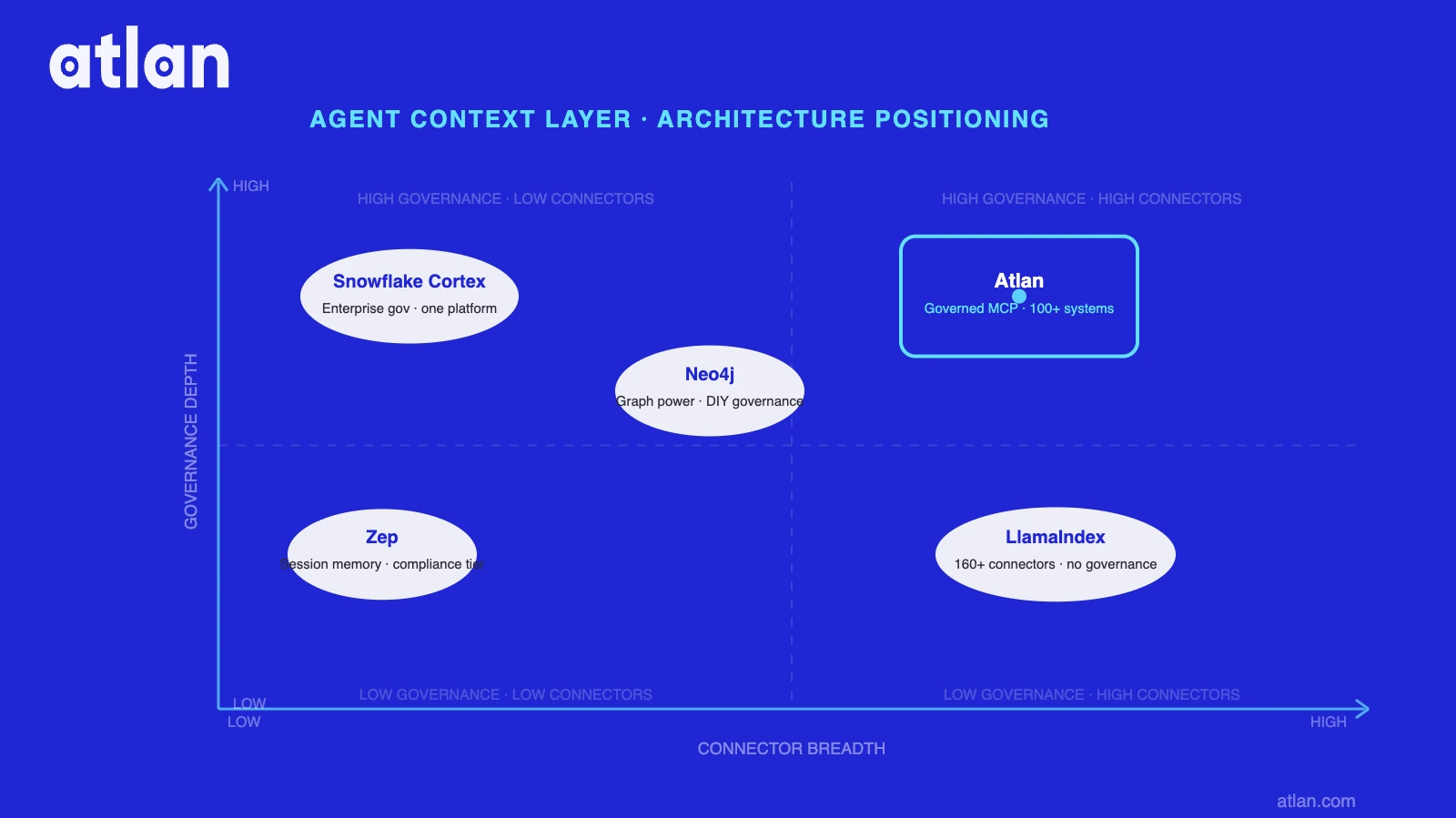
Five tools are most frequently mentioned when enterprise teams evaluate what an agent context layer is: Atlan, Snowflake Cortex, Neo4j, Zep/Graphiti, and LlamaIndex. Across more than 30 comparison pages currently ranking on this topic, not one uses governance depth, MCP support, and cross-platform portability as the primary evaluation axes. Those three dimensions are also the ones that most directly determine whether a tool functions as a context layer or a context feature – and the distinction has real consequences for context-aware AI agents operating in production. This page scores all five tools honestly on those dimensions so you can match the right tool to your actual architecture.
How we evaluated these five tools
The weights below reflect what enterprise teams consistently report as the hardest problems to retrofit after initial deployment. Governance is weighted highest because governance retrofitted after the fact costs significantly more than governance built in from the start.
| Criteria | Weight | Why it matters |
|---|---|---|
| Governance depth | 25% | Certification workflows, automatic policy propagation, and governance audit trails are required for production AI in regulated environments. See: AI agent risks and guardrails. |
| Cross-platform portability | 20% | Most enterprises run 3-5 data platforms. Platform-native tools cover 20-40% of a typical multi-platform data estate; cross-platform layers cover 60-80%+. See: unified context layer. |
| MCP support | 15% | 78% of enterprise AI teams report at least one MCP-backed agent in production (April 2026). The distinction that matters: consuming MCP servers vs. being a governed MCP server. See: when to use MCP vs. API. |
| Lineage support | 15% | Column-level lineage is required for AI answer traceability. Without it, you have retrieval attribution but not data provenance. See: metadata layer for AI. |
| Freshness / update model | 10% | Stale context produces confidently wrong answers. Active metadata propagation is the differentiator from scheduled re-ingestion. |
| Multi-agent coordination | 10% | Specialized agents in parallel need a shared context substrate to prevent definition drift. See: multi-agent system orchestration. |
| Auditability | 5% | Decision traces are required for enterprise compliance. This weight will rise as EU AI Act and similar regulations mature. See: AI agent observability. |
| Developer experience | Not weighted | Governance tools that developers work around provide no governance. All five tools are assessed qualitatively on DX. |
Feature comparison matrix
The nine columns below map to the criteria above. Ratings are based on primary source documentation, independent research, and verified customer evidence. “Partial” signals a capability that exists but is scoped or requires significant engineering to reach enterprise quality.
| Tool | Cross-platform coverage | MCP support | Governance depth | Lineage support | Freshness / update model | Multi-agent support | Auditability | Pricing model | Ideal for |
|---|---|---|---|---|---|---|---|---|---|
| Atlan | Yes – 100+ data sources (warehouses, BI, SaaS, orchestration) | Yes – governed MCP server; policy-enforced context delivery | Enterprise – certification workflows, RBAC/ABAC propagation, business glossary, governance audit trail | Column-level lineage across all connected systems; exposed via MCP | Active metadata – changes auto-propagate; Context Agents generate ~80% of documentation | Yes – shared governed context plane for N agents; Context Repos per use case | Full – every MCP query logged with agent identity, timestamp, and policy version | Enterprise custom | Multi-platform organizations needing governed, auditable cross-system context for production AI agents |
| Snowflake Cortex | Platform-native – Snowflake only; CLI reads dbt/Airflow configs for code generation, not governed cross-platform context | Partial – official MCP server for Snowflake warehouse context only | Enterprise (within Snowflake) – Horizon Catalog: RBAC/ABAC, sensitive-data tagging, three-tier approval system | Column-level lineage within Snowflake; External Lineage API covers some cross-system relationships | Warehouse-native – always current for Snowflake objects; external context requires CLI re-read | Yes – Cortex Agents orchestrates multi-step workflows; A2A in roadmap | Strong (Snowflake-scoped) – SNOWFLAKE.LOCAL.AI_OBSERVABILITY_EVENTS system table; audit trail ends at warehouse boundary | Consumption-based – $2.00/credit (April 2026); included in most Snowflake enterprise tiers | Organizations standardized on Snowflake as primary warehouse with agents primarily querying Snowflake data |
| Neo4j | Partial – can represent any system as graph nodes, but cross-platform ingestion requires custom ETL pipelines | Yes – official MCP server, announced 2 October 2025 and GA at v1.0.1 that December; works with Aura, self-managed, Docker, Desktop and Sandbox. Requires the APOC plugin | Database-level – Neo4j Enterprise ships native role-based access control scoping read privileges to specific labels, relationship types and properties, plus LDAP and Active Directory integration. Certification state, a business glossary and ownership are modeled into the schema by the team that builds it | Graph traversal-native; enterprise data lineage must be built and maintained | Manual / pipeline-driven – no active metadata; freshness tied to ingestion schedule | Yes – Aura Agent (GA; $0.35 per agent hour for publicly accessible agents) with ontology-driven agent construction and a hosted MCP endpoint; the Labs agent-memory package adds three memory layers; integrates with AWS AgentCore, Azure AI Foundry, Databricks | Database-level – Neo4j Enterprise writes a query log and a security events log; correlating those into an asset-level audit trail across source systems is work the team does | Community free (GPL v3); AuraDB Professional $65/GB/month, Business Critical $146/GB/month; self-managed Enterprise and Aura Virtual Dedicated Cloud are quoted, not published | Graph-native use cases (supply chain, fraud, recommendation); developer teams with resources to build governance pipelines |
| Zep / Graphiti | Application-scoped – ingests what the application explicitly writes; no live sync from enterprise data systems | Partial – Graphiti MCP Server v1.0 (Nov 2025, Pro tier+); memory-scoped, not enterprise metadata | Compliance-layer – SOC 2 Type 2, HIPAA, GDPR (Enterprise tier); access governance for memory graph, not semantic data governance | None (enterprise data pipeline lineage); temporal versioning of facts within conversation scope only | Real-time continuous ingestion – strongest freshness within its scope (agent session data ingested actively) | Partial – designed for single-agent memory; shareable graph supports multi-agent; not designed for multi-agent data coordination | Enterprise tier only – SSO + RBAC + Auditing for memory graph access; conversation reconstruction possible | Graphiti open source (Apache 2.0; needs a graph backend, with Neo4j, FalkorDB, Kuzu and Amazon Neptune all supported); Zep Cloud Pro $99/month; Enterprise custom | Conversational agents needing durable, evolving memory of user preferences and decisions; regulated industries needing compliance documentation |
| LlamaIndex | Strong for retrieval breadth (160+ connectors via LlamaHub); limited for governed context – connected for retrieval is not governed with lineage | Partial – MCP consumer (llama-index-tools-mcp calls MCP tools); can create MCP-compatible servers; not a governed MCP server | None – no built-in data governance; relies entirely on upstream data quality from source systems | None (enterprise lineage); source attribution for RAG responses only | Index refresh – scheduled re-ingestion or event-triggered; changes do not auto-propagate | Strong – LlamaAgents multi-agent orchestration; native A2A protocol support (2026) | Query-level – documents retrieved per query; no data-governance audit trail | Open source (MIT, free); LlamaCloud enterprise custom | Developer teams building RAG applications and agentic workflows where governance exists upstream; prototyping and retrieval-first use cases |

The four architecture approaches
These five tools represent four distinct approaches to providing context for AI agents. Understanding where each approach sits in the agent stack is more useful than any single feature comparison, because the architectural position determines what the tool can and cannot govern.
For a deeper look at how these architectures are designed, see agent context layer design.
Platform-native context (Snowflake Cortex)
Snowflake Cortex embeds the context layer inside the data platform itself. Cortex Code, Cortex Analyst, Cortex Search, and Cortex Agents all operate within the Snowflake boundary, backed by Horizon Catalog for governance, semantic views for business definitions, and a three-tier approval system for agent actions. The AI Observability system table provides a complete audit trail for every Cortex operation – token counts, models used, timing, execution context. For a detailed look at this architecture pattern, see context layer for Snowflake.
This is a genuinely strong architecture for Snowflake-centric organizations. When 70% or more of an organization’s data lives in Snowflake, Cortex plus Horizon Catalog provides a coherent, deeply integrated context and governance story with no additional platform to procure. The platform-native limitation is not a flaw – it is a design choice. Snowflake is building a coherent AI stack for Snowflake-native organizations, and that stack is excellent within its scope.
The honest limitation is scope. Snowflake’s own documentation acknowledges: “Snowflake doesn’t have the context for all the other systems in the enterprise data ecosystem.” Cortex Code’s CLI expansion reads dbt, Airflow, and Databricks configurations, but this is code generation assistance, not governed cross-platform context delivery. An organization running Snowflake alongside Databricks, BigQuery, Tableau, and 50 SaaS tools will reach the boundary of what Cortex can govern – not because Cortex is weak, but because it is designed for one platform. For those organizations, the context layer vs. semantic layer distinction becomes critical.
Graph-native context (Neo4j)
Neo4j positions the graph database as the context substrate. Neo4j announced its official MCP server on 2 October 2025 and shipped the fully supported version 1.0.1 that December; Neo4j Labs had published community MCP servers since December 2024. The server exposes four tools to an agent: get-schema, read-cypher, write-cypher and list-gds-procedures. It runs against Aura, self-managed instances, Docker, Desktop and Sandbox, and it needs the APOC plugin installed on the instance. The graph’s natural strength is relationship modeling, representing how entities relate to each other in ways that a flat metadata store cannot capture. For an introduction to the underlying concept, see what a knowledge graph is.
Neo4j has also moved up the stack rather than standing still. Aura Agent is generally available at $0.35 per agent hour for publicly accessible agents, free on Aura Free and priced the same across Professional and Business Critical. It builds agents from an ontology rather than from hand-written orchestration code, does multi-hop graph reasoning with chain-of-thought explainability, and deploys in one click to a hosted, secured MCP and REST endpoint. If the question is “can Neo4j serve context to an agent without a bespoke assembly project,” the answer in 2026 is yes for a graph you already own.
The question that remains is where the graph’s contents come from. Aura Agent reasons over the graph you give it, and populating that graph from Snowflake, dbt, BI tools and operational systems is still ETL the team writes and maintains, along with the freshness jobs that keep it current and the modeling work that puts certification state, a business glossary and quality classification into the schema. Neo4j Enterprise governs what it holds: role-based access control scopes read privileges to specific labels, relationship types and properties, and integrates with LDAP and Active Directory. That scope is the graph database, not the source systems feeding it.
A documented problem specific to the MCP integration is the “Identity Vacuum,” and Neo4j is the one that documented it. In STDIO mode the server authenticates to the database with a single static credential, so every request runs under the same identity regardless of who triggered it. Neo4j’s own fix, published in April 2026, is to run the server in HTTP transport mode and pass the user’s OIDC Bearer token through with each request; per-request Bearer and Basic auth are documented configuration options. Wiring that up, and keeping it wired across every tool call, is the team’s work. Compare what a context graph is vs. what a context layer provides to understand the gap.
Retrieval-native context (LlamaIndex)
LlamaIndex occupies the retrieval and orchestration layer. LlamaHub’s 160+ connectors ingest from diverse sources; index structures (vector, keyword, knowledge graph) make content queryable; the query engine executes RAG pipelines; LlamaAgents orchestrates multi-step workflows with native A2A protocol support. As a retrieval framework, LlamaIndex is excellent – the lowest barrier from “I have documents” to “my agent can answer questions about them.” For a detailed look at where retrieval fits versus context layers, see agent context layer vs. RAG.
The governance gap is complete. LlamaIndex has no built-in data governance: no certification workflow, no asset-level access control, no sensitive data classification, and no automatic policy propagation. The framework relies entirely on upstream data quality from source systems. Industry analysis is explicit: “The governance layer has no dominant open-source option as of 2026; enterprise teams typically use a commercial platform for that layer.” This is not a criticism of LlamaIndex – it is an accurate description of its architectural role. LlamaIndex is retrieval plumbing; the context layer is upstream. For the common failure modes this creates, see RAG accuracy problems.
In a well-architected enterprise agent stack, LlamaIndex handles retrieval orchestration while an enterprise catalog handles governance upstream. The two are complementary, not competing. See enterprise RAG platforms compared for how this layering works in practice.
Enterprise context layer (Atlan)
Atlan is the context layer for AI – the horizontal governed substrate that sits between all data sources and all agent frameworks, independent of which platform holds the data. Its Enterprise Data Graph unifies metadata from 108 connectors as of September 2026: warehouses (Snowflake, Databricks, BigQuery, Redshift), BI tools (Tableau, Looker, Power BI), orchestration (dbt, Airflow), and SaaS operational systems. Every agent framework – Claude, Cortex Agents, LlamaAgents, custom – connects to the same governed substrate through a single native MCP server. One context layer. Every agent. Any tool.
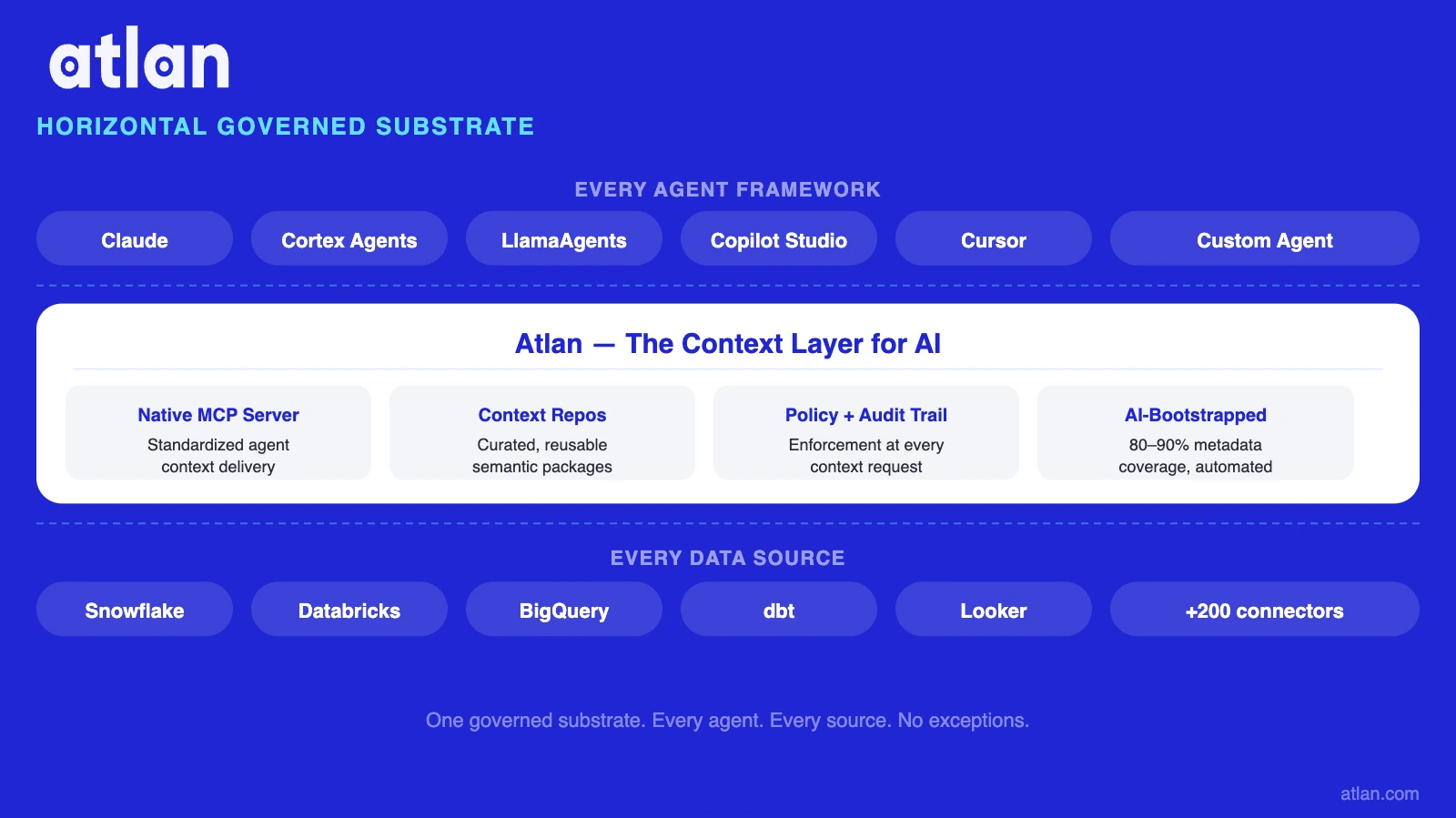
What separates Atlan from every other tool in this comparison is that the context layer is governed by default, not retrofitted. Every query through the Atlan MCP server is policy-checked: agents only see what access controls permit, every delivery is logged with agent identity and policy version, and every governance decision is versioned and attributable. Context Repos allow different agents to receive different certified context slices from the same underlying substrate – so a finance agent and a marketing agent share the same governed layer but see only what they are authorized to see.
Building the context layer does not start from scratch. Context Engineering Studio reads the Enterprise Data Graph – SQL query history, BI semantics, lineage, pipeline code, business glossaries – and AI bootstraps 80–90% of the context layer from those existing signals. Domain experts contribute the final 10–20%: business logic, exceptions, and tribal knowledge that only humans can validate. One insurance customer compressed a twelve-month documentation build into a single month using this pipeline.
The evidence is reproducible: Atlan AI Labs measured a 38% improvement in AI SQL accuracy across 522 enterprise queries when agents were grounded in governed context (p<0.0001), with a 2.15x improvement on medium-complexity queries. Workday reported 5x improvement in AI analyst response accuracy after connecting agents to shared business context via Atlan’s MCP server. For the full architecture, see core components of a context layer.
The honest scope: Atlan is not a database or retrieval framework – it requires integration with existing data infrastructure. For teams fully within the Snowflake ecosystem who do not need cross-platform context, Snowflake’s native tools may cover the basics without adding a separate platform. Atlan also does not manage session-level conversational memory the way Zep does – those are complementary layers, not competing ones.
How to choose: a decision guide
The right tool depends on your data estate, your governance requirements, and your current phase (prototype vs. production). Work through these steps in order.
1. Single-platform or cross-platform?
If 70% or more of your data lives in Snowflake and your agents primarily query Snowflake data, Snowflake Cortex with Horizon Catalog is the natural starting point. It is well-integrated, consumption-billed, and requires no additional platform procurement. If you need cross-system context – joining definitions from Snowflake, Databricks, Salesforce, and BI tools in a single agent workflow – Cortex alone will not cover the full data estate.
2. Is enterprise governance required?
Governance means: certified business definitions, automatic access policy propagation, column-level answer traceability, and an audit trail for every agent context query. If your use case touches financial reporting, customer data, healthcare records, or any compliance-audited process, governance is not optional. Skip to Atlan (cross-platform) or Snowflake Cortex (Snowflake-native) – both provide enterprise governance within their respective scopes. Retrofitting governance after deployment consistently costs 3-5x more than building it in from the start. See whether enterprises need a context layer for the full rationale.
3. Is MCP protocol support required?
If your agent frameworks use MCP as the standard integration protocol (currently 78% of enterprise AI teams in production), check MCP support depth – not just whether a tool has an MCP server, but whether that server enforces governance policies on context delivery. Atlan, Neo4j, and Zep all have MCP servers. Only Atlan’s MCP server is governed – it enforces access control and logs every context delivery.
4. Is graph relationship modeling the primary use case?
If the core intelligence problem involves complex entity relationships – supply chain provenance, fraud network analysis, recommendation engines – Neo4j is genuinely well-suited. The graph traversal capability, relationship modeling, and native MCP server make it a strong choice for graph-native problems. The tradeoff is engineering investment for governance and freshness.
5. Is conversational memory the primary use case?
If agents need durable, evolving memory of user preferences, past decisions, and evolving business facts across sessions, Zep/Graphiti is the purpose-built tool. The temporal knowledge graph stores when facts were true, not just whether they are currently true – a genuinely differentiated capability for types of AI agent memory. Zep Enterprise provides SOC 2, HIPAA, and GDPR compliance for regulated industries. For more context on where memory fits in the broader architecture, see memory layer vs. context layer.
6. Is retrieval-first with developer flexibility the priority?
If the primary goal is getting documents and structured data queryable by agents quickly, with maximum developer flexibility, LlamaIndex is the lowest-friction path. Use it as the retrieval layer in a larger stack. Plan for a governed enterprise catalog upstream when moving from prototype to production. See best AI agent memory frameworks 2026 for how this fits into the broader tooling landscape.
The evaluation framework and scoring rubrics are set out in full below.
Platform-native tools are context features, not context layers
The most important distinction this page makes is between a context feature and a context layer. Platform-native tools like Snowflake Cortex solve the context problem within their ecosystem – and they solve it well. Horizon Catalog is a genuine enterprise governance product for Snowflake data. Cortex Code’s accuracy numbers are real: Snowflake’s own research found that adding an ontology layer produces 20% higher accuracy and 39% fewer tool calls. The platform-native choice is not a weak choice; it is a scoped choice.
The problem emerges when agents need to answer cross-domain questions. “What is our Q4 revenue?” requires joining a Snowflake data warehouse definition with a Salesforce opportunity definition with a dbt transformation with a Looker metric. Each system has its own definition of “revenue.” A platform-native context tool governs the Snowflake portion. The cross-system join – the part that actually produces the business answer – remains unresolved. Agents in this situation hallucinate confidently, because they have partial context and no mechanism to detect the gap. This is the problem the enterprise context layer pattern is designed to solve.
A context layer is a substrate, not a feature. It is independent of any single data platform, governed by default, and serves all agent frameworks through a standard protocol. It does not replace platform-native tools – Atlan’s Snowflake Data Governance Partner of the Year 2025 relationship validates the complementary architecture: Atlan as the cross-platform context layer and Snowflake Cortex as the warehouse AI stack, with both MCP servers running in parallel in the same agent workflow. The context engineering platforms comparison page covers this layered architecture in greater detail.
For any organization where agents will eventually need to reason across systems, the substrate question has to be answered. Building governance into the context layer from the start is the decision that scales. The alternative – adding governance layer by layer to each platform’s context features – produces the fragmentation that the substrate pattern exists to prevent.
Frequently asked questions
1. Is Snowflake Cortex a context layer or a context feature?
Snowflake Cortex is a context feature – an excellent one, within its scope. It provides enterprise governance for Snowflake data via Horizon Catalog, semantic views, and a three-tier approval system. The distinction is portability: Cortex governs Snowflake objects. Cross-platform context (Databricks + Looker + Salesforce + SaaS) requires a complementary layer. For Snowflake-centric organizations, Cortex is sufficient. For multi-platform organizations, Cortex covers the Snowflake portion; an enterprise context layer covers the rest.
2. Does Neo4j qualify as an enterprise context layer?
Neo4j is a powerful graph database with a real agent story on top of it. The official MCP server, Aura Agent’s ontology-driven agent construction with a hosted MCP endpoint, native Enterprise role-based access control scoped to labels, relationship types and properties, and graph traversal are all documented capabilities. What Neo4j documents is governance of the graph it holds: privileges over graph elements inside Neo4j databases, a query log, and a security events log. Policies already defined on Snowflake, Databricks or a BI tool sit outside that scope, as does getting their metadata into the graph in the first place. Whether Neo4j qualifies as an enterprise context layer depends on whether your team builds and maintains that ingestion, that cross-system policy mapping, and the glossary and certification model in the schema. For graph-native use cases, that investment is often worth it.
3. What is the difference between Zep/Graphiti and an enterprise context layer?
Zep/Graphiti manages agent memory – durable, evolving facts about entities across conversation sessions. An enterprise context layer manages data governance – certified business definitions, access policies, column-level lineage, and semantic consistency across the full data estate. Both are called “context,” but they solve different problems at different layers of the agent stack. Zep is the right tool for conversational memory. It is not a substitute for governed enterprise metadata. The memory layer vs. context layer page covers this distinction in detail.
4. Does LlamaIndex have governance features for enterprise use?
LlamaIndex has no native data governance. LlamaCloud (the managed enterprise offering) provides SSO, platform audit logs, and compliance certifications for the LlamaCloud infrastructure – not data-level governance of the assets being retrieved. The distinction matters: you can audit who queried LlamaCloud, but not whether the data they retrieved was certified, correctly classified, or governed under an appropriate access policy. In enterprise deployments, LlamaIndex typically sits in front of a governed catalog that handles those concerns upstream.
5. Can Atlan and Snowflake Cortex work together?
Yes – this is the validated complementary architecture. Atlan’s MCP server and Snowflake’s official MCP server run in parallel; agents query both through the same standard protocol in the same workflow. Snowflake’s Data Governance Partner of the Year 2025 award validates this pattern: Atlan governs cross-platform context while Cortex provides warehouse-native AI capabilities. For organizations already on Snowflake, adding Atlan extends governance to the full data estate rather than replacing anything. See context layer for Snowflake for implementation details.
6. Which tool is best for multi-agent systems?
For multi-agent systems operating on shared enterprise data, the critical requirement is a consistent governed context substrate – all agents reading from the same certified definitions, access policies, and lineage graph. Atlan is designed for this pattern via Context Repos (different agents receive different context slices from the same governed layer). LlamaIndex and Neo4j support multi-agent orchestration patterns technically but do not provide governed semantic consistency across agents. Without a shared governed substrate, definition drift across the agent mesh produces conflicting answers. See multi-agent system orchestration for the full architecture discussion.
Sources
- Atlan. “38% improvement in AI agent SQL accuracy across 522 enterprise queries when grounded in context-rich metadata (p < 0.0001).” Atlan research, verified via multiple indexed pages including context-layer-vs-semantic-layer and context-layer-for-snowflake-cortex. 2026.
- Atlan. “690K+ descriptions auto-generated by Context Agents across 50+ enterprise customers in April 2026; 87% rated on par or better than human-written documentation.” Atlan press/blog. April 2026.
- Atlan. “Snowflake Data Governance Partner of the Year 2025.” atlan.com/snowflake-data-governance-partner-of-the-year-2025/. 2025.
- Atlan. Gartner Leader, Metadata Management Magic Quadrant 2025 and Data and Analytics Governance Magic Quadrant 2026. Atlan press releases.
- DosSantos, Joe. VP Enterprise Data and Analytics, Workday. “All of the work that we did to get to a shared language amongst people at Workday can be leveraged by AI via Atlan’s MCP server.” Atlan customer reference, verified via Glean-indexed Atlan pages.
- Snowflake. “Agent Context Layer for Trustworthy Data Agents.” Snowflake blog, snowflake.com. 2025-2026.
- Snowflake. “Snowflake Intelligence” announcement. Snowflake press, April 2026.
- Snowflake. “Cortex Code” launch announcement. November 2025. 4,400+ users cited.
- Snowflake. AI Credits pricing: $2.00 (Global) / $2.20 (Regional) per credit. Snowflake pricing page, April 2026.
- Snowflake. “Snowflake doesn’t have the context for all the other systems in the enterprise data ecosystem.” Snowflake official documentation acknowledgment of cross-platform gap.
- Snowflake research. “Adding an ontology layer produces 20% higher accuracy and 39% fewer tool calls.” Snowflake published research, 2026.
- Neo4j. “Neo4j MCP Server” official documentation. neo4j.com/docs/mcp/current/. Announced 2 October 2025; GA at v1.0.1 December 2025.
- Neo4j. “$100M investment to accelerate agentic AI” press release, announcing Aura Agent and the MCP Server for Neo4j. neo4j.com/press-releases/neo4j-100m-genai-investment/. 2 October 2025.
- Neo4j. “From Identity Vacuum to Identity-Driven Access Control: Securing LLM Agents in the Enterprise.” Neo4j blog. 20 April 2026.
- Neo4j. Published pricing: AuraDB Professional $65/GB/month; AuraDB Business Critical $146/GB/month; self-managed Enterprise, Infinigraph and Aura Virtual Dedicated Cloud are “Contact Sales” with no published figure. neo4j.com/pricing/. Read 18 September 2026.
- Neo4j. “Neo4j Launches Aura Agent.” GA; $0.35 per agent hour for publicly accessible agents from March 2026. neo4j.com/blog/agentic-ai/neo4j-launches-aura-agent/.
- Zep / Graphiti. “Graphiti MCP Server v1.0” release. November 2025. Available at Pro tier and above.
- Zep. Community Edition deprecated April 2025. Feature retirements February 2026. Zep changelog.
- Zep. SOC 2 Type 2, HIPAA, GDPR compliance (Enterprise tier). Zep pricing and compliance documentation.
- Zep Cloud pricing. Pro $99/month (500K messages, 500K nodes/edges); Enterprise custom. Zep.io pricing page. 2026.
- WeavAI. “Zep 2026 Review: AI Agent Temporal Memory King.” Overall score 8.5/10. May 2026.
- LlamaIndex. “160+ data source connectors” via LlamaHub. LlamaIndex documentation. 2026.
- LlamaIndex. Native A2A (Agent2Agent) support in LlamaIndex Agents. 2026.
- LlamaIndex. “The governance layer has no dominant open-source option as of 2026; enterprise teams typically use a commercial platform for that layer.” Industry analysis confirmed via multiple independent sources.
- LlamaIndex. GitHub stars: 52.2k on github.com/run-llama/llama_index, read 18 September 2026.
- Digital Applied. “MCP Adoption Statistics 2026: 78% of enterprise AI teams report at least one MCP-backed agent in production; 67% of CTOs say MCP will be default agent-integration standard within 12 months; 97M+ monthly SDK downloads (March 2026).” digitalapplied.com. April 2026.
