

Data certification is the accountable owner’s sign-off that a data asset can be trusted for one named use. Atlan’s context layer, the shared store of definitions, owners and rules that AI reads, records that sign-off as Verified, Draft, Deprecated or No certificate with the owner’s message. AI agents read it through Atlan MCP (Model Context Protocol, the standard way agents call tools and data) alongside certified metrics. Few teams have that footing: 72% of organizations “do not have trusted data of the right quality, overlaid with standardized governance practices,” according to Accenture’s AI-ready data research (Accenture, 2026).
The phrase also names scheduled validation of IT configuration records, and professional data governance certifications that people earn. Everything below is about certifying data assets.
Picture a data governance lead whose team certified the board’s revenue table in a BI tool. An analytics agent never reads that badge, answers from a busy test table instead, and a wrong number lands in a leadership deck. For years the badge had one reader: an analyst browsing a catalog. Its newer reader is an agent choosing which table, metric or query to answer from, and an agent cannot ask a colleague what the badge means.
| Field | Detail |
|---|---|
| What it is | An owner’s recorded approval that a data asset meets written criteria for a stated use |
| What gets certified | Tables, views, metrics, saved queries, dashboards, semantic models |
| Typical statuses | Certified or Verified, Draft, Deprecated, no certificate |
| Who certifies | The asset’s accountable owner, with a steward preparing evidence |
| Second reader | AI agents choosing which source to answer from |
What does a data certificate contain?
A data certificate has four parts. They are written criteria, the owner who approved the asset, the use it was approved for, and a status with a message and a review date.
Certifying a table approves a source. Certifying a metric or a saved query approves a computation, and that is the certificate an analytics agent needs when it has to produce a number.
The stated use carries the weight. A table certified for the monthly finance close may not suit an agent answering customers in real time. That is why trusted data for AI is judged per use. Write the criteria down first, mapped to what makes data AI-ready and kept in your data governance taxonomy, the agreed list of domains, owners and terms. A badge with no written criteria tells an agent only that someone, once, felt good about the asset.
What is the difference between certified, endorsed and verified data?
Certified, endorsed and verified labels differ in who may apply them and what they promise. An endorsement says someone found an item useful; a certification says an authorized owner checked it against criteria.
| Label | What it says | Who usually applies it | What an agent should do |
|---|---|---|---|
| Promoted or endorsed | Someone recommends it | People with edit rights | Treat it as a hint |
| Certified or Verified | Checked against the organization’s standards | Reviewers an admin names | Use it for the stated use |
| Verified query | A stored question and its SQL | A domain expert | Reuse the SQL when the question matches |
| Certified metric | An approved definition of a number | The metric’s owner | Compute from this definition |
| Draft | Work in progress | The owner | Use only with a caveat |
| Deprecated | Withdrawn from use | The owner | Look for the replacement |
Tools use “Certified” and “Verified” interchangeably for tables, so the word matters less than what was approved: a source or a computation. A verified query might pair “What was Q3 net revenue?” with SQL over fct_revenue and record verified_by and verified_at. Certified metrics live in the semantic layer, where business metrics are defined once for every tool, and agents reach them as governed metrics over MCP. For an agent, the label worth the most effort is the one that carries the computation with it.
How does data certification work?
Certification works as a loop that starts with written criteria and an owner’s decision, then keeps a status on the asset and a review that can withdraw it. Programs that build only the first half end up with badges nobody revisits.
Criteria, owner and evidence
Criteria are the checklist: documentation complete, tests passing, data fresh within an agreed window, and the business definition approved. The owners and stewards for AI-ready data split the work: the steward gathers evidence, the owner certifies. The stored message is an approval summary. It should point to evidence, such as “Verified for the monthly finance close; freshness and reconciliation tests passed in the 2026-11-01 run,” with a link to that run. Checks from data quality for AI and data contracts for AI are the usual inputs.
A status that travels with the asset
The status has to be a field a machine can read, so an agent can rank candidates before writing SQL. An illustrative query:
-- Verified first; drafts only as a fallback the answer must disclose
SELECT asset_name, certificate_status, certified_for
FROM candidate_assets
WHERE certificate_status IN ('VERIFIED', 'DRAFT') AND owner IS NOT NULL
ORDER BY CASE certificate_status WHEN 'VERIFIED' THEN 1 ELSE 2 END;
That is why governance rules should be readable by AI agents. Access controls, separate from the certificate, still decide whether this user and agent may query the asset. And when a BI tool and a lakehouse catalog certify the same asset under different labels, map both to one vocabulary where agents query.
Recertification and deprecation along lineage
Certificates decay. Set a review date per asset, and send the certificate back for review on material change: a modified transformation, a removed column, a new upstream source. When a source is deprecated, data lineage for AI and AI-ready data lineage show which downstream columns and dashboards depend on it. Flag those dependents for their owners to review; never hand a dashboard a Verified status no owner approved.
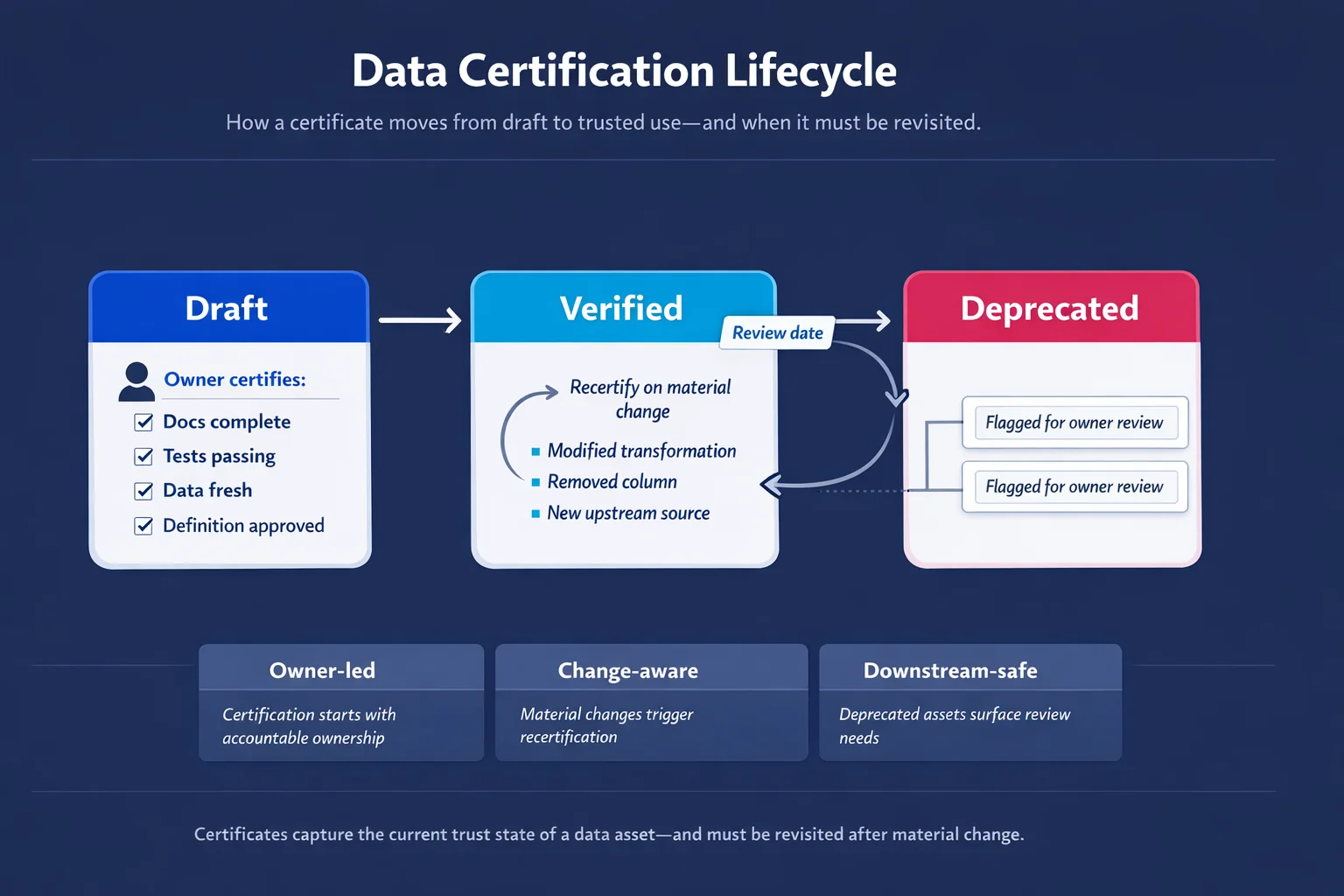
A certificate moves from Draft to Verified to Deprecated, and a deprecation flags downstream assets for owner review. Source: Atlan.
| Aspect | Certificate inside one tool | Certificate as shared context for agents |
|---|---|---|
| Who reads it | That tool’s users and API callers | Any agent selecting sources |
| What it carries | A status, often a note | Owner, stated use, summary, review date |
| Across tools | Each tool keeps its own labels | One vocabulary across sources |
| How an answer reports it | Left to the agent builder | The answer names the route used |
The loop keeps the second reader honest, because an agent acts on the status without asking anyone first.
Why does data certification matter for AI agents?
Data certification matters for AI agents because an agent picks its own sources. Without an enforced selection policy, it ranks them on names and usage, which can favor a busy test table over the board’s revenue table.
“They said it was easier to build an agent than to give it context that made it trustworthy,” Prukalpa Sankar, Co-founder, Atlan, said in her 2026 opening keynote.
Austin Kronz, Field CDAO, Atlan, gave a routing rule in The Post-AI Data Stack session. First, “you should always start with certified metrics where you have them,” he said. Then, “if the agent doesn’t have a certified metric it can find for that use case, go and just browse the hopefully AI-ready data,” he went on. In a later recap he added a third step: “you need to have that third level of control, which is just tell the user which mechanism you used.”
“This is not a verified query. This is not a definitive source of truth,” is how Joe DosSantos, VP, Enterprise Data & Analytics, Workday, said an agent should flag SQL it builds on the fly.
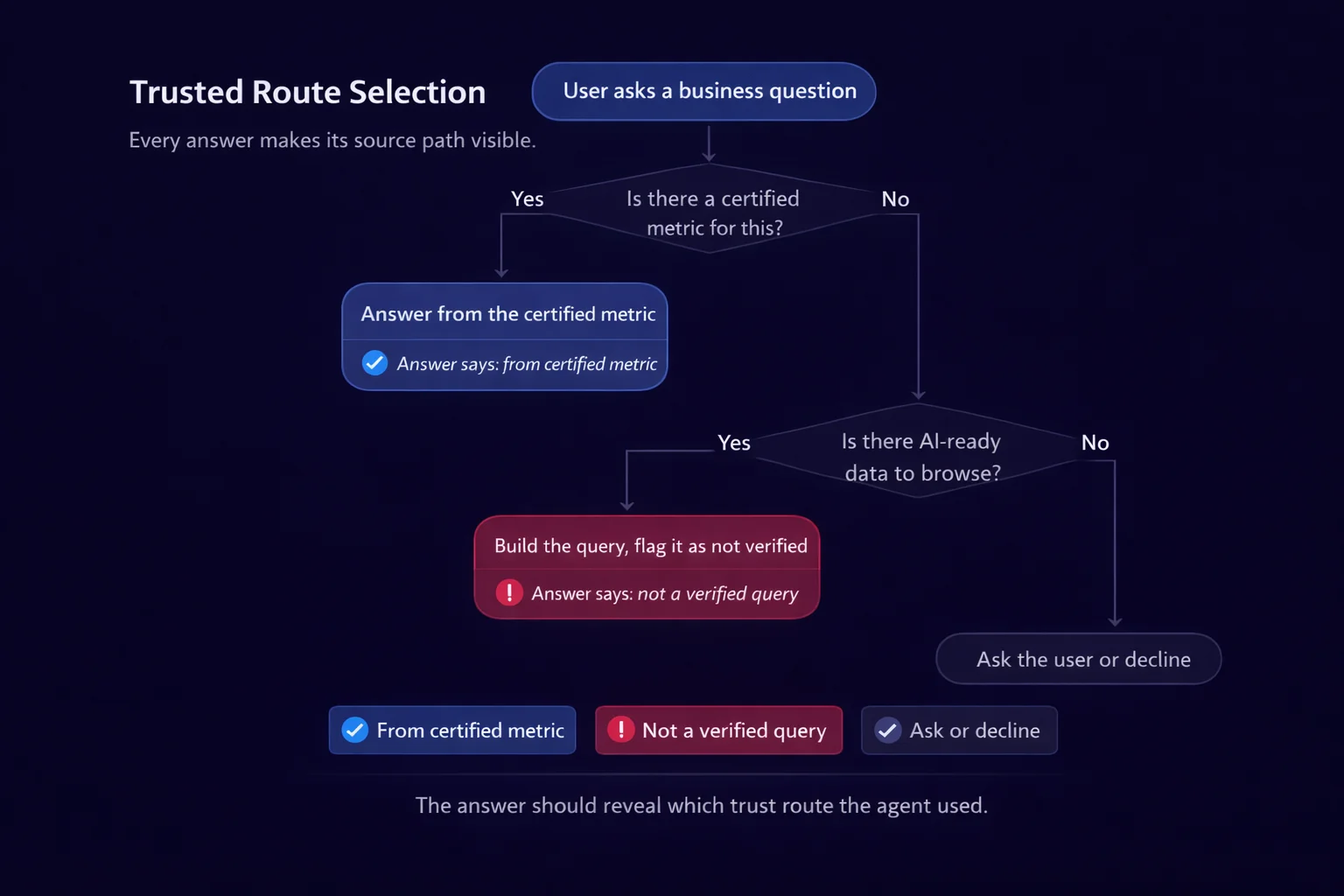
An agent starts from a certified metric, falls back to AI-ready data with a caveat, and names the route it used. Source: Atlan.
What the evidence shows
In a 2026 report by MIT Technology Review Insights in association with Atlan, 68% of 250 executives ranked governance, business understanding or trustworthy outputs as their biggest AI barrier.
The accuracy evidence is about what a certificate points to. In a 2026 internal benchmark from Atlan’s FDE Playbook for Analytics Agents, one model scored 31.8% on 107 real business questions with tables and columns only, and 83.2% with AI-generated metrics and trusted past queries added. Answers were graded by code, and the test had no certificate flag. Certification is how a team decides which metrics and queries an agent should prefer.
Certified does not mean correct, so test certified routes against a golden set of questions with known answers. For numbers that must be exact every time, Kronz’s advice was that a fixed dashboard can still be the right tool. A semantic layer for AI agents is one part of context engineering, and context infrastructure for AI agents has to deliver the certificate at query time.
When to certify a data asset
Certify the few assets behind high-stakes, repeated questions, and leave the rest uncertified on purpose. Each review costs an owner’s time, so spend it where a wrong number costs most:
- Executive KPIs and board numbers, where two versions of one figure destroy trust.
- Finance and regulated reporting, which needs a record of who approved what.
- Shared semantic models, where metric conflicts across analytics teams surface first.
- The metrics and queries behind AI-ready data for talk-to-data analytics.
Certification also grows from use. In DosSantos’s loop, a user confirms an agent’s answer. A governance step then sets the go-forward definition, so “you’re crowdsourcing your versions of truth so that over time, your accuracy rate can go higher and higher,” as he put it. Piyush Bhargava, Sr. Director, Global Data & Analytics, DocuSign, said in The Post-AI Data Stack session that high-trust questions need verified queries, rigorous testing, feedback and evals.
If 400 of 450 tables are Verified, a filter on Verified removes almost nothing, and self-service analytics governance falls back to asking an analyst which table is real.
How to certify data assets
Five steps take a team from written criteria to agents that read the status. You need named owners, a catalog that stores status, and lineage on the assets in scope.
- Write the criteria per asset type. Tables, metrics and queries each get a checklist; the AI-ready data checklist is a start for tables.
- Name the accountable owner. One person per asset, with the stated use and reason in the message.
- Certify the smallest useful set first. Start with the metrics and queries behind your top questions; an AI readiness assessment helps you find them.
- Automate status changes. Run rule-based updates on a schedule and flag dependents of deprecated assets, so embedded data governance happens in the flow of work.
- Expose the status to agents. Serve it through the interface agents query, and require answers to name the route used, a rule for your AI agent harness.
Pitfalls and criteria to check
The common pitfalls mirror those steps: certifying everything, skipping the reason, no review date, and certificates agents never read. A certified query can also be wrong; the FDE Playbook gives that case its own episode, “The Certified Query That Was Wrong,” and answers it with a golden set.
Use these criteria to judge a certification workflow; a missing one is one way data governance implementations fail.
| Criterion | What to look for |
|---|---|
| Written criteria | A checklist per asset type, linked from the certificate |
| Named owner | One accountable person per asset, plus a backup |
| Machine-readable status | A field exposed through API or MCP |
| Review date | Per-asset dates and change-triggered review |
| Lineage-aware deprecation | Dependents flagged when a source is deprecated |
| Agent testing | Golden-set context evals on certified routes |
Scaling governance across business domains keeps criteria consistent while ownership stays local.
How Atlan approaches data certification
Atlan, the AI Context Platform, stores a certificate as one of four statuses with the owner’s message, inside the enterprise context layer. The status and the owner’s message sit on the asset, update by rule, can move along lineage, and reach agents through Atlan MCP.
Certificates set by hand drift: a source is retired while its dashboards stay Verified, the AI agent governance problem in miniature. Documented on docs.atlan.com:
- Adding certificates offers Verified “for ready to be used,” Draft “for work in progress,” Deprecated “if the asset no longer exists,” and No certificate. A message adds context, and certificates filter assets on the Assets page.
- Playbooks update certificates in bulk through rule-based automations, scheduled hourly, daily, weekly or monthly. Setup requires admin permissions.
- The Metadata Propagator can “Propagate metadata like owners, certificates, and tags from upstream assets to downstream dependents automatically,” with a preview run before changes are committed.
- Per Atlan’s product overview, an agent reads governed data context through Atlan MCP, including table definitions, column meanings, certified metrics, lineage and ownership.
The certificate becomes something an agent filters on. Teams implementing an enterprise context layer for AI can start with the context graph, the connected record of assets, owners, lineage and status.
Real stories from real customers: Shared definitions and lineage behind trusted answers
"Atlan captures Workday's shared language to be leveraged by AI via its MCP server. As part of Atlan's AI labs, we're co-building the semantic layer that AI needs."
Joe DosSantos, VP, Enterprise Data and Analytics, Workday

"Context is the differentiator. Atlan gave our teams the shared vocabulary and lineage to move from reactive data management to proactive AI enablement."
Kiran Panja, Managing Director, Cloud and Data Engineering, CME Group

Where data certification goes next
The hard part of data certification has moved from awarding badges to keeping them current while agents read them on every question. A stale certificate now steers every answer until someone fixes it.
When answers from a certified metric start failing evals, a sensible default is that the failure flags the certificate and only the owner withdraws it. Whether repeated failures should withdraw it automatically is unsettled, and teams building enterprise-ready AI agents will need an answer before the first wrong number reaches a board deck.
FAQs about data certification
1. What does it mean when a dataset is certified?
A named owner has checked it against written criteria and approved it for a stated use, such as the monthly finance close. It does not make the data correct for every question, so read the stated use first.
2. Who should certify data assets?
The person accountable for what the asset means, usually the domain owner, with a steward preparing evidence. Platform admins decide who may certify; they should not approve business meaning themselves.
3. What is the difference between a certified metric and a verified query?
A certified metric is an approved definition of a business number that many queries reuse. A verified query is a stored question paired with its SQL, plus who verified it and when. One approves a definition; the other approves one computation.
4. How often should certified data be recertified?
On a review date set per asset, and on any material upstream change, such as a changed transformation or a deprecated source. Board metrics need shorter review dates than low-risk assets.
5. Should AI agents only use certified data?
They should start with certified metrics and queries. For low-stakes questions with no certified route, well-documented data with a caveat is acceptable; for regulated or board numbers, answer only from certified routes. Either way, name the route used.
6. What happens downstream when a certified table is deprecated?
Everything that reads it now depends on a withdrawn asset. Lineage should flag those dependents for owner review, or a dashboard can stay Verified on top of a retired source.
7. Is data certification the same as a data governance certification for people?
No. Data certification approves a data asset for use. A data governance certification is a professional credential a person earns through a course or exam.
Sources
- AI-Ready Data for Advanced AI, Accenture
- What’s really holding enterprise AI back?, MIT Technology Review Insights in association with Atlan
- The FDE Playbook for Analytics Agents, Atlan
- Opening keynote, Atlan (2026)
- The Post-AI Data Stack, Atlan (2026)
- Recap of the day: The Context Contract, Atlan (2026)
- Add certificates, Atlan Documentation
- Set up playbooks, Atlan Documentation
- Propagate metadata through lineage, Atlan Documentation
- Atlan products, Atlan Documentation

