

ContextOps is the day-to-day work of keeping agent context accurate once agents are live. Every change to a definition, policy or skill gets a version, a test, an owner’s approval and a staged release, and production traces show which version produced each answer. Atlan runs this work through Context Engineering Studio, where Context Repos version every change and support rollback.
If you lead an AI platform or data team with agents in production, the trigger is usually a business change. Finance redefines a metric or legal updates a policy, and an agent that was right before the change is now confidently wrong.
| Field | Detail |
|---|---|
| What it is | Operating discipline for context assets and context flows |
| Proposed by | Forrester, June 10, 2026; definition October 19, 2026 |
| Core practices | Versioning, testing and evals, release gates, observability, refresh |
| Settings | Design-time development, runtime execution, offline updates |
| Closest neighbor | Context engineering (builds context; ContextOps runs it) |
| Typical trigger | A business rule, metric or policy change |
What does ContextOps mean, and where did the term come from?
ContextOps is a 2026 analyst term with a few looser uses by tool makers. Forrester’s definition is the one to anchor on, because it is specific about what gets operated and where.
According to Forrester analysts Charlie Dai, Leslie Joseph and Indranil Bandyopadhyay (2026), ContextOps is “the operational discipline for managing, governing, monitoring, and improving context assets and context flows” (Forrester, 2026). They place it across “design-time development, runtime execution, and offline updates.” Context assets are the things an agent reads. Context flows are the paths that carry them to the agent.
The idea arrived four months earlier. Frederic Giron, VP and Senior Research Director at Forrester, wrote in June 2026: “I argue that a new discipline will emerge: ContextOps” (Forrester, 2026). So Forrester proposed the discipline in one blog post and defined it in a second.
Some AI coding tool makers also use the word, more narrowly, for managing instruction files in a code repository.
The working definition here is practical. ContextOps keeps the context an agent depends on versioned (in a repository with history), tested (by regression evals), observed (through per-answer traces) and current (through refresh triggers on source changes) after it ships. If you need the foundation first, context layer 101 explains the layer ContextOps operates on.
The definition matters less than the decision behind it: who keeps that context true next quarter, and with what process.
How is ContextOps different from context engineering?
Context engineering designs and delivers context to an agent, while ContextOps runs the lifecycle of that context so it stays accurate as the business moves. The two overlap at design time and runtime, but each answers a different question.
According to Forrester (2026), context engineering is “the practice of designing, orchestrating, and delivering structured, relevant, and timely context to AI systems.” That covers construction and orchestration: choosing sources, shaping definitions, applying strategies such as write, select, compress and isolate. It is also the step past prompt writing, covered in context engineering vs prompt engineering.
Example: a refund rule changes
Engineering choices do not stay correct on their own. A refund rule moves in a policy deck and a PDF, while the agent’s skill still says refund_threshold_usd = 15. Ashwin Murali of Atlan described this case at Atlan’s company brain session: “The business keeps changing. And all these eight agents, your actors, need the rules as soon as they get approved, which is why you need to manage all of these context artifacts like code.”
| Question | Context engineering | ContextOps |
|---|---|---|
| Main job | Decide what an agent should know and how it gets it | Keep that context true after release |
| When it happens | During design and at query time | Every time a source, rule or definition changes |
| Typical output | A definition, skill or retrieval design | A tested, versioned, observed release |
The handoff is concrete. Context engineering writes v2 of the refund skill, along with updated expected answers for the questions whose correct answer changed, and commits both to a shared repository. ContextOps runs the regression evals against v2, gets sign-off from the skill’s named owner, rolls it out to one agent first, and only then moves the other agents off v1. If v2 misbehaves, the fallback is a human review queue, because v1 now holds a retired rule and should not quietly return.
Good engineering produces the right context for today’s rules. ContextOps is how you find out, quickly, when today’s rules have moved.
How does ContextOps compare with DevOps, DataOps, MLOps, LLMOps and FinOps?
The habits come from earlier Ops disciplines, and the object is new: the business context agents read. Forrester (2026) puts it this way: “ContextOps extends DataOps, MLOps, and AIOps principles into the context layer” (Forrester, 2026).
Google Cloud describes MLOps as a practice that “aims at unifying ML system development (Dev) and ML system operation (Ops)” (Google Cloud Architecture Center, 2024), and calls LLMOps “a specialized subset of MLOps” (Google Cloud). The LLMOps vs MLOps split shows how much operational practice those teams already own.
Why Forrester compares ContextOps with FinOps
FinOps is the comparison Forrester leans on. Giron calls ContextOps “the FinOps of the agentic era.” In his framing, FinOps optimizes how tokens are consumed and, at maturity, ties that spend to business outcomes, while ContextOps governs what those tokens represent. He also explains why the spend climbs: agentic workflows loop, and Anthropic’s engineering research found a single agent used about 4x the tokens of a chat and a multi-agent system about 15x, as cited by Forrester (2026). Those ratios come from Anthropic’s own setup, so treat them as direction rather than a forecast for your agents.
| Discipline | What it keeps running | Illustrative trigger | Source cited |
|---|---|---|---|
| DevOps | Application code and infrastructure | A commit, config change or incident | Industry practice |
| DataOps | Data pipelines | A schema, source or pipeline change | Industry practice |
| MLOps | Trained ML models | New data, model drift, retraining | Google Cloud |
| LLMOps | LLMs in production, including monitoring and evaluation | A model, prompt or provider change | Google Cloud |
| FinOps | Cloud and token spend | Spend allocation, forecasting or a budget limit | Forrester’s comparison |
| ContextOps | Context assets and context flows | A business rule, metric or policy change | Forrester |
What existing LLMOps and DataOps practice already covers
The disciplines overlap, and a mature team already has a lot in place. Google Cloud’s LLMOps scope covers monitoring and evaluation of models in production. Data teams version metric code, test pipelines and enforce schema contracts.
A team can run ContextOps inside that stack. What it adds is ownership and triggers for context that does not live in code: a refund policy in a PDF, a metric definition finance owns, a rule shared by eight agents. A policy can change on a Tuesday with no pipeline run or model release scheduled at all. The overlap with test practice is real too, as context evals vs data quality testing shows.
So the question for an existing LLMOps program is narrow: when the business owner changes a rule, what tells every agent that reads it, and who approves the new version? That work tends to sit at the harness and the context layer, close to the business owners, rather than inside the model pipeline.
Why do enterprise AI agents need ContextOps now?
Agents are already in production, few organizations have scaled them, and the barriers they name are about data and trust more than models.
According to Forrester’s State of AI Survey 2026, 77% of AI decision-makers report at least one agentic app in production, yet only 20% believe their organization has the technology in place to scale AI (Forrester, 2026). The same survey found only 14% have many apps scaled at enterprise level (Forrester, 2026).
Deloitte (2026) points to the foundation. In its survey, the top barrier to scaling agents is the lack of a unified, accessible data foundation, cited by 72%, followed by the inability to trust and govern agents at 70% (Deloitte Insights, 2026). The 2026 MIT Technology Review Insights report with Atlan, based on a poll of 250 executives, found 68% of organizations rank governance, business understanding or trustworthy outputs as their biggest AI barrier. None of these surveys isolates stale context as a cause, but data foundations and trust top the Deloitte and MIT lists.
Context design moves agent results
Context design also moves results. The Agentic Context Engineering paper treats contexts as “evolving playbooks” and reports gains of 10.6% on agent tasks and 8.6% on finance tasks (Zhang et al., arXiv, 2025). In one Vercel test on framework docs, a compressed 8KB docs index in an AGENTS.md file reached a 100% eval pass rate, while skills alone matched the 53% no-docs baseline and reached 79% only with explicit instructions (Vercel, 2026). An unreviewed context change can move pass rates just as far the other way.
Builders feel the decay first. Amandeep Khurana, Member of Technical Staff at Anthropic, described a personal project at Atlan’s Open Context Interchange debate, speaking for himself rather than for Anthropic: “the upkeep is where the hard work is.” Without upkeep, he said, “The evals start to go down.” That slide is context drift in practice. Wrong or manipulated inputs that reach an agent’s memory are a separate risk, context poisoning, and need their own controls.
Day one is the easy part. The hard part is noticing when the context underneath a live agent changes.
How do the components of ContextOps work across design time, runtime and offline updates?
Forrester names three settings for ContextOps, and each has its own job. The stage-by-stage build view lives in the context development lifecycle, and the practices below are the operating work inside those stages.
Design time: version and test context like code
At design time, every change to curated context gets a version, a test and a review before agents see it. Prukalpa Sankar, Co-founder of Atlan, said in the opening keynote: “context now is a production dependency. Today, we need to manage it the way we do code. We need a GitHub for context, collaborative authoring, versioning, dependency management, testing, evals.”
A context repository holds those versions, and release gates sit on top. Rohan Goel, Director, Product at Atlan, put it this way at the company brain session: “Just pin it to v1. Until I test it or run evals on it, I don’t want you to move it to v2.” In practice, an agent reads revenue_definition@v1 until v2 passes its context quality tests. Context testing is the umbrella term for that gate.
Two details keep the gate honest. Version the expected answers with the rule, so a correct new answer is not scored as a regression. And because LLM evals vary from run to run, gate on the questions that matter most and repeat runs before you call a drop real.
Runtime: observe what agents actually read
At runtime, you need traces that record which context version an agent used for each answer, plus replayed eval suites and sampled human review that raise an alert when quality falls. Context observability answers “what did the agent read?”, a different question from pipeline health or token cost, as the context, data and LLM observability comparison lays out.
Offline updates: refresh context when the business changes
Offline updates regenerate context when a source changes. The ACE research optimizes context both offline, in system prompts, and online, in agent memory (Zhang et al., arXiv, 2025).
Enterprise teams do the same with context mining from query logs and documents, and with refresh rules tied to context freshness. A regenerated asset is a proposed version, and it goes through the same evals and approval as a hand-written change. Memory is the exception: it changes every session, so it gets validation, isolation and expiry rules instead of release gates.
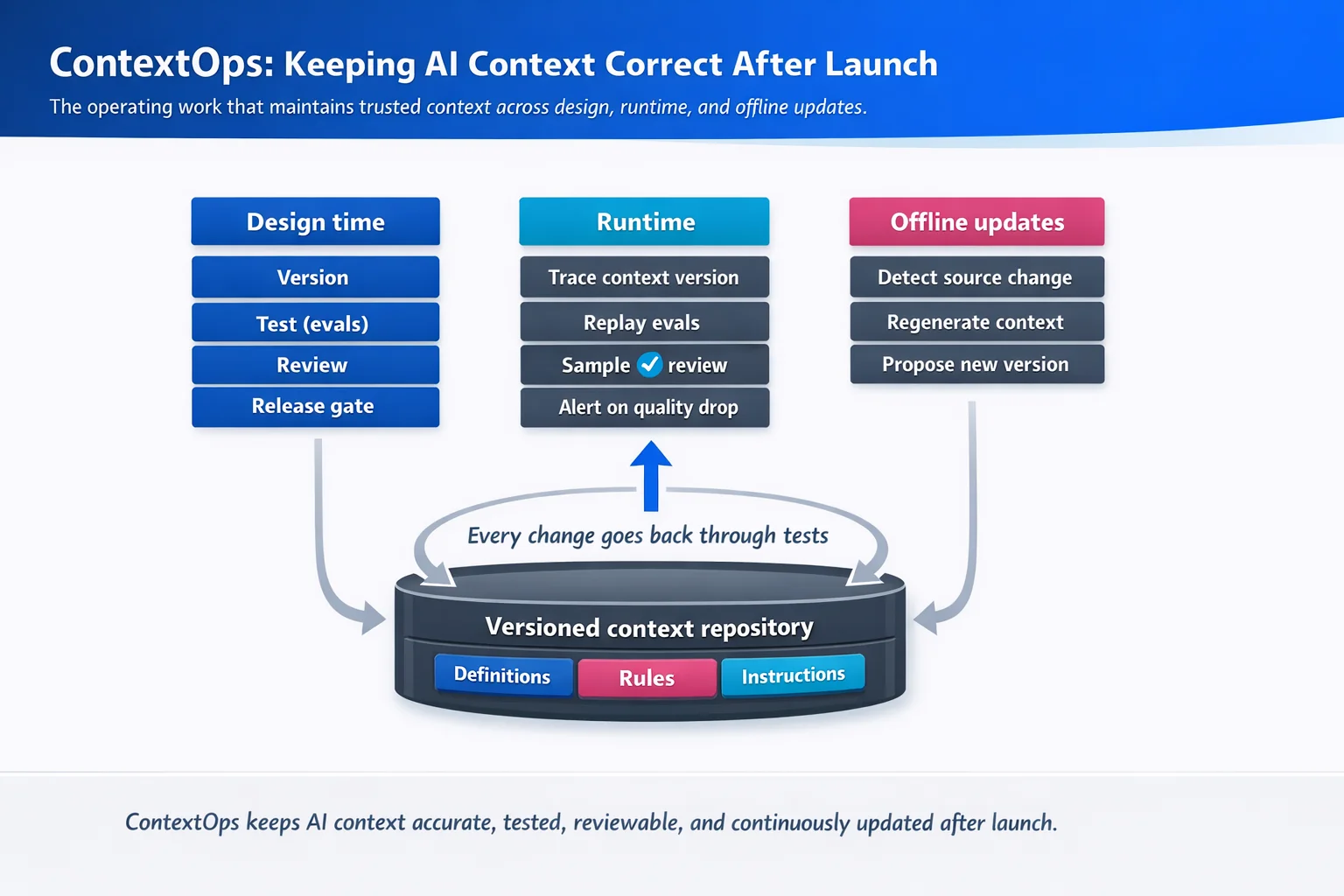
ContextOps across design time, runtime and offline updates. Source: Atlan.
Context as a project vs context run with ContextOps
| Aspect | Context as a one-time project | Context run with ContextOps |
|---|---|---|
| Ownership | Whoever built the agent | A named owner per context asset |
| Change control | Edits made in place | Versioned changes with review |
| Testing | Checked at launch | Regression evals on every change, with expected answers versioned |
| Release | Every agent gets the change at once | Pinned versions and staged rollout |
| Monitoring | General app monitoring | Per-answer context traces and quality alerts |
| Refresh trigger | Someone notices | A source or rule change |
Most teams sit somewhere between the two columns. The useful exercise is picking the one row where a wrong answer would cost you most and moving that row first.
How to start practicing ContextOps in your team
You can start ContextOps with the context you already have. Before step one, check three things: a list of agents in production, the business definitions and policies those agents read, and one person accountable for the program.
- Inventory context assets per agent. List every definition, metric, skill, policy and memory store each agent reads.
- Name an owner per asset. Ownership usually splits between data and AI teams, as who owns the context layer explains, and some teams create a dedicated context engineer role. Data contracts for AI can make each owner’s promises explicit.
- Put context in a versioned repository. Every change gets a version, an author and a diff.
- Write regression evals and gate releases on them. Pick questions with known answers per agent, using AI agent evaluation metrics, version those answers with the rules behind them, and block a release that fails the questions you mark as critical.
- Observe in production and set refresh triggers. Trace which version each answer used, and flag context for review when its source changes. Track the time from a source change to the agent update, the share of critical questions that pass per release, and how often a regression reaches production.
Common mistakes when starting ContextOps
Common mistakes show up early:
- Treating context as a one-time project that ends at launch.
- Leaving a definition with no owner, so nobody approves changes.
- Skipping regression evals, so decay stays invisible until users complain.
- Shipping new context to every agent at once, with no pin and no rollback. Many agent harness failures trace back to this.
For the wider build, how to implement an enterprise context layer covers the architecture these steps run on. Start with the single rule that changes most often in your business, and run it through all five steps before you scale the habit.
What to look for in a platform that runs ContextOps
The platform should treat context as a versioned, tested, observed and access-controlled asset. Use the criteria below to assess any option, alongside a broader review of enterprise AI context management tools.
| Criterion | Why it matters | What to look for |
|---|---|---|
| Versioning and rollback | A bad change must be reversible fast | Git-like history, diffs, one-step rollback |
| Evals and simulation before release | Catches regressions before agents read them | Test sets per agent, versioned expected answers |
| Staged rollout and pinning | Limits the blast radius of a change | Version pins per agent, gradual rollout |
| Runtime observability and drift signals | Shows what agents actually read | Per-answer traces, quality alerts |
| Source-change triggers | Keeps context current without manual checks | Links from context to its sources |
| Access control at retrieval | Agents should only read what their user may see | Permissions enforced when context is served |
| Human review of AI-proposed changes | Keeps accountability with people | Review queues, approval history |
Questions to ask any vendor:
- Can I pin one agent to an older context version while another tests a new one?
- What happens to a context asset when its source table or policy document changes?
- How do I see which context version produced a specific answer?
- Who can approve a change, and where is that approval recorded?
The same questions sit inside a full AI readiness platform evaluation. Ask for a live demo of the second question; it is the one that separates a repository from an operating loop.
How Atlan approaches ContextOps
Atlan, the AI Context Platform, runs ContextOps on its context layer through Context Engineering Studio. The problem it targets: context changes often, agents keep reading old rules, and nobody sees the decay until answers go wrong.
Context Engineering Studio runs a loop of Bootstrap, Simulate, Deploy and Observe. Simulate runs evaluations before release. Deploy pushes context to agents. Observe tracks traces and drift.
Underneath sit Context Repos, described as “the versioned source of truth that every deployment reads from,” with Git-like versioning, branching, A/B testing, staged rollouts and rollbacks.
AI does the repetitive part. Context Agents bootstrap descriptions, metrics and ontology context, and the studio generates test questions and suggests fixes, while people verify the result, the model Atlan calls Human ON the loop. When a linked source changes, you regenerate the affected context from that source and run the new version through Simulate before it deploys, instead of hunting for stale copies.
All of this sits inside the enterprise context layer that serves every agent, described in more depth in context layer for AI agents. The refund rule from earlier is the test case: one owner approves v2, Simulate checks it against the questions that changed, one agent gets it first, and the trace shows which version answered.
Real stories from real customers: One shared context that agents read
A change made once should reach every agent, which takes a single place where context lives. Two Atlan customers describe building that shared base.
"Atlan is our context operating system to cover every type of context in every system including our operational systems. For the first time we have a single source of truth for context."
Sridher Arumugham, Chief Data Analytics Officer, DigiKey

"Atlan captures Workday's shared language to be leveraged by AI via its MCP server. As part of Atlan's AI labs, we're co-building the semantic layer that AI needs."
Joe DosSantos, VP, Enterprise Data and Analytics, Workday

ContextOps is a new word for work your agents already need
The label is new, and the name may change before the market settles. The work underneath will stay.
Every agent reads definitions, metrics and policies that someone wrote on a particular day, and the business keeps moving after that day. Teams with agents in production already do some of this by hand, often after a wrong answer surfaces. Whether they do it before the complaint is still open for most of them. For the wider picture of where this work sits, the AI context stack maps the layers, and whether enterprises need a context layer is the question most teams answer first.
FAQs about ContextOps
1. How is ContextOps different from DevOps?
DevOps keeps application code building, shipping and running, while ContextOps keeps the context AI agents read, such as metric definitions, policies and skills, accurate after release. The habits carry over (version control, automated tests, gated releases and monitoring), but ContextOps work starts when a business rule, metric or policy changes, even if no code changed at all.
2. Is ContextOps just LLMOps or MLOps with a new name?
Partly. Google Cloud’s description of LLMOps already includes monitoring and evaluation, and a team can run ContextOps inside that stack. What ContextOps adds is the object it manages: business-owned context such as metric definitions and policy rules, shared across many agents and refreshed when its source changes. Forrester describes ContextOps as extending DataOps, MLOps and AIOps principles into the context layer.
3. Is ContextOps the same as FinOps for AI?
No, though Forrester connects them. Forrester calls ContextOps “the FinOps of the agentic era.” In its framing, FinOps optimizes how tokens are consumed and, at maturity, ties that spend to business outcomes, while ContextOps governs what those tokens represent: whether the context an agent reads is still accurate. A team can cut token spend and still feed an agent a stale definition.
4. Who coined the term ContextOps?
Forrester proposed ContextOps as a discipline in a June 10, 2026 blog post and defined it on October 19, 2026. Some coding-tool makers also use the word, more narrowly, for agent instruction files.
5. Who owns ContextOps in an enterprise?
Each context asset needs one named owner, usually the team that owns the business meaning behind it. Data teams tend to own definitions, metrics and lineage. AI teams tend to own skills, prompts and evals. ContextOps works when both sides share one versioned repository and one release process, so a change from either side is tested before agents read it.
6. What is context drift, and how does ContextOps catch it?
Context drift is the gap that opens when the business changes and the context an agent reads does not. A refund threshold moves, a metric is redefined, a policy is updated. ContextOps catches drift three ways: regression evals that fail when answers change, runtime traces that show which context an agent used, and triggers that flag context for refresh when its source changes.
Sources
- Your AI Bill Is A Context Problem, Forrester
- Context Engineering And ContextOps: The Missing Foundation For Scaling Agentic AI, Forrester
- AI Has A Scaling Problem, Forrester
- The path to agentic transformation, Deloitte Insights
- Agentic Context Engineering: Evolving Contexts for Self-Improving Language Models, arXiv
- AGENTS.md outperforms skills in our agent evals, Vercel
- LLMOps: What it is and how it works, Google Cloud
- MLOps: Continuous delivery and automation pipelines in machine learning, Google Cloud
- Driving AI business value, MIT Technology Review Insights with Atlan

