

A context layer for natural-language analytics is one shared, versioned home for the metrics, synonyms, verified queries and agent instructions that plain-English data tools read. Those tools need it because SQL generated from a bare schema misses business meaning: on 9,128 real enterprise questions in the BEAVER benchmark, agentic text-to-SQL frameworks answered 10.8% correctly (BEAVER, arXiv, revised 2026). Atlan’s Context Agents build that layer from your query history and BI layers.
Each metric is kept with its definition, formula, dimensions, grain, SQL examples and dependencies, managed by version (The Post-AI Data Stack session). If you lead a data or analytics team, the cost of skipping this shows up as two tools giving two revenue numbers in the same meeting.
| Field | Detail |
|---|---|
| What it is | One shared, versioned place for metric definitions, synonyms, verified queries and agent instructions, read by each natural-language analytics tool you connect |
| The four context types | Governed metric definitions, business vocabulary and synonyms, verified queries, agent instructions |
| Where it lives | Outside any single BI tool, warehouse agent or copilot |
| Who owns it | Named owners per business domain, with subject-matter experts reviewing changes |
| When it pays off | At the second tool, the second team, or the second definition of the same metric |
What is natural-language analytics, and why does it depend on context?
Natural-language analytics lets you ask a data question in plain English and get back a number, chart or table, usually through SQL run on your warehouse. The hard part is business meaning, which the schema rarely states.
It is one application of natural language processing (NLP), a much broader field.
According to the Spider 2.0 authors (2025), a code agent solved 21.3% of enterprise text-to-SQL workflow tasks in Spider 2.0, against 91.2% on the earlier Spider 1.0 benchmark. The drop mixes several causes: larger schemas, more dialects, longer tasks. Business meaning is the cause your own team has to supply.
In a warehouse it looks like this. Your net revenue metric is sum(amt) from fct_orders, but only where is_test = false and status = 'closed'. Nothing in the schema says so. A model reading it writes valid SQL that sums every row, and the answer looks right.
Joe DosSantos, VP, Enterprise Data and Analytics, Workday, put the shift plainly on a session panel: “It’s not data availability, it’s metric availability, it’s context availability.”
The mechanics of AI-generated SQL and where it breaks and the case for a context layer for AI agents are well documented. For AI agents for data analytics, a better model narrows the gap; written-down meaning supplies what the schema leaves out.
Why do natural-language analytics tools give wrong answers?
Many wrong answers from natural-language analytics trace to a missing piece of business context, not to a model that cannot write SQL. The SQL usually runs.
It just answers a slightly different question from the one you asked.
One warehouse-native analyst’s documentation says it directly: “Generic AI solutions often struggle with text-to-SQL conversions when given only a database schema” (product documentation).
What each wrong answer was missing
Each common failure maps to a missing piece:
| What the user sees | What actually went wrong | Context that was missing |
|---|---|---|
| A revenue number that is wrong but plausible | The query summed gross amounts at the wrong grain | A governed metric definition with grain and filters |
| “Bookings” answered from the wrong column | The tool guessed which field the word meant | A synonym mapping the term to a column |
| Totals that are double the real figure | A join fanned out rows before the sum | A defined join path |
| The right number for the wrong region or period | No default filter was applied | An instruction setting default filters |
| A confident answer to a question it should refuse | Nothing told the tool when to stop | A certified route and a refusal rule |
You can fix every row inside one tool’s own semantic layer, the place where that tool defines its metrics, joins and filters. The harder problem starts when two tools each hold a copy. Both are covered in why text-to-SQL breaks at enterprise scale and why AI answers differ from your BI reports.
A confident wrong number does more damage than “I can’t answer that,” because nobody checks it. A context layer reduces hallucinations, answers an AI tool makes up, by giving the tool the definition, and a rule for when none exists.
What context does an analytics agent need?
An analytics agent needs four kinds of business context, and each one fixes a different class of wrong answer. Steven Huang, Lead Enterprise Architect, Verizon, described what it takes “to support the analytic agent”: “describe assets, both table and columns,” and “define SQL joins whenever possible in the semantic layer” (Inside Verizon’s context architecture).
Governed metric definitions
A governed metric carries its definition, formula, grain, default filters and dependencies, so every query computes it the same way.
metric: net_revenue  # illustrative, not a specific vendor's syntax
formula: sum(amt)
grain: order_id
filters:
  - is_test = false
  - status = 'closed'
depends_on: [fct_orders]
Managing KPI definitions and a business glossary covers the ownership side.
Business vocabulary and synonyms
People ask for “bookings”, “ARR” or “churn”. The warehouse stores net_bookings_usd. A glossary term mapped to a metric or column, with its synonyms, turns the word a person uses into the field the SQL needs. Where a word has two valid meanings, such as logo churn and revenue churn, the term should say so and the agent should ask.
Verified queries
A verified query is SQL a person has checked against a known question. Piyush Bhargava, Sr. Director, Global Data & Analytics, DocuSign, said on the same panel: “for questions where the trust is high, it does require a lot of… putting in verified queries.”
Instructions written for agents
Instructions carry routing rules, default filters and refusal rules. Zach Michel, Atlan, explained why they differ from documentation for people: “context looks different when you’re serving it to humans versus when you’re serving it to an agent.” In Atlan Labs work he presented, giving an agent a table’s DDL with its traps noted was about 20 points more accurate than a natural-language description of the same table. His reasoning: an agent “actually needs the definition. It needs things like the grain, and it also needs to know where it can and can’t look from a SQL sense.” The 20-point figure is a talk finding, not a published study.
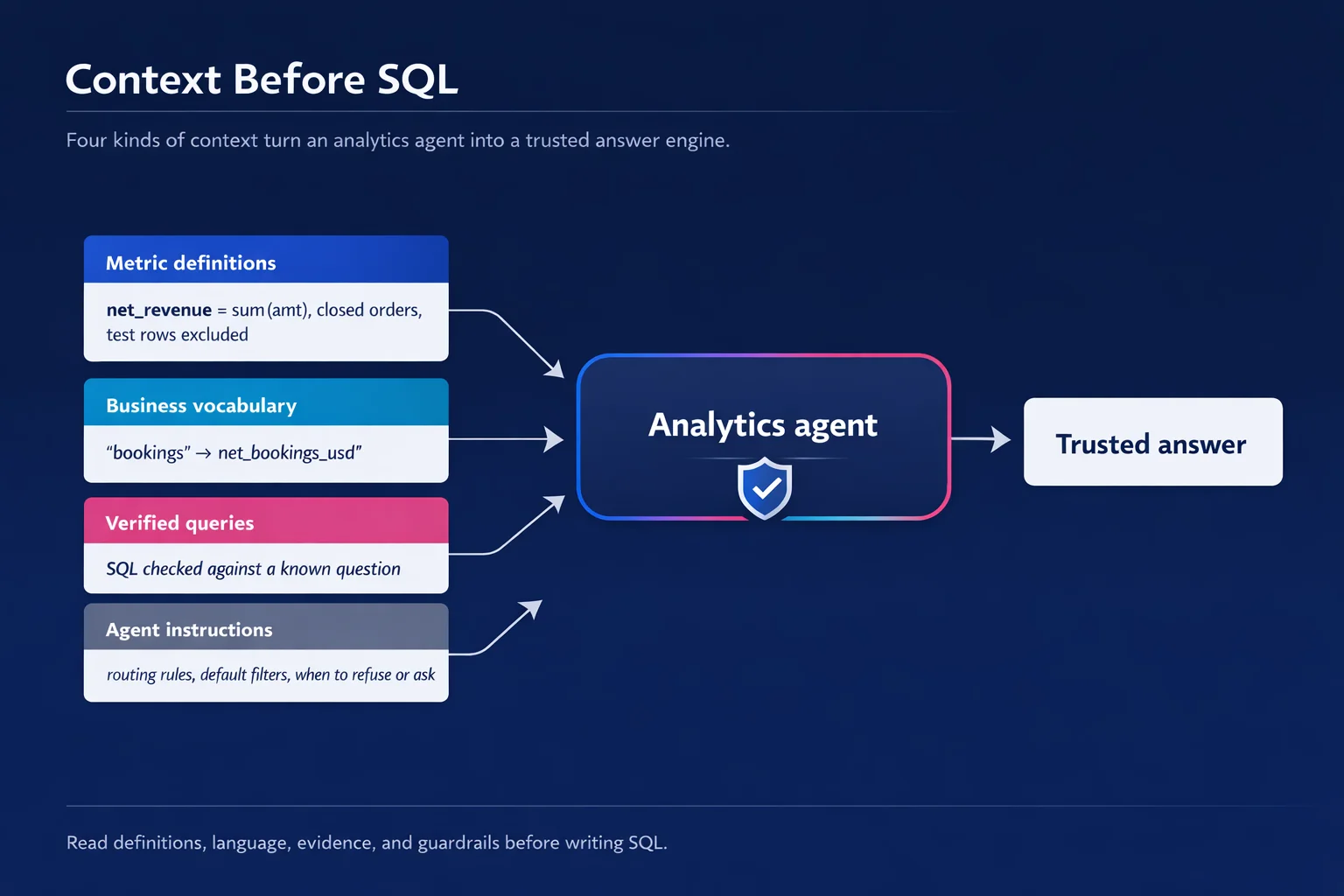
The four kinds of context an analytics agent reads before it writes SQL. Source: Atlan.
The four types are the working core of context engineering for an AI analyst, and they sit on top of a semantic layer for analytics where one exists. The difference between a semantic layer built for BI and one built for AI agents is mostly this agent-facing writing.
Every natural-language analytics tool asks for the same context in its own store
Warehouse analysts, BI copilots and data agents ask for the same four kinds of context, and by default each reads it from its own store. The product documentation for five widely used tool categories, read on 2026-11-17, shows the pattern.
| Tool category | Context it asks for | Where that context is stored | Source |
|---|---|---|---|
| Warehouse-native analyst | Metric formulas, join paths, descriptions, synonyms and verified queries | A semantic view in the warehouse | Product documentation |
| Warehouse conversational data agent | Table and field metadata (descriptions of each table and column), synonyms and default filters as instructions, glossary terms, verified queries; its guidance ranks verified queries first, then glossaries, then instructions | The data agent | Product documentation |
| BI copilot | AI data schemas, verified answers, AI instructions | The BI semantic model | Product documentation |
| Lakehouse data agent | Instructions and up to 100 example queries per data source | The data agent | Product documentation |
| BI topic layer | Join keys across up to 12 datasets, custom instructions for “disambiguation rules, and business definitions”, column descriptions, synonyms | The topic and its datasets | Product documentation |
Each design is sound for its own tool. Stores can also be shared: the lakehouse data agent above can use a BI semantic model as a data source. See semantic views in a cloud warehouse, the context a BI copilot’s conversational analytics depends on, a BI suite’s semantic layer and a warehouse’s own knowledge catalog.
Where separate stores start to drift
The trouble starts when a company runs more than one. In the same session, Zach Michel described a customer who had built a dozen semantic views, “one for each agent,” and found it “impossible to manage the improvements across all 12 of these views.” That is one customer’s story.
A universal semantic layer solves part of this for metrics (warehouse-native vs universal semantic layers). A multi-cloud context layer extends it to synonyms, verified queries and instructions, and semantic views generated from one source stay consistent.
How does a context layer serve natural-language analytics?
A context layer holds the four context types once, with owners and versions, and each connected tool reads from it. A change to net_revenue is made in one place.
Tools still keep their own artifact, such as a semantic view, a semantic model or agent instructions. That artifact is built from or checked against the shared definition, and each tool’s own evals confirm the change landed.
Zach Michel described the design goal: a metric written for an agent should be possible to “version it and manage it centrally so many agents can refer to the same metric.” His team found that “the model is not the bottleneck for analytics workloads”: frontier models beat smaller ones on a bare schema, yet none reached production accuracy without the right context. That is the case for a model-agnostic context layer: the definitions outlast any one model or tool.
Storage is half of it. The other half is ownership. Sowmya Parthan, Sr. Director, Data Platform & AI Engineering, Upwork, described opening the work to analysts and product managers “that contribute into that context layer and to democratize, right, while governing that context layer is really key.”
Context per tool vs context defined once
The difference shows up in day-to-day upkeep.
| Aspect | Context defined inside each tool | Context defined once in a context layer |
|---|---|---|
| Where “revenue” is defined | In each tool’s semantic view, model or agent | In one shared definition each tool reads |
| Who owns it | The team that set up that tool | A named owner for the business domain |
| How a change reaches each tool | Someone edits each copy | One versioned change, pushed or read by each tool |
| Versioning and testing | Per tool, often by hand | Versioned once, tested in each tool |
| What a new tool costs | Rewriting the definitions | Connecting it and running its evals |
| What the user hears when no certified answer exists | Depends on each tool’s setup | One shared rule |
The left column is a reasonable choice for one tool. It gets expensive at the second.
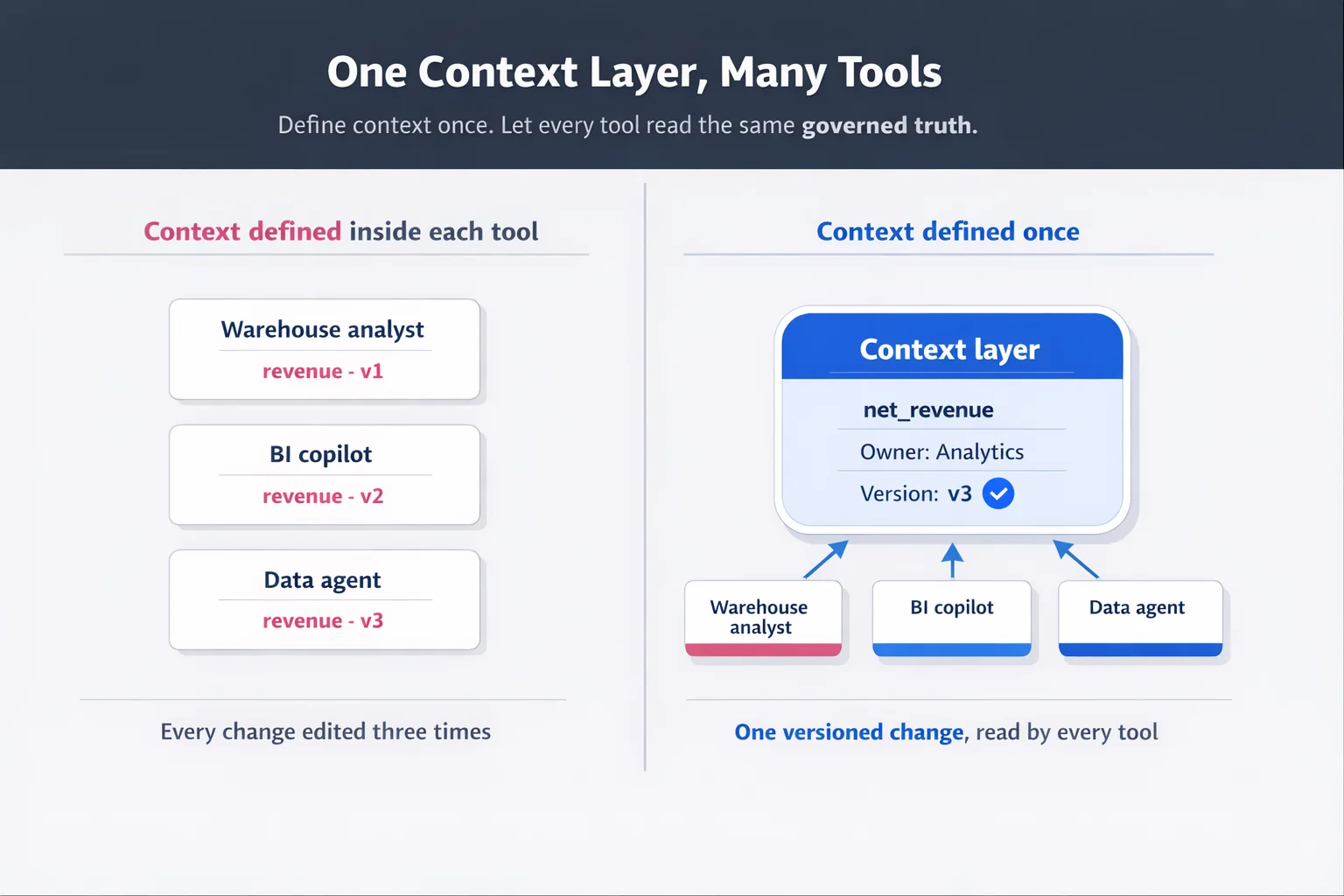
One context layer, many question-answering tools. Source: Atlan.
For where a semantic layer stops, see context layer vs semantic layer and what an enterprise context layer actually is. Open Semantic Interchange works on portability from the format side.
How accurate does natural-language analytics need to be?
The accuracy bar depends on the decision a question feeds. Teams set it per domain and send questions that need certainty to certified answers.
Accuracy here means the share of a domain’s test questions, each with a known correct answer, that the agent gets right.
Upwork runs this way. On the same 2026 panel, Sowmya Parthan described a range across domains “anywhere from seventy percent accurate to ninety-six percent accurate,” adding, “We’re at, like, ninety-six percent for three of our domains right now.” In the 2026 session, Zach Michel described a customer agent at “about 89% accurate” that still stalled, because the use case “needed 98% plus accuracy.”
Routing each question to the right answer
Austin Kronz, Field CDAO, Atlan, gave the blunt version: “if you need a hundred percent accuracy on something, dare I say, you might need a dashboard.” Read that as a case for certified answers. His fallback pattern has three steps:
- “Always start with certified metrics” where they exist.
- If none fits, browse “the hopefully AI-ready data” for the domain.
- Tell the user which path was taken: “Here’s which route I took.”
| Question type | Accuracy the decision needs | Best route |
|---|---|---|
| A board or finance number | Exact and reconciled | A certified metric or report, no generated SQL |
| A recurring operational metric | High, set by the domain owner | A certified metric, with verified queries |
| An exploratory “why” question | Lower, if labelled | AI-ready data, with the route stated |
| A one-off lookup on uncertified data | Lowest | AI-ready data, labelled as uncertified |
Measuring accuracy per domain is the job of an AI agent harness. AI agent accuracy depends on the context the agent can reach, and AI-ready data for talk-to-data scores readiness one question at a time.
When to move to a shared context layer
A shared context layer pays off once a second tool, a second team or a second definition of the same metric appears. Before that, it can be overhead.
The crossover is a judgment call, not a fixed number.
A team running one natural-language analytics tool, with one owner, can keep its context in that tool’s store and do well. Joe DosSantos recalled on the panel that when he joined Workday there were a thousand dashboards, and “each one of them was adamant that it was in fact the source of truth.” Agents that each keep their own definitions risk the same pattern, the problem a context layer for data analytics teams addresses.
Three signals say it is time:
- A second tool starts answering the same questions as the first
- A second team writes its own definitions for shared metrics
- Two definitions of one metric give two answers in the same meeting
According to MIT Technology Review Insights (2026), in a poll of 250 executives produced in association with Atlan, 68% of organizations rank governance, business understanding, or trustworthy outputs as their biggest AI barrier (What’s really holding enterprise AI back?). Business understanding is the barrier the four context types address, and it is one reason AI agents need an enterprise context layer.
Starting now? The preparation steps for natural-language analytics cover tables, metrics, synonyms, example SQL, access and testing. Settle text-to-SQL vs a semantic layer for self-serve analytics before the second tool arrives.
How Atlan approaches the context layer for natural-language analytics
Atlan, the AI Context Platform, mines your query history and BI layers to draft each metric’s definition, formula, grain and SQL examples, then keeps them versioned for the tools you connect.
The challenge is drift: one metric defined in several tool-local stores, with nobody owning the difference.
Atlan’s approach, as shown in the session, has three steps: bootstrap the context, manage it so it is “versioned, owned, and tested”, then improve it with evals. Context Agents do the bootstrapping by mining query history and existing BI layers. Each metric is kept with its definition, formula, dimensions, grain, SQL examples and dependencies, managed by version.
The Model Context Protocol (MCP), an open standard for connecting AI tools to outside context, is one way those definitions reach the tools; see how MCP delivers business context. The talk-to-data agent blueprint shows where each piece sits. For rollout order, see implementing an enterprise context layer, and for the discipline behind it, what is context engineering.
Where natural-language analytics goes next
More tools answer data questions in plain English every year, and each new one brings its own place to store definitions. The open question for most data teams is who owns “revenue” when five tools all claim to know what it means.
The AI readiness work underneath is the same either way; what changes is how many times you do it.
FAQs about context layers for natural-language analytics
1. What is a context layer for natural language analytics?
A context layer for natural language analytics is one shared, versioned place for metric definitions, synonyms, verified queries and agent instructions. Each tool that answers plain-English data questions reads from it, so a warehouse analyst, a BI copilot and a data agent start from the same metric definition.
2. Is natural language analytics the same as NLP?
No. Natural language processing (NLP) is the broad field of machines understanding text. Natural language analytics is one application of it: turning a business question asked in plain English into a query over your data, then returning a number, chart or table.
3. Do I need a semantic layer for natural language analytics?
Governed metric definitions are one of the four kinds of context these tools need, and a semantic layer is a common home for them. A context layer covers all four, with owners and versions, and serves them to each tool you connect rather than to one.
4. Can a context layer make natural-language analytics fully accurate?
No. Teams set accuracy targets per domain, higher where the decision carries more weight. Questions that need an exact answer, such as board or finance numbers, go to a certified metric or report, and the agent says which route it took.
5. Why do two AI tools give different answers to the same data question?
Often because each tool reads its own copy of the definitions, synonyms and join paths, and those copies drift apart. A shared context layer gives both tools the same formula, grain and filters, which removes that source of disagreement. Differences in how each tool reads the question still need evals.
6. Does a team using only one natural-language analytics tool need a context layer?
Not always. One tool with one owner can keep its context in that tool’s own store. A shared context layer starts to pay off when a second tool, a second team or a second definition of the same metric appears.
Sources
- BEAVER: An Enterprise Benchmark for Text-to-SQL, arXiv, 2026
- Spider 2.0: Evaluating Language Models on Real-World Enterprise Text-to-SQL Workflows, arXiv, 2025
- The Post-AI Data Stack: A blueprint for analytics agents, Atlan
- Inside Verizon’s context architecture, Atlan
- What’s really holding enterprise AI back?, MIT Technology Review Insights in association with Atlan, 2026

