

Your AI agent just produced a revenue forecast that’s off by 12%, and it reached three stakeholders before anyone flagged it. According to Fivetran (2026), 42% of data professionals say missing lineage is the top agentic AI barrier, and an investigation without it takes a week with no definitive answer. Atlan’s data lineage for AI connects column-level lineage, certified semantic definitions, and quality signals directly into the inference layer, so every agent response carries a decision trace back to the context it consumed instead of a week of manual reconstruction.
| What it is | Tracing AI agent answers back through retrieved context, semantic definitions, and source data |
|---|---|
| Classic lineage ends at | The BI and warehouse layer (source to transform to report) |
| AI lineage extends to | The inference layer: context window, definitions, quality signals, and source records |
| Top production barrier | 42% of data professionals cite data quality and lineage as the leading agentic AI blocker (Fivetran, 2026) |
| Key regulation | EU AI Act Article 12, fully enforceable August 2, 2026 |
| Non-compliance penalty | Up to 15 million euros or 3% of global annual turnover (Article 99, second tier) |
What does classic lineage miss and why does it matter?
Classic lineage was designed for a trust model where a person could inspect a number and escalate before it reached a decision, answering only where a column came from and what touched it. AI agents break that model: no human inspects the intermediate steps, so a wrong answer isn’t a suspicious dashboard, it’s a decision made on false premises before anyone notices.
According to MIT Project NANDA (2025), 95% of enterprise generative AI deployments report zero measurable ROI, and the failure is almost never the model. It is the chain between the AI answer and the data source, which was never built.
The data stack is shifting under AI
See the 7 shifts reshaping data infrastructure for an AI-first world, including why lineage now has to reach the inference layer.
Download the 2026 ReportWhy does the BI boundary leave a forensic dead zone for AI?
The revenue forecast we started with shows exactly what classic lineage can and cannot tell you: that net_sales flowed from raw_transactions through a dbt model, but not which “revenue” definition the agent retrieved, or whether the underlying table’s quality check was passing when it ran.
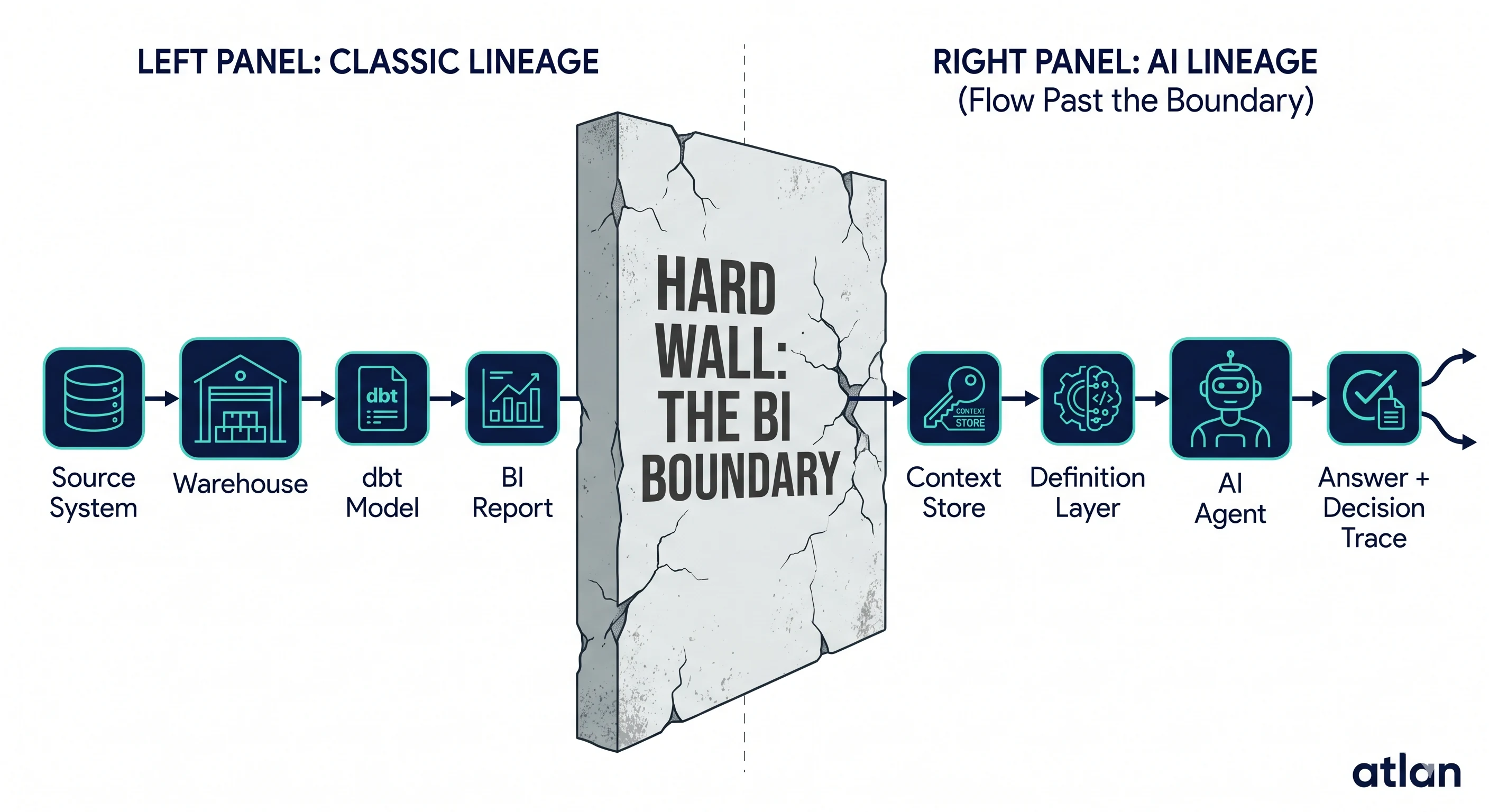
Caption: Classic lineage stops at the BI boundary. AI lineage extends past it into the context store, definition layer, and the agent itself.
| Classic lineage | AI lineage | |
|---|---|---|
| Scope | Source system to BI layer | Source system to inference layer |
| What it tracks | Tables, columns, transformations | Context, definitions, quality signals, unstructured sources |
| Query direction | Forward impact analysis | Forward and backward at inference speed |
| Unstructured sources | Not tracked | Policies, glossary terms, documents included |
| Decision audit trail | Not applicable | Decision trace per agent response |
| Regulatory coverage | SOX, BCBS 239 | Also covers EU AI Act Article 12 |
The three gaps that AI lineage fills
Each gap below is a distinct failure mode: agents that looked fine in testing collapse in production when a source table changes, a definition updates, or a policy document is replaced.
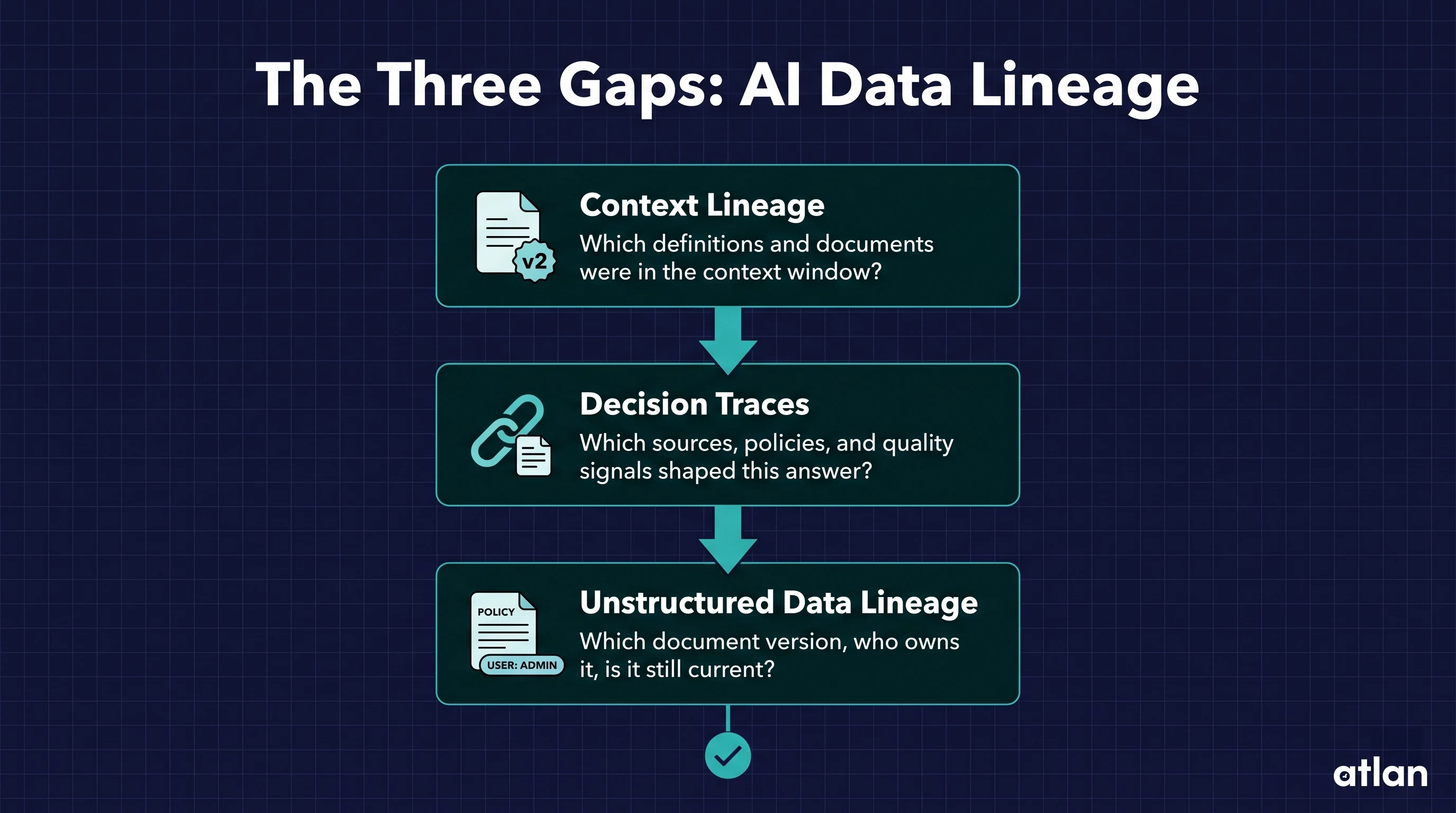
Caption: Context lineage, decision traces, and unstructured data lineage: the three gaps classic lineage leaves open for AI agents.
| Gap | What it looks like in production |
|---|---|
| No context lineage | Agent retrieves an outdated policy document. The Q4 version replaced Q3 six weeks ago. The agent does not know. |
| No decision traces | Revenue forecast is off by 12%. Your team reconstructs logs for a week and finds no definitive root cause. |
| No unstructured lineage | Agent cites a compliance policy verbatim. That policy was superseded two months ago. The answer is confident and wrong. |
What is context lineage and why does it break production agents?
An AI agent retrieves context through the context infrastructure underneath it, a context window that classic data lineage tracks none of. Context lineage tracks that window’s version, ownership, and currency, so decision traces make stale context detectable after the fact rather than invisible.
Why do wrong AI answers resist debugging without decision traces?
A decision trace is a structured, linked record attached to every AI agent response, logging sources, definitions, policies, and quality signals active at inference time. Without one, a wrong answer requires days of forensic reconstruction across raw logs.
With a decision trace on the 12% wrong revenue forecast, the investigation runs instead as a graph traversal: the agent retrieved the sales definition instead of the finance one, that table had a quality check failure logged six days prior, and a glossary update hadn’t yet propagated to the agent’s context store. Root cause identified in minutes, fix scoped to a configuration change.
How does unstructured lineage prevent outdated policy citations?
Policy documents, glossary definitions, and compliance frameworks aren’t in your warehouse, but AI agents cite them constantly, which means you need to know which version, who owns it, and whether it’s been superseded.
Unstructured data lineage extends the graph to document identity, version, and ownership for every non-structured source. Without it, the graph has a hole precisely where agents rely most on organizational knowledge, and it’s where AI agent hallucination is hardest to catch: the agent cited something real, just the wrong version.
How does trust transfer from humans to AI systems?
The trust organizations have built in their data over years isn’t in the data itself. It’s encoded in the lineage, audit trails, and glossary definitions that let a CFO sign off on a revenue number.
AI agents need that same trust but cannot participate in the organizational ceremony that created it: they consume context at inference speed, without the review cycles that made the data trustworthy. AI agent memory governance must be structural, not an afterthought. Workday’s revenue analysis agent, below, is what happens when it isn’t.
Organizations with strong business glossaries and enterprise AI memory infrastructure aren’t starting over; the gap is extending that investment one step further, to the inference layer.
What does the EU AI Act now require from enterprise AI systems?
Article 12 of the EU AI Act, enforceable from August 2, 2026, requires automatic logging of the datasets used as inputs at inference time and, where feasible, the input data behind each output.
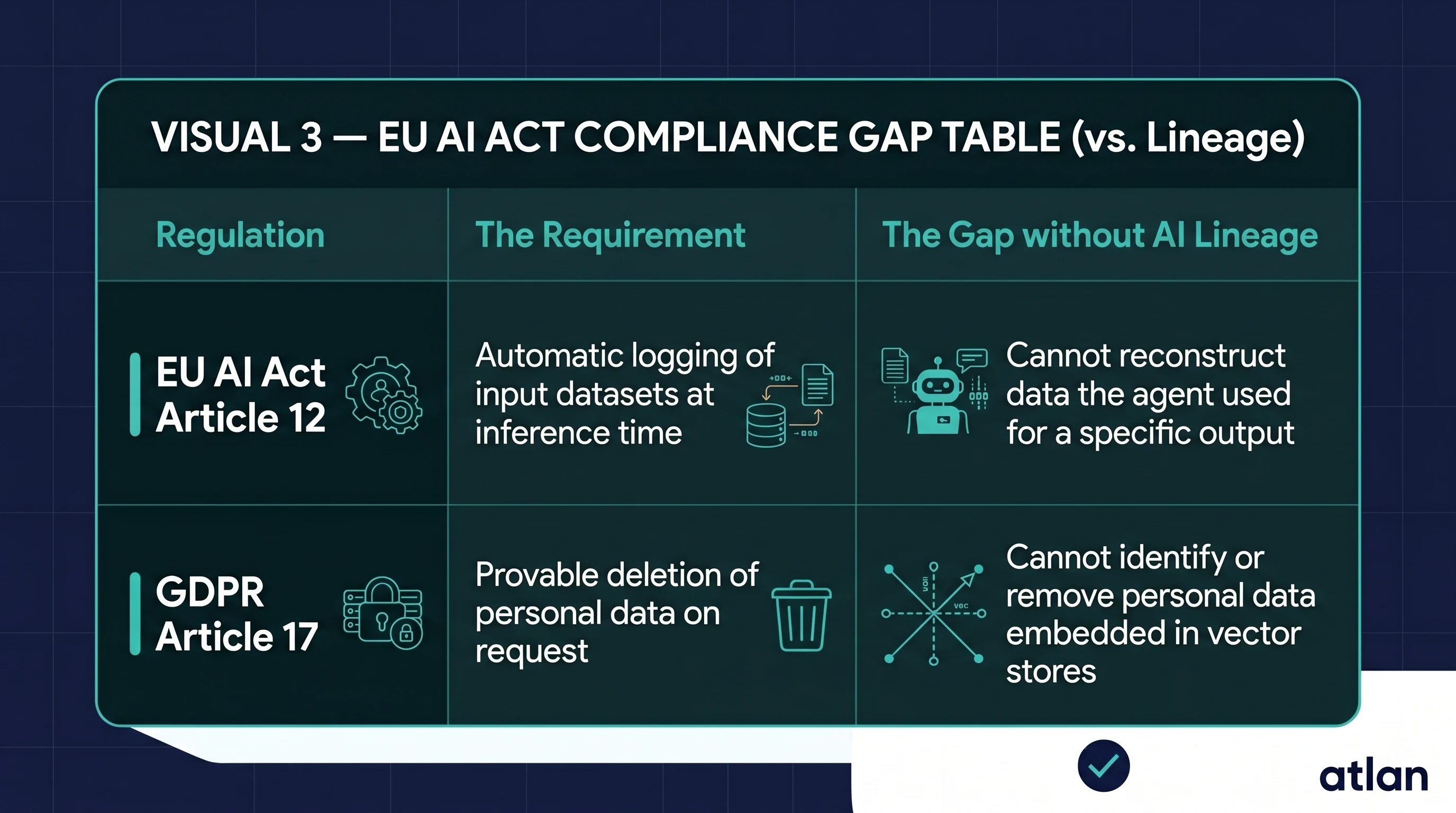
Caption: What EU AI Act Article 12 and GDPR Article 17 require, and the gap that opens without AI lineage.
What is ‘automatic logging’ and why can’t manual logging satisfy Article 12?
Two words in that mandate do the heavy lifting, according to Help Net Security (2026): “automatic” rules out manual documentation; “lifetime” means from deployment to decommissioning. A system with no AI lineage cannot satisfy either through manual reconstruction.
Penalties reach up to 15 million euros or 3% of turnover, the second of three tiers under Article 99 (the highest, for prohibited practices under Article 5, reaches 35 million euros or 7%).
| Organizations should not treat August 2, 2026 as a starting point. Logging controls should already be operational by then; the regulation effectively requires six months of retained audit trail before enforcement begins. EU AI Act compliance is an infrastructure problem, and infrastructure takes months to build. |
|---|
Why does GDPR create a lineage problem for vector stores?
GDPR Article 17, the right to erasure, is a second pressure point: proving personal data embedded in a vector store has been durably deleted is architecturally complex, since embedding compresses data in ways that make provable deletion difficult. AI lineage must track which personal data was indexed, into which store, under which policy, so GDPR compliance requests can be accurately scoped.
Where's your AI lineage gap?
Run the Context Gap Calculator to see how much of your data estate still stops at the BI boundary.
Calculate Your GapHow Atlan extends lineage to the inference layer
The challenge
Existing lineage reaches the warehouse boundary; agents operate past it, and nothing bridges the two. The result is AI agent governance on paper but not at inference time: quality checks fire downstream from agents that never saw them.
The approach
Atlan connects existing lineage infrastructure to the inference layer where agents operate. Column-level lineage across 108 connectors as of September 2026 extracts transformation logic from Snowflake, BigQuery, Redshift, and Databricks. Impact analysis via Context Engineering Studio shows every downstream dashboard, model, and agent memory layer that depends on a changed source, before the failure reaches production.
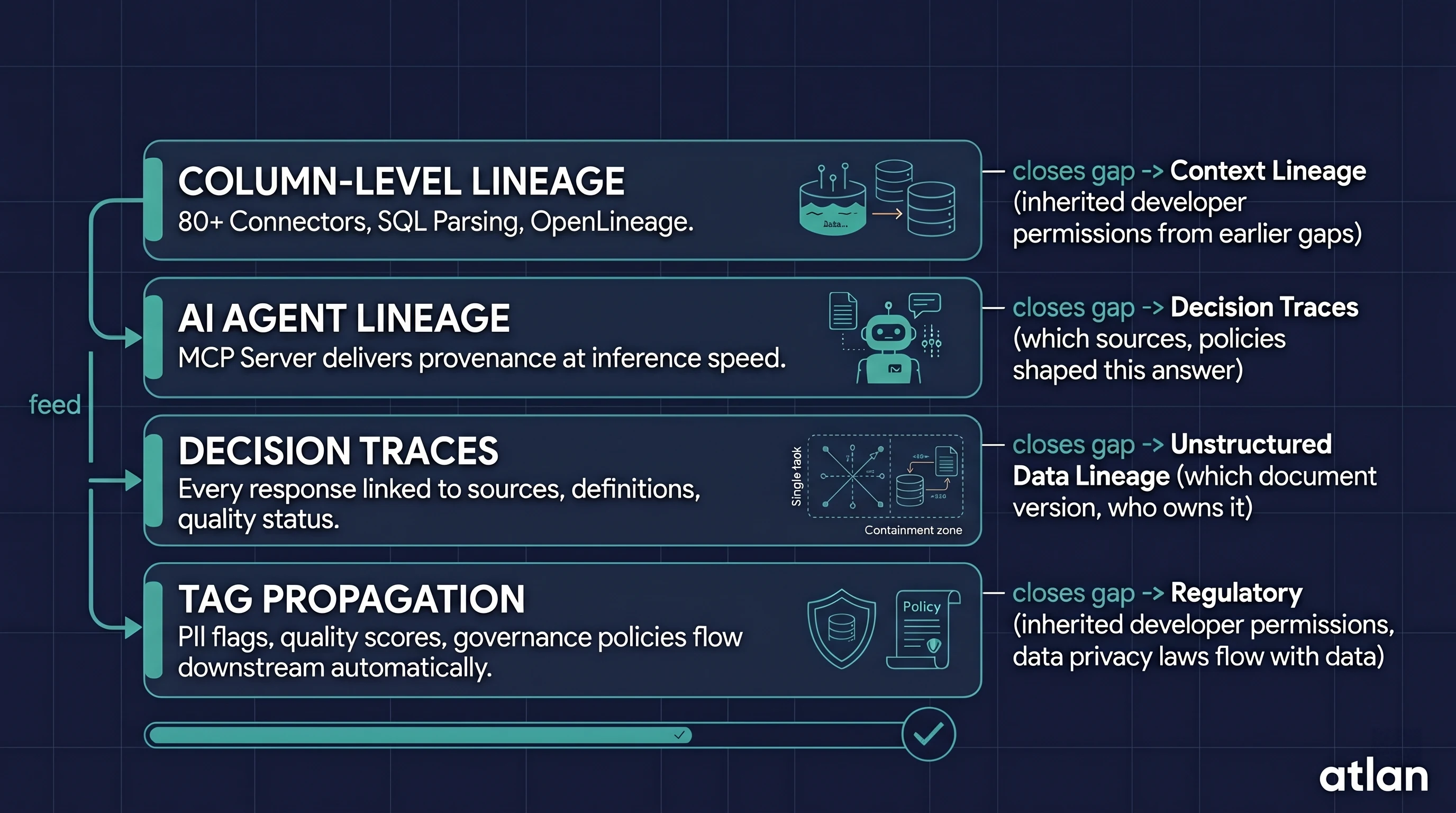
Caption: Column-level lineage, AI agent lineage, decision traces, and tag propagation: how each closes a specific AI lineage gap.
AI agents query the lineage graph before using any data through Atlan’s MCP server: a column check returns provenance, quality score, and ownership in a single call, and when a table is certified, that signal flows automatically to every dependent agent context store. Context agents operate within this governed layer from the first query, bypassing the organizational cold start.
The outcome
Atlan AI Labs research shows a 38%+ query accuracy uplift when agents operate on enriched semantic metadata with lineage versus raw schema alone. The model is unchanged; the context environment is the variable, and teams implementing an enterprise context layer extend this investment rather than starting a parallel one.
The 38%+ figure is from Atlan’s own research.
Real stories from real customers: lineage that survives contact with production agents
"We built a revenue analysis agent, and it couldn't answer one question. We started to realize we were missing this translation layer. We had no way to interpret human language against the structure of the data."
Joe DosSantos, VP Enterprise Data & Analytics, Workday

"With Atlan, we cataloged over 18 million data assets and 1,300+ glossary terms in our first year, so teams can trust and reuse context across the exchange."
Kiran Panja, Managing Director, Cloud and Data Engineering, CME Group

At CME Group’s scale, one of the most complex financial services ecosystems where data provenance is a regulatory requirement, manually added context slowed reuse until Atlan became the lineage foundation that made trusted context reusable across the exchange.
What's the ROI of closing your lineage gap?
Run the Context Layer ROI Calculator to size the cost of debugging AI answers without decision traces.
Calculate the ROIThe last mile is where AI trust is won or lost
According to Fivetran (2026), 41% of organizations are running agentic AI in production while only 15% have the data infrastructure to support it reliably. Every major enterprise’s warehouse lineage investment wasn’t wasted; what’s missing is extending it to the inference layer, where AI agents actually consume data and produce answers that reach business decisions.
Five signals tell you the lineage gap has become a production problem:
-
Wrong AI answers cannot be traced to a root cause after an incident
-
A definition is updated in the glossary but agents in production do not reflect it for days
-
Different agents owned by different teams return different numbers for the same governed metric
-
A regulatory or compliance audit asks for AI inference logs you cannot produce
-
Every new AI use case builds its own private context store from scratch, with no shared lineage
If three or more of these describe your organization, the cost of continuing without AI lineage is already higher than building it.
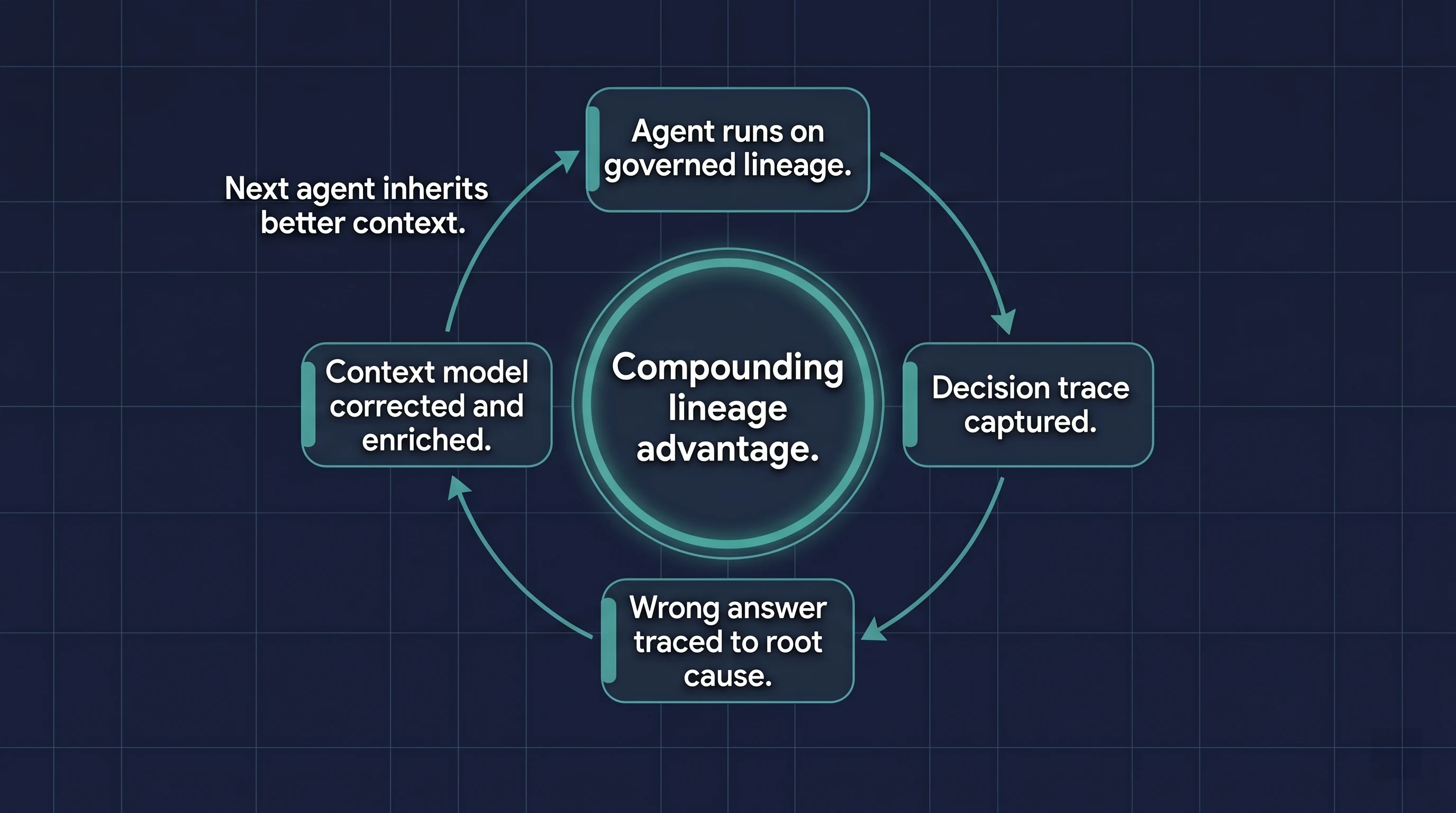
Caption: Every governed agent interaction enriches the lineage graph, making the next agent more reliable than the last.
Every agent interaction that runs through governed lineage enriches the graph. The tenth production agent is more reliable than the first, not because the model improved, but because the lineage did, and teams that build it first don’t rebuild it for every new agent they deploy.
FAQs about data lineage for AI
1. What is the difference between classic data lineage and AI data lineage?
Classic lineage traces data through transformation to BI reports. AI lineage extends that chain to the inference layer, linking each agent response to the context and quality signals active when it was produced.
2. What is a decision trace and why do AI systems need one?
A decision trace is a structured record logging which sources and quality signals were active when a response was generated. Without one, root cause takes days; with one, it’s a graph traversal that takes minutes.
3. How does EU AI Act Article 12 connect to data lineage for AI?
Article 12 requires automatic logging of the datasets used as inputs at inference time, a requirement AI lineage satisfies and manual documentation cannot. Full enforcement begins August 2, 2026.
4. What is context lineage and how is it different from data lineage?
Context lineage tracks the documents and definitions in an agent’s context window: version, ownership, currency. Data lineage tracks how structured data moved across systems. Both are required for fully auditable AI answers.
5. Does implementing AI lineage require rebuilding existing infrastructure?
No. It extends existing lineage rather than replacing it. Organizations with column-level lineage already have the hard part built; the gap is extending that graph into the context stores where agents operate.
6. Why does GDPR create a specific problem for lineage in vector databases?
GDPR Article 17 grants the right to erasure, but proving personal data embedded in a vector store has been deleted is architecturally complex, since embedding compresses data in ways that make deletion hard to verify.
7. How does lineage-based tag propagation work in practice?
When a source table receives a quality certification or PII flag, that signal propagates automatically to every dependent asset, including AI context stores, so agents know at query time whether data is certified or failing checks.
8. What penalty tier does EU AI Act Article 12 sit in?
Article 12 record-keeping violations fall in the second of three penalty tiers under Article 99: up to 15 million euros or 3% of turnover. The highest tier, for prohibited practices, reaches 35 million euros or 7%.
Sources
-
85% of Enterprises Are Running Agentic AI on a Data Foundation That Isn’t Ready, Fivetran (2026)
-
The GenAI Divide: State of AI in Business 2025, MIT Project NANDA, via Fortune (2025)
-
What the EU AI Act Requires for AI Agent Logging, Help Net Security (2026)
-
Regulation 2024/1689 (EU AI Act), Article 12, European Union (2024)
