

Two agent interoperability protocols now sit at the center of enterprise AI architecture. MCP (Model Context Protocol), released by Anthropic in November 2024, connects AI models to tools and data sources through a standardized interface. A2A (Agent2Agent protocol), released by Google in April 2025 with 50+ enterprise partners, enables AI agents to delegate tasks to other agents. These protocols solve different problems at different layers of the stack. They are designed to work together, not compete.
Inside Atlan AI Labs & The 5x Accuracy Factor
Learn how context engineering drove 5x AI accuracy in real customer systems. Explore real experiments, quantifiable results, and a repeatable playbook for closing the gap between AI demos and production-ready systems.
Download E-BookWhat is MCP (Model Context Protocol)?
The Model Context Protocol (MCP) is an open standard introduced by Anthropic in November 2024 that defines how AI models connect to external tools, data sources, and APIs. MCP standardizes the interface between an AI model and the systems it accesses, replacing one-off, fragile integrations with a single, reusable connection layer. Anthropic’s November 25, 2024 announcement describes MCP as “an open standard that enables developers to build secure, two-way connections between their data sources and AI-powered tools,” which is the point a USB-C analogy is usually reaching for: one interface instead of a new integration per pair.
According to Anthropic’s MCP announcement (November 2024), the protocol’s goal is to let AI assistants work with the data and tools people already use, through a standard that any system can implement. MCP has since been adopted by OpenAI (March 2025, Agents SDK) and LangChain (early 2025, native support), confirming its position as a cross-vendor standard rather than an Anthropic-specific protocol. The question of MCP vs function calling is often raised in this context: MCP provides a standardized server layer that function calling alone does not.
What MCP does not address: the quality, versioning, or governance of the context it delivers. A server can be technically compliant and still return business definitions that are three months out of date. Protocol compliance is not context accuracy. One production implementation that addresses this gap is the Atlan MCP Server, which exposes governed, versioned metadata to any MCP-compatible model.
Core components of MCP
- Resources: Data objects exposed to the model (files, database records, API responses) via URI addressing
- Tools: Executable functions the model can invoke (search, query, write) with typed input/output schemas
- Prompts: Reusable prompt templates that encode workflows and can be parameterized at runtime
- Transport layer: stdio for in-process local tools; Server-Sent Events (SSE) over HTTP for remote servers
- Host/client/server architecture: The host (e.g., Claude Desktop, VS Code) manages the client; the client connects to MCP servers that expose capabilities to context-aware AI agents
Building context-aware AI agents on MCP gives your team standardized access to any enterprise data graph, but the protocol itself makes no guarantee about what the data in that graph means or how current it is. Specialized MCP servers like the Snowflake MCP server and the Databricks MCP server connect agents directly to cloud data warehouse and lakehouse environments, while the dbt MCP server exposes transformation pipeline definitions and lineage. For enterprise teams, the gap between protocol compliance and context accuracy is the real architectural question MCP raises, not the question of how to connect.
What is A2A (Agent2Agent protocol)?
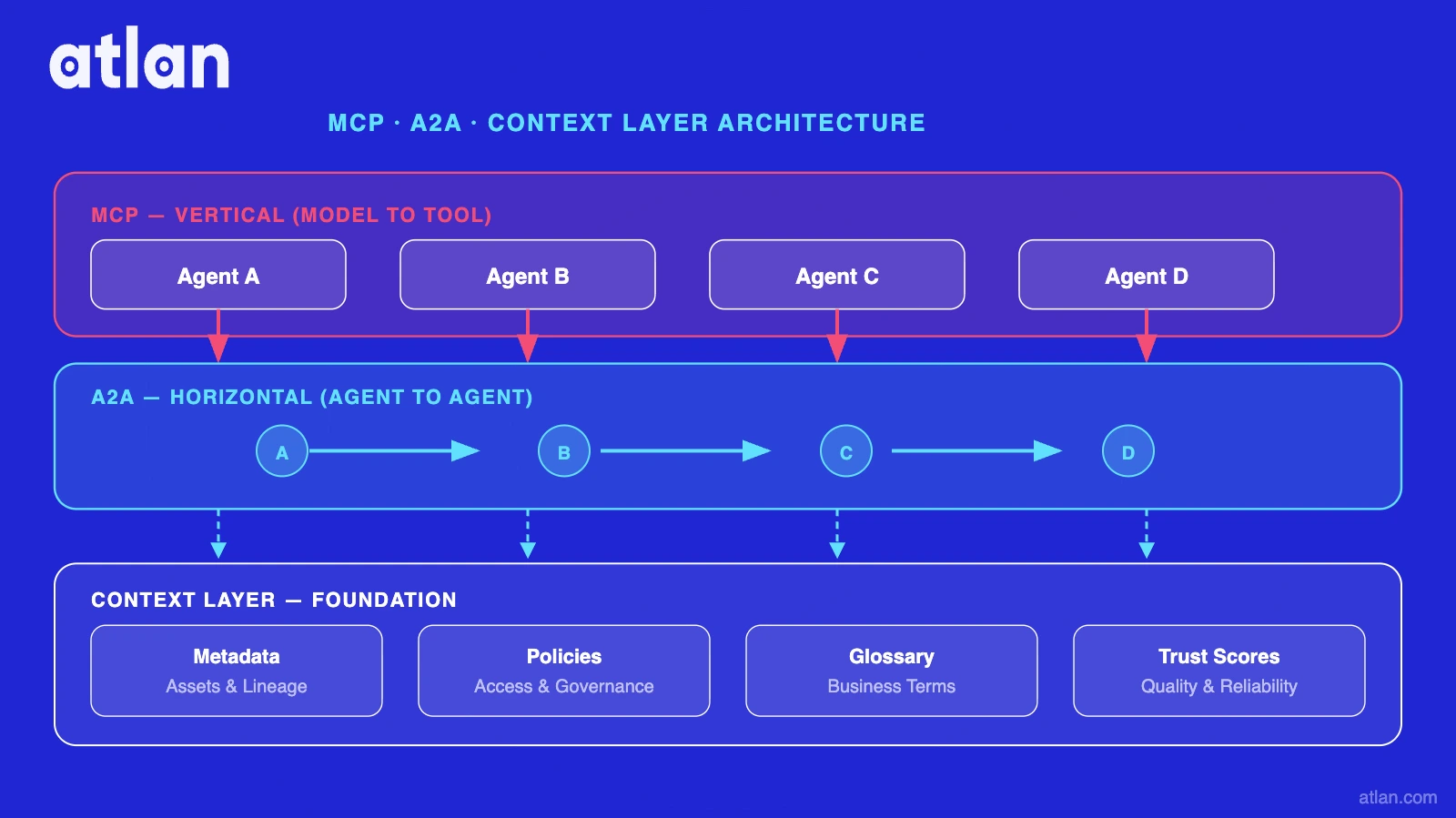
The Agent2Agent (A2A) protocol is an open standard released by Google in April 2025 that enables AI agents built on different frameworks or platforms to communicate, discover each other’s capabilities, and delegate tasks. Where MCP handles the vertical connection between a model and its tools, A2A handles the horizontal coordination between multiple agents. That makes it the right tool for multi-agent system orchestration at scale.
According to the Google Developers Blog announcement (April 2025), A2A launched with 50+ technology partners including Atlassian, Salesforce, SAP, ServiceNow, and Workday. Microsoft confirmed support for both MCP and A2A in Azure AI Foundry and Copilot Studio at Build 2025. That confirmation is a significant signal: these protocols are not competing choices but complementary infrastructure.
A2A uses HTTP/S transport and is cloud-native by design. Unlike MCP’s optional stdio transport for local use, A2A assumes network-distributed agents. What A2A does not address is the content quality of the context being exchanged. Agent memory and shared business definitions are outside the A2A spec. The protocol routes tasks; it does not ensure that the agents executing those tasks work from a consistent, governed definition of the problem. For AI agent governance, A2A is a transport layer, not the governance layer.
Core components of A2A
- Agent Cards: JSON-LD documents served at
/.well-known/agent.jsonthat describe an agent’s capabilities, authentication requirements, and skill set - Tasks: The primary work unit with a lifecycle (submitted, working, completed, failed) carrying structured inputs and outputs
- Capability advertisement: A2A defines how agents discover what other agents can do, without defining what quality or accuracy those capabilities deliver
- HTTP/S transport: Designed for network-distributed agents, cloud-native by default
- Streaming support: SSE-based streaming enables real-time status updates between agents for long-running tasks
A2A represents the coordination layer of an enterprise agent stack. Teams that scale to multi-agent architectures without thinking about the context substrate those agents share are solving the routing problem while leaving the consistency problem open. The protocol moves the work; it does not know if both agents mean the same thing by “revenue.” Addressing enterprise context silos is the prerequisite for A2A to deliver consistent multi-agent outputs.
MCP vs A2A: head-to-head comparison
The sharpest difference between MCP and A2A is the integration surface each addresses. MCP connects a single AI model to external data and tools: it is vertical. A2A connects multiple AI agents to each other for task coordination: it is horizontal. They operate at adjacent layers of the same enterprise AI stack, which is exactly why the question “MCP or A2A?” misframes the decision.
| Dimension | MCP | A2A |
|---|---|---|
| Integration surface | Model to tool/data/API | Agent to agent |
| Direction | Vertical (model reaches down to systems) | Horizontal (agents coordinate laterally) |
| Protocol spec | JSON-RPC 2.0 over stdio or SSE/HTTP | HTTP/S with JSON-LD Agent Cards |
| Primary primitive | Resources, Tools, Prompts | Agent Cards, Tasks, Task lifecycle |
| Context it handles | Delivers context to the model | Routes tasks between agents |
| Context quality control | None in spec: server-author responsibility | None in spec: capability advertisement only |
| Ecosystem | 2,000+ community servers; OpenAI, LangChain, VS Code | 50+ enterprise partners; Azure AI Foundry, Vertex AI |
| Failure mode | Stale MCP server returns outdated business definitions | Agents coordinate efficiently on wrong shared context |
Consider a real-world scenario: a financial services firm builds an AI system where a risk-scoring agent (running on Claude) needs current portfolio data and must hand off flagged accounts to a compliance review agent. MCP handles the first part: the risk-scoring agent connects to the data warehouse via an MCP server. A2A handles the second part: the risk agent delegates flagged items to the compliance agent using an Agent Card and task lifecycle. The context architecture for AI agents that governs what “flagged” means, how “risk” is defined, and whether both agents share the same certified business glossary is the work of the agent context layer, not of either protocol.
The failure mode Microsoft and the developer community surface repeatedly: both protocols are independently working, yet agents produce inconsistent outputs because they draw from different versions of the same context graph. Protocol correctness does not equal context consistency. Effective context management across multi-agent systems requires a governed substrate that sits beneath both protocols.
Build Your AI Context Stack
Get the blueprint for implementing context graphs across your enterprise. This guide walks through the four-layer architecture from metadata foundation to agent orchestration, with practical implementation steps for 2026.
Get the Stack Guide
How MCP and A2A work together
MCP and A2A are not alternatives; they operate at different layers of the same agent stack. A production multi-agent system typically uses MCP for each agent’s data and tool access, and A2A for coordination between those agents. According to Microsoft Build 2025 announcements, Azure AI Foundry and Copilot Studio support both protocols simultaneously, confirming the architectural pattern that practitioners have been describing: these protocols are layered, not competing.
Single-agent tool access (MCP only)
An agent uses MCP to access a governed metadata store, a SQL database, or a file system. This is the most common starting point. A2A is not involved when a single model needs external context. The context engineering framework that structures what that single agent receives matters more than the connection mechanism. Understanding when to use MCP vs API is the first architectural decision: MCP provides a standardized, discoverable interface that raw API calls do not.
Multi-agent task delegation (A2A orchestration with MCP data access)
An orchestrator agent breaks a task into subtasks and routes them to specialist agents via A2A. Each specialist agent accesses the data it needs via its own MCP connections. The two protocols are layered, not competing. This is the pattern Microsoft’s dual-protocol support confirms for Azure AI Foundry, and it is the expected architecture for any context engineering for AI agents implementation at enterprise scale.
Context consistency across agents (the missing layer)
When multiple agents each access separate MCP servers, they can return semantically inconsistent results, using different definitions of the same business concept. A2A coordinates their task flow but cannot resolve the definition gap. This is the problem context versioning for AI agents addresses: ensuring that each agent, regardless of which protocol connects it to data, draws from the same versioned, certified business definitions. Practitioners building on A2A have noted publicly that context isolation between agents remains an unsolved problem at the protocol level. Neither protocol’s spec addresses it. The agent context layer does.
When to use MCP vs A2A
The decision is not competitive; it follows from your architecture.
Use MCP when:
- A model needs to read from or write to an external system (database, file system, API, metadata catalog)
- You are standardizing how one or more models access the same data source, effectively applying AI agent primitives to data connection
- Your architecture is single-agent, or the agent does not need to coordinate with other agents
Use A2A when:
- You are building a multi-agent system where one agent needs to delegate work to another
- Your agents run on different frameworks or are managed by different teams
- You need task lifecycle visibility (submitted, working, completed, failed) across agent boundaries
Use both when:
- You are running a production multi-agent system where each agent needs governed data access and the agents must coordinate tasks with each other
- This is the expected end-state for most enterprise agentic deployments: MCP for data access, A2A for coordination
The choice between when to use MCP vs API is a separate but related decision. MCP’s standardization advantage compounds when multiple agents all need to access the same MCP connected data catalog: one governed server serves all of them consistently, instead of each agent maintaining its own custom integration. A well-designed context API makes the underlying business context available in a structured, versioned form regardless of which protocol delivers it.
Teams building production-scale agent systems need both protocols. But the protocol choice is secondary to the question of what governs the context each protocol delivers. That is the investment that determines whether agent outputs are trustworthy, and it is reversible only if you build the substrate first.
Common mistakes when choosing between MCP and A2A
These are the patterns practitioners on Reddit, HN, and X surface repeatedly when describing production failures.
1. Treating MCP and A2A as competing choices. They solve different problems. Choosing one does not replace the other. Most production systems will eventually use both. The relevant question is which layer of the stack each addresses.
2. Building MCP servers without versioning the context they serve. An MCP server can return structured data correctly and still serve stale business definitions. Protocol compliance is not the same as context accuracy. Without AI agent observability across what each server returns, stale definitions propagate silently.
3. Assuming A2A solves context consistency. A2A manages task delegation and agent capability advertisement. It does not ensure that two agents using the same term (“revenue,” “churn,” “active_user”) mean the same thing. Multi-agent memory silos are an A2A blind spot: the protocol coordinates agents, it does not unify what they know.
4. Delaying governance until “later.” Teams that build MCP servers without a governed metadata layer spend, according to practitioners on r/dataengineering, what amounts to a second full-time job maintaining tool descriptions as schemas change. The maintenance burden compounds with every new agent. AI agent access control and context lifecycle management are not follow-up investments. They are foundational to every protocol choice that follows.
5. Confusing model routing with context governance. Choosing which LLM to call is a routing decision. Ensuring that model has accurate, versioned, governed context is an infrastructure decision. These require different investments, different team ownership, and different timelines. Teams that treat them as the same decision consistently discover, after the rebuild, that they were not.
The missing layer: what MCP and A2A don’t solve
Both MCP and A2A define how context travels. Neither defines what that context is worth. A tool definition that returns get_revenue_by_quarter is correctly formatted. But if the underlying business context definition of revenue has changed and no one versioned it, three agents can each return a different number. The protocol moved the packet; no protocol knows if the packet is meaningful.
The structural gap is built into both specs. MCP defines Resources, Tools, and Prompts, not business meaning, lineage, or certification status. A2A defines Task lifecycle and Agent Card capabilities, not whether the context backing those capabilities is current. According to community signals from r/MachineLearning, “MCP servers return stale data all the time because nobody versions the metadata.” This is a structural failure mode that has nothing to do with protocol correctness and everything to do with the absence of a governed context substrate. This is also why enterprises need a context layer as a precondition for reliable agentic AI.
The enterprise question no current SERP page addresses: how does your team stay in control when agents talk to each other? The answer is not a protocol choice. It is the context infrastructure for AI agents that both protocols run on top of: versioned definitions, certified business glossary (Active Ontology), lineage, ownership, quality scores. A well-governed context catalog is where that managed context lives, and it is why enterprises building the context layer first make their protocol choices reversible.
A reasonable counterargument: MCP’s typed tool definitions and typed resources ARE a form of context governance, since schema validation enforces format. This is true. Format is not meaning. A schema can validate that revenue is a float; it cannot validate that it is the same float your CFO uses. The enterprise context layer is where that validation lives, and it is the layer the agent context layer documentation describes in detail.
According to Atlan’s Context Quality Testing (2025), enterprises that deployed governed context via Atlan’s MCP Server saw a 38% improvement in AI accuracy across 522 queries compared to unstructured retrieval. Andrew Reiskind, CDO at Mastercard, put the scale challenge directly: “AI initiatives require more context than ever. Atlan’s metadata lakehouse is configurable, intuitive, and able to scale to hundreds of millions of assets.” Kiran Panja, Managing Director of Cloud and Data Engineering at CME Group, distilled the enterprise conviction: “Context is the differentiator.”
The investment decision is not “MCP or A2A?” Enterprises that invest in the context layer first make their protocol choices reversible. Enterprises that skip it will rebuild.
Real stories from real customers: when the context layer came before the protocol
Workday and DigiKey did not start with a protocol decision. They built a governed context layer first: shared definitions, certified metadata, versioned business logic. Then they activated it via Atlan’s MCP Server. The protocol was the delivery vehicle. The context layer was the infrastructure that made the delivery worth having. The context layer ROI that Workday and DigiKey demonstrate is a direct result of sequencing: context layer first, protocol choice second.
"We're excited to build the future of AI governance with Atlan. All of the work that we did to get to a shared language at Workday can be leveraged by AI via Atlan's MCP server…as part of Atlan's AI Labs, we're co-building the semantic layer that AI needs with new constructs, like context products."
Joe DosSantos, VP of Enterprise Data & Analytics, Workday

At Workday, AI accuracy was not a model problem; it was a context problem. The team built a shared language first: certified definitions, ownership, business glossary. Once that substrate existed, MCP became the delivery mechanism. Workday AI Labs measured a 5x improvement in AI accuracy when agents consumed governed context versus unstructured data. The protocol was added after the context layer. That sequence is not incidental; it is the architecture.
"Atlan is our context operating system to cover every type of context in every system including our operational systems. For the first time we have a single source of truth for context."
Sridher Arumugham, Chief Data Analytics Officer, DigiKey

DigiKey’s approach confirmed the same architecture from a different angle. Rather than treating MCP, governance, and data quality as separate investments, DigiKey built one context layer that served all of them. One governed substrate, multiple delivery paths. Protocol-agnostic by design.
Protocols are the delivery system. Context is the infrastructure.
Choosing MCP vs A2A is a routing decision. Building a context layer is an infrastructure decision. These are not equivalent choices, and conflating them is the source of most enterprise AI architecture regret.
According to Gartner’s “Top Strategic Technology Trends for 2025: Agentic AI”, agentic AI is a top strategic technology trend for enterprises. The practical implication: as agent systems scale to dozens of models coordinating across hundreds of data sources, the question that determines outcomes is not “which protocol?” but “what governs the context every protocol serves?”
Protocol decisions are reversible if the context layer is solid. According to Microsoft Build 2025, Azure AI Foundry supports both MCP and A2A simultaneously. Your team can run both protocols on the same infrastructure, add either one later, and switch approaches as the ecosystem evolves. What is not reversible: context layer gaps. They compound as agents proliferate. An agent stack built on unversioned, unowned, ungoverned context will not become more accurate as you add more agents; it will become less accurate, because each new agent introduces a new surface for definition drift. The AI control plane that manages model routing is valuable; it does not substitute for the context layer that governs what every model in that plane actually sees.
The architecture that Workday and DigiKey confirm independently: build the governed context layer first. Then choose your protocols. The model router vs model gateway decision comes after the context layer decision, not before it. Teams that sequence this correctly make every downstream protocol choice reversible. Teams that skip the context layer and go straight to protocol selection will find themselves rebuilding their AI infrastructure when accuracy fails to meet production standards.
FAQs
1. What is the difference between MCP and A2A?
MCP connects AI models to external tools and data sources: it is a vertical, model-to-system protocol. A2A connects AI agents to each other for task delegation: it is a horizontal, agent-to-agent protocol. They operate at different layers of the same stack and are designed to complement each other, not compete.
2. Does A2A replace MCP?
No. A2A handles coordination between agents; MCP handles each agent’s access to tools and data. A multi-agent system using A2A for orchestration still needs MCP (or equivalent) for each agent’s data connections. Microsoft’s Azure AI Foundry supports both protocols simultaneously, confirming that production architectures use both.
3. Can MCP and A2A work together in the same system?
Yes, and most production multi-agent systems will eventually use both. The typical pattern: each agent uses MCP to access the data and tools it needs; agents use A2A to coordinate tasks with each other. The protocols operate at different layers of the stack and are not in conflict.
4. Who created the A2A protocol?
Google created and open-sourced the Agent2Agent (A2A) protocol, announcing it at Google Cloud Next on April 9, 2025. The launch included commitment from 50+ technology companies including Atlassian, Salesforce, SAP, ServiceNow, and Workday. The A2A specification and SDK are available on GitHub at google-a2a/A2A.
5. What is an Agent Card in A2A?
An Agent Card is a JSON-LD document served at a well-known endpoint (/.well-known/agent.json) that describes an AI agent’s capabilities, supported task types, and authentication requirements. Agent Cards are how A2A-compatible agents advertise themselves to orchestrators and other agents in a multi-agent system.
6. Do I need both MCP and A2A in a multi-agent architecture?
For a single-agent system, MCP is sufficient. For a multi-agent system where agents on different frameworks or teams need to coordinate, A2A adds task delegation and lifecycle management. Most enterprise deployments scaling beyond a single agent will eventually need both: MCP for data access, A2A for coordination.
7. What sits below MCP and A2A in an enterprise AI stack?
Both protocols are delivery mechanisms: they define how context travels but not what that context means or whether it is accurate. Below MCP and A2A is the context layer: the governed substrate of certified definitions, lineage, ownership, and versioned business logic that agents actually consume. Without this layer, protocol compliance does not guarantee agent accuracy.
Sources
-
Introducing the Model Context Protocol, Anthropic (November 2024)
-
Model Context Protocol - Official Specification, modelcontextprotocol.io
-
Announcing the Agent2Agent Protocol, Google Developers Blog (April 2025)
-
A new era of agent interoperability, Google Cloud Blog (April 2025)
-
Top Strategic Technology Trends for 2025: Agentic AI, Gartner
