

Skill engineering is the fourth rung in the AI agent lineage, after prompt engineering (2022-2024), context engineering (2025), and harness engineering (2026+), a ladder Atlan documents across two live comparison pages. A support-ticket triage skill you write still calls a customer_tier field at runtime, and a stale value routes the ticket wrong no matter how well the SKILL.md is written.
| Dimension | Prompt Engineering | Skill Engineering |
|---|---|---|
| What it is | A single instruction to an LLM | A packaged, reusable procedure (SKILL.md) |
| What it does | Shapes one response | Bundles instructions, examples, and resources an agent loads on demand |
| Who owns the standard | No formal standard, community practice | Anthropic’s Agent Skills open standard (Dec 2025) |
| Key strength | Fast, no setup, works anywhere | Persistent, versioned, composable across sessions |
| Best for | One-off, exploratory questions | A procedure repeated across a team |
| Questions it answers | “How do I ask this well?” | “How does my team always do this?” |
| Complexity to adopt | None | Low to moderate: authoring, evaluation, versioning |
Watch the context layer ground a live agent
See how Atlan's context layer delivers certified metrics, lineage, and policy into a running agent skill through MCP, in a recorded live demo series.
Watch Live Context Layer DemosSkill engineering vs prompt engineering: what’s the difference?
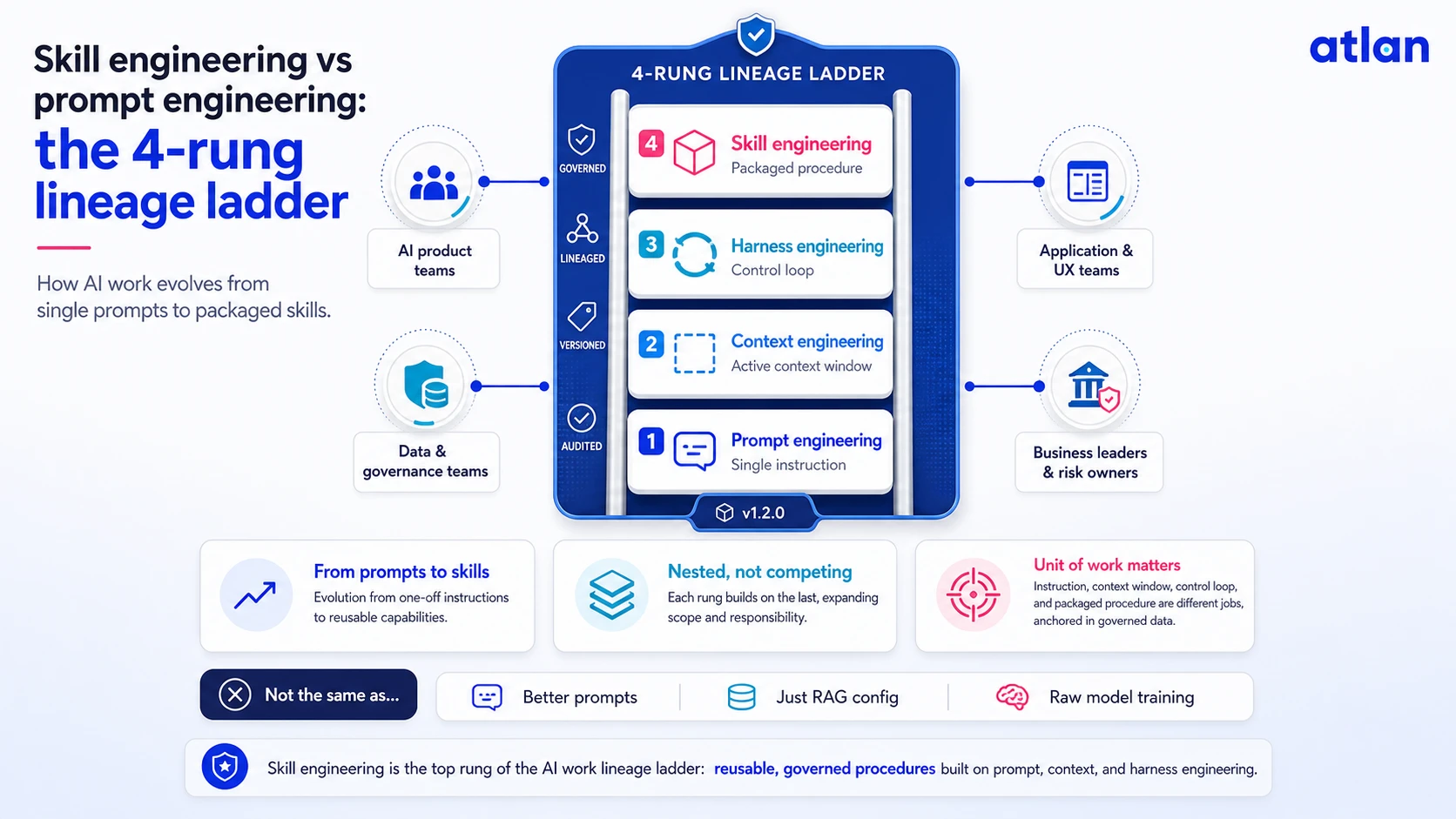
Skill engineering, prompt engineering, context engineering, and harness engineering form a single four-rung lineage, not four unrelated disciplines, and practitioners on X are already sketching versions of this same ladder unprompted. This page keeps harness engineering as its own rung, distinct from skill engineering, rather than collapsing the two.
Each rung governs a different unit of agent behavior, and skill engineering is the first to make the procedure itself the portable artifact:
| Rung | Unit of work | Era | Atlan reference |
|---|---|---|---|
| Prompt engineering | A single instruction | 2022-2024 | Foundational rung |
| Context engineering | The active context window | 2025 | States plainly it’s not a skills problem |
| Harness engineering | The control loop around a running agent | 2026+ | See why the context layer grounds the harness |
| Skill engineering | A packaged, reusable procedure | 2025+ | What Is Skill Engineering? |
The word “skill” carries three different meanings across current search results:
- A SKILL.md package, Anthropic’s Agent Skills standard, the sense this page uses throughout.
- ML skill-training, a fine-tuning-adjacent sense that evaluates a model’s skill through feedback (see Presient Labs’ comparison).
- Human job-skills, what skills a prompt engineer needs as a career, not this page’s topic.
Some practitioner writing goes further and argues prompt engineering is finished: no re-explaining a 500-word prompt every session, no agent forgetting requirements mid-task. Those are gains from containment, not replacement, the same tension Atlan’s harness engineering page already resolved one rung down: nested, not competing.
What is prompt engineering?
Prompt engineering is the discipline of designing instructions that elicit accurate, useful responses from large language models, the smallest, message-level unit of control in the lineage. Between 2022 and 2024 it was the primary lever for improving LLM output: zero-shot prompting, few-shot examples, chain-of-thought reasoning, and role assignment all live at this layer. Prompt engineering for data retrieval shows what the discipline can and can’t do alone. It extracts structured output well, but it can’t prompt its way to reliable multi-step agent behavior.
Classic prompt engineering advice still applies inside a skill. Verifiable constraints, persona framing, and few-shot examples all carry forward, they just live inside a reusable file instead of getting retyped.
What is skill engineering?
Skill engineering is the discipline of packaging a repeatable agent procedure into a persistent, version-controlled unit, SKILL.md, that an agent loads on demand instead of re-typing into every prompt. Anthropic’s engineering blog is the tier-1 anchor for the mechanics this page borrows rather than contests.
Tristan Handy, Founder and CEO of dbt Labs, frames the propagation effect directly: “Agent skills are bundles of prompts and procedural guidance that AI agents load dynamically when you ask them to do relevant work… best practices encoded in a skill propagate faster than best practices in a blog post.”
That speed cuts both ways. According to a University of California, Irvine study of real-world skills (Hong, Imani, and Ahmed, arXiv:2607.01456, 2026), over 99% of SKILL.md files contain at least one authoring defect, a “skill smell.” That statistic measures how skills are written, not whether the data they reach for at runtime is true, the distinction this page builds on.
The same story already played out one rung down: harness deployments failed less often because the control loop was poorly written than because nobody validated what it reached for at runtime, documented in full on agent harness failures and anti-patterns, with how to build an AI agent harness showing how to guard against it before a harness ships.
See where your context stack has gaps
The AI Context Stack brief maps every layer an agent depends on, from prompt to skill, so you can see which layer is ungoverned before a skill ships against it.
Get the AI Context StackSkill engineering vs prompt engineering: head-to-head comparison
The sharpest differences show up in reusability, persistence, and failure mode: prompt engineering lives in the conversation, skill engineering lives on disk, and both share the same unexamined runtime blind spot.
| Dimension | Prompt Engineering | Skill Engineering |
|---|---|---|
| Control | A single message | A persistent, reusable package |
| Abstraction | Per-interaction | Reusable across sessions |
| Era | 2022-2024 | 2025+ |
| Primary failure mode | Poorly worded instructions | Ungoverned data reached at runtime |
| Tools needed | None beyond the LLM | SKILL.md registry plus a supporting client |
| Best for | Single-turn or exploratory tasks | Repeatable, multi-step procedures |
| Origin | Community, informal | Anthropic, Agent Skills standard (Dec 2025) |
| Defining framing | “Classic prompt engineering advice still applies” | “Stop prompt engineering” claim, disputed here |

Real-world example: a support-ticket triage skill packages the whole procedure, categorize, check the SLA, draft a response, into a reusable SKILL.md the agent loads for every ticket. It still calls a customer_tier and sla_deadline field at runtime; if those fields are stale, the skill executes flawlessly and still routes the ticket wrong, the same failure mode documented for AI agent harnesses.
How do prompt engineering and skill engineering work together?
A skill does not replace prompt engineering, it contains it. Every SKILL.md still issues prompts internally, it just bundles them with instructions, examples, and resources that persist and compose across sessions, one of the AI agent primitives teams now build with.
A revenue-analysis skill is a useful example. The skill defines the reusable procedure: pull the table, apply the standard filters, format the output. The analyst still prompt-engineers the specific question each time, “break this down by region” versus “by product line,” inside that fixed structure.
One-off, exploratory tasks don’t justify the overhead of authoring, testing, and versioning a skill; prompt engineering remains the right tool when there’s no procedure to reuse yet. Start writing a skill once a procedure repeats three or more times, needs to be shared across a team, or the same mistake keeps recurring across sessions.
Two adjacent boundaries are worth naming, though not this page’s job to resolve. A skill is not MCP: MCP and function calling give an agent access to systems, while a skill teaches it how to use that access. MCP matters for AI agents because a skill without governed access to real systems is just documentation. A skill is also not a discrete tool call, the same split showing up one rung down between an agent harness and an agent framework. Both get full treatment on Agent Skills vs MCP and Agent Skills vs Tools.
How Atlan approaches skill engineering and prompt engineering
A well-engineered skill and a well-engineered prompt share the same blind spot: neither one asks whether the data it reaches for is current, certified, or correctly attributed. Every external source comparing skills to prompts argues the structural case only, never whether a skill’s runtime output is trustworthy; a skill can pass every check, no SKILL.md smells, well-scoped, well-described, and still produce a confidently wrong answer if the data it queries is stale or uncertified.
The enterprise skills governance guide covers this two-layer model in depth: a procedure layer (SKILL.md, Anthropic’s spec) and a context layer (metric definitions, lineage, and policy), delivered through the same context layer, MCP server, and context graph a skill already queries for enterprise data, on top of the same enterprise context layer an agent needs regardless of which rung is calling it. It’s progressive disclosure applied to governed data, not just instructions, a pattern implementing an enterprise context layer covers in more depth.
Joe DosSantos, VP of Enterprise Data & Analytics at Workday, frames the same idea from the customer side: “All of the work that we did to get to a shared language at Workday can be leveraged by AI via Atlan’s MCP server…” Governed context serves any consuming layer, prompt, skill, or harness, equally.
Real stories from real customers: context that grounds every layer of the stack
"We're excited to build the future of AI governance with Atlan. All of the work that we did to get to a shared language at Workday can be leveraged by AI via Atlan's MCP server…as part of Atlan's AI Labs, we're co-building the semantic layer that AI needs with new constructs, like context products."
Joe DosSantos, VP of Enterprise Data & Analytics, Workday

"Atlan is much more than a catalog of catalogs. It's more of a context operating system…Atlan enabled us to easily activate metadata for everything from discovery in the marketplace to AI governance to data quality to an MCP server delivering context to AI models."
Sridher Arumugham, Chief Data & Analytics Officer, DigiKey

See where your skill engineering practice stands
Score whether the data your skills and prompts reach for is actually governed, not just well-structured.
Take the Context Maturity AssessmentBoth quotes describe the same substrate serving a different consuming layer: prompt, skill, or harness.
Why skill engineering still needs a governed context layer
Skill engineering gives agents a portable, testable way to encode how work gets done, and it deserves the credit the practitioner community is giving it. It is the fourth rung after prompt, context, and harness engineering, and the first rung where the procedure itself, not just the model’s inputs or its control loop, becomes the reusable unit.
But a portable procedure and an ungoverned data source combine into a reliable-looking, wrong agent. The distinction that separates skill deployments that scale from ones that quietly erode trust is not whether the SKILL.md is well-written. It is whether the data behind every data-reaching skill, and every prompt inside it, is current, certified, and consistently defined. Practitioners already treat skill, context, and harness engineering as adjacent disciplines. The missing piece across all of them is the same one.
Sources
- Getting Started with AI Agent Skills, James Wilkins
- Stop Prompt Engineering! Claude Skills Are the Secret Weapon Top Devs Use, BrightCoding
- Stop Engineering Prompts, Start Engineering Context: A Guide to the Agent Skills Standard, Medium
- Equipping Agents for the Real World with Agent Skills, Anthropic Engineering
- From Anatomy to Smells: An Empirical Study of SKILL.md in Agent Skills, arXiv
- AI Skill Optimization vs Prompt Engineering: What’s the Difference?, Presient Labs
- Prompt Engineer: Analyzing Hard and Soft Skill Requirements in the AI Job Market, arXiv
- Agent Skills: Disseminating Expertise, dbt Labs
- Claude Skills Are Awesome, Maybe a Bigger Deal Than MCP, Simon Willison
- The Agentic Age Needs a Cognitive Operating Model, Forrester
FAQs about skill engineering vs prompt engineering
-
Is prompt engineering dead because of Agent Skills?
No. Prompt engineering is a contained, necessary discipline inside skill engineering. Every SKILL.md still issues prompts internally, bundled with instructions, examples, and resources that persist and compose across sessions instead of being rewritten each time. -
What is the difference between a skill and a prompt?
A prompt is a single, per-interaction instruction rewritten each time. A skill is a persistent, version-controlled package, SKILL.md plus bundled resources, that an agent loads on demand and reuses across sessions without re-explaining itself. -
Do Agent Skills replace prompt engineering?
No. Some writing frames skills as a replacement for prompts, but a skill still issues prompts internally every time it runs. It contains prompt engineering rather than competing with it, the same relationship that holds one rung down between harness and prompt engineering. -
What is a SKILL.md file?
A SKILL.md file is the core artifact in Anthropic’s Agent Skills standard: a markdown file with YAML frontmatter plus optional bundled scripts and reference files loaded through progressive disclosure. -
Are Agent Skills the same as fine-tuning?
No. Agent Skills package instructions and resources an agent reads at runtime; nothing about the model changes. Fine-tuning, and the “skill optimization” sense some sources use, retrains the model itself through evaluation and feedback, a different process. -
When should you write a skill instead of a prompt?
Write a skill once a procedure repeats three or more times, needs sharing across a team, or the same mistake keeps recurring. For one-off or exploratory tasks with no procedure to reuse yet, prompt engineering remains the right tool. -
Does Atlan’s context layer work with Agent Skills?
Yes. Atlan’s context layer delivers certified metric definitions, lineage, and policy through the same MCP connection a skill already uses to reach enterprise systems, covered in the enterprise skills governance guide.
