

Building a context layer in-house, buying a dedicated platform (Atlan is a common choice), or getting one bundled inside Databricks Unity Catalog or Snowflake Horizon are three different cost structures, not two. Mightybot, an AI agent platform vendor, estimates in its own build-vs-buy TCO breakdown (Mightybot, 2026) that a single custom-built AI agent workflow runs $4.5M-$9.75M over three years, against roughly 30 days to production for a bought platform; that figure is the vendor’s own directional estimate, not an independently audited number.
Every existing build-vs-buy article collapses the decision into two options, missing the fact that “buy” now splits into two genuinely different paths with opposite cost profiles. This page compares all three across five cost categories that determine real total cost of ownership: engineering headcount, integration and maintenance burden, governance and compliance risk, the opportunity cost of delay, and bundle lock-in risk. For a durably single-platform estate, bundling genuinely is the lower-cost choice, this comparison does not argue otherwise. What follows is the full breakdown, plus the hybrid pattern most enterprises actually land on.
| Dimension | Build in-house | Buy (dedicated platform) | Bundle (platform-native) |
|---|---|---|---|
| What it is | Custom-built context infrastructure, owned end-to-end by internal engineering | A dedicated context layer platform, purchased and configured for the estate | Governance and context features included inside an existing compute or storage platform |
| Who owns the roadmap | Internal engineering, indefinitely | The vendor, with the buyer configuring policy and coverage | The platform vendor, scoped to that platform only |
| Time to first value | 12-18 months typical for a working custom stack | Days to weeks (Atlan reports 40 minutes to 1 week for initial setup) | Fast within the platform, but starts over for anything outside it |
| Ongoing engineering headcount | 2-3 infra engineers plus product, UX, and security, commonly $800K-$1M a year | Minimal, managed SaaS delivery | Low within the platform; hidden cost appears at the multi-platform boundary |
| Multi-platform coverage | Whatever the team chooses to build connectors for | Built for the estate as a whole (100+ connectors typical) | Native to its own platform only |
| Lock-in risk | None to a vendor, but heavy sunk-cost lock-in to the internal build itself | Low if built on open, portable architecture | Compounds after 12-24 months as policies, lineage, and tags accumulate |
| Best for | Teams for whom context infrastructure is itself strategic IP | Multi-platform enterprise estates needing governed context across systems | Durably single-platform shops with low estate complexity |
Atlan in Action: Live Context Layer Demos
Watch how a governed context layer covers a multi-platform estate without the headcount a build requires or the lock-in a bundle creates.
Watch the DemosBuild vs buy vs bundle: what’s the real difference for a context layer’s TCO?
Total cost of ownership here means the full multi-year cost of getting governed, current business context to AI agents at query time: not just license or infrastructure spend, but engineering headcount, integration and maintenance burden, governance and compliance risk, the opportunity cost of delay, and, for the bundle path specifically, lock-in cost. According to Okteto’s TCO framework (Okteto, 2026), the general software build-versus-buy lifecycle already spans salaries, infrastructure operations, and maintenance well beyond a sticker price, and a context layer narrows that same lifecycle to one specific, high-stakes system.
Every top-ranking article on this topic collapses “buy” into a single bucket. None separates buying a dedicated context layer for AI agents from getting one bundled inside a compute or storage platform, and that gap matters: low integration cost but capped coverage for bundle, broader coverage but a real purchase decision for buy-dedicated. It is the same distinction that separates a data catalog from a context layer, and getting it wrong shows up as cost twelve months later, not on day one.
Google’s own AI Overview for this query already structures around “capability debt”: the compounding cost of choosing an option that cannot scale with agent maturity. Capability debt is not just a build-path concern. It shows up differently in each of the three paths, and understanding what context engineering actually requires is the fastest way to see where each path’s debt accumulates.
Atlan’s own framing of this choice is an operating-model question, not a which-product-is-best question: build if context infrastructure is your strategic IP, bundle if your estate is durably single-platform, buy a dedicated layer if you need governed context across a real multi-platform enterprise. The category that gets missed in every generic TCO article is exactly the one that determines your real number: which of these three operating models you are actually signing up for.
What does it cost to build your own context layer?
Building a custom context layer in-house carries a true multi-year cost that a single sticker price never captures. Mightybot, an AI agent platform vendor with a direct stake in this comparison, estimates in its own build-vs-buy TCO breakdown (Mightybot, 2026) that a single custom-built AI agent workflow runs $1.7M-$3.75M in Year 1 and $4.5M-$9.75M over three years, before counting opportunity cost. Treat the specific figure as directional, not audited: it is the clearest dollar estimate publicly available for this comparison, but it comes from a vendor selling the “buy” side of the decision.
Maintenance, not the initial build, dominates that multi-year number. According to Murdio’s 2026 build-vs-buy data catalog guide (Murdio, 2026), illustrative modeling puts build-in-house maintenance at 60-80% of 5-year TCO for enterprise-scale software, meaning most of what a team pays for happens after launch. A recurring pattern on r/dataengineering and Hacker News names the same underestimate differently: building in-house means signing up for permanent headcount, commonly 2-3 infrastructure engineers plus product, UX, and security, cited at $800K-$1M a year, indefinitely, not a one-time cost.
Corvair’s TCO model for agentic AI (Corvair, 2026) layers a comparable build/integration bucket at $30K-$250K for a minimum viable version, a figure that looks small next to Mightybot’s three-year number only because it stops at MVP. This is the direct counter to “build takes 12-18 months”: Atlan’s own reported time-to-first-value for initial setup runs 40 minutes to one week, one data point for how fast the buy-dedicated path can move. Who should own the context layer, data teams or AI teams, is the organizational question underneath this headcount commitment. Decisions made during a rushed build often surface later as decision traces nobody documented, which is why teams serious about the build path stand up an AI center of excellence to keep it from drifting.
Core cost components of building a context layer in-house
- Engineering salaries: 2-3 dedicated infrastructure engineers, ongoing, not a one-time project team
- Infrastructure operations: running the equivalent of Kafka, Elasticsearch, and Kubernetes-class systems yourself, patched and scaled indefinitely
- Integration maintenance: every new data source is a connector the team builds and maintains, not activates
- Capability debt: features that ship late (search, lineage, policy enforcement) compound as agent use cases mature faster than the internal roadmap
The build path is the right call when context infrastructure is genuinely your strategic IP and you are prepared to staff it like a product for years, not a project with an end date; for every other case, the 12-18 month timeline and the $800K-$1M annual headcount bill are the opportunity cost competitors are not paying.
What does it cost to buy a dedicated context layer platform?
A dedicated, purchased context layer platform costs more than its license line once implementation and operations are counted, but far less than the build path’s headcount commitment. According to Data Pilot’s 2026 data catalog pricing guide (Data Pilot, 2026, citing Gartner’s 2024 guidance), bought or vendor TCO commonly runs 40-60% higher than the license fee once implementation, engineering, and operations are included; the sticker price is never the real number, on either side of this comparison.
That premium is still well below the build path’s headcount commitment. Implementation hours carry a real opportunity cost of their own, typically tens of thousands of dollars at standard loaded engineering rates, per Hevo Data’s pipeline TCO guide (Hevo Data, 2025), a genuine cost but a fraction of the build column’s permanent headcount. A managed, SaaS-delivered context layer removes the need to operate infrastructure equivalent to Kafka, Elasticsearch, and Kubernetes; 108 connectors as of September 2026 pulling context across the estate once and activating it everywhere directly addresses the integration burden that dominates the build column, the same coverage question behind what is context layer ROI.
Named case-study figures ground the opportunity-cost side of the buy-dedicated column: Porto’s 6-week migration and go-live delivered 40% time savings for its governance team, and North reported $1.4M in annual efficiency gains alongside a 700% increase in tagged Snowflake assets. Teams choosing this path still need a practical implementation sequence, and the same governed foundation is what most AI agent harnesses depend on once agents move past a pilot.
Core cost components of buying a dedicated context layer platform
- License or subscription fee: the visible number, rarely the whole story
- Implementation hours: configuration, connector setup, initial policy modeling
- Ongoing engineering: light, since the platform is managed; the main internal cost shifts to adoption, not infrastructure
- Cross-platform coverage: the buy-dedicated path’s structural advantage, one governed layer across every system, not one per platform
Buying a dedicated platform is the right call specifically when the estate spans more than one system and governed context has to travel with the agent across all of them; the 40-60% premium on the license fee is still the cheapest path to that coverage compared with staffing a build team to replicate it.
What does it cost to bundle context inside your existing platform?
Relying on the context and governance features built into an existing compute or storage platform has the lowest integration cost of the three paths, and a lock-in risk that compounds over time rather than showing up on day one. The modern data stack has visibly been rebundling around large compute platforms through 2026, with Databricks Unity Catalog positioned as the default governance answer inside that ecosystem, a hardening market dynamic, not a hypothetical third option.
Lock-in is real but rarely quantified. Switching cost rises sharply after policies, lineage, and tags accumulate inside a platform-native metadata store for 12-24 months, so the bundle path’s integration cost looks lowest early and most expensive late. One asymmetry illustrates why, with the caveat that it comes from an interested party. Snowflake Engineering’s technical comparison of Snowflake Horizon and Databricks Unity Catalog (2026) is one competitor’s account of another’s product, written and published by Snowflake. In it, Snowflake reports that both catalogs expose Iceberg REST endpoints for external engines, but that Unity Catalog’s native governance controls (access controls, column masking, row filters) apply to Databricks compute, while external engines connecting through its Iceberg REST endpoint do not carry that same governance depth. Read it as a claim to verify against Databricks’ own docs, not as a neutral benchmark. Even Snowflake’s own April 2026 Polaris announcement commits to portable governance policies rather than proprietary lock-in, evidence that platform vendors are being pressured to answer the lock-in question themselves. Teams evaluating a Databricks context layer or a Snowflake context layer, including the AI-specific coverage in Snowflake Cortex, are evaluating how far that boundary extends, and the same question applies to Unity Catalog’s own metrics.
Policy context enforced across systems, not just inside one console, is the direct counter to “bundled governance only sees its own platform.” One customer testimonial notes Unity Catalog “worked out of the box” for a Databricks estate, but a dedicated context layer “gave us visibility from the cloud all the way back to our on-prem.” The same question extends past data platforms: agent interoperability protocols and the emerging OpenAI frontier vs. semantic layer question show this boundary is not unique to Databricks and Snowflake.
Core cost components of bundling context inside your platform
- Marginal license cost: often near-zero if already paying for the platform
- Integration cost: lowest of the three paths, since nothing new is deployed
- Coverage ceiling: governs that platform well and nothing else, a real cost the moment the estate becomes multi-platform
- Lock-in switching cost: compounds after 12-24 months as governance metadata accumulates inside the platform’s proprietary store
Bundling is the right call when the estate is durably single-platform and stays that way; the moment a second platform enters the picture, the coverage ceiling stops being a footnote and becomes the largest line item in the TCO math nobody modeled at signing.
The AI Context Stack
See where build, buy, and bundle each sit in the four-layer stack behind any enterprise AI agent, and where the cost actually accumulates.
Get the BriefContext layer build vs buy vs bundle: head-to-head TCO across five cost categories
The three paths look identical at the sticker-price level. They diverge sharply once the comparison breaks into the five cost categories below, and that breakdown, not the top-line number, is where the real decision lives.
Detailed cost comparison
| Cost category | Build in-house | Buy (dedicated platform) | Bundle (platform-native) |
|---|---|---|---|
| Engineering headcount | 2-3 infra engineers plus product, UX, and security, $800K-$1M a year, indefinitely | Minimal, implementation hours only (tens of thousands in opportunity cost) | Near-zero incremental, absorbed into the existing platform team |
| Integration and maintenance burden | 60-80% of 5-year TCO is maintenance, not build | Vendor-managed; 100+ connectors activated once across the estate | Lowest, but only covers what’s native to the platform |
| Governance and compliance risk | Depends entirely on what the team chooses to build and enforce | Policy and lineage enforced across systems, not one console | Enforced only within the platform’s own boundary |
| Opportunity cost of delay | 12-18 months typical time to production | Days to weeks; a 6-week full go-live is achievable | Fast within platform, slow the moment scope extends beyond it |
| Bundle lock-in risk | Not applicable, the lock-in is to the internal build itself | Low, if architecture is open and portable | Compounds after 12-24 months as metadata accumulates |
| Adoption and behavior cost | Real regardless of path, a catalog nobody tags is a sunk cost | Same adoption risk, mitigated by faster time to value | Same adoption risk, plus a false sense that “it’s already done” |
| Failure mode | Team ships 60% of a catalog, stalls, still ends up buying a vendor | Vendor doesn’t fit the full estate, partial re-buy | Platform boundary discovered mid-migration, expensive to unwind |
| 3-year TCO anchor | $4.5M-$9.75M for a single workflow | 40-60% above license fee, once fully loaded | Low sticker cost; switching cost realized later, not upfront |
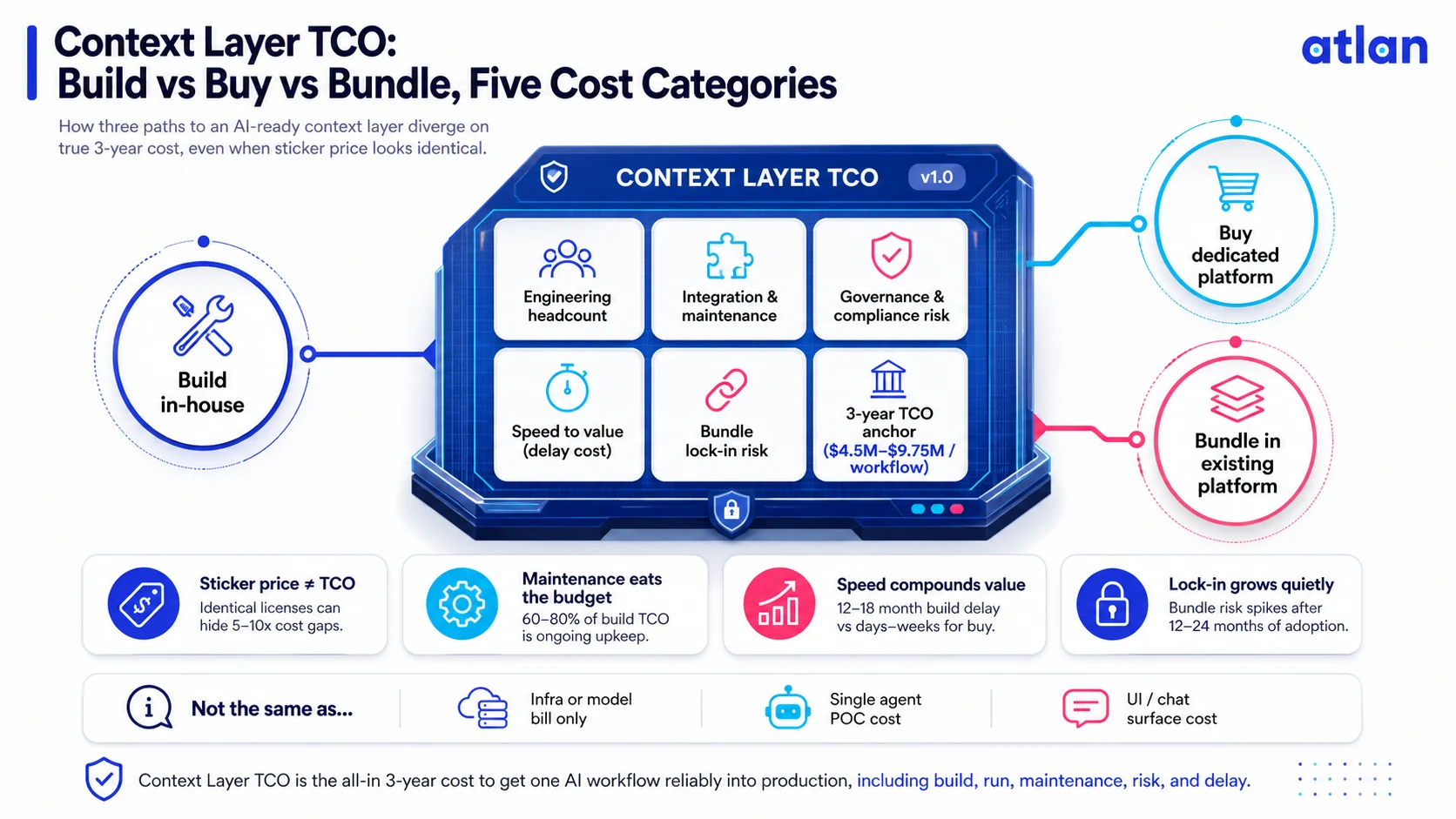
Context layer TCO across three paths, build in-house, buy a dedicated platform, or bundle inside an existing platform, broken into the cost categories that diverge even when sticker price looks identical. Source: Atlan
An enterprise running Snowflake for its warehouse and AWS for its data lake, with a growing set of AI agents, illustrates why this table matters more than any single number. Building a custom metadata layer means 12-18 months and $800K or more a year in permanent headcount once live. Bundling inside Snowflake Horizon is fast, but blind to the AWS-side estate. Buying a dedicated context layer that spans both is the third option most competitor TCO content never models. Autodesk faced close to this exact shape of decision and chose a dedicated platform specifically to bridge context across its mixed Snowflake-warehouse-and-AWS-lake stack, scaling to 60 teams on one governed layer instead of two disconnected ones.
The context layer vs. semantic layer distinction and the broader semantic layer category matter here too: none of these three paths automatically deliver a governed semantic layer, so whichever path you choose still needs that layer accounted for separately in the TCO math. Gartner’s own research on context graphs treats governed structure as the differentiator across all three paths, not a feature unique to any one of them, and the same distinction that separates a context graph from a knowledge graph shows up again here: structure without governance is not the same asset in any of the three columns.
Whichever path an enterprise chooses, the five categories above are what determine the real number twelve months later, not the number in the pitch deck or the internal build estimate on day one.
When does bundling actually make sense, and when does build-then-buy double your cost?
The honest counter-case for bundling, and the hybrid pattern most enterprises land on, both deserve equal weight against the failure mode where a stalled build converts into extra cost rather than saved cost.
When bundling genuinely is the right call
For a durably single-platform estate, bundling’s lower integration cost is a legitimate win, not a compromise. Practitioners describe Unity Catalog and Snowflake Horizon as excellent inside the platform, and some explicitly prefer single-platform lock-in over adding “another complex system to maintain.” Nidhi Vichare, Vice President of Data & AI and Chief Data & AI Officer at Cloud Destinations, frames this as two entirely separate markets: “The technical catalog war (Polaris vs. Unity vs. Glue) and the governance catalog war (Atlan vs. Alation vs. Collibra vs. OpenMetadata vs. DataHub) are entirely different markets with different tools, different budgets, and different buying decisions,” according to Vichare’s “The Other Catalog War” analysis (Nidhi Vichare, April 2026). That framing is the clearest independent validation that “buy” was never one decision.
The hybrid path: buy the foundation, build the glue
Google’s own AI Overview structure for this query already names the middle path: buy the foundation, build the glue. Most enterprises buy a dedicated context layer for cross-platform governance and build lightweight, use-case-specific integrations on top of it, capturing the buy path’s speed without forfeiting build-path customization for what is genuinely differentiating. This is also where context engineering for AI governance and a working AI governance framework tend to live in practice: purchased as a foundation, then extended.
The failed-build-then-buy trap
No competitor TCO model accounts for this: it is the exact failure mode named in the “Failure mode” row of the table above. A team ships 60% of an internal catalog, stalls on schema drift and new sources, and still ends up buying a vendor, meaning the true cost is build spend plus buy spend, not build or buy. A recurring pattern on r/dataengineering describes a self-built catalog on Postgres, dbt docs, and a custom UI that “works” for roughly six months, then consumes a dedicated engineer plus about 20% of every analyst’s time to keep current, at which point “the free solution was more expensive than just buying something.” That is why AI agent governance and defensible AI risk management cannot wait for the build to finish; a stalled build with no governance layer is a live compliance gap. Regulated industries feel this most acutely, which is why context layer for financial services treats governance as day one, and why any serious evaluation runs into AI model governance as its own cost category.
The counter-view Vichare makes explicit
“Cloud-native tools govern their own cloud well and nothing else. The moment you are multi-cloud, multi-platform, or heavily regulated, you need a third-party governance layer,” according to the same Vichare analysis (Nidhi Vichare, April 2026). This is the honest boundary of the bundle path, stated by a named, credentialed practitioner voice, not asserted by any vendor with a stake in the answer.
Bundling, building, and buying all remain reasonable choices in isolation; what the honest version of this comparison shows is that most enterprises are actually choosing a hybrid, whether they call it that or not, and the failed-build-then-buy trap is the clearest sign that treating this as a one-time either/or decision is the single most expensive mistake on the table.
How Atlan approaches context layer TCO
The operating-model question above, build if context is your strategic IP, bundle if your estate is durably single-platform, buy a dedicated layer for a real multi-platform enterprise, is where Atlan fits specifically inside the buy-dedicated column, not as a verdict on the other two. Organizations that treat build, buy, and bundle as a one-time, either/or decision routinely rediscover the cost mid-project: a stalled internal build that still needs a vendor, or a bundled tool that hits its platform boundary the moment the estate becomes multi-cloud. The community pattern is consistent. Homegrown catalogs work for months, then quietly become the most expensive option on the table once engineer time and analyst tagging burden are counted honestly, echoing the same gap covered in why AI agents need an enterprise context layer in the first place.
Atlan is delivered as a managed, SaaS context layer, with no infrastructure equivalent of Kafka, Elasticsearch, or Kubernetes to operate, and 108 connectors pulling context across the estate once and activating it everywhere, addressing the integration and maintenance-burden category directly. Context is delivered through open, standard interfaces (MCP, A2A, SQL, REST, and graph APIs), so agents and tools across vendors can consume it, the direct counter to bundle lock-in. Policy context and lineage are enforced across systems, not just inside one console, and the underlying architecture is open and Iceberg-native, portability instead of proprietary lock-in. That structure is what an enterprise context graph actually is in practice, a queryable asset every one of the three paths eventually needs. Teams weighing this decision from scratch often start with context layer 101, and the same open-interface approach is what makes it possible to secure multi-agent systems across more than one platform.
Porto completed a 6-week migration and go-live, with 40% time savings for the governance team. North reported $1.4M in annual efficiency gains, 200% growth in business-user adoption, and a 700% increase in tagged Snowflake assets. Autodesk chose Atlan specifically to bridge context across a mixed Snowflake-warehouse-and-AWS-lake stack, scaling to 60 teams on one governed layer.
Real stories from real customers: context across build, buy, and bundle decisions
"We're excited to build the future of AI governance with Atlan. All of the work that we did to get to a shared language at Workday can be leveraged by AI via Atlan's MCP server…as part of Atlan's AI Labs, we're co-building the semantic layer that AI needs with new constructs, like context products."
— Joe DosSantos, VP of Enterprise Data & Analytics, Workday

"Atlan is much more than a catalog of catalogs. It's more of a context operating system…Atlan enabled us to easily activate metadata for everything from discovery in the marketplace to AI governance to data quality to an MCP server delivering context to AI models."
— Sridher Arumugham, Chief Data & Analytics Officer, DigiKey

Neither quote is framed around build-vs-buy math specifically, but both point at the same thing this page argues: a shared language and MCP-delivered context that travels across systems is exactly what the buy-dedicated path is built to deliver, and what a build or a bundle each struggle to replicate on their own.
Calculate Your Context Layer ROI
See where build, buy, or bundle costs actually land for your own multi-platform estate.
Calculate Your ROIWhat actually decides build vs buy vs bundle
Build, buy, and bundle are not one decision with two options. They are three genuinely different cost structures, and the honest answer depends on whether context infrastructure is your strategic IP (build), your estate is durably single-platform (bundle), or you need governed context across a real, multi-platform enterprise without permanent engineering headcount or platform lock-in (buy). The costs competitors do not model, failed builds that still end in a purchase, lock-in that compounds silently for two years, adoption cost that applies no matter which path you pick, are exactly where TCO estimates go wrong.
Most enterprises land on a hybrid: buy the governed foundation, build only the glue that is genuinely differentiating. That hybrid pattern, not a single winner among the three, is the finding every generic build-vs-buy article misses, and it is why what an enterprise context layer actually is and semantic layers built for AI agents both matter more once you’ve picked a path than the path itself. Teams still comparing vendors within the buy-dedicated column can start from the best semantic layer tools available in 2026.
FAQs about context layer TCO: build vs buy vs bundle
1. Is it cheaper to buy a bundled AI platform or build a custom stack?
Almost always cheaper to buy or bundle upfront. A single custom-built AI agent workflow runs $4.5M-$9.75M over three years before opportunity cost, versus roughly 30 days to production for a bought platform. Bundling is cheapest immediately, but its lock-in cost compounds after 12-24 months as governance metadata accumulates inside the platform.
2. Should you build or buy a data catalog for AI agents?
Buy or bundle unless context infrastructure is itself your strategic IP and you’re willing to staff it like a product indefinitely. Building typically means 2-3 dedicated infrastructure engineers at $800K-$1M a year, ongoing, not a one-time project, a commitment most organizations underestimate at the outset.
3. How do costs change with a platform-native context layer vs a dedicated one?
A platform-native, bundled context layer keeps context resolution inline with that platform’s own compute, which can lower overhead within the platform, but it cannot resolve context that lives outside it. A dedicated context layer resolves context once across the whole estate, trading a small integration layer for coverage across every platform.
4. What is the true total cost of ownership for building custom AI infrastructure?
Real TCO includes engineering salaries, infrastructure operations, integration maintenance, and opportunity cost, not just development time. Mightybot, an AI agent platform vendor, estimates in its own build-vs-buy breakdown that a single build-your-own AI agent workflow costs $1.7M-$3.75M in Year 1 and $4.5M-$9.75M over three years, before counting the opportunity cost of a 12-18 month build timeline. Treat that figure as one vendor’s directional estimate, not an audited number.
5. What are the hidden costs of free open-source AI frameworks?
Open-source frameworks carry no license fee, but the maintenance burden does not disappear. It shifts entirely to internal engineering time. Illustrative modeling puts build-in-house maintenance at 60-80% of 5-year TCO for enterprise-scale software, meaning the free framework’s real cost shows up in year two and three, not year one.
6. When does a hybrid buy-and-build approach make the most sense for AI?
A hybrid approach makes sense when an enterprise needs cross-platform governance fast but also has genuinely differentiating, use-case-specific integration work. The common pattern buys a dedicated context layer as the governed foundation, then builds lightweight, custom glue on top for the parts that do not fit any vendor’s standard offering.
7. How does capability debt affect the build vs buy decision in AI?
Capability debt is the compounding cost of choosing a path that cannot keep pace with how fast agent use cases mature. A build path accumulates it as unshipped features stack up against a finite internal roadmap. A bundle path accumulates it at the platform’s boundary, whenever an agent needs context the platform does not natively see.
Sources
- Total Cost of Ownership (TCO) of Building Versus Buying Software for Development, Okteto
- Build vs Buy AI Agent Platform: Cost & TCO, Mightybot
- Build vs buy data catalog 2026: A strategic guide for enterprise data leaders, Murdio
- Total Cost of Ownership for Agentic AI, Corvair
- Complete Data Catalog Pricing Guide for 2026, Data Pilot
- How to Calculate Data Pipeline Total Cost of Ownership, Hevo Data
- Snowflake Horizon vs. Databricks Unity Catalog: The Technical Comparison, Snowflake Engineering
- The Other Catalog War: Governance Platforms and the Two-Layer Architecture, Nidhi Vichare
