

Reranking is a second-pass model, typically a cross-encoder, that reorders the candidates your retriever pulled. In Pinecone’s own cascading-retrieval tests, rerankers improved on dense vector search by 24% on average on TREC datasets and by up to 48%, and by 12% on average on BEIR over dense or sparse alone. Cohere, BGE-Reranker, and Voyage AI score what retrieval already found; Atlan’s context layer approach, through Orion and Vera, works one step earlier, resolving what your query’s business terms mean first.

Atlan’s context layer approach treats reranking as one signal among several, not the whole retrieval story. Its search stack factors in certification and freshness signals so verified, current assets outrank stale look-alikes. Orion resolves what a business term means, and Atlas narrows the candidate pool by domain, so the set a reranker scores already reflects governed meaning, alongside standard rerankers like Cohere and BGE-Reranker.
| Field | Value |
|---|---|
| What it is | A second-pass cross-encoder that reorders candidates before the LLM |
| Key benefit | 24% average gain over dense vector search on TREC, up to 48% (Pinecone’s own tests) |
| Best for | Recall@50 already above 0.85, with business-term ambiguity |
| Added latency | One extra model pass; scales with top-k and model size. No vendor publishes a universal range |
| Cost range | Cohere bills Rerank per search unit (one query, up to 100 documents); it publishes no per-search rate |
| Core dependency | Retrieval quality upstream, it can only reorder what’s already surfaced |
What is reranking in RAG?
The distinction that matters is similarity versus relevance. Vector search finds documents that look like the query; reranking finds documents that answer it, and that’s where most explanations stop. For the full technique catalog, see Advanced RAG Techniques; for RAG basics, start with What Is RAG? or What Is Retrieval-Augmented Generation?
For enterprise teams, the more consequential question isn’t which reranker to pick. It’s whether the candidate set already reflects what the business means by the query, a question reranking was never built to answer.
How does reranking work in a RAG pipeline?
Two stages make up reranking: a fast, approximate first pass narrows millions of documents to a candidate set, then a slower, more accurate model rescores the candidates against the query itself, the foundation the RAG architecture builds on.
Two-stage retrieval architecture
A bi-encoder embeds the query and documents independently, enabling fast approximate search across a vector database index. A cross-encoder processes query and document pairs jointly, slower but truer to relevance. NVIDIA’s Amit Bleiweiss, in the NVIDIA Developer Blog (2026): “Much of a RAG pipeline’s success is based on the retrieval step finding the right context for generation.” See Hybrid RAG for how sparse and dense retrieval feed a reranker; Pinecone (2026) calls this cascading retrieval.
| Dimension | Bi-encoder (retriever) | Cross-encoder (reranker) |
|---|---|---|
| Scoring | Embeds separately, compares vectors | Scores query and document jointly |
| Speed | Fast, millions of documents | Slow, 20 to 100 candidates |
| Accuracy | Approximate | Higher, relevance-based |
Latency and cost trade-offs
Cohere bills Rerank by search unit, one query against up to 100 documents, splitting any document over 500 tokens into chunks that each count separately. It publishes no per-search rate, so model the cost from your own top-k. Vectorize.io argues most teams should default to including a reranker at current pricing. The real question is what reranking can’t do: its gains are bounded by the candidate set.
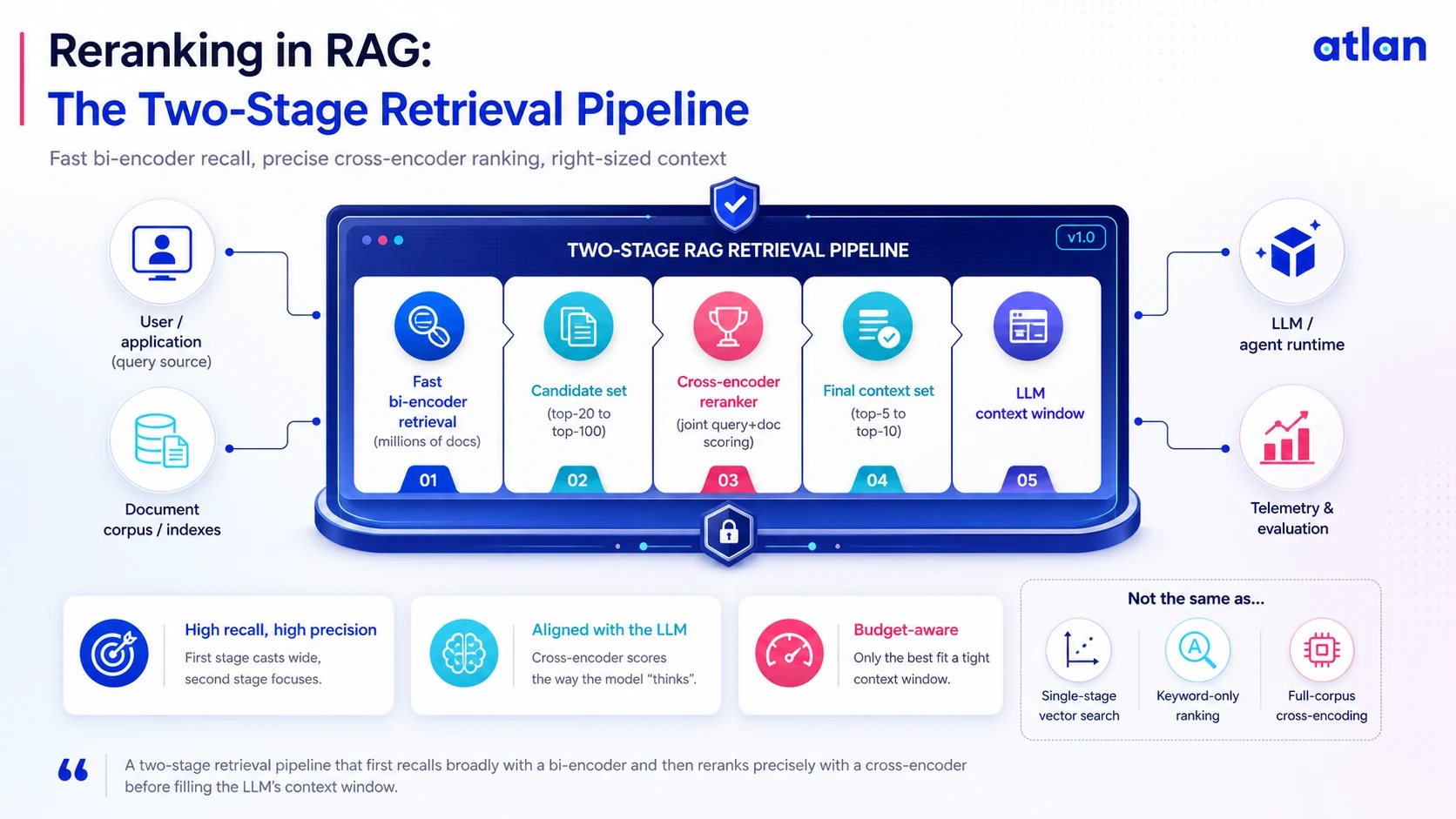
The two-stage RAG retrieval pipeline. Source: Atlan.
Why doesn’t reranking fix bad retrieval?
Reranking can only reorder candidates retrieval already surfaced. If the right document never made it into that set, no reranker can recover it.
The garbage-in-garbage-out mechanism
“Reranking can only reorder the candidate documents retrieved by the first-stage retriever, and thus cannot compensate for relevant documents that fail to surface in the initial retrieval results.”
Pandit, Mahendru, Raval, and Upadhyay, “The Evolution of Reranking Models in Information Retrieval” (arXiv, December 2025)
That’s independent academic research, not Atlan. A dev.to (February 2026) account adds a threshold: below recall@50 of 0.85, fix retrieval and chunking instead. Per Flotorch (2026), reranking has moved from optional to a default expectation. See RAG Accuracy Problems and Semantic Search vs. Keyword Search for why candidate sets go wrong.
Business-term and entity disambiguation failures
Even a vendor with every incentive to sell reranking as a fix admits the gap. Apoorva Joshi, Senior AI Developer Advocate at MongoDB, writes in MongoDB’s piece (2026): “These domain-specific hierarchies, quality indicators, and compliance requirements are rarely explicit in user queries.”
Atlan saw this firsthand with an enterprise customer. A semantic search returned 10 assets and 7 glossary terms with near-identical relevance scores, none in the required certified-production scope, so the assistant fell back to keyword SQL. Enriched descriptions already existed; retrieval never used scope or disambiguation before scoring. The fix was pushing scope constraints into retrieval, not swapping the reranker.
Inside Atlan AI Labs: The 5x Accuracy Factor
How resolving business context before retrieval changes what a reranker has to do, with the accuracy math behind it.
Get the 5x Accuracy EbookHow do you add reranking to an existing RAG pipeline?
Adding reranking to an existing pipeline means inserting a rescoring step between your retriever’s top-k output and the LLM’s context window, without rebuilding retrieval.
Prerequisites: a retriever returning a top-k candidate set (k=20 to 100), a model such as Cohere, BGE-Reranker, or ColBERT, a measured latency budget for one extra model pass, and a baseline recall@k measurement.
Steps: measure recall@50, over-fetch top-50 to top-100 candidates at retrieval, insert the reranker before generation, truncate to top-5 to top-10, then re-measure precision@k. Oracle’s documentation describes a SQL-native version; see How to Evaluate RAG Systems for the recall@k framing.
Common pitfalls when adding a reranker
Over-fetching too small a set (k=5) leaves nothing to reorder. Treating the reranker as a fix for a recall problem is the second mistake. Skipping a before/after evaluation is the third. The fourth pitfall is assuming a general-purpose reranker understands your domain’s business terms; the durable fix is resolving that meaning upstream.
How do you choose the right reranker, and validate what feeds it?
Choosing a reranker means weighing latency, cost, and domain fit, but most teams skip whether the candidate set already reflects business context.
| Criterion | Why it matters | What to look for |
|---|---|---|
| Model type | Cross-encoders score accurately but add latency | Accuracy-first, or lighter if latency is tight |
| Latency budget | A reranker adds one model pass over your top-k | Measure it on your own k, then confirm your SLA absorbs it |
| Domain fit | General rerankers like Qwen3 need fine-tuning | Test on your own domain queries |
| Candidate quality | Recall@50 below 0.85 leaves nothing valid | Measure recall@k first |
| Trust awareness | No certification signal in most cross-encoders | Ask if freshness factors in |
A training-free approach in a 2026 arXiv paper uses the LLM’s own confidence signals to rerank without a separate model; see What Are Embeddings in AI Search? for background. Enterprise RAG Platforms Comparison covers platform tradeoffs, and the context graph tooling landscape covers what sits underneath. That’s the real question: whether your retrieval substrate, a context graph rather than a plain vector database, already resolved what the query means.
Context Gap Calculator
Score how much of your retrieval ambiguity is actually a context problem before tuning another reranker.
Try the Context Gap CalculatorHow do knowledge graphs and ontology fix what reranking can’t?
When a reranker’s candidate set carries unresolved business-term ambiguity, the fix isn’t a smarter reranker, it’s an ontology and knowledge graph that disambiguate what the query means before or during retrieval, one layer beneath ranking. No search result page connects reranking to these topics today; this section is the bridge.
Ontology: resolving what a business term means
A reranker has no mechanism to know that “revenue” means something specific and certified in your organization. Orion, Atlan’s ontology agent, resolves what a term means so retrieval scores against the right definition. See Ontology Design for AI, Ontology 101, and What Is Active Ontology?
Knowledge graphs: multi-hop relationships flat reranking can’t see
A cross-encoder scores one query-document pair at a time; it cannot traverse “which team owns this metric, and did the definition change.” Per Li et al. (arXiv, June 2025), dependency-aware reranking improves multi-hop resolution over flat scoring. See Knowledge Graph Construction for AI, How to Build a Knowledge Graph for AI Agents, and Knowledge Graph for AI Agents.
Atlas narrows the candidate pool by domain before ranking starts; the Context Lakehouse’s typed traversal handles the multi-hop case, see How to Query a Context Graph with an AI Agent and Vector Database vs. Knowledge Graph for Agent Memory. See also AI Memory vs. RAG vs. Knowledge Graph and Agent Context Layer vs. RAG. JPMC has weighed a knowledge-graph proof of concept against a governed context-layer approach; no benchmarks are public yet.
A reranker can only improve the order of what it’s given. Fixing entity meaning and scope is a context layer job, before or during retrieval.
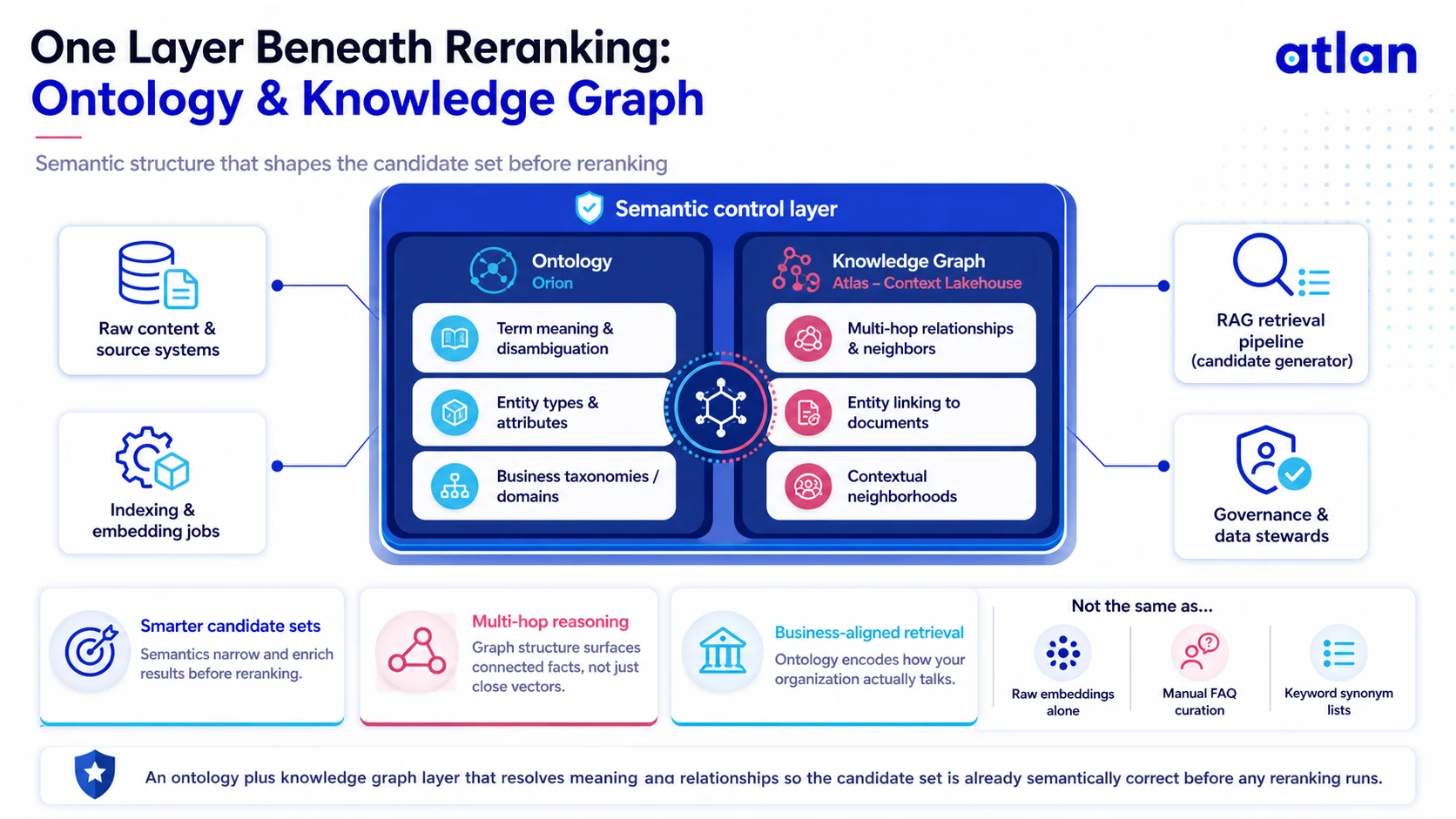
The semantic control layer beneath reranking. Source: Atlan.
When should you use reranking in a RAG pipeline?
Reranking earns its cost when recall@50 is high and queries carry ambiguity a bi-encoder can’t resolve alone.
| Signal | What it means | Action |
|---|---|---|
| Recall@50 below 0.85 | Retrieval isn’t surfacing the right documents | Fix retrieval first |
| Recall@50 above 0.85, precision@k low | Right documents ranked poorly | Reranking helps, textbook case |
| Order-insensitive generator (GPT-4o, Claude-class) | LLM synthesizes well regardless | Latency cost matters more |
| Business-term or entity ambiguity | Cross-encoder can’t resolve “revenue” alone | See the ontology section above |
| Latency budget under 100ms | No room for a rescoring pass | Skip reranking or use a lighter model |
Industry analysis referencing Gartner’s Market Guide for Enterprise AI Search, via gosearch.ai (2026), points to retrieval quality, not model choice, as the top cause of underperforming AI agents. See Fine-Tuning vs. RAG for the adjacent tuning decision. What the table can’t tell you is whether “relevant” means the same thing to your reranker as to your business.
How Atlan approaches reranking and context quality
Every cross-encoder on the market, Cohere, BGE-Reranker, Voyage AI, scores pure semantic relevance. None has a certification signal, so a stale look-alike scores as well as the current, trusted asset. Elastic, already running BM25 and reranking together, asked for more configurable reranking controls because a single semantic endpoint was too opaque to evaluate.
Atlan doesn’t position itself as a better reranker, but as the governed context substrate that gives whatever reranker sits on top less ambiguity to resolve. Atlan’s own search factors in certification and freshness signals, so verified, current assets surface ahead of stale look-alikes. Orion resolves business-term meaning, Atlas narrows the candidate pool by domain, and the Context Lakehouse’s entity resolution means the candidate set already reflects governed context. That’s what MCP delivers to an agent; see why MCP matters for AI agents versus a plain API.
Shell asked what Atlan adds beyond typical RAG. The answer: retrieval methods keep changing, but the persistent problem is conflicting context embedded in the data, a distraction the semantic layer reranking scores against has to resolve first.
Real stories from real customers: context that makes retrieval trustworthy
"We're excited to build the future of AI governance with Atlan. All of the work that we did to get to a shared language at Workday can be leveraged by AI via Atlan's MCP server...as part of Atlan's AI Labs, we're co-building the semantic layer that AI needs with new constructs, like context products."
Joe DosSantos, VP of Enterprise Data & Analytics, Workday

"Atlan is much more than a catalog of catalogs. It's more of a context operating system...Atlan enabled us to easily activate metadata for everything from discovery in the marketplace to AI governance to data quality to an MCP server delivering context to AI models."
Sridher Arumugham, Chief Data & Analytics Officer, DigiKey

AI Agent Context Readiness Checklist
Check whether your retrieval and reranking stack rests on a disambiguated context layer, or just looks like it does.
Take the Readiness ChecklistWhy closing the context gap matters more than picking a reranker
Reranking is a genuinely useful precision lever. The gains Pinecone measured, 24% on average over dense vector search on TREC, are real, and current practitioner consensus favors using one. But reranking inherits whatever ambiguity already exists in the candidate set, and at enterprise scale that’s usually business-term and entity disambiguation a reranker was never built to resolve.
That’s backed by the academic literature stating reranking cannot fully compensate for a failed retrieval stage, and by Atlan’s own customer evidence of near-identical relevance scores across the wrong scope. Most troubleshooting stops at “fix the chunking,” without asking whether business terms were resolved.
The teams getting the most out of reranking will resolve business meaning in the ontology and knowledge graph before the reranker sees the candidate set. That’s the argument behind the broader shift toward an enterprise context layer: govern meaning once, upstream, so every technique built on top has less ambiguity left to fix. Teams building AI agent harnesses on that foundation inherit disambiguated context by default.
FAQs about reranking in RAG
1. What is reranking in RAG systems?
A second-pass model, typically a cross-encoder, that re-scores an already-retrieved candidate set to promote the most relevant results, correcting for cases where similarity and relevance diverge.
2. What is the difference between a bi-encoder and a cross-encoder?
A bi-encoder embeds query and documents separately for fast search at scale. A cross-encoder scores query and document together, more accurate but too slow for a whole index.
3. Is reranking necessary if I have a large context window?
Not automatically. A large context window changes how much you pass to the LLM, not whether the candidate set is correctly ordered.
4. Can reranking fix bad retrieval?
No. A 2025 arXiv survey states reranking cannot fully compensate when the first retrieval stage fails to surface relevant documents. Below recall@50 of 0.85, fix retrieval first.
5. Does reranking add latency to RAG?
Yes. A reranker is a second model pass over the candidate set, so the cost rises with your top-k and the size of the cross-encoder. No reranker vendor publishes a universal latency range, so measure it on your own k.
6. How can I tell what “relevant” means for my specific use case?
Relevance for enterprise queries usually depends on business-term disambiguation a generic reranker was never given. Resolving that meaning through an ontology and knowledge graph upstream, the approach Orion and Atlas take, is what makes relevance consistent.
Sources
- Pinecone: “Rerankers and Two-Stage Retrieval”: https://www.pinecone.io/learn/series/rag/rerankers/
- Pinecone: “Introducing Cascading Retrieval”: https://www.pinecone.io/blog/cascading-retrieval/
- NVIDIA Developer Blog: “Enhancing RAG Pipelines with Re-Ranking” (Amit Bleiweiss): https://developer.nvidia.com/blog/enhancing-rag-pipelines-with-re-ranking/
- MongoDB: “What are Rerankers?”: https://www.mongodb.com/resources/basics/artificial-intelligence/reranking-models
- MongoDB: “Instruction-Following Rerankers” (Apoorva Joshi): https://www.mongodb.com/company/blog/technical/instruction-following-rerankers-an-unsung-context-engineering-tool
- Oracle Docs: “Use Reranking for Better RAG Results”: https://docs.oracle.com/en/database/oracle/oracle-database/23/vecse/use-reranking-better-rag-results.html
- dev.to: “I Spent $400/Month on a Reranker That Made My RAG Worse”: https://dev.to/mossforge/i-spent-400month-on-a-reranker-that-made-my-rag-worse-113k
- Vectorize.io: “Why You Should Always Use a Reranker When Doing RAG”: https://vectorize.io/blog/why-you-should-always-use-a-reranker-when-doing-rag
- arXiv: “PankRAG” (Li, Liu, Shan, Huang, Gong, Li, 2025): https://arxiv.org/abs/2506.11106
- arXiv: “The Evolution of Reranking Models in Information Retrieval” (Pandit, Mahendru, Raval, Upadhyay, 2025): https://arxiv.org/pdf/2512.16236
- arXiv: “LLM-Confidence Reranker”: https://arxiv.org/pdf/2602.13571
- gosearch.ai: “Why Your AI Agents Are Underperforming” (references Gartner Market Guide for Enterprise AI Search): https://www.gosearch.ai/blog/why-ai-agents-underperform-rag-retrieval-gartner/
- Flotorch: “The 2026 RAG Performance Landscape”: https://www.flotorch.ai/blogs/the-2026-rag-performance-landscape-what-every-enterprise-leader-needs-to-know/
