

A semantic layer for finance stores each KPI once as an executable definition that every report and AI agent reads the same way. That definition holds a measure, a grain, filters, and a fiscal calendar. A working checklist for a defensible finance KPI has eight fields, and four of them (owner, certification state, effective date, and plain-language purpose) sit outside the query engine. Atlan’s AI Context Platform keeps that governed meaning in the context layer, the shared layer where people and AI agents read approved business definitions, and renders it into Snowflake, Databricks, or dbt definitions.
Finance KPIs rarely break at the formula. They break when one name carries two formulas, when a formula changes mid-year with no record of when, or when a spreadsheet, a BI model, and a chat assistant each keep a private copy. The cost lands on finance: hand reconciliation before every close, and reported figures nobody can trace to the formula that produced them. A semantic layer for AI agents removes the copies by defining each measure once.
Whether you call it a semantic layer or a metrics layer, the harder question in finance is what each definition carries beyond the math. Ownership, certification, and change history belong in the enterprise context layer, next to the definition, so a controller and an agent read the same approved version.
| Item | Answer |
|---|---|
| Topic | Semantic layer for finance KPIs |
| Fields a definition carries | 8 |
| Fields held in the query layer | 4: measure and aggregation, grain, filters and exclusions, time basis and fiscal calendar |
| Fields held in the glossary | 4: owner, certification state, effective date, purpose |
| Certification lifecycle in Atlan’s glossary guide | Draft, verified, deprecated |
| Where the layer stops | Policy disputes and questions nobody modeled |
| Persona | Finance data leader, analytics leader |
| Regulator example | SEC Commission Guidance on MD&A (Release 33-10751) and Corporation Finance non-GAAP interpretations; other jurisdictions set their own disclosure rules, so check the ones that apply to you |
| Primary stakeholders | Controller, FP&A lead, head of analytics, data steward |
| Typical challenges | One KPI name with two formulas, silent formula edits between periods, definitions copied into BI tools, spreadsheets, and agent prompts |
What does a finance KPI definition need to carry in a semantic layer?
A finance KPI definition needs eight fields: four that make it executable and four that make it defensible. A semantic layer is a governed place where a measure is defined once and queried at runtime, so every tool that asks for net revenue gets the same calculation.
The eight-field split is a working checklist, not a regulator’s list. Neither SEC source cited below names fields or tools; the checklist puts what a filing reviewer asks about in the same place as the formula.
The executable half: what the query engine runs
The executable half is well documented by the platforms that run it. According to Snowflake’s documentation on semantic views, a semantic view is a schema-level object where you “define business metrics and model business entities and their relationships.” Its own example defines net revenue as SUM(gross_revenue * (1 - discount)) to give “a single authoritative definition.”
Databricks documentation for Unity Catalog metric views (last updated October 29, 2026) describes separating measure definitions from dimensions so teams “define metrics once and query them at runtime,” with agent metadata such as synonyms, display names, and formats. The dbt Semantic Layer documentation places metrics “in the modeling layer (your dbt project),” powered by MetricFlow.
The defensible half: what people approve
The defensible half sits around the formula. According to Atlan’s guide to structuring a glossary and metrics catalog, a finance KPI is a glossary term recording the formula, data sources, refresh frequency, owner, and certification status, with one term per distinct formula. Effective date and purpose are fields your team adds by convention in the term description.
Some of this already exists in the tools finance data teams use. The dbt documentation on groups says every group has an owner, and Git history dates each formula change. What the glossary adds is one certification state and purpose that BI tools and agents read too, outside the dbt project.
All eight fields at a glance
| Field | Finance example | Where it lives | Documented in |
|---|---|---|---|
| Measure and aggregation | Net revenue after discounts, as in Snowflake’s example | Query layer | Snowflake semantic views docs |
| Grain | Revenue schedule line per fiscal period, not customer | Query layer | Snowflake semantic views docs (aggregation level) |
| Filters and exclusions | Intercompany transfers removed | Query layer | Databricks metric views docs (filters); Atlan CES docs (intercompany example) |
| Time basis and fiscal calendar | Fiscal quarter, not calendar quarter | Query layer | Atlan CES docs (fiscal vs calendar quarter) |
| Owner | A named controller | Glossary | Atlan glossary guide; dbt groups docs |
| Certification state | Draft, verified, deprecated | Glossary | Atlan glossary guide |
| Effective date | First period the formula applies | Glossary (team convention) | Team convention; relates to SEC MD&A guidance on calculation changes |
| Purpose | Why the metric is useful and how management uses it | Glossary (team convention) | Team convention; relates to SEC MD&A guidance |
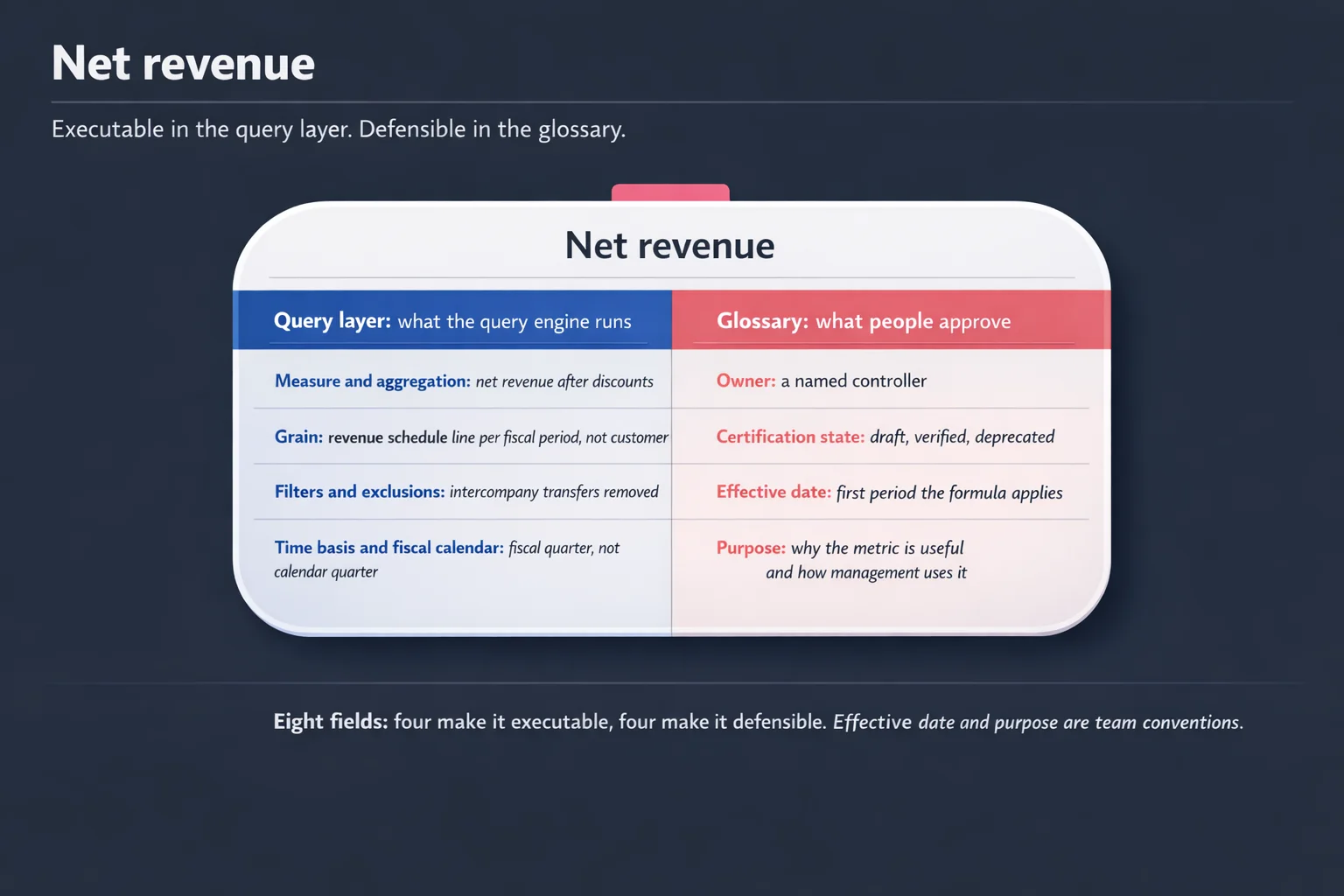
Source: Atlan
How the two halves relate
The left column is what a semantic model encodes, and it differs from the physical tables described in semantic layer vs data model comparisons. The right column is the work of managing KPI definitions and a business glossary. The two overlap only when teams copy the formula into both places, which is the duplication risk weighed in semantic layer vs business glossary.
A formula that runs is only half a finance KPI. The other half, the owner, status, and history, is what lets someone defend the number when it is questioned.
What do regulators ask a finance metric definition to carry?
One regulator’s guidance, the SEC’s, shows what a finance metric definition has to carry to be defensible, and it maps onto the eight fields. Rules differ by jurisdiction, and guidance describes expectations rather than a compliance checklist a tool can satisfy.
According to the SEC’s Commission Guidance on Management’s Discussion and Analysis (2020), for key performance indicators the SEC would generally expect “[a] clear definition of the metric and how it is calculated,” along with why the metric is useful to investors and how management uses it. If the method of calculating or presenting a metric changes between periods, the guidance says the company should consider disclosing, to the extent material, the differences, the reasons, and the effects.
Period consistency for non-GAAP measures
The SEC staff interpretations on non-GAAP financial measures add a period-consistency point in Question 100.02. A non-GAAP measure presented inconsistently between periods can be misleading unless the change is disclosed and explained, and depending on the significance of the change, it may be necessary to recast prior measures.
If your team already meets these expectations through close checklists, documented approvals, and version-controlled dbt models, nothing here replaces them. The fields restate the same evidence next to the definition, where BI tools and agents read it too.
How the guidance maps to the fields
| What the guidance asks | Field it implies | What the semantic layer or glossary does |
|---|---|---|
| Definition and calculation | Measure, filters, grain | Semantic layer runs one definition; glossary states it in words |
| Why the metric is useful and how management uses it | Purpose | Glossary records it next to the formula |
| Disclosure when a calculation changes between periods | Effective date, deprecated state | Glossary marks the old term deprecated and dates the new one |
| Consistent presentation across periods | One term per formula, recast note | Both formulas stay queryable for a recast decision |
Financial services teams running AI agents face the same questions, which is why AI agents in finance need to show which definition produced an answer. Tracing a reported figure back to its source tables through data lineage for AI covers the “how is it calculated” side from the data end.
How do you control a finance KPI change across reporting periods?
Control a KPI change by giving the new formula its own term, deprecating the old one, and recording the effective date and the reason. Atlan’s glossary guidance supports this directly: one glossary term per distinct formula, with certification status set to draft, verified, or deprecated.
Three steps: draft, verify, deprecate
The control runs in three steps, and each one has a named owner:
- Draft. Write the new formula as a new term, with its sources, refresh frequency, purpose, and the first period it applies to.
- Verify. Certify the term once the executable definition in the semantic layer matches the formula in words.
- Deprecate. Mark the old term deprecated and note the last period it applies to, so earlier reports can still name the formula they used. Atlan’s guide archives deprecated terms after roughly six months rather than deleting them.
Atlan’s glossary guide also scales approval to the change: a typo needs no approval, a definition tweak needs the term owner, and a formula or scope change needs the governance forum. The person who drafts a formula change is then not the only person who approves it.
This is where the SEC staff point on recasting lands in practice. Recasting prior periods is a finance decision; the layer’s job is to keep the old and new formulas separately queryable so either decision can be carried out.
A worked example at a quarter boundary
Here is how it looks at a quarter boundary. Term A, the old formula, is verified through Q3 and then deprecated with Q3 as its last period. Term B is verified with an effective date of Q4.
The Q4 close checklist names Term B; dashboards and agents pointed at verified terms pick up Term B for new periods, and the Q1 to Q3 reports still name Term A, so a reviewer can see which formula produced each figure.
For the prior-period comparatives in the Q4 filing, finance either recasts Q1 to Q3 on Term B, which stays queryable for any period, or presents them on Term A with a disclosure of the change.
Which changes need a new term
| Type of change | How it is handled | Why |
|---|---|---|
| New formula for an existing KPI name | New term, approved by the governance forum; old term deprecated with its last period | A distinct formula needs its own definition |
| Exclusion rule added | New term, approved by the governance forum | Changing what is excluded changes the scope |
| Owner changes | Edit the owner on the same term | The formula is unchanged |
| Typo, label, or synonym change only | Edit in place, no approval | No calculation changes |
| Policy change in revenue treatment | New, separately named metric | Two meanings, two owners |
Named AI-ready data owners and stewards make each step accountable. Teams that already publish data contracts for AI can treat a formula change like a contract change: versioned, announced, and dated.
Change control is where a semantic layer stops being a convenience and becomes evidence. The layer keeps both versions runnable; the glossary carries the certification state, the owner, and the dated note that explain the switch.
Semantic layer for finance KPIs: three problems and their outcomes
Three finance workflows show where an owned, certified KPI definition earns its place: board and BI reporting, period-consistent KPIs, and agent answers.
One net revenue definition across the board deck, BI, and an AI agent
The board deck pulls net revenue from an ERP extract, the BI model computes it from invoice tables, an FP&A spreadsheet applies its own discount logic, and a chat assistant writes fresh SQL. Someone in finance reconciles the four by hand before every close.
Defining the measure once, as in Snowflake’s net revenue example, and pointing every consumer at it removes the four-way reconciliation between tools. Finance still ties the certified figure to the general ledger at close; that check now runs once instead of four times. Agents can query the same definition: dbt’s documentation says AI tools can connect to the dbt Semantic Layer through the dbt MCP server (Model Context Protocol, an open-source standard for connecting AI applications to external systems).
The outcome is one named metric that returns the same number in each tool that reads it. It is the pattern behind AI agents for finance that can be trusted with a board question, and the fix for the metric conflicts a context layer for data analytics teams is built to resolve. It also explains why Genie and Copilot answers differ from BI reports when each reads a different definition.
A non-GAAP style KPI that stays consistent between periods
A KPI such as adjusted operating margin is edited quietly mid-year to exclude a new cost category. Prior quarters no longer reconcile, and nobody can say which formula a past report used.
The three-step control applies: a new term for the new formula, the old term deprecated with its last period, and the effective date recorded. Both formulas stay queryable, and the change is documented in the place people look for the definition.
If agents read metrics over a protocol, as in an MCP semantic layer for AI agents, keep the deprecated term and its last period in the definition they read, so an agent can name the formula behind a past figure.
An agent answers a finance question only from certified metrics
An agent asked for gross margin finds two definitions, one draft and one verified, and picks the wrong one.
The fix is to let certification state travel with the definition. Atlan handles this with Context Engineering Studio. According to Atlan’s documentation on the studio, it builds from certified glossary terms with column linkages, and agents that read its context repository over MCP get the same definition without a deploy. The agent then reads a definition assembled from certified terms, not the draft.
Boris Evelson, Vice President, Principal Analyst at Forrester, wrote in a July 2026 Forrester blog post: “What matters is grounding them in the same semantic layer so that every agent interprets business terms, metrics, relationships, and context consistently.” In finance, that shared layer only helps if the definitions in it are owned and certified.
Finance semantic layer capabilities in Snowflake, dbt, and Databricks
Each platform’s own docs describe where a finance definition can execute today, and the open Apache Ossie effort describes how semantic metadata moves between them. The table lists them alphabetically and records only what each source says.
| Option | What its docs say it defines | Source |
|---|---|---|
| Apache Ossie (incubating) | A specification effort to standardize how semantic metadata is exchanged across analytics, AI, and BI platforms | Apache Ossie |
| Databricks Unity Catalog metric views | Measures separated from dimensions, defined once and queried at runtime, with synonyms, display names, and formats | Databricks documentation, Unity Catalog metric views |
| dbt Semantic Layer | Metrics defined in the dbt project, powered by MetricFlow, reachable by AI tools through the dbt MCP server | dbt Semantic Layer docs and About MetricFlow, dbt Developer Hub |
| Snowflake semantic views | Schema-level objects that define business metrics and model business entities and their relationships | Snowflake documentation, overview of semantic views |
Where net revenue has to run
For finance, the practical test is where net revenue has to run. A team whose reporting sits in Snowflake can weigh how Snowflake semantic views compare with other universal options; a lakehouse team can create Databricks metric views next to its finance tables.
Teams that already model revenue in dbt keep the definition beside the transformation code. dbt’s documentation says MetricFlow is distributed under the Apache 2.0 license, a point the guide to the MetricFlow Apache 2.0 license weighs for how portable a dbt Semantic Layer definition is. If finance metrics must move between engines, Open Semantic Interchange, which the Ossie site says is now Apache Ossie, is the exchange format to watch.
The choice that matters most for finance is less which engine than how many: the trade-off between a warehouse-native and a universal semantic layer decides how many copies of net revenue you will have to keep certified.
Where does a semantic layer stop for finance KPIs?
A semantic layer executes a definition; it does not decide which definition finance should use, and it only answers the questions someone modeled.
Policy disputes are the first limit. Annual recurring revenue (ARR) and recognized revenue are different metrics that sales and finance both call revenue, and each team uses its own for different decisions. The layer can expose both as separately named metrics with named owners, but choosing between them is a finance policy call.
Coverage is the second limit. dbt Labs’ own 2026 benchmark post, run on insurance data, says its high accuracy applies to queries that a well-modeled semantic layer covers. Questions outside the model need another route, often generated SQL, which is the trade-off in text-to-SQL vs a semantic layer for self-serve analytics.
Production finance schemas make that fallback hard. According to Sehanobish and colleagues (2026), in an arXiv paper on text-to-SQL for complex financial data listed for the EMNLP 2026 Industry Track, general text-to-SQL methods “fall below 50%” on production financial databases where business concepts are stored as opaque integer keys, across two datasets totaling 359 questions. The authors close that gap with a finance-specific system built on lookup agents and expert-written query templates, which shows how much modeling these questions need. The failure modes in text-to-SQL for enterprise data show up sharply in finance.
None of this promises a specific accuracy gain from adding a layer. What a governed layer gives finance is a clear boundary: modeled, certified questions get one answer, and everything else is visibly outside it.
How Atlan connects governed finance KPIs to your semantic layer
Atlan’s AI Context Platform holds the approved meaning of a finance KPI, its formula, sources, owner, and certification, and renders it into the Snowflake, Databricks, or dbt semantic layer a team already runs.
According to Atlan’s documentation on Context Engineering Studio, the studio assembles a context repository from governed catalog and glossary context and renders it as a Snowflake semantic view for Cortex Analyst, metric views for Databricks Genie, or MetricFlow models for dbt. Context Agents keep the underlying descriptions, metrics, and definitions current, and agents that read the repository over MCP get the same definition without a deploy.
Changing a definition
To change a definition, you edit the glossary term itself. The repository shows that its sources changed, you regenerate it, and a redeploy replaces what is live.
Atlan’s semantic offerings by connector reference lists Databricks metric views as a supported semantic asset that Atlan crawls.
Who owns which layer
| Layer | What it holds | Who owns it | Where it runs |
|---|---|---|---|
| Executable definition | Measure, grain, filters, fiscal calendar | Analytics engineering | Semantic layer in the warehouse or dbt project |
| Approved meaning | Formula in words, sources, owner, certification, purpose, effective-date note | Finance owner and data steward | Atlan glossary in the context layer |
| Rendered output | Semantic view, metric view, MetricFlow model | Context Engineering Studio | The platform you query |
The design choice is to keep meaning and execution separate but linked, which is the core of context engineering vs a semantic layer. It is also how the context layer, data catalog, and semantic layer divide the work, and why semantic layer vs data catalog is a question of roles. For teams on more than one platform, the same approved term can feed each engine instead of being rewritten, the trade-off covered in Unity Catalog vs a cross-platform semantic layer.
Finance gets one approved definition with an owner and a status, and every engine it runs on gets the same version.
Getting started with a semantic layer for finance KPIs
Start with the five KPIs finance reports most often, write each as one glossary term, then connect the term to the executable definition. If you are still deciding whether you need a semantic layer at all, the inventory step answers it.
- Inventory. List the KPIs in board packs and external reporting, and flag any name that maps to two formulas, such as net revenue with and without intercompany transfers.
- Write one term per formula. Record the formula, sources, refresh frequency, owner, purpose, and an effective-date note.
- Build or point to the executable definition in the platform you already use. The build vs buy semantic layer trade-off and the best semantic layer tools help if you have none.
- Certify. Move each term from draft to verified with finance as the owner, and deprecate what it replaces.
- Agree the change process before the first formula edit, so nobody improvises it during a close.
Four pitfalls come up often:
- One name over two formulas. Teams keep “revenue” and argue about it. Instead, split it into two named metrics with two owners.
- Editing a formula in place. The history disappears with no effective date. Instead, create a new term and deprecate the old one.
- Treating the layer as proof of compliance. It carries the fields regulators ask about; the filing judgment stays with finance.
- Modeling only the easy questions. Agents then guess at the rest. Instead, add the questions finance actually gets asked, starting with board-pack metrics.
The broader rollout follows how to implement an enterprise context layer for AI, and the data-side preparation is the same as preparing data for natural-language analytics.
FAQs about semantic layer for finance
Short answers to the questions finance and data teams ask most about a semantic layer for finance KPIs.
1. What is a semantic layer for finance, and how is it different from a general semantic layer?
A semantic layer is a governed layer where business metrics are defined once and queried at runtime, so every tool that asks for a metric gets the same calculation. A semantic layer for finance applies that to finance KPIs such as net revenue: each one is defined with its grain, filters, and fiscal calendar, and also carries an owner, a certification state, an effective date, and a purpose, so the number can be defended when it is questioned.
2. What fields does a finance KPI definition need in a semantic layer?
A finance KPI definition needs eight fields: four that make it executable (the measure and its aggregation, the grain, the filters and exclusions, and the time basis with the fiscal calendar) and four that make it defensible (a named owner, a certification state, an effective date, and a plain-language purpose). The first four run in the semantic layer. The last four sit in a governed glossary.
3. What does the SEC expect a metric definition to carry?
The SEC’s 2020 guidance on MD&A says it would generally expect a clear definition of a key metric and how it is calculated, why it is useful to investors, and how management uses it. When the calculation changes between periods, the company should consider disclosing, to the extent material, the differences, the reasons, and the effects. Other jurisdictions set their own rules.
4. How do you handle a KPI change between periods?
Give the new formula its own glossary term and executable definition, then deprecate the old term and record the last period it applies to. Note the effective date and the reason for the change. Whether to recast prior periods is a finance decision; keeping both formulas queryable makes either choice possible.
5. Can a semantic layer settle a revenue dispute between finance and sales?
No. A semantic layer runs whichever definition it is given; it cannot decide which one is right. When ARR and recognized revenue both get called revenue, expose each as a separately named metric with its own owner, so every report and agent says which one it used.
6. Is Snowflake a semantic layer?
Snowflake offers semantic views, which its documentation describes as schema-level objects where you define business metrics and model business entities and their relationships. A semantic layer is a function a platform can provide, so Snowflake can serve one for data it holds. Whether those definitions also reach every other tool finance uses is a separate design choice.
7. What is the best semantic layer for finance?
No single semantic layer is best for every finance team. If finance reporting runs on one warehouse, a warehouse-native option keeps one copy of each definition; if several engines and BI tools must read the same KPIs, a cross-platform approach cuts the copies to certify. Either way, each definition needs an owner, a certification state, and a change history.
8. How does a business glossary relate to a semantic layer for finance KPIs?
The glossary holds the approved meaning of a KPI: its formula in words, sources, owner, and certification state. The semantic layer holds the executable version that queries run against. In Atlan, Context Engineering Studio renders governed glossary context into Snowflake semantic views, Databricks metric views, or dbt MetricFlow models, so the two stay tied to one source.
9. What is the difference between a semantic layer and a data catalog for finance KPIs?
A data catalog inventories data assets and the context around them, such as owners, lineage, glossary terms, and certification. A semantic layer turns metric definitions into something a query engine runs. For finance KPIs you need both: the catalog’s glossary holds the approved meaning and the owner of net revenue, and the semantic layer executes its formula.
Sources
- Commission Guidance on Management’s Discussion and Analysis of Financial Condition and Results of Operations, Release 33-10751, U.S. Securities and Exchange Commission
- Non-GAAP Financial Measures, Compliance and Disclosure Interpretations, SEC Division of Corporation Finance
- Overview of semantic views, Snowflake Documentation
- Unity Catalog metric views, Databricks documentation (last updated October 29, 2026)
- dbt Semantic Layer, dbt Developer Hub
- About MetricFlow, dbt Developer Hub
- Add groups to your DAG, dbt Developer Hub
- Apache Ossie (incubating), Apache Software Foundation
- Semantic Layer vs. Text-to-SQL: 2026 Benchmark Update, dbt Developer Blog
- From Benchmarks to Production: A Text-to-SQL System for Complex Financial Data, arXiv
- Multimodal, Semantic, And Agentic Enterprise Data Consumption Is The Future, Forrester
- Structure your glossary, taxonomy, and metrics catalog, Atlan Documentation
- What is Context Engineering Studio?, Atlan Documentation
- Semantic offerings by connector, Atlan Documentation

