

Quick facts: AI agent vs. chatbot
| Dimension | Chatbot | AI agent |
|---|---|---|
| Task scope | Single-turn responses | Multi-step goal pursuit |
| Tool use | None or limited | Calls external systems via function calling |
| Memory | Session only | Persistent across sessions via external memory |
| Human involvement | Required for each action | Autonomous between checkpoints |
| Failure mode | Wrong single answer | Compounding errors across steps |
| Enterprise requirement | Good answers | Correct answers grounded in business context |
Most articles defining AI agents describe what agents do technically. The starting point here is where your organization actually is: agents in pilot or production, working in demos, producing inconsistent results on real business queries. The technical definition is useful context for understanding why enterprise deployment is harder than demos suggest.
An AI agent perceives inputs, reasons through a large language model, and acts on external systems to achieve a goal. PwC’s 2025 survey found 79% of organizations have deployed AI agents, yet only 66% report tangible productivity gains. The 13-point gap is consistent: agents are being deployed without the context infrastructure they need to produce correct results in production.
How does an AI agent differ from a chatbot or traditional automation?
To have AI agents explained in a way that matters for enterprise deployment, the distinction to focus on is not autonomy in the abstract but what the agent’s autonomy operates on.
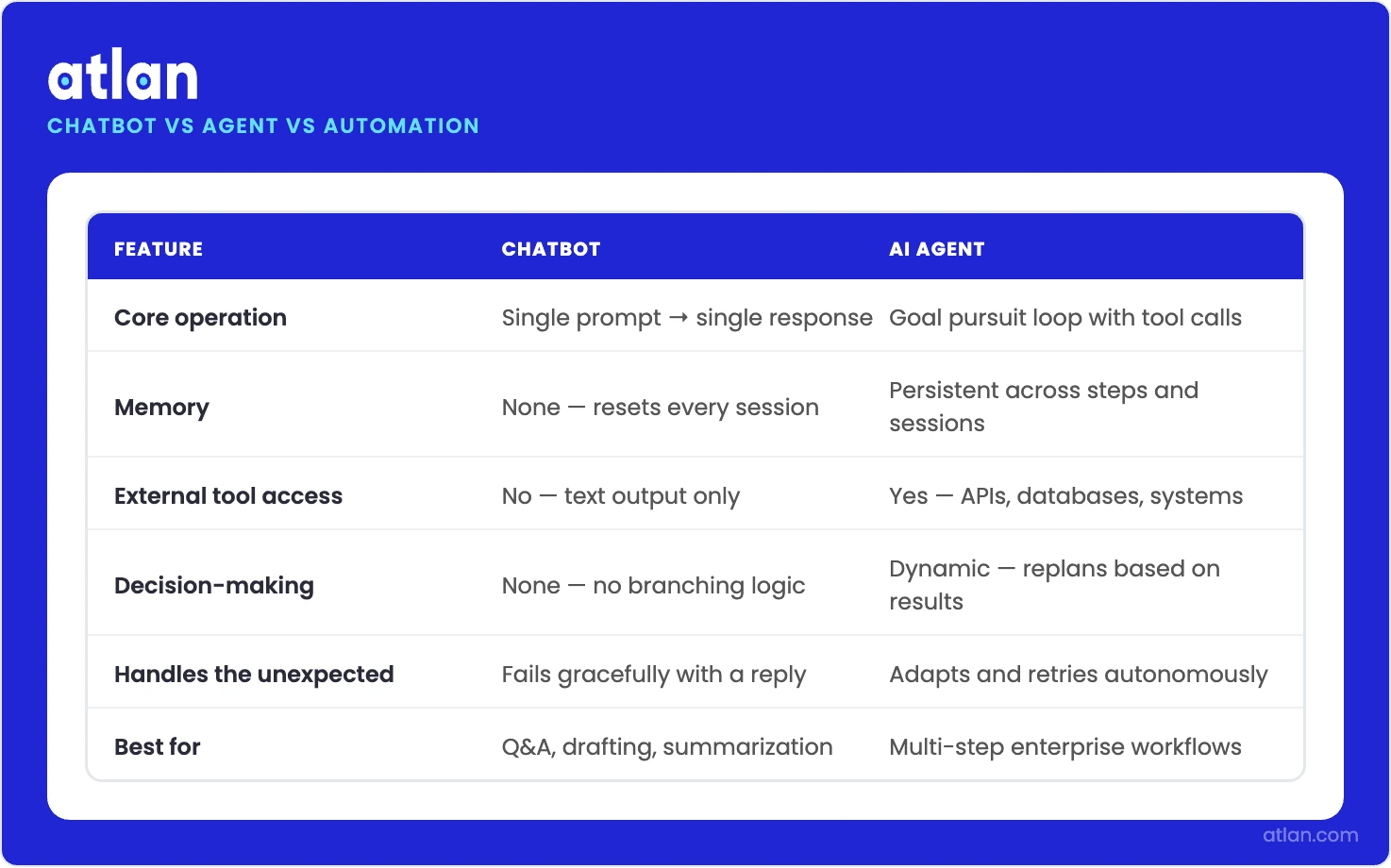
A chatbot responds to a prompt from its training knowledge or a provided context window. It has no memory between sessions, calls no external systems, and takes no actions beyond generating text. Every output is a single response to a single input.
An AI agent pursues a goal by perceiving the current state of the environment (a user query, a tool result, a memory retrieval), reasoning about the next action, executing that action on an external system, observing the result, and updating its reasoning before the next step. An agent building a sales forecast queries the CRM, validates the data against the finance team’s definitions, runs the calculation, checks the result against known benchmarks, and presents a sourced, traceable answer rather than generating text about forecasting.
Traditional automation follows fixed sequences and fails silently when data arrives in an unexpected format or business logic changes without a corresponding workflow update. An agent adapts by reasoning about the problem before acting, handling novel inputs that rigid workflows are structurally unable to process.
What are the core components of an AI agent?
The architecture of an AI agent has five layers, each contributing a distinct capability.
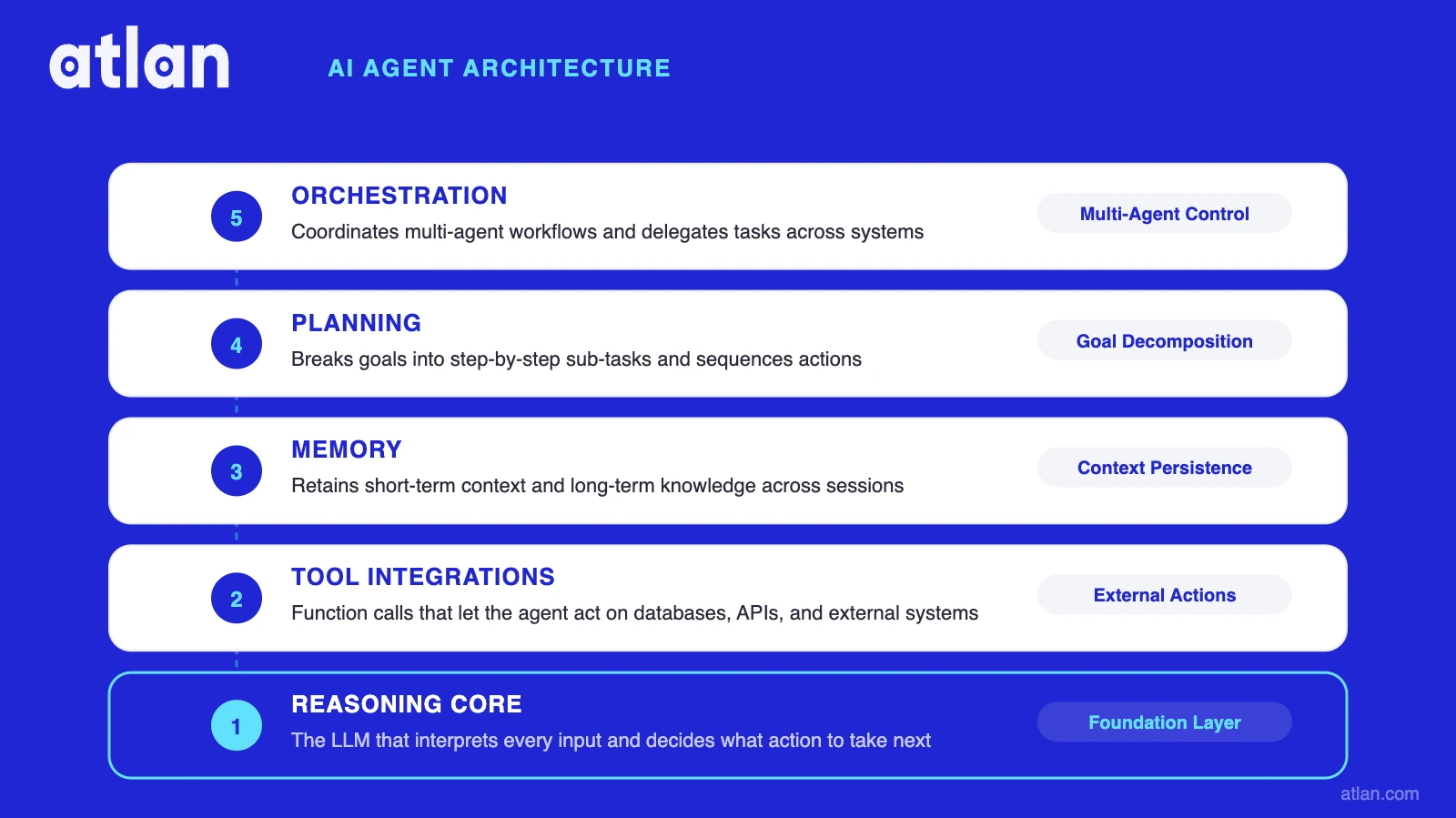
The reasoning core is the large language model that interprets every input and decides what to do next. The model’s quality determines how well it reasons given the information it has. It has no knowledge of your organization beyond what is supplied in context.
Tool integrations are how the agent acts on external systems. A tool is a function call: a database query, an API request, a code execution, a browser action. Tools extend the agent’s reach beyond its context window into your live data estate.
Memory divides into short-term (the active session context) and long-term (stored knowledge the agent retrieves from external stores between sessions). Memory determines what the agent can recall across interactions without being re-told.
Planning handles complex goals through decomposition. A planning layer breaks the goal into subtasks, sequences them, and determines what information each step needs before proceeding - handling novel situations that rigid sequential workflows cannot process.
Orchestration manages the sequence of perceive-reason-act cycles, coordinates between agents in a multi-agent system, and ensures tool calls and memory retrievals happen in the right order.
What are real-world AI agent examples in enterprise settings?
Data analyst agents answer business questions by querying data warehouses, resolving metric definitions, and presenting sourced results. A finance agent answering “what was net revenue retention last quarter?” needs to know which table is canonical, how NRR is defined in your business, and whether the data is current.
Research and synthesis work maps naturally to agent architecture: pulling from internal documents, CRM records, and unstructured data sources to produce summaries, competitive analyses, and briefing documents in minutes rather than hours of manual effort.
Operations agents route requests, update records, trigger workflows, and escalate issues across enterprise systems. A support agent handling complex cases queries the knowledge base, checks the customer’s history, applies the appropriate escalation policy, and updates the CRM record without human input at each step.
In developer toolchains, coding agents generate, review, and fix code across a codebase, run tests, and open pull requests. Organizational context about code standards, architecture decisions, and dependency policies determines whether the output fits the codebase or creates new technical debt.
How do AI agents work in enterprise settings?
The 13-point gap between AI agent adoption (79%) and measurable productivity gains (66%) reflects a consistent pattern: agents are being deployed without the context infrastructure they need to produce correct results. Understanding where that gap comes from is what this section covers.
Why does context quality determine agent output quality?
Consider a content team’s agent receiving the query: “Identify the top 10 political shows to feature on the homepage this week.”
The query looks simple. Answering it correctly requires five distinct types of information.
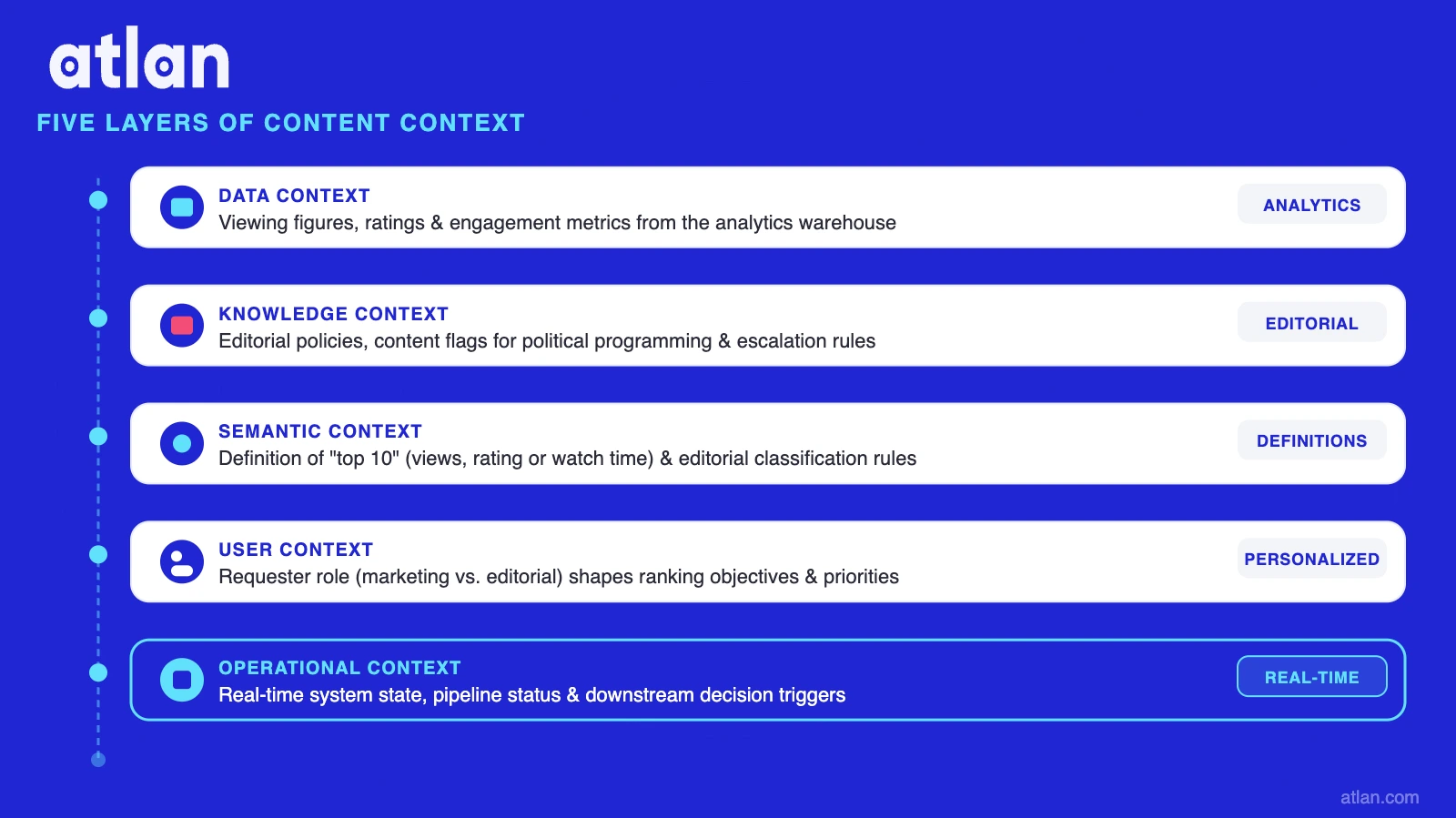
Data context: viewing figures, ratings, and engagement metrics from the analytics warehouse.
Knowledge context: editorial policies about which content flags apply to political programming and escalation rules for contested topics.
Semantic context: the specific definition of “top 10” your team uses (by views, by rating, or by projected watch time?), and which shows qualify as “political” under your editorial classification.
User context: whether the request comes from marketing (who optimize for views) or editorial (who optimize for watch time), because the correct answer differs by audience.
Operational context: which experiments are active this week that might override the standard ranking logic, and whether any seasonal programming considerations apply.
Remove any one of these and the agent hallucinates, applies the wrong definition, or produces a result that is internally coherent and factually wrong. Context quality is the variable that determines which scenario produces the right answer; the model’s reasoning capability holds constant across all five.
What happens when agents operate on ungoverned business data?
AI agent hallucination in enterprise settings is the confident application of wrong context to an otherwise coherent chain of reasoning, not random confabulation. The agent applies its reasoning to whichever definition of “active customer” or “ARR” it finds first, with no mechanism to determine which one your finance team considers canonical.
McKinsey’s survey found 23% of organizations are actively scaling agentic AI, with 39% in experimental phases. The organizations making the jump from experimental to scaled treat context as infrastructure before they treat agents as products. The organizations stuck in experimental phases are almost always debugging wrong answers, not wrong models.
When an agent encounters three competing definitions of “active customer” across three tables in your data warehouse, it has no organizational authority to resolve the conflict. Without a governed semantic layer telling it which definition is canonical, it selects arbitrarily. The answer is technically a valid database result and organizationally wrong. Multiply that across dozens of agents querying the same estate, and you have the data silo problem recreated at the function call layer - documented in detail in Atlan’s research on multi-agent memory silos.
What do reliable enterprise AI agents actually need?
Internal memory types handle what the agent has been told. What they leave unaddressed is what your organization actually means by its own business terms, data definitions, and governance rules. The distinction between these two things is where most enterprise agent failures originate.
How does organizational context memory differ from standard agent memory?
The framework-level memory types most agent documentation covers store what the agent has been told. Organizational context memory stores how the business actually defines, uses, and connects information across teams and systems.
That is the difference between a finance agent storing “the finance team’s definition of ARR” as text in a vector store and an agent retrieving the right business definition in the moment it is needed, with the surrounding context that makes it usable. When the organizational cold start problem is that an agent does not understand your business, the fix is better context memory, not a larger memory store.
Why is governance an accelerator rather than a brake for AI agents?
A common assumption is that governance slows down AI deployment. The production data says the opposite.
The most common cause of agent project failure is insufficient data infrastructure, cited as the primary failure mode in 40% of failed projects. Model quality and framework choice rarely form the bottleneck. The counter-intuitive implication: stronger models make ungoverned context more dangerous, not less. A weak model producing wrong answers from bad context fails obviously. A strong model producing wrong answers from the same bad context fails convincingly.
One way to frame it: ungoverned context multiplied by agent autonomy equals increased risk exposure. The more autonomous your agents become, the more consequential each decision, and the more important it is that the context they reason from is accurate, current, and traceable.
AI agent memory governance is the mechanism that makes autonomous AI trustworthy enough to act without human review at every step - not compliance overhead. By 2028, Gartner predicts 15% of day-to-day work decisions will be made autonomously through agentic AI, up from essentially zero in 2024. Skipping context infrastructure now means accumulating context debt that surfaces as production failures, wrong decisions, and eroded trust in AI outputs.
How Atlan approaches enterprise AI agents
Most explanations of AI agents focus on reasoning, tools, and orchestration. In enterprise settings, that is only part of the picture. The harder problem is whether the agent has the right organizational context at runtime: what your business means by ARR, which source is authoritative for a given question, how different systems relate to each other, and what has changed since the last time the agent acted.
That is the role Atlan plays. Atlan is the context layer between enterprise systems and AI agents, connecting data, definitions, workflows, usage patterns, and business relationships into a shared runtime layer agents can use across frameworks and models. Instead of every agent building its own partial agent memory of the business, Atlan makes that context reusable and portable.
That is also the difference between ordinary agent memory and organizational context memory. Standard agent memory stores what the agent has been told. Organizational context memory stores how the business actually defines, connects, and uses information across teams and systems. When enterprise agents fail, it is often not because they cannot reason. It is because they are reasoning over incomplete or inconsistent context. The context layer is what closes that gap.
Why the agent you deploy is only as good as the context it carries
A context-aware agent produces answers that are consistent, relevant, and aligned with how your organization actually works. Building agents is getting easier. Building the context that makes those agents reliable is still the hard part, and that is the layer that compounds over time across every future deployment.
FAQs about what is an AI agent
1. What is the difference between an AI agent and a chatbot?
A chatbot generates a single response from its training knowledge or a provided context window, takes no external actions, and has no memory between sessions. An AI agent pursues a goal across multiple steps, calls external systems via tool use, maintains persistent memory, and adapts its approach based on results. For enterprise deployment, the key difference is consequence: agents take real actions, which means their outputs must be grounded in accurate organizational context.
2. What are the five types of context an enterprise AI agent needs?
Enterprise AI agents require five context types to function reliably. Data context covers which tables and sources are authoritative. Knowledge context covers business rules and decisions that live in Confluence, Slack, and institutional memory. Semantic context covers what your business terms actually mean - your specific definition of “active customer” or “ARR.” User context covers who is asking and what role-specific logic applies. Operational context covers active experiments, seasonal adjustments, and incidents that should override default behavior.
3. Why do AI agent projects fail in production?
Insufficient data infrastructure is the primary failure mode in 40% of failed agent projects. Agents fail when they encounter competing metric definitions with no canonical authority, when their data access bypasses governance controls built for human users, and when wrong answers produce no audit trail for diagnosis. These are context infrastructure failures, not model or framework failures.
4. What is an AI agent definition in the context of enterprise data?
In enterprise data settings, an AI agent is an autonomous system that queries your data estate, reasons about business questions using your organizational definitions, and produces auditable outputs. The perceive-reason-act definition is insufficient for enterprise deployment without four additions: governed business definitions, data lineage from source to output, access control at the agent level, and decision traces that make every answer traceable to the context that produced it.
5. What is the difference between an AI agent and agentic AI?
Agentic AI refers to the broader category of AI systems with autonomous, goal-directed behavior. An AI agent is the specific software instance implementing agentic behavior: a system with defined tools, memory, planning capabilities, and an orchestration layer that sequences its actions. An agentic AI system might include multiple coordinated agents, each specialized for different tasks, operating within a shared context layer. Agentic AI describes the paradigm; an AI agent is the discrete implementation.
Sources
-
PwC. (2025). AI agents in the enterprise: adoption and ROI survey. https://www.pwc.com/us/en/services/consulting/business-transformation/ai/ai-agents.html
-
McKinsey. (2025). The state of AI: global survey. https://www.mckinsey.com/capabilities/quantumblack/our-insights/the-state-of-ai
-
Gartner. (2025, January 27). Gartner identifies the top 10 strategic technology trends for 2025. https://www.gartner.com/en/newsroom/press-releases/2025-01-27-gartner-identifies-the-top-10-strategic-technology-trends-for-2025
